United States (US) Photonics Market Top 5 Importing Countries and Market Competition (HHI) Analysis
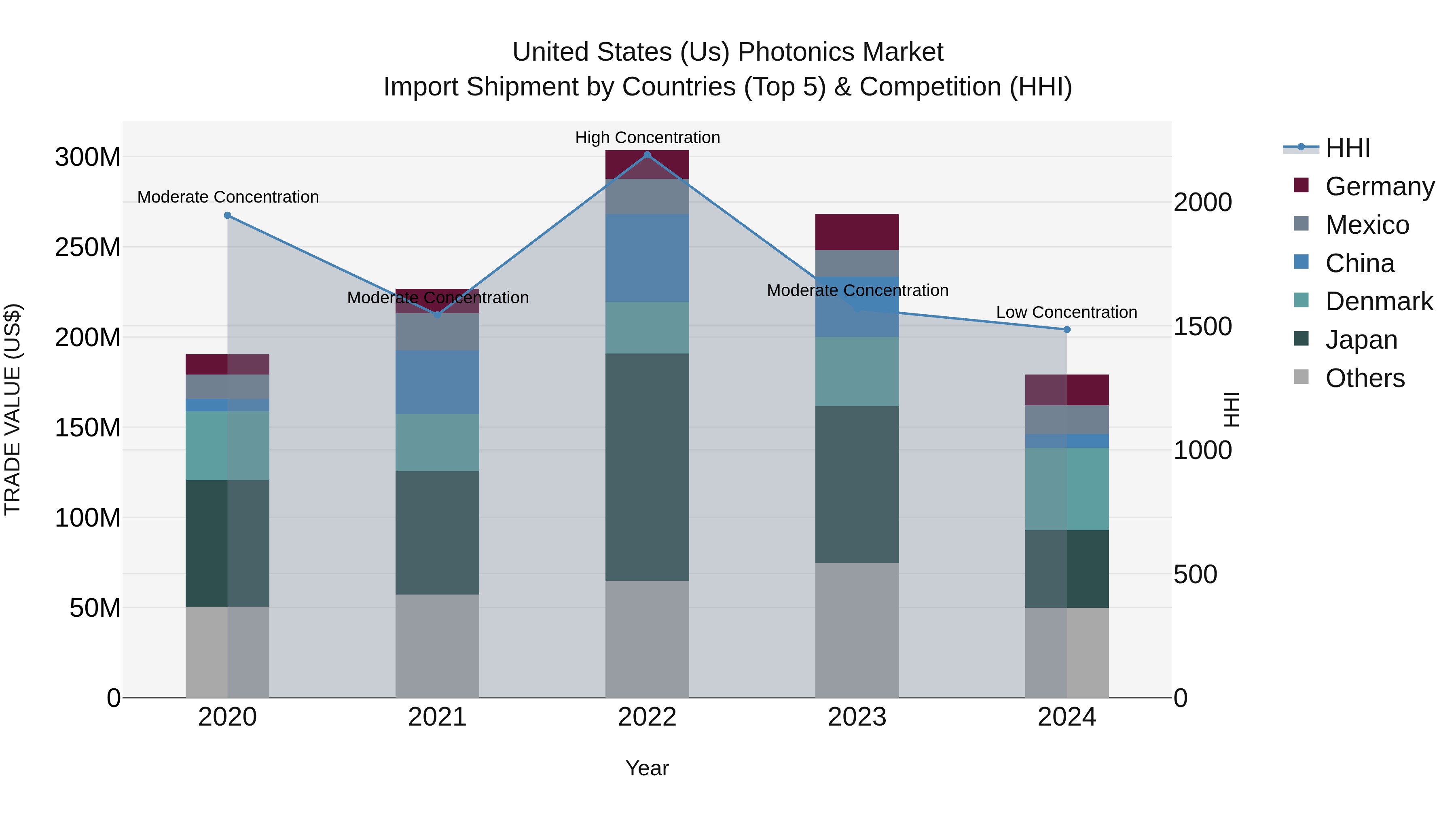
The United States saw a shift in photonics import patterns in 2024, with top exporters being Denmark, Japan, Germany, Mexico, and Netherlands. The market showed a decrease in concentration from moderate to low in the Herfindahl-Hirschman Index, indicating a more diversified import landscape. Despite a negative Compound Annual Growth Rate (CAGR) of -1.49% from 2020 to 2024, the sharp decline in growth rate of -33.14% from 2023 to 2024 suggests recent challenges in the photonics import market. This data highlights the need for a deeper analysis of market dynamics and potential factors impacting import trends.
United States (US) Photonics Market Overview
The United States Photonics Market is a rapidly growing sector encompassing the development and application of light-based technologies across various industries such as healthcare, telecommunications, defense, and manufacturing. With a focus on innovations in lasers, optics, imaging, and other photonics components, the market is driven by increasing demand for high-speed data transmission, advanced medical devices, and enhanced manufacturing processes. Key players in the US Photonics Market include companies specializing in photonics equipment, components, and systems, as well as research institutions driving technological advancements. Government initiatives supporting research and development in photonics further contribute to the market`s growth, with opportunities for expansion in emerging sectors like autonomous vehicles, augmented reality, and renewable energy. The US Photonics Market presents a dynamic landscape with substantial growth potential and opportunities for innovation and collaboration.
United States (US) Photonics Market Trends and Opportunities
The US Photonics Market is experiencing significant growth driven by increasing demand for advanced technologies in sectors such as healthcare, telecommunications, and defense. Key trends include the rising adoption of photonics in emerging applications like autonomous vehicles, 5G networks, and virtual reality. Additionally, the push towards miniaturization and higher efficiency in optical components is driving innovation in the market. Opportunities lie in the development of integrated photonics solutions, the expansion of fiber optic networks, and the advancement of quantum technologies. With a strong focus on research and development, collaboration between academia and industry players is crucial to stay competitive in the rapidly evolving US Photonics Market.
United States (US) Photonics Market Challenges
In the US Photonics market, some challenges include intense global competition, rapid technological advancements, and the need for significant investments in research and development. Global competition, particularly from countries with lower production costs, puts pressure on US companies to innovate and stay competitive. The fast-paced nature of technological advancements requires companies to constantly upgrade their products and processes to meet changing customer demands. Additionally, the photonics industry relies heavily on research and development to drive innovation, which can be a costly endeavor. Access to skilled labor and a supportive regulatory environment are also key challenges faced by companies in the US Photonics market as they strive to maintain their position as industry leaders.
United States (US) Photonics Market Drivers
The United States Photonics Market is being primarily driven by factors such as increasing demand for advanced technologies in sectors like healthcare, telecommunications, and manufacturing. The growing focus on research and development activities, coupled with government initiatives to promote the adoption of photonics solutions, is also fueling market growth. Additionally, the rising awareness about the benefits of photonics technologies in improving efficiency, reducing energy consumption, and enhancing overall performance across various industries is driving the demand for photonics products and services in the US market. Moreover, the rapid expansion of applications in areas like autonomous vehicles, augmented reality, and data communication is further contributing to the growth of the photonics market in the country.
United States (US) Photonics Market Government Policy
The US government has implemented various policies to support and promote the growth of the Photonics Market. This includes funding initiatives such as the National Photonics Initiative, which aims to advance photonics research and technology development. Additionally, the government provides financial support through grants and tax incentives to encourage investment in photonics companies. The US government also collaborates with industry stakeholders to develop standards and regulations that promote innovation and competitiveness in the photonics sector. Overall, these policies demonstrate a commitment to fostering a thriving photonics industry in the US through strategic investments and partnerships.
United States (US) Photonics Market Future Outlook
The United States Photonics Market is poised for significant growth in the coming years, driven by increasing demand for photonics technologies across various industries such as telecommunications, healthcare, defense, and manufacturing. Key factors contributing to this growth include the rising adoption of photonics-enabled products and services for advanced data communication, medical imaging, laser processing, and sensing applications. Additionally, ongoing research and development efforts in emerging photonics technologies like silicon photonics, quantum photonics, and integrated photonics are expected to further fuel market expansion. With a strong emphasis on innovation, collaboration between industry players, academic institutions, and government initiatives, the US Photonics Market is likely to witness continuous advancement and investment opportunities, positioning itself as a global leader in the photonics industry.
Key Highlights of the Report:
- United States (US) Photonics Market Outlook
- Market Size of United States (US) Photonics Market, 2024
- Forecast of United States (US) Photonics Market, 2031
- Historical Data and Forecast of United States (US) Photonics Revenues & Volume for the Period 2021 - 2031
- United States (US) Photonics Market Trend Evolution
- United States (US) Photonics Market Drivers and Challenges
- United States (US) Photonics Price Trends
- United States (US) Photonics Porter's Five Forces
- United States (US) Photonics Industry Life Cycle
- Historical Data and Forecast of United States (US) Photonics Market Revenues & Volume By Product for the Period 2021 - 2031
- Historical Data and Forecast of United States (US) Photonics Market Revenues & Volume By Transceivers for the Period 2021 - 2031
- Historical Data and Forecast of United States (US) Photonics Market Revenues & Volume By Variable Optical Attenuators for the Period 2021 - 2031
- Historical Data and Forecast of United States (US) Photonics Market Revenues & Volume By Switches for the Period 2021 - 2031
- Historical Data and Forecast of United States (US) Photonics Market Revenues & Volume By Cables for the Period 2021 - 2031
- Historical Data and Forecast of United States (US) Photonics Market Revenues & Volume By Sensors for the Period 2021 - 2031
- Historical Data and Forecast of United States (US) Photonics Market Revenues & Volume By Component for the Period 2021 - 2031
- Historical Data and Forecast of United States (US) Photonics Market Revenues & Volume By Lasers for the Period 2021 - 2031
- Historical Data and Forecast of United States (US) Photonics Market Revenues & Volume By Modulators for the Period 2021 - 2031
- Historical Data and Forecast of United States (US) Photonics Market Revenues & Volume By Photo Detectors for the Period 2021 - 2031
- Historical Data and Forecast of United States (US) Photonics Market Revenues & Volume By Waveguide for the Period 2021 - 2031
- Historical Data and Forecast of United States (US) Photonics Market Revenues & Volume By 400-1,500 NM for the Period 2021 - 2031
- Historical Data and Forecast of United States (US) Photonics Market Revenues & Volume By 1,310-1,550 NM for the Period 2021 - 2031
- Historical Data and Forecast of United States (US) Photonics Market Revenues & Volume By 900-7000 NM for the Period 2021 - 2031
- Historical Data and Forecast of United States (US) Photonics Market Revenues & Volume By Application for the Period 2021 - 2031
- Historical Data and Forecast of United States (US) Photonics Market Revenues & Volume By Data Centers and High-performance computing for the Period 2021 - 2031
- Historical Data and Forecast of United States (US) Photonics Market Revenues & Volume By Telecommunication for the Period 2021 - 2031
- Historical Data and Forecast of United States (US) Photonics Market Revenues & Volume By Military, Defense and Aerospace for the Period 2021 - 2031
- Historical Data and Forecast of United States (US) Photonics Market Revenues & Volume By Medical and Life Science for the Period 2021 - 2031
- Historical Data and Forecast of United States (US) Photonics Market Revenues & Volume By Other Applications for the Period 2021 - 2031
- United States (US) Photonics Import Export Trade Statistics
- Market Opportunity Assessment By Product
- Market Opportunity Assessment By Component
- Market Opportunity Assessment By Waveguide
- Market Opportunity Assessment By Application
- United States (US) Photonics Top Companies Market Share
- United States (US) Photonics Competitive Benchmarking By Technical and Operational Parameters
- United States (US) Photonics Company Profiles
- United States (US) Photonics Key Strategic Recommendations






































