United States (US) Polyols Market Top 5 Importing Countries and Market Competition (HHI) Analysis
The United States saw a significant increase in polyols import shipments in 2024, with key exporting countries being Indonesia, Malaysia, Germany, India, and China. Despite high concentration levels indicated by the HHI index, the industry maintained a strong growth trajectory. The compound annual growth rate (CAGR) from 2020 to 2024 stood at an impressive 6.96%, with a notable growth rate of 22.68% from 2023 to 2024, indicating a robust market demand and potential opportunities for further expansion in the polyols sector.
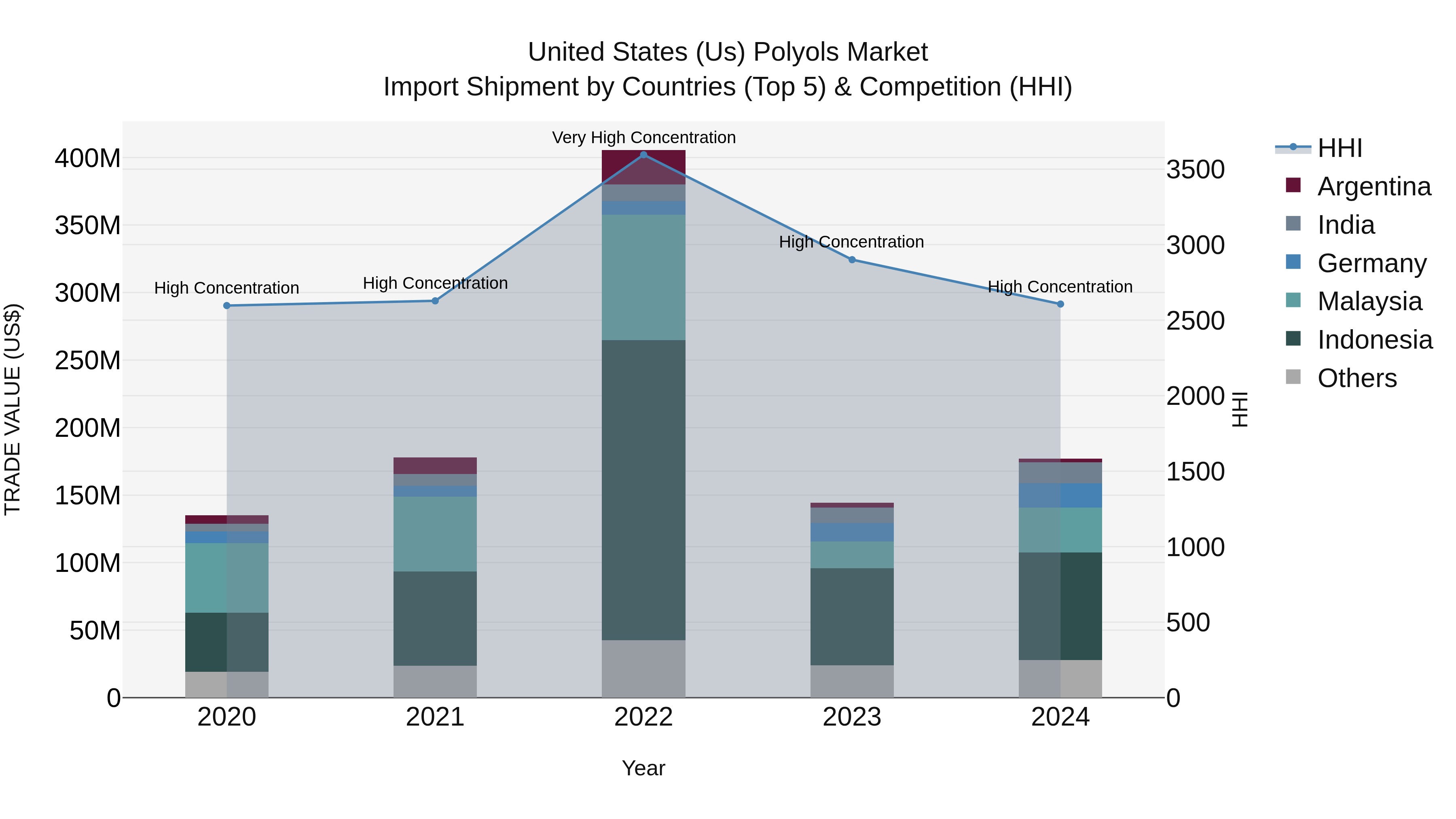
United States (US) Polyols Market Overview
The United States Polyols Market is experiencing robust growth driven by increasing demand from various end-use industries such as construction, automotive, and food & beverages. Polyols, which are key ingredients in the production of polyurethane foams, resins, and coatings, are witnessing rising adoption due to their versatile properties such as high durability, flexibility, and thermal insulation. With a growing focus on sustainable and eco-friendly products, bio-based polyols are gaining traction in the market. The market is also influenced by technological advancements, expanding applications in furniture, packaging, and consumer goods, and the presence of key players like Dow Chemical Company, BASF SE, and Covestro AG. Factors such as stringent regulations regarding environmental protection and volatile raw material prices may pose challenges to market growth, but overall, the US Polyols Market is poised for steady expansion in the coming years.
United States (US) Polyols Market Trends and Opportunities
The US Polyols Market is experiencing steady growth driven by increasing demand for polyols in industries such as food and beverages, pharmaceuticals, and personal care products. Consumers are increasingly seeking healthier alternatives, leading to a rise in the use of polyols as sugar substitutes in food products. Additionally, the growing awareness of the health benefits of polyols, such as their low glycemic index, is further fueling market growth. Opportunities in the market include the development of innovative polyol formulations to cater to specific consumer preferences and the expansion of product offerings in emerging applications such as renewable chemicals and bio-based materials. Collaborations between key players in the industry to enhance production capabilities and distribution networks also present promising prospects for market growth in the US Polyols Market.
United States (US) Polyols Market Challenges
In the US Polyols Market, several challenges are faced including fluctuating raw material prices, increasing competition from alternative sweeteners, and regulatory uncertainties related to labeling and health claims. The volatility of raw material prices, such as corn and soybeans, can impact the production costs of polyols, affecting pricing strategies and profit margins for manufacturers. Additionally, the growing consumer preference for natural and healthier sweeteners like stevia and monk fruit presents a competitive threat to polyols as sugar substitutes. Meeting changing consumer demands while navigating complex regulations for product labeling and health claims further adds to the challenges faced by companies operating in the US Polyols Market. Adapting to these challenges through innovation, market differentiation, and regulatory compliance will be crucial for success in the industry.
United States (US) Polyols Market Drivers
The United States Polyols Market is primarily driven by growing demand from the food and beverage industry due to the rising awareness about health and wellness among consumers. Polyols are widely used as sugar substitutes in various food products such as beverages, confectionery, and baked goods, as they offer a lower calorie content and are suitable for diabetic individuals. Additionally, the increasing application of polyols in the pharmaceutical industry for manufacturing sugar-free medications and dietary supplements is contributing to market growth. The market is also propelled by the expanding usage of polyols in personal care products, such as toothpaste and mouthwash, owing to their non-cariogenic properties. Overall, the US Polyols Market is expected to continue its growth trajectory due to the versatile applications of polyols across multiple industries.
United States (US) Polyols Market Government Policy
Government policies related to the US Polyols Market primarily focus on regulations and standards for the production, import, and use of polyols in various industries. The Environmental Protection Agency (EPA) has set guidelines under the Clean Air Act for reducing emissions of volatile organic compounds (VOCs) from polyol manufacturing facilities to minimize air pollution. Additionally, the Food and Drug Administration (FDA) regulates the use of polyols in food and pharmaceutical products to ensure consumer safety. The Department of Commerce monitors trade agreements and tariffs affecting polyol imports and exports. Overall, government policies aim to promote sustainability, protect public health, and maintain fair trade practices in the US Polyols Market.
United States (US) Polyols Market Future Outlook
The United States Polyols Market is expected to witness steady growth in the coming years due to increasing demand from end-use industries such as automotive, construction, and food & beverage. Factors contributing to this growth include a rising focus on sustainable and eco-friendly products, as polyols are widely used in the production of bio-based polyurethane foams. Additionally, the growing awareness of health benefits associated with reduced sugar intake is driving the demand for polyols in the food and beverage sector. Technological advancements and innovations in manufacturing processes are also expected to further boost market growth. However, challenges such as fluctuating raw material prices and stringent regulations regarding environmental impact may hinder market expansion to some extent. Overall, the US Polyols Market is poised for a positive outlook with opportunities for growth and innovation.
Key Highlights of the Report:
- United States (US) Polyols Market Outlook
- Market Size of United States (US) Polyols Market, 2024
- Forecast of United States (US) Polyols Market, 2031
- Historical Data and Forecast of United States (US) Polyols Revenues & Volume for the Period 2021 - 2031
- United States (US) Polyols Market Trend Evolution
- United States (US) Polyols Market Drivers and Challenges
- United States (US) Polyols Price Trends
- United States (US) Polyols Porter's Five Forces
- United States (US) Polyols Industry Life Cycle
- Historical Data and Forecast of United States (US) Polyols Market Revenues & Volume By Type for the Period 2021 - 2031
- Historical Data and Forecast of United States (US) Polyols Market Revenues & Volume By Polyether polyols for the Period 2021 - 2031
- Historical Data and Forecast of United States (US) Polyols Market Revenues & Volume By Polyester polyols for the Period 2021 - 2031
- Historical Data and Forecast of United States (US) Polyols Market Revenues & Volume By Application for the Period 2021 - 2031
- Historical Data and Forecast of United States (US) Polyols Market Revenues & Volume By Flexible Polyurethane Foam for the Period 2021 - 2031
- Historical Data and Forecast of United States (US) Polyols Market Revenues & Volume By Rigid Polyurethane Foam for the Period 2021 - 2031
- Historical Data and Forecast of United States (US) Polyols Market Revenues & Volume By CASE for the Period 2021 - 2031
- Historical Data and Forecast of United States (US) Polyols Market Revenues & Volume By End Use Industry for the Period 2021 - 2031
- Historical Data and Forecast of United States (US) Polyols Market Revenues & Volume By Building & Construction for the Period 2021 - 2031
- Historical Data and Forecast of United States (US) Polyols Market Revenues & Volume By Automotive for the Period 2021 - 2031
- Historical Data and Forecast of United States (US) Polyols Market Revenues & Volume By Electronics for the Period 2021 - 2031
- United States (US) Polyols Import Export Trade Statistics
- Market Opportunity Assessment By Type
- Market Opportunity Assessment By Application
- Market Opportunity Assessment By End Use Industry
- United States (US) Polyols Top Companies Market Share
- United States (US) Polyols Competitive Benchmarking By Technical and Operational Parameters
- United States (US) Polyols Company Profiles
- United States (US) Polyols Key Strategic Recommendations






































