United States (US) POS Security Market Size & Growth Rate (2026-2032)
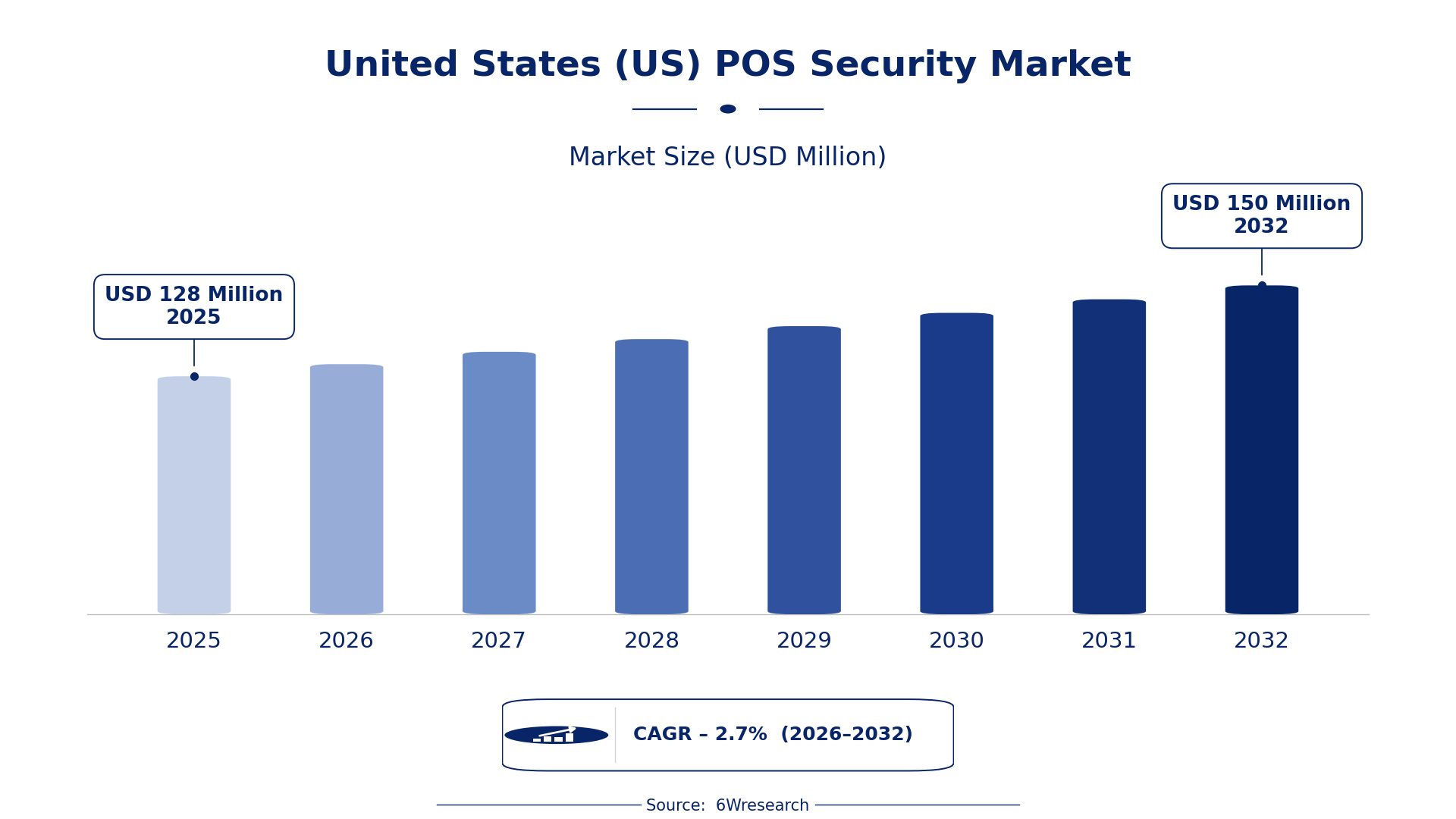
The United States (US) POS Security Market was estimated at USD 128 Million in 2025 and is projected to reach USD 150 Million by 2032, growing at a CAGR of 2.7% from 2026 to 2032.
United States (US) POS Security Market Synopsis
The accelerating shift toward digital payment methods is currently the driving force in the United States POS Security Market. As consumers demand more convenient payment solutions, businesses are compelled to invest in security measures that protect sensitive data against cyber threats.
Data breaches are on the rise, specifically targeting point-of-sale systems, which further intensifies the urgency for robust security solutions. Companies across retail, hospitality, and various sectors are enhancing their security infrastructures, integrating advanced technologies like biometrics and tokenization to safeguard customer information.
United States (US) POS Security Market Year-wise Growth Rate and Key Drivers
This graph illustrates the annual growth rates of the United States (US) POS Security Market from 2021 to 2032, highlighting a steady upward trajectory and projected expansion over the forecast period.
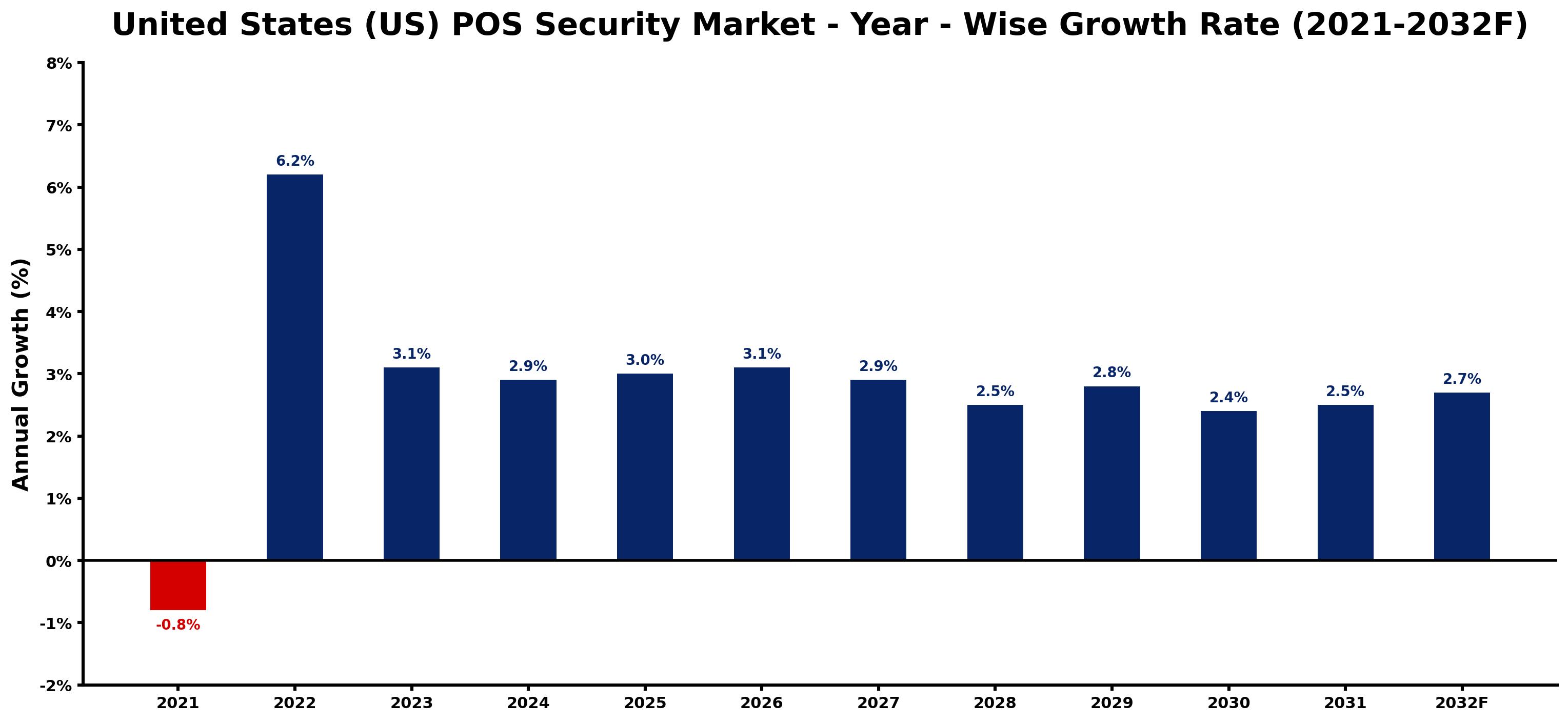
The table below presents the year‑wise growth rates along with the key drivers influencing the market
| Year | Growth Rate | Major Drivers |
| 2021 | -0.8% | Chip shortage restricted new POS system deployments. |
| 2022 | 6.2% | Implementation of PCI DSS compliance among retailers. |
| 2023 | 3.1% | Increased focus on EMV chip card adoption nationwide. |
| 2024 | 2.9% | Shift toward mobile point-of-sale systems in restaurants. |
| 2025 | 3.0% | Surge in demand for cybersecurity insurance among merchants. |
| 2026 | 3.1% | Local governments incentivizing digital payment security upgrades. |
| 2027 | 2.9% | Emerging threats prompting investments in fraud detection software. |
| 2028 | 2.5% | High-profile payment data breaches driving security enhancements. |
| 2029 | 2.8% | Retail sector robust recovery influencing security technology investments. |
| 2030 | 2.4% | Chip-and-PIN protocol mandatory for large retailers. |
| 2031 | 2.5% | Rising consumer awareness of data privacy and security. |
| 2032 | 2.7% | Partnerships between retailers and cybersecurity firms expanding. |
Note: Market size estimations and growth projections presented in this report are based on 6Wresearch's proprietary forecasting methodology, utilizing the latest available industry data, government publications, and primary research inputs.
United States (US) POS Security Market Key Takeaways
Below are some of the specific key takeaways from the market, including:
- Increasing adoption of EMV chip technology is setting new standards for transaction security.
- Point-to-point encryption (P2PE) is gaining traction as a vital measure against payment fraud.
- Tokenization solutions are replacing sensitive cardholder information, enhancing transaction security.
- Regulatory compliance, particularly with PCI DSS, is compelling organizations to prioritize cybersecurity investments.
- Growing interest in cloud-based POS systems reflects a move toward scalable and flexible security solutions.
Evaluation of Restraints in United States (US) POS Security Market
Despite the positive trajectory, the United States POS Security Market faces significant barriers. The sophistication of cyber threats has escalated, with hackers employing increasingly complex tactics to infiltrate POS systems. This scenario presents a daunting challenge for businesses striving to maintain security. Furthermore, the compliance landscape remains complicated; adhering to standards such as PCI DSS requires constant vigilance and can strain resources. Additionally, the diversity of POS systems across industries creates a fragmented security environment, making it challenging for organizations to implement uniform security protocols effectively.
United States (US) POS Security Market Trends
Current trends indicate a marked shift toward technologies that enhance security and streamline payment processing. The increasing focus on point-to-point encryption is a direct response to mounting concerns about payment card fraud. Companies are also adopting tokenization to ensure sensitive customer data is securely replaced with unique identifiers during transactions.
The growth of cloud-based POS systems is notable, as businesses seek scalable solutions that adapt to their evolving needs. With the backdrop of rising cyber threats, compliance with PCI DSS and other regulatory frameworks has become paramount. Organizations are investing heavily in advanced security measures, including biometric authentication and real-time monitoring capabilities, to mitigate risks associated with data breaches.
United States (US) POS Security Market Opportunities
The US POS Security Market is brimming with investment opportunities driven by the increasing reliance on secure payment systems. Businesses are actively seeking solutions that offer enhanced security against cyber threats. This trend presents lucrative opportunities for companies specializing in POS security software, encryption technologies, and fraud detection systems.
Investing in cybersecurity consulting services tailored to POS security compliance can also yield significant returns. As the retail and hospitality sectors expand their digital footprint, the demand for reliable security measures is set to soar, making this market an attractive landscape for investors.
Government Initiatives in the United States (US) POS Security Market
Government policies are crucial in shaping the direction of the United States POS Security Market. The focus on safeguarding consumer data is driving legislative efforts aimed at enhancing cybersecurity measures across the industry. Regulatory frameworks, including the Payment Card Industry Data Security Standard (PCI DSS), require organizations to implement stringent protocols to ensure secure payment processing and consumer protection.
- A recently completed initiative established new guidelines under PCI DSS aimed at enhancing encryption requirements for transaction data.
- An ongoing government program is providing grants to small businesses to help them upgrade their POS security systems to meet compliance standards.
- A planned public-private initiative is set to launch in late 2026, aimed at developing a comprehensive framework for securing payment card information across all sectors.
- Current federal oversight actions are focused on investigating data breaches and enforcing compliance with data protection regulations.
- Upcoming legislation anticipated for introduction in early 2027 may further tighten regulations around consumer data protection in electronic transactions.
Future Insights of the United States (US) POS Security Market
Looking ahead to 2026-2032, the United States POS Security Market appears set for significant growth. With the increasing prevalence of digital payment systems, businesses will continue to prioritize the integration of advanced security technologies. The rise of artificial intelligence and machine learning within POS security systems will enhance real-time threat detection and response capabilities.
This emphasis on cutting-edge technology will not only secure transactions but also build consumer confidence in digital payment systems. As organizations evolve their cybersecurity strategies, the market is expected to expand, driven by a growing awareness of the importance of securing financial transactions against the backdrop of rising cyber threats.
United States (US) POS Security Market Latest Developments
In the past year, the United States POS Security Market has seen a flurry of activities aimed at enhancing the security of payment systems. With rising concerns over data breaches, companies are increasingly focused on upgrading their security protocols and implementing advanced technologies.
- A major technology vendor initiated a nationwide rollout of a new point-to-point encryption solution in early 2025 to help businesses protect customer transaction data.
- A regional operator is currently upgrading its POS systems to integrate biometric authentication capabilities, enhancing security measures for its retail partners.
- A recent partnership between a cybersecurity firm and a retail chain aims to enhance fraud detection systems, a project that is underway and expected to complete by late 2025.
- An upcoming launch of a new cloud-based POS security platform is scheduled for Q2 2026, promising to offer scalable solutions tailored to various business sizes.
- A completed study in mid-2025 assessed the effectiveness of current security measures across the retail sector, influencing new regulatory recommendations.
United States (US) POS Security Market - Key Attractiveness of the Report
- 10 Years of Market Numbers
- Historical Data Starting from 2022 to 2025
- Base Year: 2025
- Forecast Data until 2032
- Key Performance Indicators Impacting the Market
- Major Upcoming Developments and Projects
Key Highlights of the Report:
- United States (US) POS Security Market Outlook
- Market Size of United States (US) POS Security Market, 2025
- Forecast of United States (US) POS Security Market, 2032
- Historical Data and Forecast of United States (US) POS Security Revenues & Volume for the Period 2022-2032F
- United States (US) POS Security Market Trend Evolution
- United States (US) POS Security Market Drivers and Challenges
- United States (US) POS Security Price Trends
- United States (US) POS Security Porter's Five Forces
- United States (US) POS Security Industry Life Cycle
- Historical Data and Forecast of United States (US) POS Security Market Revenues & Volume By Offering for the Period 2022-2032F
- Historical Data and Forecast of United States (US) POS Security Market Revenues & Volume By Solutions for the Period 2022-2032F
- Historical Data and Forecast of United States (US) POS Security Market Revenues & Volume By Services for the Period 2022-2032F
- Historical Data and Forecast of United States (US) POS Security Market Revenues & Volume By Organization Size for the Period 2022-2032F
- Historical Data and Forecast of United States (US) POS Security Market Revenues & Volume By SMEs for the Period 2022-2032F
- Historical Data and Forecast of United States (US) POS Security Market Revenues & Volume By Large Enterprises for the Period 2022-2032F
- Historical Data and Forecast of United States (US) POS Security Market Revenues & Volume By Vertical for the Period 2022-2032F
- Historical Data and Forecast of United States (US) POS Security Market Revenues & Volume By Retail for the Period 2022-2032F
- Historical Data and Forecast of United States (US) POS Security Market Revenues & Volume By Restaurants for the Period 2022-2032F
- Historical Data and Forecast of United States (US) POS Security Market Revenues & Volume By Hospitality for the Period 2022-2032F
- United States (US) POS Security Import Export Trade Statistics
- Market Opportunity Assessment By Offering
- Market Opportunity Assessment By Organization Size
- Market Opportunity Assessment By Vertical
- United States (US) POS Security Top Companies Market Share
- United States (US) POS Security Competitive Benchmarking By Technical and Operational Parameters
- United States (US) POS Security Company Profiles
- United States (US) POS Security Key Strategic Recommendations






































