United States (US) Printed Signage Market Top 5 Importing Countries and Market Competition (HHI) Analysis
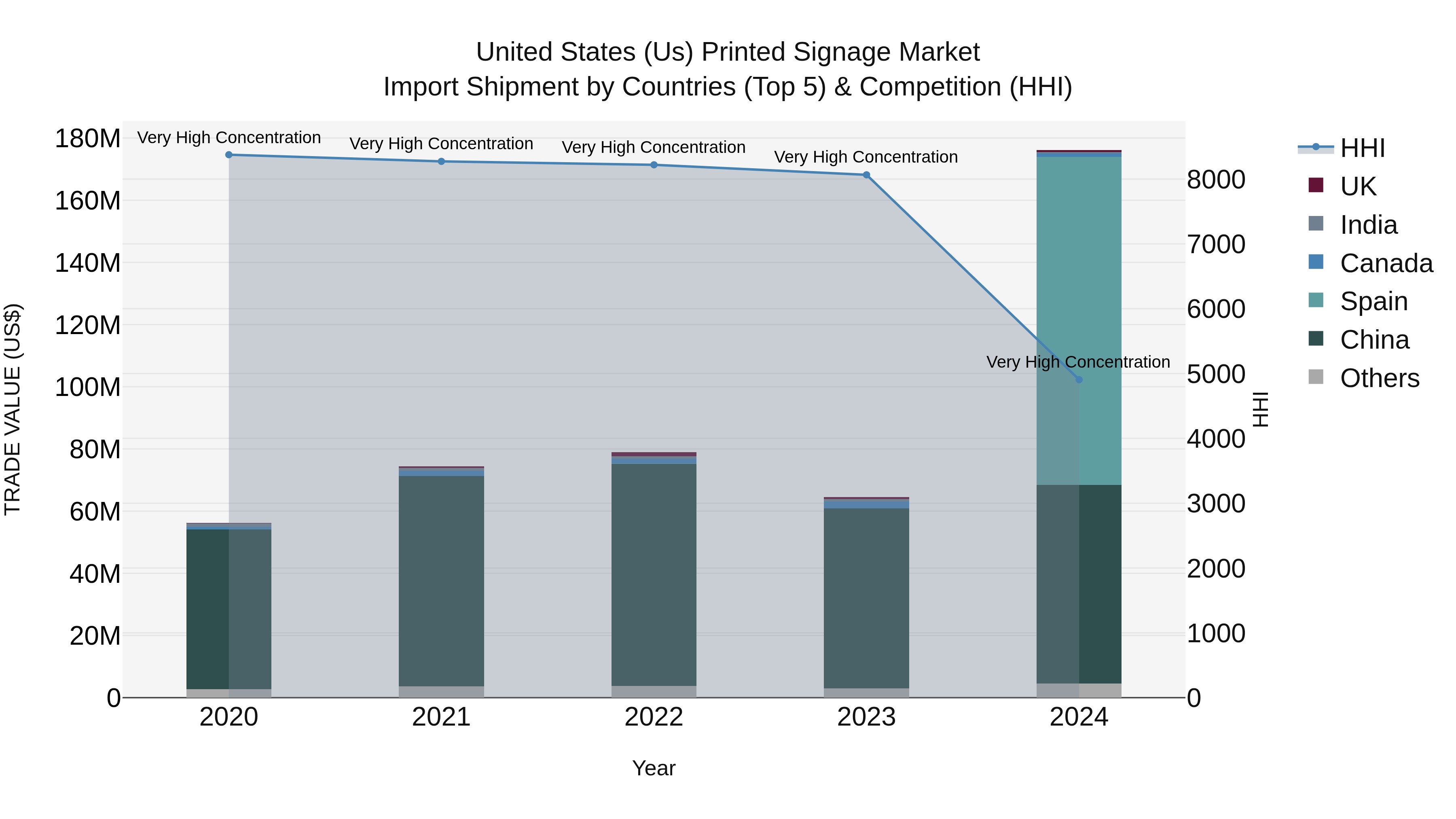
The United States continues to be a key importer of printed signage, with significant shipments coming from Spain, China, Vietnam, Canada, and Japan in 2024. The market shows high concentration with a high Herfindahl-Hirschman Index (HHI). A notable Compound Annual Growth Rate (CAGR) of 33.02% from 2020 to 2024 indicates a strong upward trend in import volumes. The impressive growth rate of 173.0% from 2023 to 2024 underscores the increasing demand for printed signage in the US market, pointing towards a thriving industry with promising opportunities for both domestic and international suppliers.
United States (US) Printed Signage Market Synopsis
The United States Printed Signage Market is a dynamic and growing industry driven by factors such as increasing demand for advertising and promotion, rapid urbanization, and technological advancements in printing technologies. The market encompasses a wide range of printed signage products including banners, posters, billboards, and vehicle wraps, catering to various industries such as retail, transportation, and hospitality. Key players in the market are constantly innovating to offer customized and visually appealing signage solutions to meet the diverse needs of businesses and organizations. With the rise of digital printing and environmentally friendly materials, the market is also witnessing a shift towards sustainable practices. Overall, the US Printed Signage Market is poised for continued growth and innovation in the coming years.
United States (US) Printed Signage Market Trends
In the United States Printed Signage Market, there is a growing trend towards digital and interactive signage solutions. Businesses are increasingly opting for dynamic and customizable digital signs that offer the flexibility to update content in real-time and engage customers more effectively. This shift is driven by the desire to deliver personalized messaging, improve customer experience, and stand out in a crowded marketplace. Additionally, sustainability is becoming a key consideration, leading to a rise in demand for eco-friendly materials and practices in printed signage production. As technology continues to advance, we can expect to see further innovation in the US Printed Signage Market, with a focus on enhancing interactivity, visual impact, and environmental sustainability.
United States (US) Printed Signage Market Challenges
The US Printed Signage Market faces several challenges, including increased competition from digital signage solutions, rising raw material costs, and evolving consumer preferences towards eco-friendly and sustainable options. Additionally, the market is impacted by the shift towards online advertising channels, leading to a decrease in demand for traditional printed signage. Keeping up with technological advancements, such as UV printing and large format digital printing, is essential for companies to remain competitive in the market. Furthermore, regulations surrounding signage permits and zoning restrictions can pose challenges for businesses looking to display printed signage. To succeed in this industry, companies need to adapt to changing trends, invest in innovative printing technologies, and offer unique value propositions to attract and retain customers.
United States (US) Printed Signage Market Investment Opportunities
The United States Printed Signage Market offers promising investment opportunities due to the increasing demand for visually appealing and informative signage across various industries such as retail, hospitality, healthcare, and transportation. With the rise of digital printing technologies, personalized and customizable signage solutions have become more accessible and cost-effective, driving market growth. Investing in companies that provide innovative printing technologies, eco-friendly materials, and digital signage solutions can be lucrative in this market. Additionally, the growing emphasis on sustainability and eco-conscious practices presents opportunities for investments in companies offering recyclable and energy-efficient signage options. Overall, the US Printed Signage Market offers a dynamic landscape for investors looking to capitalize on the evolving needs of businesses and consumers for effective visual communication solutions.
Jordan Agar Market Government Policies
Government policies related to the US Printed Signage Market primarily focus on regulations concerning safety, environmental impact, and advertising standards. The US government requires signage to meet specific safety standards regarding visibility, font size, and placement to ensure public safety. Additionally, regulations related to environmental impact require businesses to use eco-friendly materials and disposal methods for printed signage. Moreover, advertising standards set by the government aim to prevent misleading or false information on signage to protect consumers. Overall, government policies in the US Printed Signage Market are aimed at promoting safety, sustainability, and consumer protection in the industry.
United States (US) Printed Signage Market Future Outlook
The future outlook for the US Printed Signage Market is positive, with continued growth anticipated due to factors such as increasing demand for signage in retail, hospitality, and transportation sectors. Technological advancements in printing techniques, such as digital and large-format printing, are expected to drive innovation and customization in the industry. Additionally, the rise of e-commerce and online marketing is creating opportunities for printed signage as businesses look for ways to enhance their physical presence and stand out in a crowded digital landscape. Sustainability concerns are also driving the adoption of eco-friendly materials and practices in signage production. Overall, the US Printed Signage Market is poised for growth as businesses recognize the importance of effective visual communication in engaging customers and driving sales.
Key Highlights of the Report:
- United States (US) Printed Signage Market Outlook
- Market Size of United States (US) Printed Signage Market, 2024
- Forecast of United States (US) Printed Signage Market, 2031
- Historical Data and Forecast of United States (US) Printed Signage Revenues & Volume for the Period 2021- 2031
- United States (US) Printed Signage Market Trend Evolution
- United States (US) Printed Signage Market Drivers and Challenges
- United States (US) Printed Signage Price Trends
- United States (US) Printed Signage Porter's Five Forces
- United States (US) Printed Signage Industry Life Cycle
- Historical Data and Forecast of United States (US) Printed Signage Market Revenues & Volume By Product for the Period 2021- 2031
- Historical Data and Forecast of United States (US) Printed Signage Market Revenues & Volume By Billboard for the Period 2021- 2031
- Historical Data and Forecast of United States (US) Printed Signage Market Revenues & Volume By Backlit Display for the Period 2021- 2031
- Historical Data and Forecast of United States (US) Printed Signage Market Revenues & Volume By Pop Display for the Period 2021- 2031
- Historical Data and Forecast of United States (US) Printed Signage Market Revenues & Volume By Banner for the Period 2021- 2031
- Historical Data and Forecast of United States (US) Printed Signage Market Revenues & Volume By Corporate Graphics for the Period 2021- 2031
- Historical Data and Forecast of United States (US) Printed Signage Market Revenues & Volume By Others for the Period 2021- 2031
- Historical Data and Forecast of United States (US) Printed Signage Market Revenues & Volume By Type for the Period 2021- 2031
- Historical Data and Forecast of United States (US) Printed Signage Market Revenues & Volume By Indoor Printed Signage for the Period 2021- 2031
- Historical Data and Forecast of United States (US) Printed Signage Market Revenues & Volume By Outdoor Printed Signage for the Period 2021- 2031
- Historical Data and Forecast of United States (US) Printed Signage Market Revenues & Volume By End-user Vertical for the Period 2021- 2031
- Historical Data and Forecast of United States (US) Printed Signage Market Revenues & Volume By BFSI for the Period 2021- 2031
- Historical Data and Forecast of United States (US) Printed Signage Market Revenues & Volume By Retail for the Period 2021- 2031
- Historical Data and Forecast of United States (US) Printed Signage Market Revenues & Volume By Sports and Leisure for the Period 2021- 2031
- Historical Data and Forecast of United States (US) Printed Signage Market Revenues & Volume By Entertainment for the Period 2021- 2031
- Historical Data and Forecast of United States (US) Printed Signage Market Revenues & Volume By Transportation and Logistics for the Period 2021- 2031
- Historical Data and Forecast of United States (US) Printed Signage Market Revenues & Volume By Healthcare for the Period 2021- 2031
- Historical Data and Forecast of United States (US) Printed Signage Market Revenues & Volume By Others for the Period 2021- 2031
- United States (US) Printed Signage Import Export Trade Statistics
- Market Opportunity Assessment By Product
- Market Opportunity Assessment By Type
- Market Opportunity Assessment By End-user Vertical
- United States (US) Printed Signage Top Companies Market Share
- United States (US) Printed Signage Competitive Benchmarking By Technical and Operational Parameters
- United States (US) Printed Signage Company Profiles
- United States (US) Printed Signage Key Strategic Recommendations






































