United States (US) Proactive Services Market Size & Growth Rate (2026-2032)
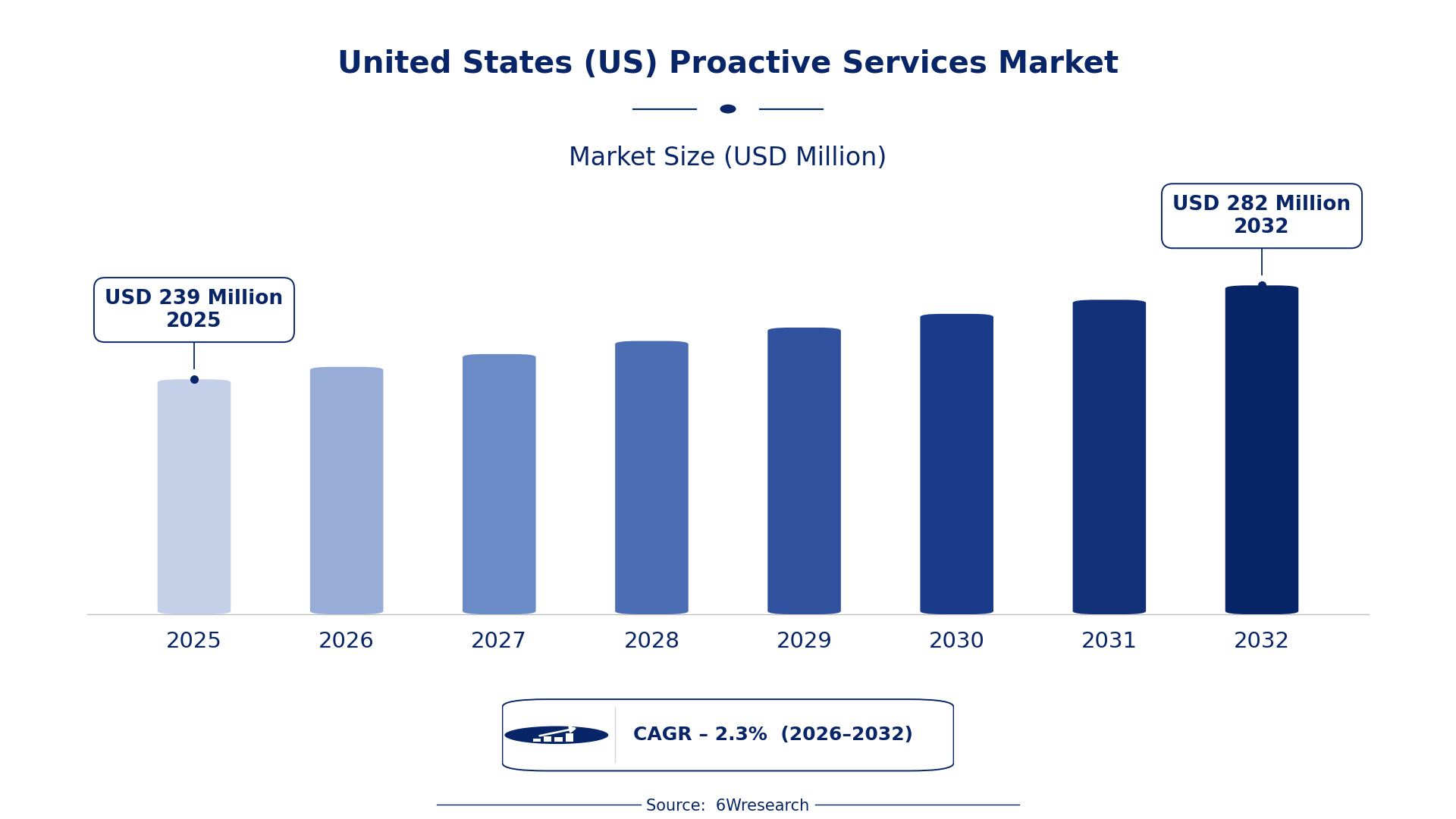
The United States (US) Proactive Services Market was estimated at USD 239 Million in 2025 and is projected to reach USD 282 Million by 2032, growing at a CAGR of 2.3% from 2026 to 2032.
United States (US) Proactive Services Market Synopsis
The United States Proactive Services Market has gained notable momentum recently, driven by the increasing necessity for businesses to minimize downtime and ensure operational continuity. As organizations adopt advanced technologies, the focus is shifting towards proactive solutions that enhance performance and efficiency, positioning the market for robust growth in the coming years.
Looking ahead, the market is set to evolve as companies increasingly prioritize customer-centric approaches and personalized service offerings. This shift will not only reshape service delivery but also redefine customer expectations, leading to a landscape where proactive services become integral to competitive strategy.
United States (US) Proactive Services Market Year-wise Growth Rate and Key Drivers
This graph illustrates the annual growth rates of the United States (US) Proactive Services Market from 2021 to 2032, highlighting a steady upward trajectory and projected expansion over the forecast period.
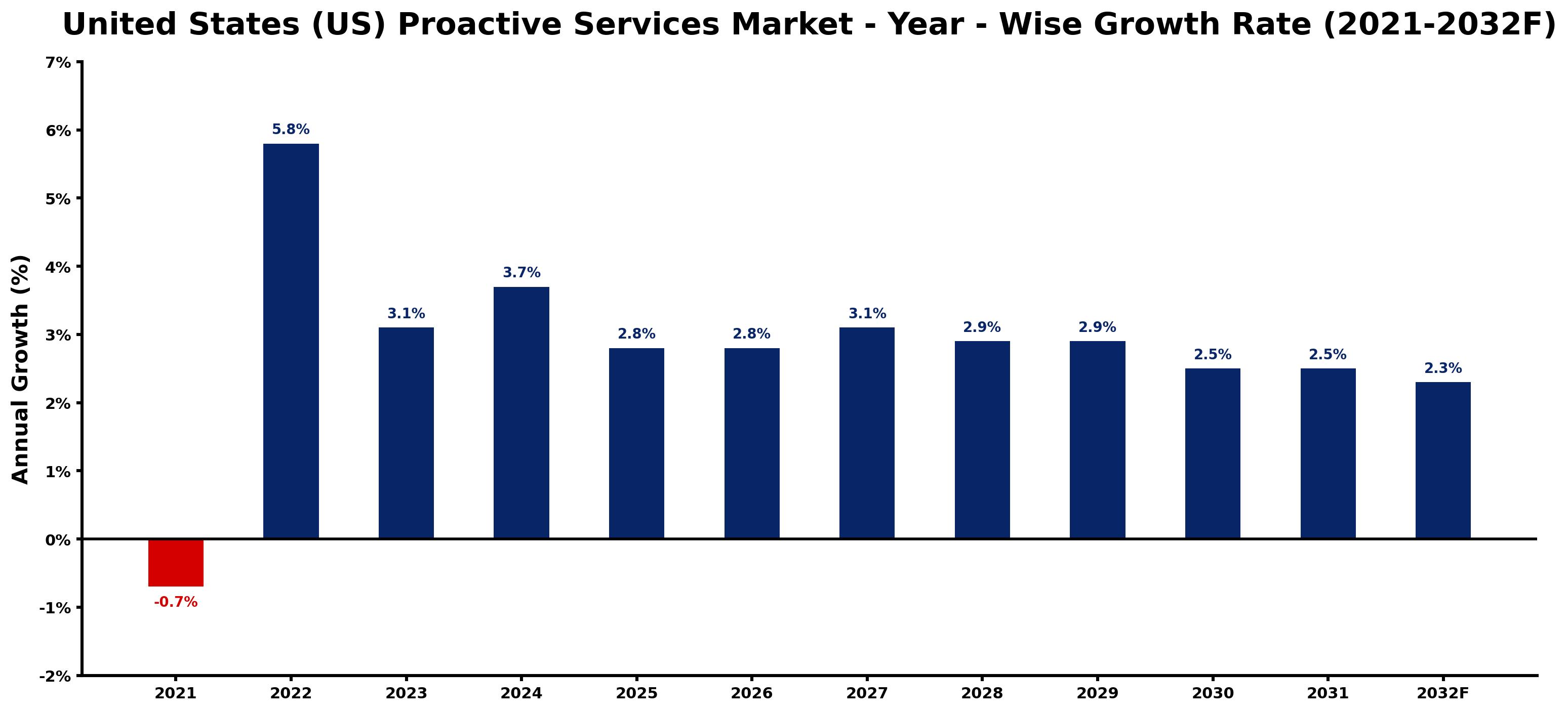
The table below presents the year‑wise growth rates along with the key drivers influencing the market
| Year | Growth Rate | Major Drivers |
| 2021 | -0.7% | Labor shortages affecting service delivery efficiency. |
| 2022 | 5.8% | Increased funding from CMMI for preventive care initiatives. |
| 2023 | 3.1% | Growing awareness of chronic disease management programs. |
| 2024 | 3.7% | Enhanced integration of wearable health tech in services. |
| 2025 | 2.8% | State mandates for proactive health screenings implemented. |
| 2026 | 2.8% | Rise in employer-sponsored wellness programs nationwide. |
| 2027 | 3.1% | Advancements in AI-driven health monitoring technologies. |
| 2028 | 2.9% | Supportive policy changes by CMS for preventive services. |
| 2029 | 2.9% | Partnerships with community health organizations expanding reach. |
| 2030 | 2.5% | Emerging healthcare startups focusing on preventive solutions. |
| 2031 | 2.5% | Increased consumer demand for personalized health interventions. |
| 2032 | 2.3% | Legislative push for mental health proactive care access. |
Note: Market size estimations and growth projections presented in this report are based on 6Wresearch's proprietary forecasting methodology, utilizing the latest available industry data, government publications, and primary research inputs.
United States (US) Proactive Services Market Key Takeaways
Below are some of the specific key takeaways from the market, including:
- The market is on track to reach USD 282 Million by 2032, indicating sustained growth.
- Increasing adoption of AI and predictive analytics is transforming service delivery methodologies.
- Competition is intensifying, driving innovation and differentiation among service providers.
- Regulatory frameworks are shaping market practices, particularly regarding data privacy and security.
- Investment in proactive customer service solutions is becoming a key focus for businesses across sectors.
Evaluation of Restraints in United States (US) Proactive Services Market
The United States Proactive Services Market faces several restraints that could hinder its growth trajectory. The fierce competition among service providers complicates differentiation, compelling companies to continuously innovate while maintaining high service quality. on top of that, the rapid pace of technological advancement demands constant investment, which can strain resources. Concerns regarding data privacy and security further complicate the landscape, as organizations must adhere to stringent regulations to protect customer information. These factors create a challenging environment that companies must navigate to succeed.
United States (US) Proactive Services Market Trends
A clear trend is emerging towards the integration of AI-driven solutions that enable businesses to anticipate customer needs and enhance service delivery. This trend is particularly pronounced in sectors like telecommunications and healthcare, where customer interactions are increasingly being automated through advanced analytics and machine learning.
Additionally, the focus on omnichannel customer engagement strategies is reshaping how companies interact with their clients. Proactive services are being integrated across multiple channels, ensuring a consistent and efficient customer experience that meets the evolving demands of consumers.
United States (US) Proactive Services Market Opportunities
The US Proactive Services Market presents numerous investment opportunities, particularly in technology-driven solutions. Companies offering proactive monitoring, predictive maintenance, and customer service enhancements are in high demand as organizations seek to mitigate risks and improve operational efficiency.
Investors should look toward software solutions leveraging predictive analytics and AI, which can provide substantial returns. The growing emphasis on customer service technologies, including chatbots and personalized communication platforms, further signifies a ripe landscape for investment.
Government Initiatives in the United States (US) Proactive Services Market
Government policies are playing a crucial role in shaping the United States Proactive Services Market by establishing regulations that promote transparency, consumer protection, and innovation. These frameworks are vital for ensuring that businesses can operate effectively while safeguarding customer interests, particularly in terms of data security and privacy.
- A recently completed initiative focused on updating the Federal Trade Commission Act to strengthen consumer protection in digital services.
- Currently, there is an ongoing regulatory review by the Federal Communications Commission aimed at enhancing data privacy standards across service providers.
- A planned public-private partnership set to launch in 2026 aims to bolster cybersecurity measures within proactive service frameworks.
- The National Institute of Standards and Technology is developing updated guidelines for proactive service providers to enhance compliance with data protection laws.
- Upcoming initiatives are expected to focus on fostering innovation in the sector through grants and funding for technology advancements.
Future Insights of the United States (US) Proactive Services Market
From 2026 to 2032, the US Proactive Services Market is likely to experience substantial growth as organizations increasingly prioritize preventive strategies. The integration of advanced technologies such as AI and machine learning will enable businesses to proactively address challenges, thereby enhancing operational efficiency and customer satisfaction.
on top of that, as the demand for proactive maintenance and monitoring solutions grows, service providers will have ample opportunities to innovate and deliver tailored offerings. The market's trajectory will be shaped by the convergence of technology, customer expectations, and regulatory developments, making it essential for companies to remain agile and responsive.
United States (US) Proactive Services Market Latest Developments
In recent months, the United States Proactive Services Market has witnessed significant developments, reflecting the ongoing shift toward proactive solutions across various sectors. Companies are increasingly adopting innovative technologies and strategies to enhance service delivery and meet rising customer expectations.
- A major technology vendor launched a new AI-driven predictive maintenance tool in Q2 2025, aimed at enhancing operational efficiency for industrial clients.
- An initiative that began in early 2025 focuses on integrating proactive customer service solutions across multiple platforms for a leading telecommunications provider.
- A project expected to commence in mid-2026 will develop a nationwide framework for proactive cybersecurity measures among service providers.
- A healthcare provider initiated a pilot program in late 2025 that leverages predictive analytics to improve patient engagement and service delivery.
- A collaborative effort is underway as multiple companies join forces to create an industry standard for data privacy in proactive services, expected to be finalized by late 2026.
United States (US) Proactive Services Market - Key Attractiveness of the Report
- 10 Years of Market Numbers
- Historical Data Starting from 2022 to 2025
- Base Year: 2025
- Forecast Data until 2032
- Key Performance Indicators Impacting the Market
- Major Upcoming Developments and Projects
Key Highlights of the Report:
- United States (US) Proactive Services Market Outlook
- Market Size of United States (US) Proactive Services Market, 2025
- Forecast of United States (US) Proactive Services Market, 2032
- Historical Data and Forecast of United States (US) Proactive Services Revenues & Volume for the Period 2022-2032F
- United States (US) Proactive Services Market Trend Evolution
- United States (US) Proactive Services Market Drivers and Challenges
- United States (US) Proactive Services Price Trends
- United States (US) Proactive Services Porter's Five Forces
- United States (US) Proactive Services Industry Life Cycle
- Historical Data and Forecast of United States (US) Proactive Services Market Revenues & Volume By Application for the Period 2022-2032F
- Historical Data and Forecast of United States (US) Proactive Services Market Revenues & Volume By Network Management for the Period 2022-2032F
- Historical Data and Forecast of United States (US) Proactive Services Market Revenues & Volume By Customer Experience Management for the Period 2022-2032F
- Historical Data and Forecast of United States (US) Proactive Services Market Revenues & Volume By Data Center Management for the Period 2022-2032F
- Historical Data and Forecast of United States (US) Proactive Services Market Revenues & Volume By Cloud Management for the Period 2022-2032F
- Historical Data and Forecast of United States (US) Proactive Services Market Revenues & Volume By Application Management for the Period 2022-2032F
- Historical Data and Forecast of United States (US) Proactive Services Market Revenues & Volume By Device / Endpoint Management for the Period 2022-2032F
- Historical Data and Forecast of United States (US) Proactive Services Market Revenues & Volume By Service for the Period 2022-2032F
- Historical Data and Forecast of United States (US) Proactive Services Market Revenues & Volume By Managed Services for the Period 2022-2032F
- Historical Data and Forecast of United States (US) Proactive Services Market Revenues & Volume By Technical Support for the Period 2022-2032F
- Historical Data and Forecast of United States (US) Proactive Services Market Revenues & Volume By Design and Consulting for the Period 2022-2032F
- Historical Data and Forecast of United States (US) Proactive Services Market Revenues & Volume By Technology Type for the Period 2022-2032F
- Historical Data and Forecast of United States (US) Proactive Services Market Revenues & Volume By Big Data Analytics for the Period 2022-2032F
- Historical Data and Forecast of United States (US) Proactive Services Market Revenues & Volume By Business Intelligence for the Period 2022-2032F
- Historical Data and Forecast of United States (US) Proactive Services Market Revenues & Volume By Machine Intelligence for the Period 2022-2032F
- Historical Data and Forecast of United States (US) Proactive Services Market Revenues & Volume By Organization Size for the Period 2022-2032F
- Historical Data and Forecast of United States (US) Proactive Services Market Revenues & Volume By Small and Medium-sized Enterprises (SMEs) for the Period 2022-2032F
- Historical Data and Forecast of United States (US) Proactive Services Market Revenues & Volume By Large enterprises for the Period 2022-2032F
- Historical Data and Forecast of United States (US) Proactive Services Market Revenues & Volume By Vertical for the Period 2022-2032F
- Historical Data and Forecast of United States (US) Proactive Services Market Revenues & Volume By Banking, Financial Services, and Insurance (BFSI) for the Period 2022-2032F
- Historical Data and Forecast of United States (US) Proactive Services Market Revenues & Volume By Telecommunication for the Period 2022-2032F
- Historical Data and Forecast of United States (US) Proactive Services Market Revenues & Volume By Retail for the Period 2022-2032F
- Historical Data and Forecast of United States (US) Proactive Services Market Revenues & Volume By Healthcare for the Period 2022-2032F
- Historical Data and Forecast of United States (US) Proactive Services Market Revenues & Volume By Government and Defense for the Period 2022-2032F
- Historical Data and Forecast of United States (US) Proactive Services Market Revenues & Volume By Media and Entertainment for the Period 2022-2032F
- Historical Data and Forecast of United States (US) Proactive Services Market Revenues & Volume By Others for the Period 2022-2032F
- United States (US) Proactive Services Import Export Trade Statistics
- Market Opportunity Assessment By Application
- Market Opportunity Assessment By Service
- Market Opportunity Assessment By Technology Type
- Market Opportunity Assessment By Organization Size
- Market Opportunity Assessment By Vertical
- United States (US) Proactive Services Top Companies Market Share
- United States (US) Proactive Services Competitive Benchmarking By Technical and Operational Parameters
- United States (US) Proactive Services Company Profiles
- United States (US) Proactive Services Key Strategic Recommendations






































