Uruguay Decaffeinated Coffee Market Growth Rate Analysis (2025 - 2031)
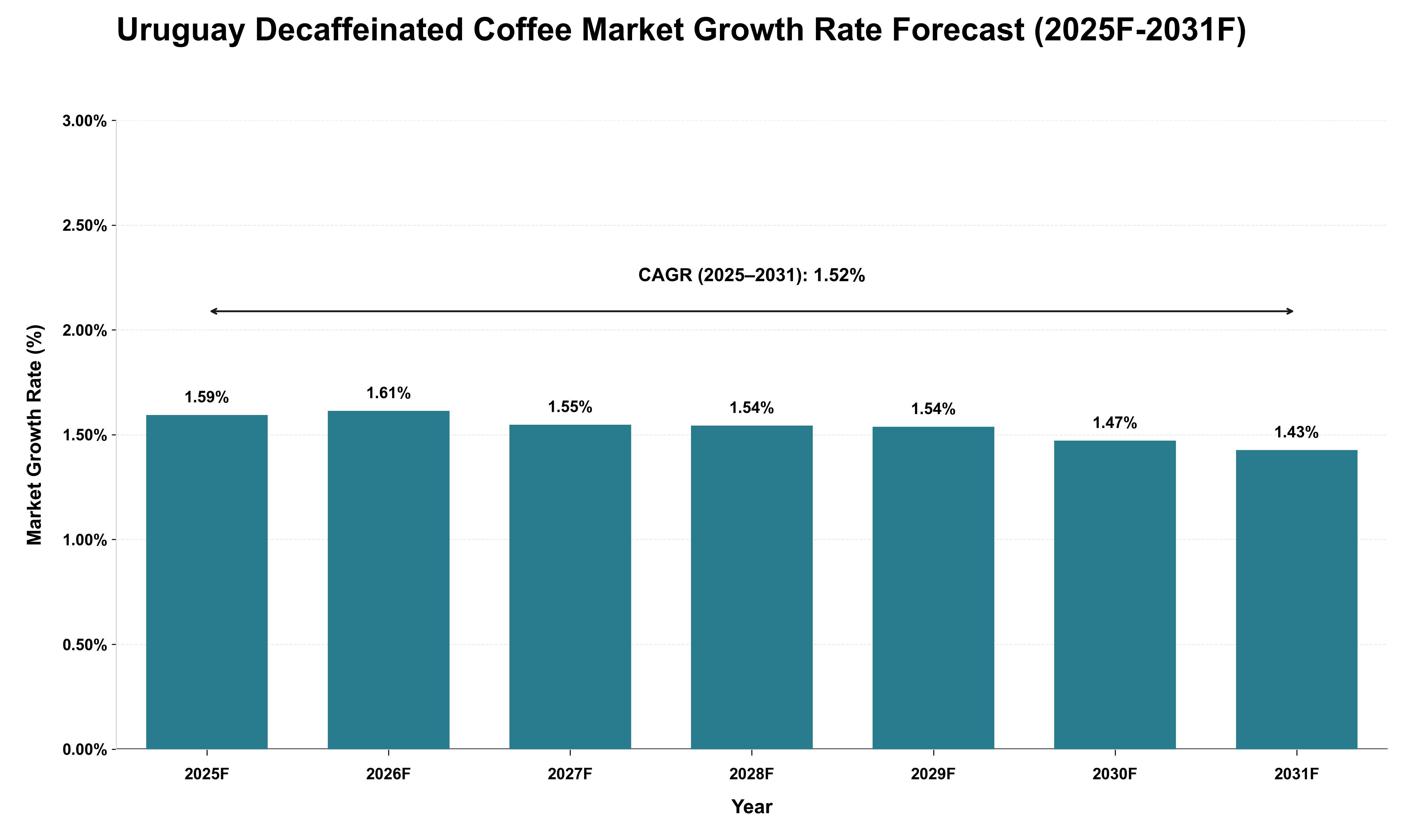
The Uruguay decaffeinated coffee market will experience a compound annual growth rate of 1.52% from 2025 to 2031, reflecting a steady yet modest expansion trajectory. This growth will be underpinned by increasing consumer preferences for health-conscious products, driving demand for decaffeinated options. The annual growth rates will fluctuate slightly, peaking at 1.61% in 2026 before gradually tapering to 1.43% by 2031, indicating a potential stabilization in import dependencies and competitive dynamics within the market. As local producers adapt to evolving consumer tastes and international suppliers enhance their offerings, the competitive landscape will likely shift towards quality differentiation rather than volume increases. Additionally, cyclical trends in global coffee prices and trade policies may influence import costs and availability, further shaping the market's capacity to meet rising demand while maintaining price stability throughout this forecast period.
Key Highlights of the Report:
- Uruguay Decaffeinated Coffee Market Outlook
- Market Size of Uruguay Decaffeinated Coffee Market, 2024
- Forecast of Uruguay Decaffeinated Coffee Market, 2031
- Historical Data and Forecast of Uruguay Decaffeinated Coffee Revenues & Volume for the Period 2021-2031
- Uruguay Decaffeinated Coffee Market Trend Evolution
- Uruguay Decaffeinated Coffee Market Drivers and Challenges
- Uruguay Decaffeinated Coffee Price Trends
- Uruguay Decaffeinated Coffee Porter`s Five Forces
- Uruguay Decaffeinated Coffee Industry Life Cycle
- Historical Data and Forecast of Uruguay Decaffeinated Coffee Market Revenues & Volume By Product for the Period 2021-2031
- Historical Data and Forecast of Uruguay Decaffeinated Coffee Market Revenues & Volume By Roasted for the Period 2021-2031
- Historical Data and Forecast of Uruguay Decaffeinated Coffee Market Revenues & Volume By Raw for the Period 2021-2031
- Historical Data and Forecast of Uruguay Decaffeinated Coffee Market Revenues & Volume By Speciesfor the Period 2021-2031
- Historical Data and Forecast of Uruguay Decaffeinated Coffee Market Revenues & Volume By Arabica for the Period 2021-2031
- Historical Data and Forecast of Uruguay Decaffeinated Coffee Market Revenues & Volume By Robusta for the Period 2021-2031
- Historical Data and Forecast of Uruguay Decaffeinated Coffee Market Revenues & Volume By Distribution Channel for the Period 2021-2031
- Historical Data and Forecast of Uruguay Decaffeinated Coffee Market Revenues & Volume By Online for the Period 2021-2031
- Historical Data and Forecast of Uruguay Decaffeinated Coffee Market Revenues & Volume By Offline for the Period 2021-2031
- Uruguay Decaffeinated Coffee Import Export Trade Statistics
- Market Opportunity Assessment By Product
- Market Opportunity Assessment By Species
- Market Opportunity Assessment By Distribution Channel
- Uruguay Decaffeinated Coffee Top Companies Market Share
- Uruguay Decaffeinated Coffee Competitive Benchmarking By Technical and Operational Parameters
- Uruguay Decaffeinated Coffee Company Profiles
- Uruguay Decaffeinated Coffee Key Strategic Recommendations






































