Chemicals Market: Uzbekistan vs Top 5 Major Economies in 2027 (Asia)
By 2027, Uzbekistan's Chemicals market is forecasted to achieve a high growth rate of 11.11%, with China leading the Asia region, followed by India, Japan, Australia and South Korea.
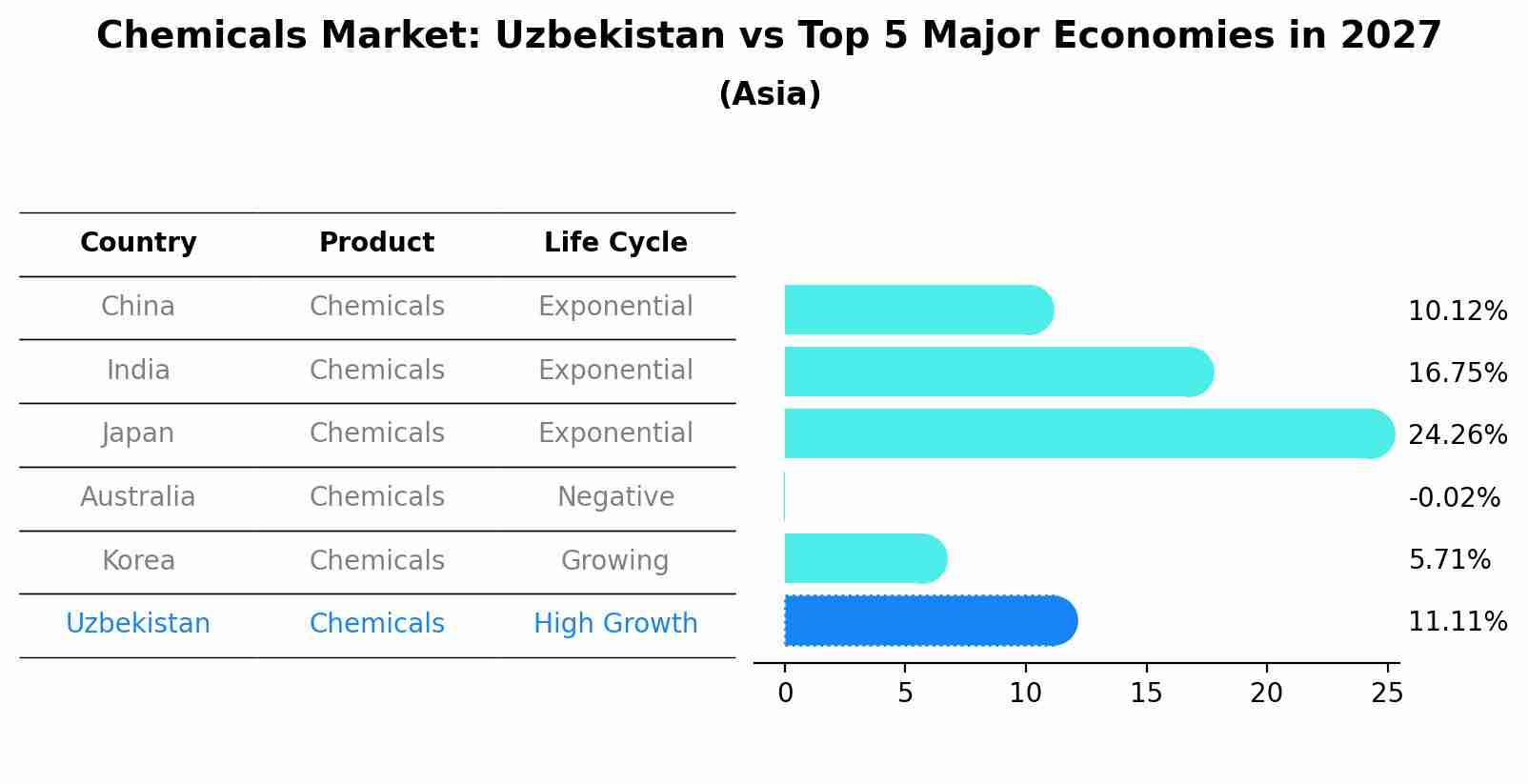
Uzbekistan Chemicals Market Growth Rate
['According to 6Wresearch internal database and industry insights, the Uzbekistan Chemicals Market is growing at a compound annual growth rate (CAGR) of 7.2% during the forecast period (2026-2032).
Topics Covered in the Uzbekistan Chemicals Market Report
The Uzbekistan Chemicals Market report thoroughly covers the market by types. The market report provides an unbiased and detailed analysis of ongoing market trends, opportunities, high-growth areas, and market drivers, which would help stakeholders devise and align their market strategies according to the current and future market dynamics.
Uzbekistan Chemicals Market Highlights
| Report Name | Uzbekistan Chemicals Market |
| Forecast period | 2026-2032 |
| CAGR | 7.2% |
| Growing Sector | Chemicals and Materials |
Uzbekistan Chemicals Market Synopsis
Uzbekistan's chemicals market is poised for substantial expansion. This amplification is fueled by increasing demand for specialty chemicals and agrochemicals, alongside considerable investments in infrastructure. The industrial applications also play a role. Government initiatives aimed at boosting chemical production, coupled with a robust manufacturing sector, are propelling the market's expansion. The increasing need for chemical products in agriculture, textiles, and construction is fueling their widespread adoption throughout the country.
Evaluation of Growth Drivers in the Uzbekistan Chemicals Market
Below mentioned are some growth drivers and their impact on market dynamics:
| Drivers | Primary Segments Affected | Why It Matters |
| Government Investments | Agrochemicals, Petrochemicals, Specialty Polymers | Robust industrial capacity and creates new market opportunities. |
| Expanding Agrochemical Demand | Agrochemicals, Specialty Polymers | Essentially stable food production and agricultural growth. |
| Petrochemical Industry Growth | Petrochemicals, Base Ingredients | Rising supply of essential raw materials for manufacturing. |
| Infrastructure Development | Construction Chemicals, Textile Chemicals | Enhance chemical processing and distribution efficiency. |
| Export Growth | Dyes and Pigments, Agrochemicals | Stabilizes Uzbekistan's position in global chemical trade. |
The Uzbekistan Chemicals Market is projected to experience substantial growth with a CAGR of 7.2% during the forecast period of 2026-2032. This growth is propelled by the increasing demand for specialty chemicals, government investments, and the expansion of key sectors such as agrochemicals and petrochemicals. Furthermore, the expanding construction, textile, and agricultural sectors are opening doors for increased use of chemical products. The market is also benefiting from a growing export market, technological progress in manufacturing, and supportive policies, which are fueling consistent demand across different chemical segments, such as specialty polymers and construction chemicals.
Evaluation of Restraints in the Uzbekistan Chemicals Market
Below mentioned are some major restraints and their influence on market dynamics:
| Restraints | Primary Segments Affected | What This Means |
| Regulatory Challenges | All Segments | Increases compliance costs and restricts market access. |
| Limited Technological Advancements | Specialty Polymers, Dyes and Pigments | Affects product innovation and quality. |
| Price Fluctuations of Raw Materials | Base Ingredients, Petrochemicals | Creates cost instability and affects production plans. |
| Competition from Imported Products | Agrochemicals, Surfactants | Limits market share for local producers. |
Uzbekistan Chemicals Market Challenges
Uzbekistan's chemicals market faces several hurdles. Regulatory hurdles, technological limitations, and all pose significant challenges. Moreover, local producers face challenges in competing with imported chemical products, mainly because of the lower production costs in other countries. To address these challenges, the industry necessitates modernization, the cultivation of a more skilled workforce, and the integration of novel technologies to boost both production efficiency and product quality. Furthermore, augmented governmental support and strategically designed collaborations can strengthen domestic manufacturing capabilities, thereby expanding the sector's growth prospects, both nationally and internationally.
Uzbekistan Chemicals Market Trends
Some major trends contributing to the Uzbekistan Chemicals Market Growth are:
- Rising Demand for Specialty Chemicals: The increasing demand for advanced chemicals in manufacturing processes, such as specialty polymers, dyes, and pigments, is driving innovation and market extension.
- Sustainability and Eco-friendly Chemicals: The growing interest in sustainable and eco-friendly chemicals is spawning entirely new product categories. Think biodegradable and non-toxic chemicals, for example.
- Focus on Agricultural Growth: The growth of agriculture is driven by the increased use of agrochemicals like new agrochemical products are being developed due to chemicals being essential for increasing crop yields.
Investment Opportunities in the Uzbekistan Chemicals Market
Here are some investment opportunities in the Uzbekistan Chemicals Industry:
- Development of Sustainable Chemical Products: Investing in the development of eco-friendly, sustainable chemical products such as biodegradable agrochemicals, which is gaining popularity among environmentally conscious consumers.
- Technological Advancements in Specialty Chemicals: Investing in research and development for specialty chemicals, including polymers and pigments, is a direct response to the increasing needs of sectors like automotive, textiles, and construction.
- E-commerce Platforms for Chemicals: The rise of e-commerce platforms for chemical distribution presents an opportunity to reach new customers, especially in remote regions.
Top 5 Leading Players in the Uzbekistan Chemicals Market
Here are some top companies contributing to the Uzbekistan Chemicals Market Share:
1. Uzkimyosanoat JSC (Uzbekistan Chemical Group)
| Company Name | Uzkimyosanoat JSC (Uzbekistan Chemical Group) |
|---|---|
| Established Year | 2001 |
| Headquarters | Tashkent, Uzbekistan |
| Official Website | Click Here |
The central governing body and holding company for the entire state-owned chemical industry. It dictates national policy, manages over twenty large-scale enterprises, and coordinates nearly all major foreign investment projects in the sector.
2. Navoiyazot JSC
| Company Name | Navoiyazot JSC |
|---|---|
| Established Year | 1964 |
| Headquarters | Navoiy, Uzbekistan |
| Official Website | Click Here |
The largest diversified chemical plant in Central Asia. It accounts for over 30% of Uzbekistan's total chemical production. It is the critical supplier for the country's gold mining industry (producing sodium cyanide) and a major global exporter of mineral fertilizers and Nitron fiber.
3. Uz-Kor Gas Chemical (Joint Venture)
| Company Name | Uz-Kor Gas Chemical (Joint Venture) |
|---|---|
| Established Year | 2008 |
| Headquarters | Nukus, Karakalpakstan |
| Official Website | Click Here |
The leading polymer producer in the region. As a high-tech partnership between Uzbekneftegaz and a South Korean consortium (Lotte Chemical, KOGAS), it represents the shift from raw gas exports to high-value plastic manufacturing, dominating the domestic market for HDPE and polypropylene.
4. Shurtan Gas Chemical Complex (SGCC)
| Company Name | Shurtan Gas Chemical Complex (SGCC) |
|---|---|
| Established Year | 2001 |
| Headquarters | Shurtan, Kashkadarya Region |
| Official Website | - |
A pioneer in the "Gas-to-Polymer" model. It was the first major facility in the CIS to implement deep gas processing for polyethylene production. It serves as the core of a massive industrial cluster that includes the world-class Uzbekistan GTL (Gas-to-Liquids) plant.
5. Ferganaazot JSC
| Company Name | Ferganaazot JSC |
|---|---|
| Established Year | 1962 |
| Headquarters | Fergana, Uzbekistan |
| Official Website | Click Here |
The agrochemical powerhouse of eastern Uzbekistan. It is the primary manufacturer of nitrogen-based fertilizers (urea and ammonium nitrate) and cellulose acetates. It is a strategic asset currently undergoing modernization to support the nation's massive cotton and textile industries.
Government Regulations Introduced in the Uzbekistan Chemicals Market
According to Uzbekistani government data, Uzbekistan has rolled out a series of several initiatives to support the chemical industry, including the Uzbekistan Chemical Industry Development Program. The aim of this program is to increase the productivity of chemical plants and, in turn, strengthen the global competitiveness of locally produced goods. In addition, environmental regulations set by the Uzbekistan Ministry of Ecology and Environmental Protection ensure that chemical production adheres to global sustainability standards. These initiatives do more than just improve the standard of chemical products but also foster a favourable environment for the growth of Uzbekistan’s chemical market.
Future Insights of the Uzbekistan Chemicals Market
The Uzbekistan chemicals market is on the upswing, showing significant growth. This expansion is largely driven by a surge in industrial demand, along with support from the government. Moreover, Uzbekistan's growing footprint in the global chemicals sector is also a key factor. Government initiatives and the rising use of online platforms for chemical sales are key factors in this development. The market seems to be gaining momentum, providing chances for expansion in sectors like agrochemicals, petrochemicals, and sustainable chemical solutions.
Market Segmentation Analysis
The report offers a comprehensive study of the subsequent market segments and their leading categories:
Agrochemicals to Dominant the Market - By Type
According to Ashutosh, Senior Research Analyst at 6Wresearch, Agrochemicals are the dominant segment in Uzbekistan’s chemicals market due to the country’s robust agricultural sector. Agriculture relies heavily on agrochemicals to protect crops, improve soil, control pests, and increase yields, which is essential for ensuring food security.
Key attractiveness of the report
- 10 Years Market Numbers
- Historical Data Starting from 2022 to 2025
- Base Year: 2025
- Forecast Data until 2032
- Key Performance Indicators Impacting the Market
- Major Upcoming Developments and Projects
Key Highlights of the Report:
- Uzbekistan Chemicals Market Outlook
- Market Size of Uzbekistan Chemicals Market, 2025
- Forecast of Uzbekistan Chemicals Market, 2032
- Historical Data and Forecast of Uzbekistan Chemicals Revenues & Volume for the Period 2022 - 2032
- Uzbekistan Chemicals Market Trend Evolution
- Uzbekistan Chemicals Market Drivers and Challenges
- Uzbekistan Chemicals Price Trends
- Uzbekistan Chemicals Porter’s Five Forces
- Uzbekistan Chemicals Industry Life Cycle
- Historical Data and Forecast of Uzbekistan Chemicals Market Revenues & Volume By Type for the Period 2022 - 2032
- Historical Data and Forecast of Uzbekistan Chemicals Market Revenues & Volume By Agrochemicals for the Period 2022 - 2032
- Historical Data and Forecast of Uzbekistan Chemicals Market Revenues & Volume By Dyes and Pigments for the Period 2022 - 2032
- Historical Data and Forecast of Uzbekistan Chemicals Market Revenues & Volume By Construction Chemicals for the Period 2022 - 2032
- Historical Data and Forecast of Uzbekistan Chemicals Market Revenues & Volume By Specialty Polymers for the Period 2022 - 2032
- Historical Data and Forecast of Uzbekistan Chemicals Market Revenues & Volume By Textile Chemicals for the Period 2022 - 2032
- Historical Data and Forecast of Uzbekistan Chemicals Market Revenues & Volume By Base Ingredients for the Period 2022 - 2032
- Historical Data and Forecast of Uzbekistan Chemicals Market Revenues & Volume By Surfactants for the Period 2022 - 2032
- Historical Data and Forecast of Uzbekistan Agrochemicals Chemicals Market Revenues & Volume By Others for the Period 2022 - 2032
- Uzbekistan Chemicals Import Export Trade Statistics
- Market Opportunity Assessment By Type
- Uzbekistan Chemicals Top Companies Market Share
- Uzbekistan Chemicals Competitive Benchmarking By Technical and Operational Parameters
- Uzbekistan Chemicals Company Profiles
- Uzbekistan Chemicals Key Strategic Recommendations
Market Covered
The report subsequently covers the market by following segments and subsegments:
By Type:
- Agrochemicals
- Dyes and Pigments
- Construction Chemicals
- Specialty Polymers
- Textile Chemicals
- Base Ingredients
- Surfactants
- Others






































