Venezuela Coffee Market Size, Share & Growth Rate
The Venezuela Coffee Market was estimated at USD 235 Million in 2025 and is projected to reach USD 306 Million by 2032, growing at a CAGR of 3.8% from 2026 to 2032. This growth trajectory is fueled by a resurgence in the appreciation of high-quality Arabica beans, alongside a burgeoning interest in specialty coffee among local consumers. Moreover, a gradual recovery in the socio-economic landscape could potentially enhance both production capabilities and export opportunities.
Venezuela Coffee Market Year-wise Growth Rate and Key Drivers
This graph highlights how the Venezuela Coffee Market has steadily grown over the years, supported by major growth factors.
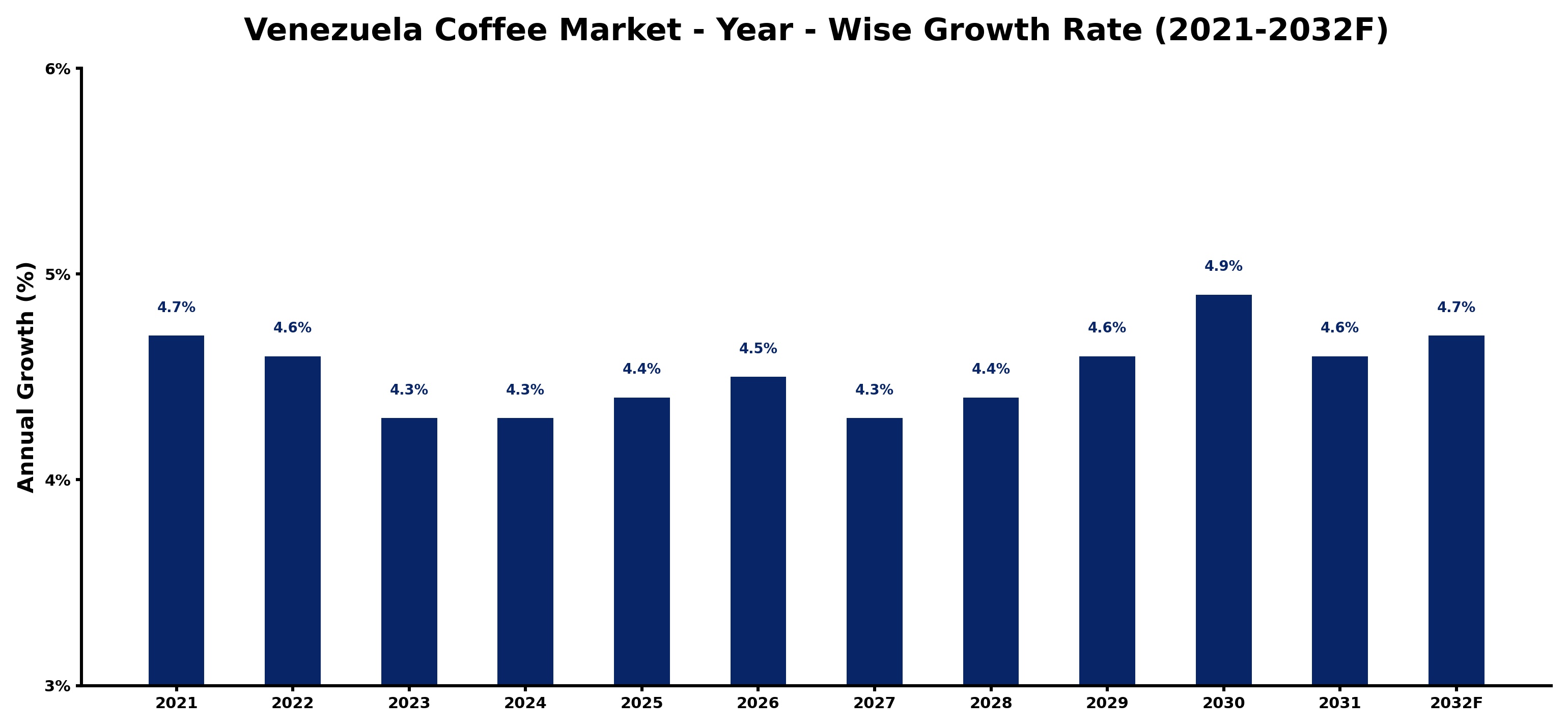
The table below presents the year‑wise growth rates along with the key drivers influencing the market
| Year | Growth Rate | Major Drivers |
| 2021 | 4.7% | Increased domestic consumption patterns |
| 2022 | 4.6% | Coffee tourism attracted new customers |
| 2023 | 4.3% | Local sourcing improved product quality |
| 2024 | 4.3% | Sustainable farming practices gained popularity |
| 2025 | 4.4% | Innovative coffee blends captured interest |
| 2026 | 4.5% | Growing café culture enhanced demand |
| 2027 | 4.3% | Export opportunities expanded significantly |
| 2028 | 4.4% | Specialty coffee shops proliferated rapidly |
| 2029 | 4.6% | Health benefits awareness increased consumption |
| 2030 | 4.9% | Digital marketing strategies engaged consumers |
| 2031 | 4.6% | Collaborations with local farmers flourished |
| 2032 | 4.7% | Coffee festivals boosted brand visibility |
Note - Market size estimations and growth projections presented in this report are based on 6Wresearch's advanced forecasting approach, validated with industry datasets as of June 2026.
Venezuela Coffee Market Synopsis
Venezuela's coffee industry is steeped in tradition, with rich agricultural practices in its mountainous regions yielding some of the world's finest Arabica beans. However, the market grapples with formidable challenges, including economic hardships and political instability, which impact both production and distribution channels.
Despite these hurdles, domestic consumption persists, with traditional coffee beverages like Café Negro and Café con Leche remaining staples in Venezuelan culture. The market is evolving, responding to both local and global trends emphasizing quality and sustainability.
Venezuela Coffee Market Key Takeaways
- The Venezuela coffee market is rich in heritage but challenged by current economic and political turmoil.
- Local coffee consumption remains stable, supported by traditional preferences and emerging specialty trends.
- Investment potential exists in sustainable farming practices and direct trade to enhance farmer incomes.
- The market faces a significant need for infrastructure improvements to support production and export capabilities.
- Government initiatives are focused on revitalizing the industry, despite persistent instability affecting effectiveness.
Evaluation of Restraints in Venezuela Coffee Market
The Venezuela Coffee Market faces significant restraints that hinder its growth trajectory. Chief among them is the persistent political instability and economic crisis, which have led to hyperinflation and stringent price controls that complicate production and export. Additionally, aging plantations and insufficient investment in modern agricultural techniques contribute to declining coffee yields, while adverse climate conditions further exacerbate these challenges. Limited access to necessary resources also means that local farmers struggle to sustain quality and production levels, which is essential for competing on a global scale.
Venezuela Coffee Market Trends
Current trends in the Venezuela Coffee Market indicate a shift towards specialty and gourmet coffee varieties. This trend is propelled by consumers' growing preference for unique coffee experiences, pushing producers to focus on sustainable and ethical farming practices. Additionally, the interest in single-origin coffees from specific Venezuelan regions showcases an evolving consumer palate eager for distinct flavor profiles. Producers are also gravitating towards direct trade models that enhance transparency and ensure fair compensation for farmers, effectively bypassing traditional distribution channels.
Venezuela Coffee Market Opportunities
Significant growth opportunities exist within the Venezuela Coffee Market for investors looking to capitalize on its historical reputation for producing high-quality coffee. Fostering partnerships with local cooperatives can lead to improved infrastructure and increased productivity, enhancing the overall quality of coffee produced. Moreover, a focus on sustainable practices could differentiate Venezuelan coffee on the global stage, attracting premium pricing and enhancing market viability. The increasing global demand for specialty coffee opens avenues for targeted investments in both farming and processing sectors.
Government Initiatives in the Venezuela Coffee Market
The Venezuelan government has taken several initiatives to bolster the coffee industry, including the establishment of the National Institute of Agricultural Research (INIA) to support coffee production. To ensure affordability, price controls have been implemented alongside efforts to promote sustainable farming practices through subsidies and technical assistance. Additionally, government campaigns aimed at increasing domestic coffee consumption are underway, attempting to revive local coffee culture and support local businesses in the face of ongoing challenges.
Future Insights of the Venezuela Coffee Market
Looking ahead to the period between 2026 and 2032, the Venezuela Coffee Market presents a complex yet potentially rewarding landscape. While challenges related to economic and political instability persist, a focus on quality, sustainability, and local consumer preferences could pave the way for recovery. For the market to realize its full potential, significant reforms and investments in infrastructure and farmer support will be crucial. Moreover, evolving global coffee trends provide a viable pathway for Venezuelan coffee to regain its competitive edge internationally.
Venezuela Coffee Market Latest Developments (May 2025 - June 2026)
Recent developments within the Venezuela Coffee Market indicate a continued push towards strengthening local production capabilities. Initiatives aimed at improving agricultural practices and investing in modern processing facilities have emerged, alongside greater support for local farmers. Furthermore, collaborations between governmental and non-governmental organizations are beginning to focus on enhancing market access for Venezuelan coffee in international markets, despite the ongoing challenges posed by the economic environment.
Venezuela Coffee Market - Key Attractiveness of the Report
- 10 Years of Market Numbers
- Historical Data Starting from 2022 to 2025
- Base Year: 2025
- Forecast Data until 2032
- Key Performance Indicators Impacting the Market
- Major Upcoming Developments and Projects
Key Highlights of the Report:
- Venezuela Coffee Market Outlook
- Market Size of Venezuela Coffee Market, 2025
- Forecast of Venezuela Coffee Market, 2032
- Historical Data and Forecast of Venezuela Coffee Revenues & Volume for the Period 2022-2032F
- Venezuela Coffee Market Trend Evolution
- Venezuela Coffee Market Drivers and Challenges
- Venezuela Coffee Price Trends
- Venezuela Coffee Porter's Five Forces
- Venezuela Coffee Industry Life Cycle
- Historical Data and Forecast of Venezuela Coffee Market Revenues & Volume By Product Type for the Period 2022-2032F
- Historical Data and Forecast of Venezuela Coffee Market Revenues & Volume By Whole-Bean for the Period 2022-2032F
- Historical Data and Forecast of Venezuela Coffee Market Revenues & Volume By Ground Coffee for the Period 2022-2032F
- Historical Data and Forecast of Venezuela Coffee Market Revenues & Volume By Instant Coffee for the Period 2022-2032F
- Historical Data and Forecast of Venezuela Coffee Market Revenues & Volume By Coffee Pods and Capsules for the Period 2022-2032F
- Historical Data and Forecast of Venezuela Coffee Market Revenues & Volume By Distribution Channel for the Period 2022-2032F
- Historical Data and Forecast of Venezuela Coffee Market Revenues & Volume By On-Trade for the Period 2022-2032F
- Historical Data and Forecast of Venezuela Coffee Market Revenues & Volume By Off-Trade for the Period 2022-2032F
- Venezuela Coffee Import Export Trade Statistics
- Market Opportunity Assessment By Product Type
- Market Opportunity Assessment By Distribution Channel
- Venezuela Coffee Top Companies Market Share
- Venezuela Coffee Competitive Benchmarking By Technical and Operational Parameters
- Venezuela Coffee Company Profiles
- Venezuela Coffee Key Strategic Recommendations






































