Vietnam Anti-aging Products Market Size, Share & Growth Rate
The Vietnam Anti-aging Products Market was estimated at USD 321 Million in 2025 and is projected to reach USD 454 Million by 2032, growing at a CAGR of 5.1% from 2026 to 2032. This growth trajectory is driven by an increasingly health-conscious population that prioritizes skincare, coupled with rising disposable incomes among the burgeoning middle class. Additionally, the influence of social media continues to shape consumer demand for innovative anti-aging solutions, creating a dynamic and competitive landscape.
Vietnam Anti-aging Products Market Year-wise Growth Rate and Key Drivers
This graph highlights how the Vietnam Anti-aging Products Market has steadily grown over the years, supported by major growth factors.
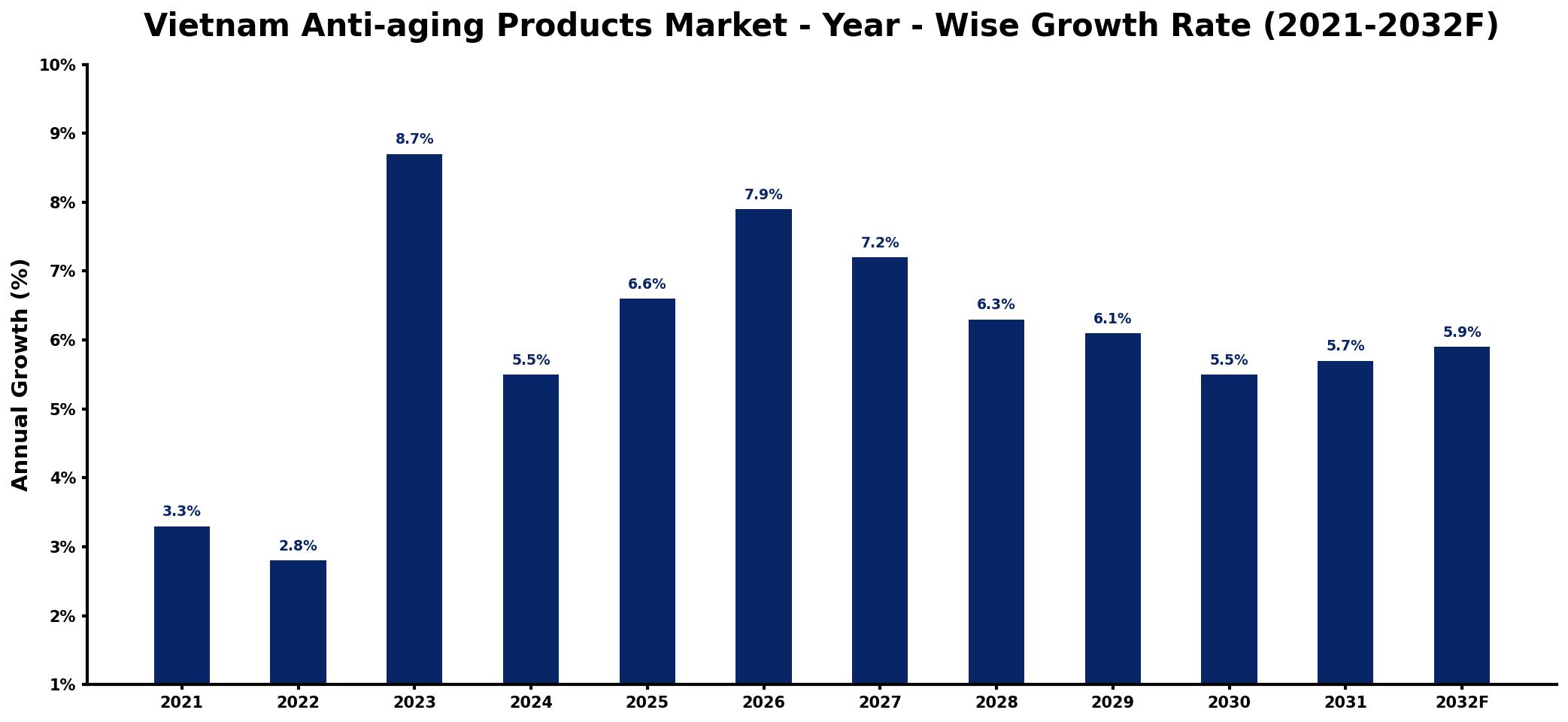
The table below presents the year‑wise growth rates along with the key drivers influencing the market
| Year | Growth Rate | Major Drivers |
| 2021 | 3.3% | Rising consumer health awareness |
| 2022 | 2.8% | Growth in skincare market |
| 2023 | 8.7% | Increased disposable income levels |
| 2024 | 5.5% | Expansion of online retailing |
| 2025 | 6.6% | Emergence of new brands |
| 2026 | 7.9% | Growing interest in wellness |
| 2027 | 7.2% | Investment in innovative technologies |
| 2028 | 6.3% | Higher demand for premium options |
| 2029 | 6.1% | Increased focus on sustainability |
| 2030 | 5.5% | growing automotive sector requirements |
| 2031 | 5.7% | Growing influence of social media |
| 2032 | 5.9% | Rising popularity of holistic approaches |
Note: Market size estimations and growth projections presented in this report are based on 6Wresearch's proprietary forecasting methodology, utilizing the latest available industry data, government publications, and primary research inputs.
Vietnam Anti-aging Products Market Synopsis
In recent years, the Vietnam anti-aging products market has experienced substantial momentum, fueled by rising consumer awareness around health and wellness. As the market evolves, it is increasingly characterized by a wide array of domestic and international brands vying for consumer attention, each offering unique formulations and targeted solutions.
Looking ahead, the market is poised for continued expansion, supported by an unwavering desire for youthful appearances and well-being. Consumer preferences are shifting, as individuals become more discerning about product efficacy, leading to potential challenges for manufacturers to meet heightened expectations.
Vietnam Anti-aging Products Market Key Takeaways
- The market is witnessing robust growth driven by increasing disposable income and a growing health-conscious demographic.
- Product innovation remains a key factor, with consumers seeking high-quality, effective anti-aging solutions.
- Social media significantly influences purchasing decisions, creating a strong market presence for brands that leverage digital marketing.
- Competition among domestic and international brands intensifies, fostering a diverse product landscape.
- Consumer skepticism about product efficacy presents ongoing challenges for manufacturers to address.
Evaluation of Restraints in Vietnam Anti-aging Products Market
Despite the promising growth outlook, the Vietnam anti-aging products market faces several constraints that may hinder its progress. Rapidly changing consumer preferences lead to high expectations for immediate results, putting pressure on manufacturers to innovate continuously. Additionally, there are significant concerns regarding the safety and authenticity of products, especially as the market becomes more competitive. These factors necessitate a commitment to quality assurance and transparency from brands aiming to build lasting consumer trust.
Vietnam Anti-aging Products Market Trends
Current trends shaping the Vietnam anti-aging products market include a surge in demand for natural and organic ingredients, as consumers increasingly prioritize sustainability and skin health. Furthermore, personalized skincare solutions are becoming more popular, with brands exploring customization to meet individual skincare needs. Technological advancements in product formulations and delivery methods, such as serums and topical treatments, are also gaining traction, attracting consumers seeking targeted anti-aging benefits.
Vietnam Anti-aging Products Market Opportunities
The evolving landscape of the Vietnam anti-aging products market presents numerous opportunities for growth and investment. Companies that can effectively leverage e-commerce channels to reach a broader audience stand to benefit substantially. Additionally, there is potential for expansion into untapped demographic segments, particularly among younger consumers who are increasingly concerned about early signs of aging. Collaborations with local dermatologists and beauty influencers could further enhance brand credibility and consumer engagement.
Government Initiatives in the Vietnam Anti-aging Products Market
The Vietnamese government has been actively promoting the personal care and cosmetics industry, facilitating an environment conducive to business growth. Various initiatives aimed at improving regulatory frameworks ensure product safety and efficacy, which is essential for bolstering consumer trust. Public spending in health and wellness campaigns also contributes to a heightened awareness of skincare and anti-aging products, further propelling market growth.
Future Insights of the Vietnam Anti-aging Products Market
Looking ahead to 2026-2032, the Vietnam anti-aging products market is anticipated to maintain its upward trajectory, bolstered by demographic shifts and growing consumer interest in health and wellness. As the economy continues to develop, a focus on premium and scientifically-backed products will likely emerge, creating space for innovative solutions. Brands that prioritize sustainability and transparency are expected to capture a larger market share, as informed consumers become increasingly selective in their purchasing decisions.
Vietnam Anti-aging Products Market Latest Developments (2025 - 2026)
In recent months, the Vietnam anti-aging products market has seen a surge in product launches, particularly in the natural and organic segment. Brands are responding to consumer demand for transparency and sustainability by reformulating existing products to incorporate eco-friendly ingredients. Additionally, several companies are investing in digital marketing strategies, utilizing social media platforms to engage with consumers and drive sales. This trend indicates a shift towards more direct consumer engagement as brands adapt to the post-pandemic landscape.
Vietnam Anti-aging Products Market - Key Attractiveness of the Report
- 10 Years of Market Numbers
- Historical Data Starting from 2022 to 2025
- Base Year: 2025
- Forecast Data until 2032
- Key Performance Indicators Impacting the Market
- Major Upcoming Developments and Projects
Key Highlights of the Report:
- Vietnam Anti-aging Products Market Outlook
- Market Size of Vietnam Anti-aging Products Market, 2025
- Forecast of Vietnam Anti-aging Products Market, 2032
- Historical Data and Forecast of Vietnam Anti-aging Products Revenues & Volume for the Period 2022-2032F
- Vietnam Anti-aging Products Market Trend Evolution
- Vietnam Anti-aging Products Market Drivers and Challenges
- Vietnam Anti-aging Products Price Trends
- Vietnam Anti-aging Products Porter's Five Forces
- Vietnam Anti-aging Products Industry Life Cycle
- Historical Data and Forecast of Vietnam Anti-aging Products Market Revenues & Volume By Product for the Period 2022-2032F
- Historical Data and Forecast of Vietnam Anti-aging Products Market Revenues & Volume By Body Wash for the Period 2022-2032F
- Historical Data and Forecast of Vietnam Anti-aging Products Market Revenues & Volume By Body Moisturizer for the Period 2022-2032F
- Historical Data and Forecast of Vietnam Anti-aging Products Market Revenues & Volume By Eye Cream & Lotion for the Period 2022-2032F
- Historical Data and Forecast of Vietnam Anti-aging Products Market Revenues & Volume By Facial Cleanser for the Period 2022-2032F
- Historical Data and Forecast of Vietnam Anti-aging Products Market Revenues & Volume By Facial Mask for the Period 2022-2032F
- Historical Data and Forecast of Vietnam Anti-aging Products Market Revenues & Volume By Facial Serum for the Period 2022-2032F
- Historical Data and Forecast of Vietnam Anti-aging Products Market Revenues & Volume By Facial Cream & Lotion for the Period 2022-2032F
- Historical Data and Forecast of Vietnam Anti-aging Products Market Revenues & Volume By Distribution Channel for the Period 2022-2032F
- Historical Data and Forecast of Vietnam Anti-aging Products Market Revenues & Volume By Hypermarket & Supermarket for the Period 2022-2032F
- Historical Data and Forecast of Vietnam Anti-aging Products Market Revenues & Volume By Pharmacy & Drug Stores for the Period 2022-2032F
- Historical Data and Forecast of Vietnam Anti-aging Products Market Revenues & Volume By Specialty Store for the Period 2022-2032F
- Historical Data and Forecast of Vietnam Anti-aging Products Market Revenues & Volume By Online for the Period 2022-2032F
- Historical Data and Forecast of Vietnam Anti-aging Products Market Revenues & Volume By Others for the Period 2022-2032F
- Vietnam Anti-aging Products Import Export Trade Statistics
- Market Opportunity Assessment By Product
- Market Opportunity Assessment By Distribution Channel
- Vietnam Anti-aging Products Top Companies Market Share
- Vietnam Anti-aging Products Competitive Benchmarking By Technical and Operational Parameters
- Vietnam Anti-aging Products Company Profiles
- Vietnam Anti-aging Products Key Strategic Recommendations






































