Vietnam Chlorine Market Size Growth Rate
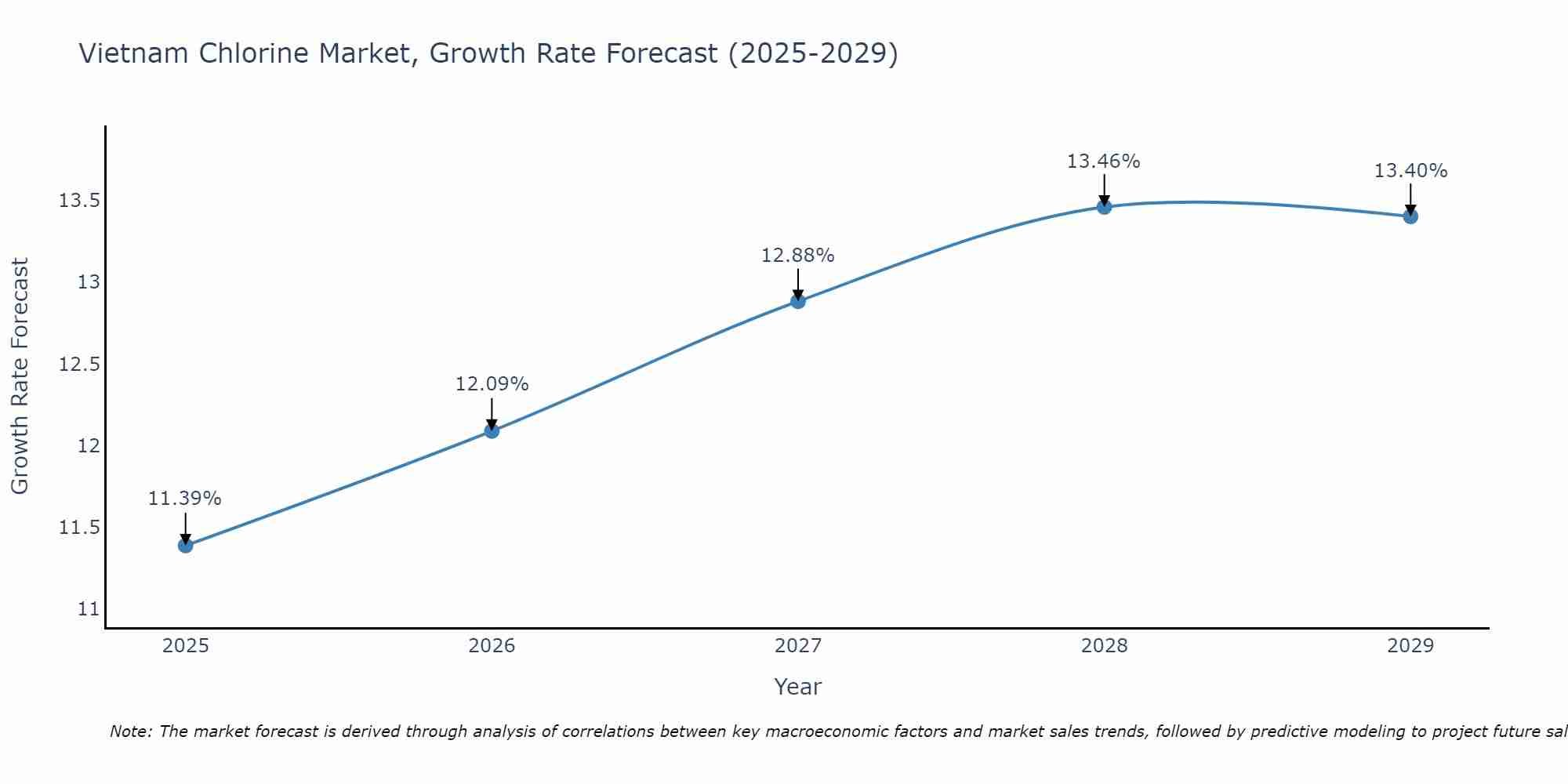
The Vietnam Chlorine Market is projected to witness mixed growth rate patterns during 2025 to 2029. Growth accelerates to 13.46% in 2028, following an initial rate of 11.39%, before easing to 13.40% at the end of the period.
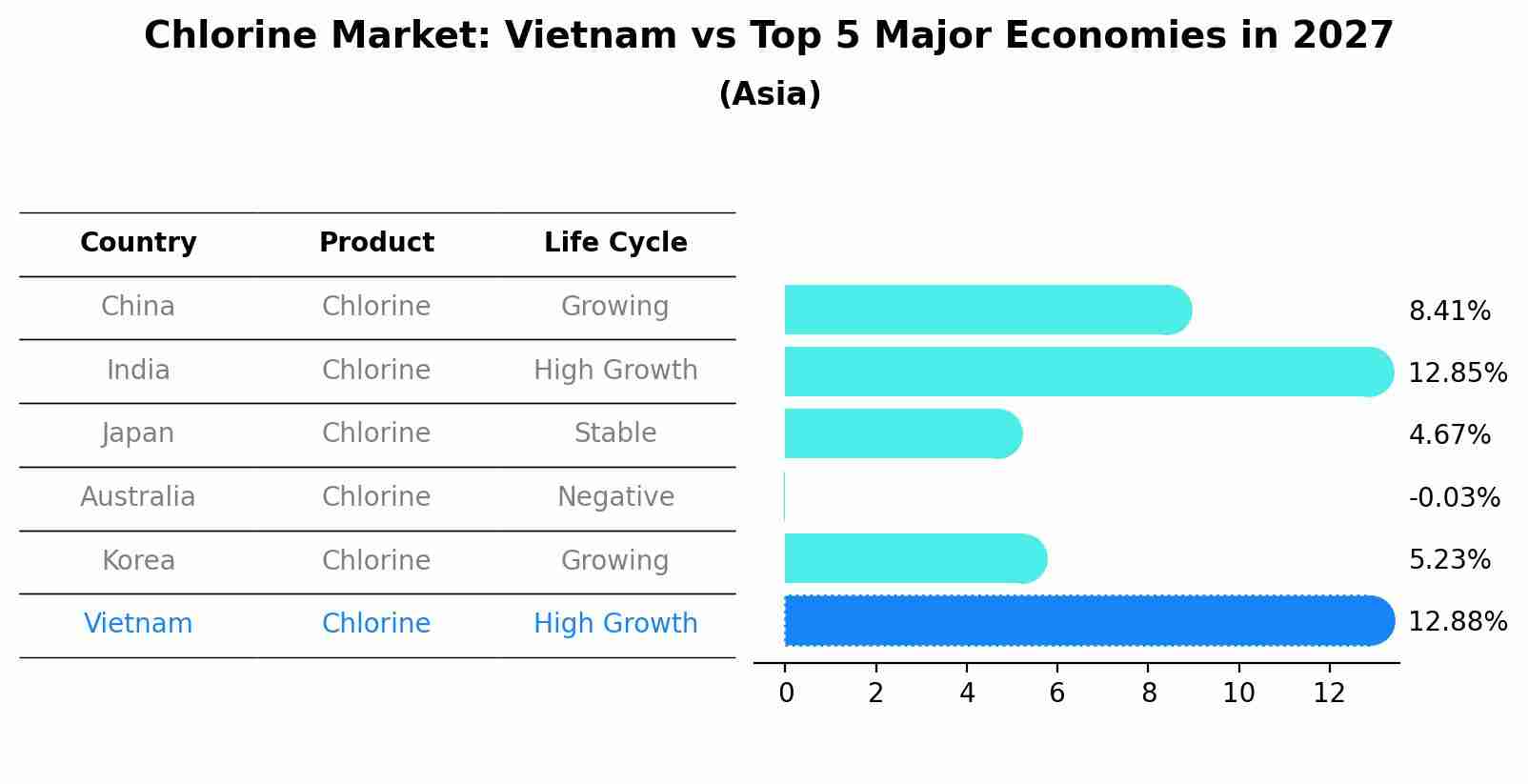
Chlorine Market: Vietnam vs Top 5 Major Economies in 2027 (Asia)
By 2027, Vietnam's Chlorine market is forecasted to achieve a high growth rate of 12.88%, with China leading the Asia region, followed by India, Japan, Australia and South Korea.
Vietnam Chlorine Market Overview
In the Vietnam Chlorine Market, the chemical industry plays a pivotal role in driving demand for chlorine, a versatile chemical widely used in water treatment, disinfection, and the production of various chemicals. The market is witnessing growth due to the expanding water treatment and sanitation infrastructure in the country. Moreover, the demand from the manufacturing sector for the production of plastics and chemicals further contributes to the market`s positive trajectory. Regulatory compliance and safety considerations are crucial aspects influencing market dynamics.
Drivers of the Market
The Vietnam Chlorine Market is buoyed by the water treatment and sanitation industry. Chlorine is widely used for disinfection and purification of water for consumption and industrial processes. As public health awareness and infrastructure development continue to improve, the demand for chlorine for water treatment purposes is on the rise.
Challenges of the Market
The Vietnam Chlorine market serves multiple sectors, including water treatment, chemical manufacturing, and plastics production. One of the primary challenges is ensuring the safe handling and transportation of chlorine gas, which can be hazardous. Effective safety protocols, transportation infrastructure, and regulatory compliance are crucial to address this challenge. Additionally, managing chlorine production to meet the demands of various industries while ensuring safety and environmental standards can be complex.
COVID 19 Impact on the Market
The Vietnam Chlorine market encountered challenges during the COVID-19 pandemic, with disruptions in key end-use sectors such as water treatment, chemicals, and textiles. The reduced demand from these industries affected the overall chlorine market. However, the market demonstrated resilience as sectors adapted to the evolving situation. The ongoing focus on water treatment and the recovery of manufacturing activities offer potential avenues for the chlorine market to regain momentum in the post-pandemic landscape.
Key Players in the Market
In the Vietnam Chlorine market, major players like Occidental Petroleum Corporation, Hanwha Chemical Corporation, and Tata Chemicals are instrumental in meeting the demand for chlorine and its derivatives. Their focus on technological innovation and sustainable practices sets the tone for the market`s future development.
Key Highlights of the Report:
- Vietnam Chlorine Market Outlook
- Market Size of Vietnam Chlorine Market, 2024
- Forecast of Vietnam Chlorine Market, 2031
- Historical Data and Forecast of Vietnam Chlorine Revenues & Volume for the Period 2021-2031
- Vietnam Chlorine Market Trend Evolution
- Vietnam Chlorine Market Drivers and Challenges
- Vietnam Chlorine Price Trends
- Vietnam Chlorine Porter's Five Forces
- Vietnam Chlorine Industry Life Cycle
- Historical Data and Forecast of Vietnam Chlorine Market Revenues & Volume By Application for the Period 2021-2031
- Historical Data and Forecast of Vietnam Chlorine Market Revenues & Volume By EDC/PVC for the Period 2021-2031
- Historical Data and Forecast of Vietnam Chlorine Market Revenues & Volume By Isocyanates and Oxygenates for the Period 2021-2031
- Historical Data and Forecast of Vietnam Chlorine Market Revenues & Volume By Chloromethanes for the Period 2021-2031
- Historical Data and Forecast of Vietnam Chlorine Market Revenues & Volume By Solvents and Epichlorohydrin for the Period 2021-2031
- Historical Data and Forecast of Vietnam Chlorine Market Revenues & Volume By Inorganic Chemicals for the Period 2021-2031
- Historical Data and Forecast of Vietnam Chlorine Market Revenues & Volume By Other Applications for the Period 2021-2031
- Historical Data and Forecast of Vietnam Chlorine Market Revenues & Volume By End-user Industry for the Period 2021-2031
- Historical Data and Forecast of Vietnam Chlorine Market Revenues & Volume By Water Treatment for the Period 2021-2031
- Historical Data and Forecast of Vietnam Chlorine Market Revenues & Volume By Pharmaceutical for the Period 2021-2031
- Historical Data and Forecast of Vietnam Chlorine Market Revenues & Volume By Chemicals for the Period 2021-2031
- Historical Data and Forecast of Vietnam Chlorine Market Revenues & Volume By Paper and Pulp for the Period 2021-2031
- Historical Data and Forecast of Vietnam Chlorine Market Revenues & Volume By Plastic for the Period 2021-2031
- Historical Data and Forecast of Vietnam Chlorine Market Revenues & Volume By Pesticides for the Period 2021-2031
- Historical Data and Forecast of Vietnam Chlorine Market Revenues & Volume By Other End-user Industries for the Period 2021-2031
- Vietnam Chlorine Import Export Trade Statistics
- Market Opportunity Assessment By Application
- Market Opportunity Assessment By End-user Industry
- Vietnam Chlorine Top Companies Market Share
- Vietnam Chlorine Competitive Benchmarking By Technical and Operational Parameters
- Vietnam Chlorine Company Profiles
- Vietnam Chlorine Key Strategic Recommendations






































