Vietnam Edible Beans Market Size, Share & Growth Rate
The Vietnam Edible Beans Market was estimated at USD 334 Million in 2025 and is projected to reach USD 471 Million by 2032, growing at a CAGR of 5.0% from 2026 to 2032. This growth trajectory is driven by the increasing consumer demand for healthier dietary options, as more Vietnamese are incorporating plant-based proteins into their diets. Additionally, the rise in local and international export opportunities is enhancing market dynamics, further solidifying the position of edible beans in the country's agricultural framework.
Vietnam Edible Beans Market Year-wise Growth Rate and Key Drivers
This graph highlights how the Vietnam Edible Beans Market has steadily grown over the years, supported by major growth factors.
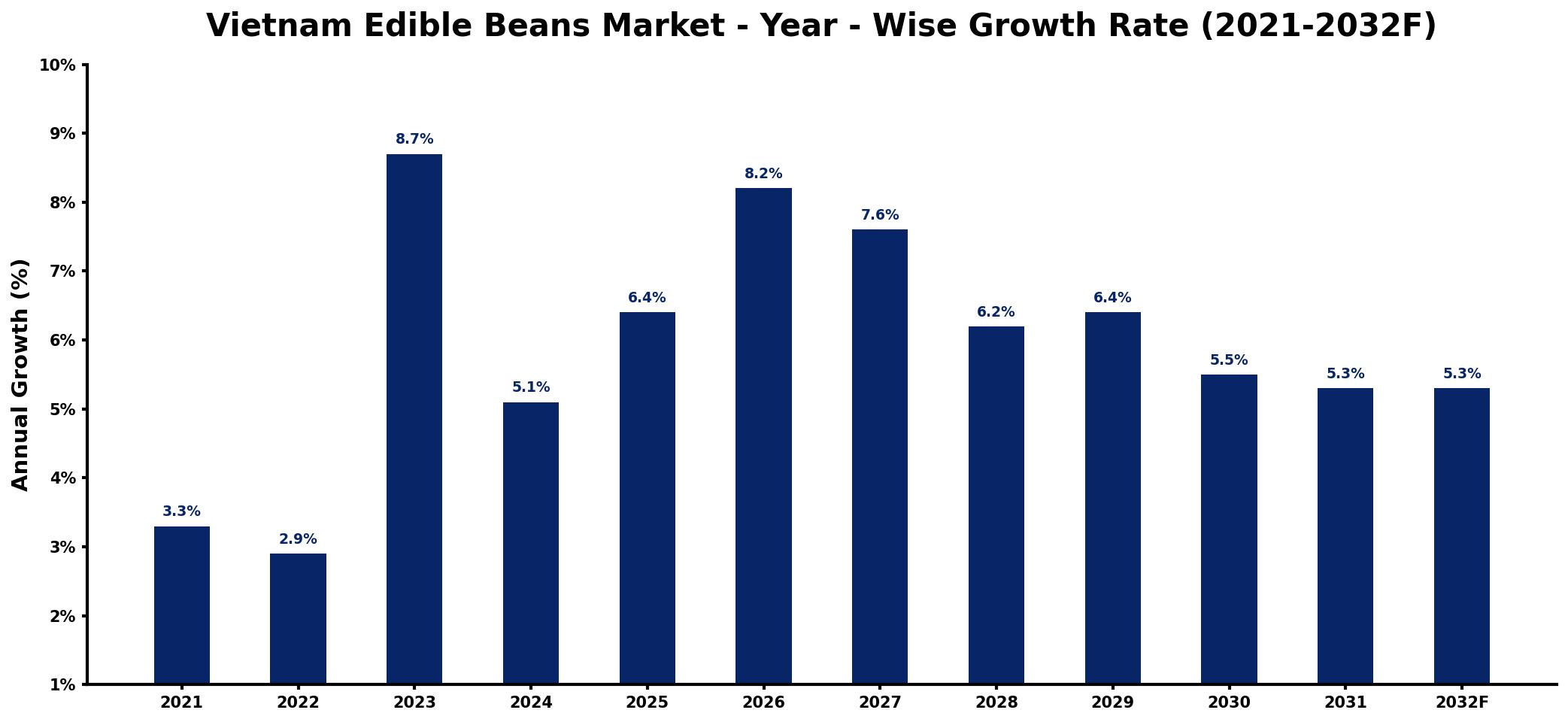
The table below presents the year‑wise growth rates along with the key drivers influencing the market
| Year | Growth Rate | Major Drivers |
| 2021 | 3.3% | Rising health consciousness among consumers |
| 2022 | 2.9% | Increased plant-based diet adoption |
| 2023 | 8.7% | Expansion of food processing facilities |
| 2024 | 5.1% | Growing demand for protein alternatives |
| 2025 | 6.4% | Investment in agricultural technologies |
| 2026 | 8.2% | Emergence of new culinary trends |
| 2027 | 7.6% | Strengthening supply chain efficiencies |
| 2028 | 6.2% | Boost in local farming initiatives |
| 2029 | 6.4% | Enhanced distribution networks established |
| 2030 | 5.5% | Growing export opportunities identified |
| 2031 | 5.3% | Increased consumer awareness campaigns |
| 2032 | 5.3% | Sustainable farming practices promoted |
Note: Market size estimations and growth projections presented in this report are based on 6Wresearch's proprietary forecasting methodology, utilizing the latest available industry data, government publications, and primary research inputs.
Vietnam Edible Beans Market Synopsis
Currently, the Vietnam edible beans market is thriving, buoyed by both domestic consumption and export potential. Key varieties like soybeans, mung beans, and kidney beans are staples in Vietnamese cuisine, reflecting the integral role they play in daily dietary practices.
Moreover, an emerging trend of health consciousness among consumers is reshaping market dynamics. With edible beans being rich in protein and essential nutrients, they have become a sought-after ingredient across various culinary applications, driving both production and innovation in the sector.
Vietnam Edible Beans Market Key Takeaways
- Increased demand for plant-based protein sources is propelling the market forward.
- Domestic production and strategic imports are vital to ensure adequate supply.
- Health benefits associated with edible beans are influencing consumer preferences.
- Export opportunities are expanding as Vietnamese edible beans gain traction internationally.
- Market volatility remains a challenge, impacted by external factors like weather and trade policies.
Evaluation of Restraints in Vietnam Edible Beans Market
Despite its growth potential, the Vietnam edible beans market faces several restraints. The agricultural sector is inherently susceptible to weather fluctuations and crop diseases, which can significantly disrupt production levels. Furthermore, trade policies and tariffs can create market uncertainties, impacting price stability and availability. These factors necessitate that stakeholders develop robust resilience strategies to navigate the complexities of the market effectively.
Vietnam Edible Beans Market Trends
Emerging trends in the Vietnam edible beans market indicate a shift towards organic and sustainable farming practices. Consumers are increasingly attracted to products that boast health benefits and environmentally friendly cultivation methods. Additionally, technological advancements in farming techniques and processing are set to enhance productivity and efficiency, further influencing market growth. The rise of plant-based diets is also pushing food manufacturers to innovate, creating new edible bean products tailored to evolving consumer preferences.
Vietnam Edible Beans Market Opportunities
The Vietnam edible beans market presents considerable growth and investment opportunities, particularly in expanding export channels. As international demand for Vietnamese beans rises, producers can leverage this by enhancing quality and diversifying their product offerings. Moreover, capitalizing on health trends through the development of fortified and ready-to-eat bean products could attract new consumer segments. There is also an opportunity for government collaborations to boost research and development initiatives that focus on pest-resistant and high-yield bean varieties.
Government Initiatives in the Vietnam Edible Beans Market
The Vietnamese government has recognized the importance of the agricultural sector, including edible beans, and has implemented various policies to support it. These initiatives focus on improving agricultural infrastructure, increasing access to modern farming techniques, and offering subsidies for sustainable farming practices. Additionally, public spending on research and development aims to enhance crop resilience and overall productivity, fostering a more robust market environment for edible beans.
Future Insights of the Vietnam Edible Beans Market
Looking ahead to the period from 2026 to 2032, the Vietnam edible beans market is positioned for sustained growth. The convergence of health trends and increased international demand will likely drive innovation and diversification within the sector. Producers who adapt to the evolving preferences of health-conscious consumers and invest in sustainable practices will be well-placed to capitalize on the expanding opportunities. Moreover, as domestic supply chains stabilize and adapt to external pressures, the market is expected to witness enhanced profitability and resilience.
Vietnam Edible Beans Market Latest Developments (2025 - 2026)
Recent developments in the Vietnam edible beans market have shown a notable shift towards more sustainable farming practices and technology integration. There has been an increase in local initiatives promoting the cultivation of indigenous bean varieties, aimed at enhancing biodiversity and local economy. Additionally, partnerships between producers and research institutions are emerging to explore innovative processing methods that extend the shelf life and nutritional value of beans, reflecting a proactive adaptation to both domestic and international market demands.
Vietnam Edible Beans Market - Key Attractiveness of the Report
- 10 Years of Market Numbers
- Historical Data Starting from 2022 to 2025
- Base Year: 2025
- Forecast Data until 2032
- Key Performance Indicators Impacting the Market
- Major Upcoming Developments and Projects
Key Highlights of the Report:
- Vietnam Edible Beans Market Outlook
- Market Size of Vietnam Edible Beans Market, 2025
- Forecast of Vietnam Edible Beans Market, 2032
- Historical Data and Forecast of Vietnam Edible Beans Revenues & Volume for the Period 2022-2032F
- Vietnam Edible Beans Market Trend Evolution
- Vietnam Edible Beans Market Drivers and Challenges
- Vietnam Edible Beans Price Trends
- Vietnam Edible Beans Porter's Five Forces
- Vietnam Edible Beans Industry Life Cycle
- Historical Data and Forecast of Vietnam Edible Beans Market Revenues & Volume By Product Type for the Period 2022-2032F
- Historical Data and Forecast of Vietnam Edible Beans Market Revenues & Volume By Pinto Beans for the Period 2022-2032F
- Historical Data and Forecast of Vietnam Edible Beans Market Revenues & Volume By Navy Beans for the Period 2022-2032F
- Historical Data and Forecast of Vietnam Edible Beans Market Revenues & Volume By Great Northern Beans for the Period 2022-2032F
- Historical Data and Forecast of Vietnam Edible Beans Market Revenues & Volume By Red Kidney Beans for the Period 2022-2032F
- Historical Data and Forecast of Vietnam Edible Beans Market Revenues & Volume By Black Beans for the Period 2022-2032F
- Historical Data and Forecast of Vietnam Edible Beans Market Revenues & Volume By Yellow Beans for the Period 2022-2032F
- Historical Data and Forecast of Vietnam Edible Beans Market Revenues & Volume By Others for the Period 2022-2032F
- Historical Data and Forecast of Vietnam Edible Beans Market Revenues & Volume By Distribution Channel for the Period 2022-2032F
- Historical Data and Forecast of Vietnam Edible Beans Market Revenues & Volume By Supermarket/Hypermarket for the Period 2022-2032F
- Historical Data and Forecast of Vietnam Edible Beans Market Revenues & Volume By Online Stores for the Period 2022-2032F
- Historical Data and Forecast of Vietnam Edible Beans Market Revenues & Volume By Specialty Stores for the Period 2022-2032F
- Historical Data and Forecast of Vietnam Edible Beans Market Revenues & Volume By Other for the Period 2022-2032F
- Historical Data and Forecast of Vietnam Edible Beans Market Revenues & Volume By Application for the Period 2022-2032F
- Historical Data and Forecast of Vietnam Edible Beans Market Revenues & Volume By Household for the Period 2022-2032F
- Historical Data and Forecast of Vietnam Edible Beans Market Revenues & Volume By Restaurants for the Period 2022-2032F
- Historical Data and Forecast of Vietnam Edible Beans Market Revenues & Volume By Others for the Period 2022-2032F
- Vietnam Edible Beans Import Export Trade Statistics
- Market Opportunity Assessment By Product Type
- Market Opportunity Assessment By Distribution Channel
- Market Opportunity Assessment By Application
- Vietnam Edible Beans Top Companies Market Share
- Vietnam Edible Beans Competitive Benchmarking By Technical and Operational Parameters
- Vietnam Edible Beans Company Profiles
- Vietnam Edible Beans Key Strategic Recommendations






































