Vietnam Flexible Intermediate Bulk Container Market Size Growth Rate
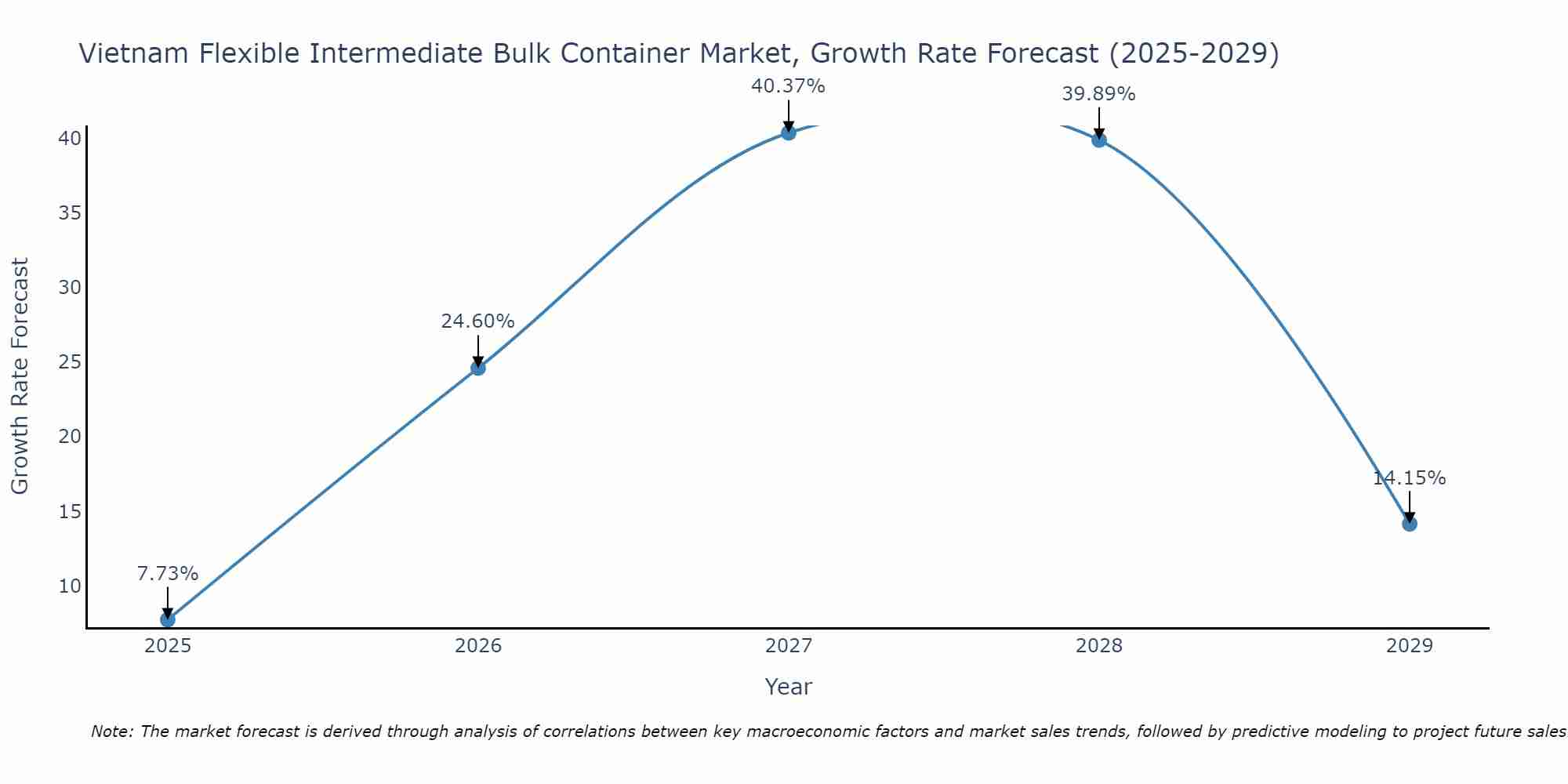
The Vietnam Flexible Intermediate Bulk Container Market is projected to witness mixed growth rate patterns during 2025 to 2029. Starting at 7.73% in 2025, the market peaks at 40.37% in 2027, and settles at 14.15% by 2029.
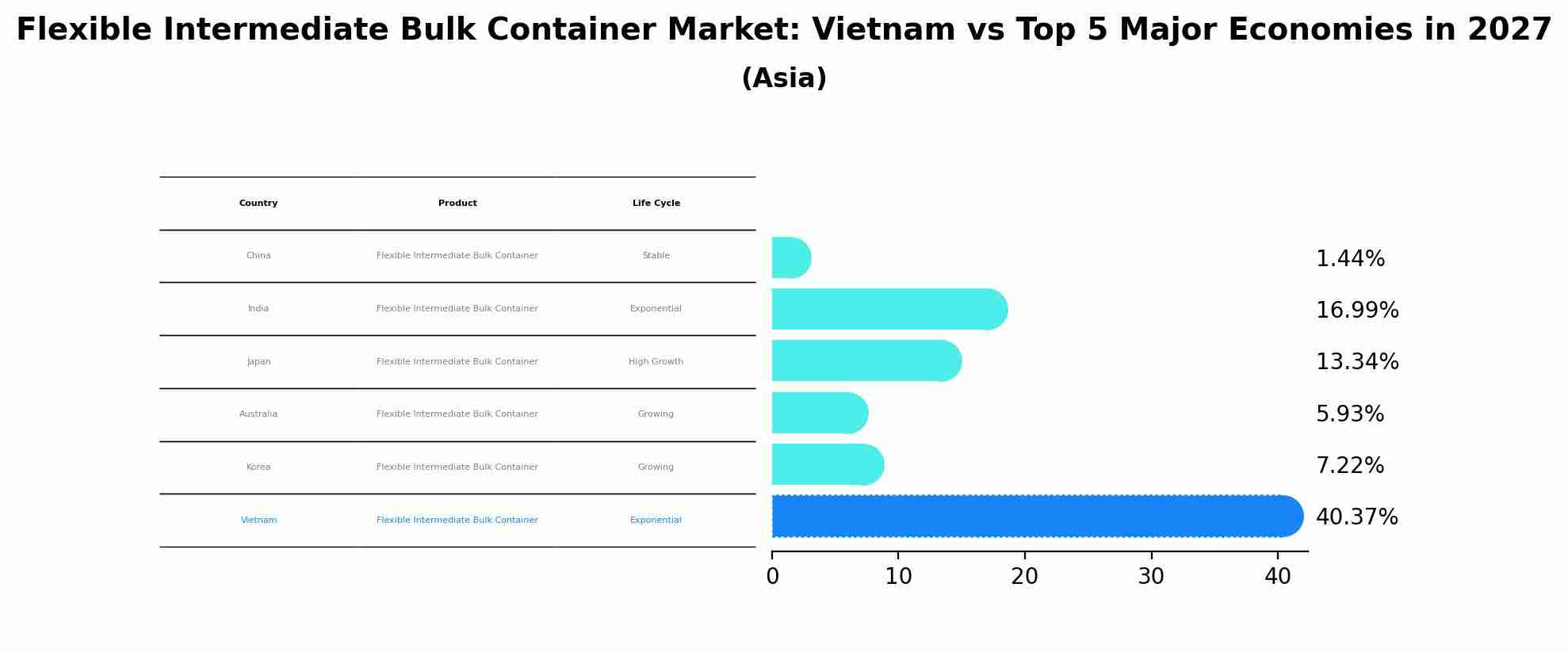
Flexible Intermediate Bulk Container Market: Vietnam vs Top 5 Major Economies in 2027 (Asia)
The Flexible Intermediate Bulk Container market in Vietnam is projected to grow at a exponential growth rate of 40.37% by 2027, highlighting the country's increasing focus on advanced technologies within the Asia region, where China holds the dominant position, followed closely by India, Japan, Australia and South Korea, shaping overall regional demand.
Vietnam Flexible Intermediate Bulk Container Market Synopsis
The Vietnam flexible intermediate bulk container (FIBC) market is experiencing notable growth due to the country`s expanding industries and international trade activities. FIBCs, also known as bulk bags or jumbo bags, are essential for the storage and transportation of various bulk materials such as chemicals, grains, and construction materials. The market is driven by the manufacturing and construction sectors, which require efficient and cost-effective packaging solutions. Additionally, the rise of e-commerce and the export of agricultural products have further propelled the demand for FIBCs. Domestic production and imports both play a role in meeting the market`s needs.
Drivers of the Market
The flexible intermediate bulk container (FIBC) market in Vietnam is driven by the country`s expanding manufacturing and export sectors. FIBCs are essential for the transportation of bulk goods, such as grains, chemicals, and construction materials. The ease of handling, cost-effectiveness, and reusability of FIBCs have made them a preferred choice for various industries, propelling market growth.
Challenges of the Market
The Vietnam flexible intermediate bulk container market confronts challenges related to bulk transportation and material handling. FIBCs are used for transporting and storing bulk materials, and they need to meet stringent safety and quality standards. Additionally, efficiently managing the logistics and storage of FIBCs can be a logistical challenge.
COVID-19 Impact on the Market
The flexible intermediate bulk container (FIBC) market in Vietnam experienced disruptions during the pandemic. Supply chain challenges and reduced demand from industries like agriculture and chemicals impacted production. With lockdowns and restrictions affecting trade, the FIBC market faced a decline in sales. However, as economic activities gradually resumed and international trade improved, the market showed signs of recovery, particularly in sectors reliant on bulk packaging solutions.
Key Players in the Market
In the Vietnam flexible intermediate bulk container market, manufacturers like Hai Phong Bag JSC are prominent, producing FIBC bags for the transportation and storage of bulk materials. These companies adhere to international standards for safety and quality in their FIBC production.
Key Highlights of the Report:
- Vietnam Flexible Intermediate Bulk Container Market Outlook
- Market Size of Vietnam Flexible Intermediate Bulk Container Market, 2024
- Forecast of Vietnam Flexible Intermediate Bulk Container Market, 2031
- Historical Data and Forecast of Vietnam Flexible Intermediate Bulk Container Revenues & Volume for the Period 2021-2031
- Vietnam Flexible Intermediate Bulk Container Market Trend Evolution
- Vietnam Flexible Intermediate Bulk Container Market Drivers and Challenges
- Vietnam Flexible Intermediate Bulk Container Price Trends
- Vietnam Flexible Intermediate Bulk Container Porter's Five Forces
- Vietnam Flexible Intermediate Bulk Container Industry Life Cycle
- Historical Data and Forecast of Vietnam Flexible Intermediate Bulk Container Market Revenues & Volume By Product for the Period 2021-2031
- Historical Data and Forecast of Vietnam Flexible Intermediate Bulk Container Market Revenues & Volume By Type A for the Period 2021-2031
- Historical Data and Forecast of Vietnam Flexible Intermediate Bulk Container Market Revenues & Volume By Type B for the Period 2021-2031
- Historical Data and Forecast of Vietnam Flexible Intermediate Bulk Container Market Revenues & Volume By Type C for the Period 2021-2031
- Historical Data and Forecast of Vietnam Flexible Intermediate Bulk Container Market Revenues & Volume By Type D for the Period 2021-2031
- Historical Data and Forecast of Vietnam Flexible Intermediate Bulk Container Market Revenues & Volume By End-Use for the Period 2021-2031
- Historical Data and Forecast of Vietnam Flexible Intermediate Bulk Container Market Revenues & Volume By Food for the Period 2021-2031
- Historical Data and Forecast of Vietnam Flexible Intermediate Bulk Container Market Revenues & Volume By Chemical for the Period 2021-2031
- Historical Data and Forecast of Vietnam Flexible Intermediate Bulk Container Market Revenues & Volume By Pharmaceuticals for the Period 2021-2031
- Historical Data and Forecast of Vietnam Flexible Intermediate Bulk Container Market Revenues & Volume By Others for the Period 2021-2031
- Vietnam Flexible Intermediate Bulk Container Import Export Trade Statistics
- Market Opportunity Assessment By Product
- Market Opportunity Assessment By End-Use
- Vietnam Flexible Intermediate Bulk Container Top Companies Market Share
- Vietnam Flexible Intermediate Bulk Container Competitive Benchmarking By Technical and Operational Parameters
- Vietnam Flexible Intermediate Bulk Container Company Profiles
- Vietnam Flexible Intermediate Bulk Container Key Strategic Recommendations






































