Vietnam Food & Grocery Retail Market Size, Share & Growth Rate
The Vietnam Food & Grocery Retail Market was estimated at USD 675 Million in 2025 and is projected to reach USD 1099 Million by 2032, growing at a CAGR of 7.2% from 2026 to 2032. This remarkable growth is largely driven by the increasing urbanization, changing consumer preferences towards convenience, and the rising proliferation of modern retail formats. As Vietnamese consumers continue to favor one-stop shopping experiences, the market is set to expand significantly over the coming years.
Vietnam Food & Grocery Retail Market Year-wise Growth Rate and Key Drivers
This graph highlights how the Vietnam Food & Grocery Retail Market has steadily grown over the years, supported by major growth factors.
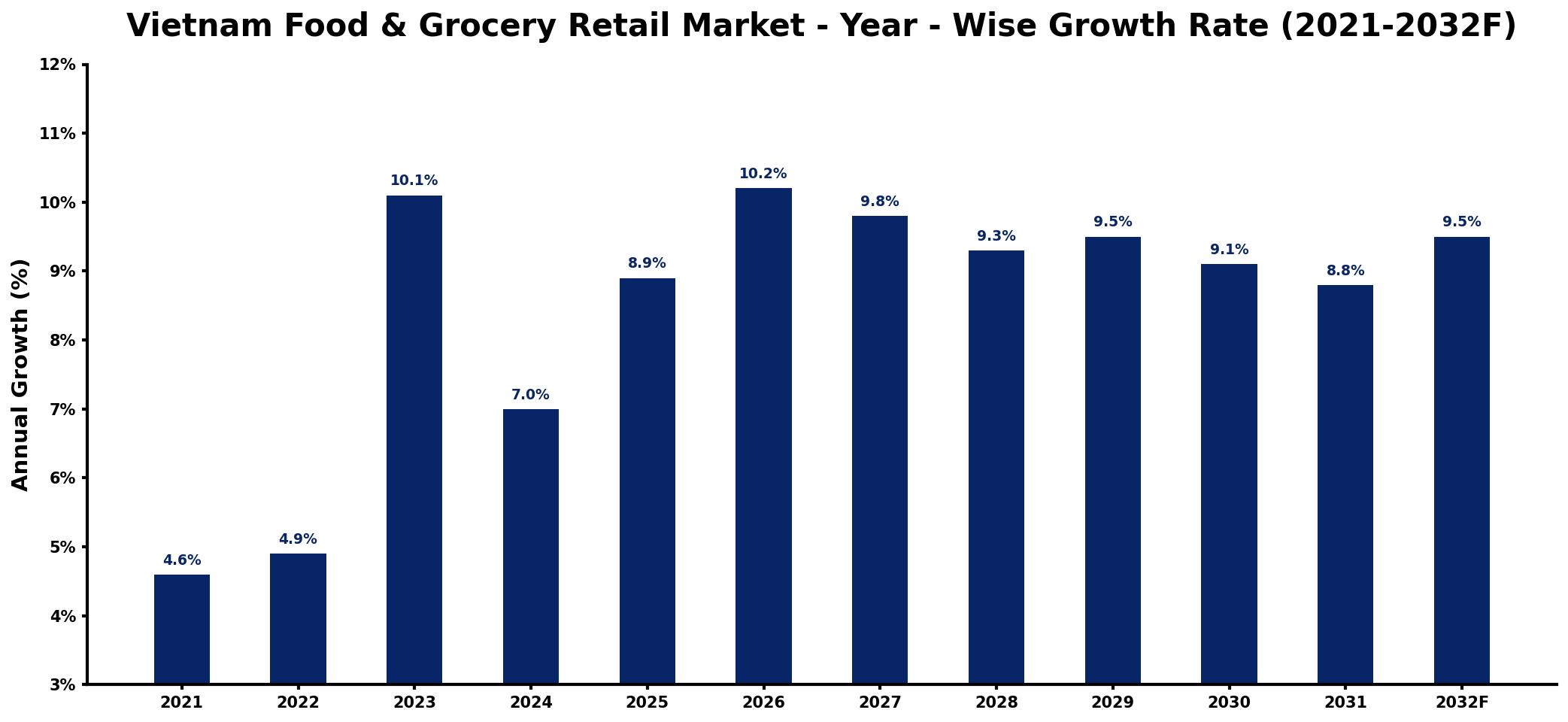
The table below presents the year‑wise growth rates along with the key drivers influencing the market
| Year | Growth Rate | Major Drivers |
| 2021 | 4.6% | Rising urban population demands convenience |
| 2022 | 4.9% | Increased disposable income encourages spending |
| 2023 | 10.1% | E-commerce platforms gaining popularity rapidly |
| 2024 | 7.0% | Health conscious consumers drive demand |
| 2025 | 8.9% | improved processing technologies adoption |
| 2026 | 10.2% | Foreign investments fueling market expansion |
| 2027 | 9.8% | increased production capacity utilization |
| 2028 | 9.3% | strengthening international trade flows |
| 2029 | 9.5% | improved raw material availability |
| 2030 | 9.1% | increased capital investment inflows |
| 2031 | 8.8% | Strategic partnerships expanding distribution channels |
| 2032 | 9.5% | Growing interest in premium offerings |
Note: Market size estimations and growth projections presented in this report are based on 6Wresearch's proprietary forecasting methodology, utilizing the latest available industry data, government publications, and primary research inputs.
Vietnam Food & Grocery Retail Market Synopsis
The landscape of the Vietnam Food & Grocery Retail Market is evolving rapidly, characterized by a blend of traditional and modern retail avenues. Consumers are increasingly gravitating towards supermarkets and online platforms for their grocery needs, driven by the demand for convenience and variety.
With the nation's growing middle class and urban population, the market is seeing a notable shift in shopping behaviors. Retailers are rising to this challenge by expanding their offerings and enhancing service models to align with consumer expectations for quality and affordability.
- The market is projected to grow from USD 675 Million in 2025 to USD 1099 Million by 2032.
- Urbanization and modern retail formats significantly drive changes in consumer shopping habits.
- There is a notable trend towards online shopping, especially post-COVID-19.
- Domestic and international retail chains are enhancing competition through varied product offerings.
- Consumer education around modern grocery options is critical for market expansion.
Despite its promising growth trajectory, the Vietnam Food & Grocery Retail Market faces notable restraints that could temper its expansion. A lack of infrastructure for the proper storage of perishable goods, particularly frozen items, can hinder the supply chain's efficiency. Moreover, consumer awareness and education regarding modern grocery options remain a challenge, as many continue to rely on traditional markets. Addressing these issues is critical for unlocking the full potential of the market.
The Vietnam Food & Grocery Retail Market is currently shaped by several key trends. The growth of e-commerce has accelerated, with online grocery shopping becoming a standard choice for many consumers. Retailers are increasingly adopting technology to streamline operations and enhance customer experiences, such as using mobile apps for seamless shopping. Additionally, a growing focus on health and sustainability is influencing product offerings, with more consumers seeking organic and locally sourced items.
Opportunities in the Vietnam Food & Grocery Retail Market are abundant. The increasing trend of urbanization offers retailers the chance to penetrate more densely populated areas with modern retail formats. Furthermore, as more consumers turn to online shopping, investments in digital infrastructure and logistics will be essential for retailers seeking to capture this growing segment. Additionally, focusing on niche markets, such as health-conscious products, presents lucrative avenues for growth.
The Vietnamese government is actively promoting the growth of the food and grocery retail sector through various initiatives aimed at improving infrastructure and regulatory frameworks. Investments in transportation and logistics enhance supply chain efficiency, while policies supporting small and medium enterprises (SMEs) in retail encourage innovation and competition. These government efforts are crucial in fostering an environment conducive to sustainable growth in the retail landscape.
Looking ahead to 2026-2032, the Vietnam Food & Grocery Retail Market is expected to undergo transformative changes. The shift towards e-commerce will continue to gather momentum, reshaping how consumers interact with retailers. Furthermore, as urban centers expand, the demand for modern grocery formats will rise, pushing retailers to adapt to rapidly changing consumer preferences. Overall, the market's future is characterized by a blend of technological advancements and evolving consumer behaviors, which will significantly impact growth.
In recent months, the Vietnam Food & Grocery Retail Market has seen a surge in initiatives focused on enhancing the online shopping experience. Retailers are investing in technology to improve logistics and delivery systems, ensuring that consumers receive their groceries in a timely and efficient manner. Moreover, promotional campaigns targeting health and wellness products are gaining traction, reflecting changing consumer priorities post-pandemic. These developments signal an ongoing evolution in the market's dynamics.
- 10 Years of Market Numbers
- Historical Data Starting from 2022 to 2025
- Base Year: 2025
- Forecast Data until 2032
- Key Performance Indicators Impacting the Market
- Major Upcoming Developments and Projects
Key Highlights of the Report:
- Vietnam Food & Grocery Retail Market Outlook
- Market Size of Vietnam Food & Grocery Retail Market, 2025
- Forecast of Vietnam Food & Grocery Retail Market, 2032
- Historical Data and Forecast of Vietnam Food & Grocery Retail Revenues & Volume for the Period 2022-2032F
- Vietnam Food & Grocery Retail Market Trend Evolution
- Vietnam Food & Grocery Retail Market Drivers and Challenges
- Vietnam Food & Grocery Retail Price Trends
- Vietnam Food & Grocery Retail Porter's Five Forces
- Vietnam Food & Grocery Retail Industry Life Cycle
- Historical Data and Forecast of Vietnam Food & Grocery Retail Market Revenues & Volume By Product for the Period 2022-2032F
- Historical Data and Forecast of Vietnam Food & Grocery Retail Market Revenues & Volume By Fresh Food for the Period 2022-2032F
- Historical Data and Forecast of Vietnam Food & Grocery Retail Market Revenues & Volume By Frozen Food for the Period 2022-2032F
- Historical Data and Forecast of Vietnam Food & Grocery Retail Market Revenues & Volume By Food Cupboard for the Period 2022-2032F
- Historical Data and Forecast of Vietnam Food & Grocery Retail Market Revenues & Volume By Beverages for the Period 2022-2032F
- Historical Data and Forecast of Vietnam Food & Grocery Retail Market Revenues & Volume By Cleaning & Household for the Period 2022-2032F
- Historical Data and Forecast of Vietnam Food & Grocery Retail Market Revenues & Volume By Others for the Period 2022-2032F
- Historical Data and Forecast of Vietnam Food & Grocery Retail Market Revenues & Volume By Distribution Channel for the Period 2022-2032F
- Historical Data and Forecast of Vietnam Food & Grocery Retail Market Revenues & Volume By Supermarkets & Hypermarkets for the Period 2022-2032F
- Historical Data and Forecast of Vietnam Food & Grocery Retail Market Revenues & Volume By Convenience Stores for the Period 2022-2032F
- Historical Data and Forecast of Vietnam Food & Grocery Retail Market Revenues & Volume By Departmental Stores & Clubs for the Period 2022-2032F
- Historical Data and Forecast of Vietnam Food & Grocery Retail Market Revenues & Volume By Online for the Period 2022-2032F
- Vietnam Food & Grocery Retail Import Export Trade Statistics
- Market Opportunity Assessment By Product
- Market Opportunity Assessment By Distribution Channel
- Vietnam Food & Grocery Retail Top Companies Market Share
- Vietnam Food & Grocery Retail Competitive Benchmarking By Technical and Operational Parameters
- Vietnam Food & Grocery Retail Company Profiles
- Vietnam Food & Grocery Retail Key Strategic Recommendations






































