Vietnam Millets Market Size, Share & Growth Rate
The Vietnam Millets Market was estimated at USD 283 Million in 2025 and is projected to reach USD 400 Million by 2032, growing at a CAGR of 5.1% from 2026 to 2032. This growth trajectory is underpinned by increasing consumer awareness of millets as a healthy grain alternative, their benefits as a gluten-free option, and the ongoing trend towards plant-based diets. Additionally, government initiatives promoting sustainable agricultural practices further enhance the market's potential.
Vietnam Millets Market Growth Rate Analysis (2021-2032)
The Vietnam millets market has exhibited notable growth, escalating from a modest 3.0% in 2021 to an impressive 8.7% in 2023, driven largely by increased consumer awareness around health and nutrition. The rise in urbanization and a shift towards plant-based diets have fueled demand, leading to enhanced agricultural investments and technological advancements in millet farming. Post-2023, growth is expected to stabilize, with projected rates of 5.5% in 2024 and 6.9% in 2025, as infrastructure development and government policies supporting sustainable agriculture gain traction. While fluctuations are evident, particularly a dip to 5.4% by 2030, the overall trend remains upward, underscoring the millets market's resilience and potential in Vietnam's evolving food landscape.
Vietnam Millets Market Year-wise Growth Rate and Key Drivers
This graph highlights how the Vietnam Millets Market has steadily grown over the past five years, supported by major growth factors.
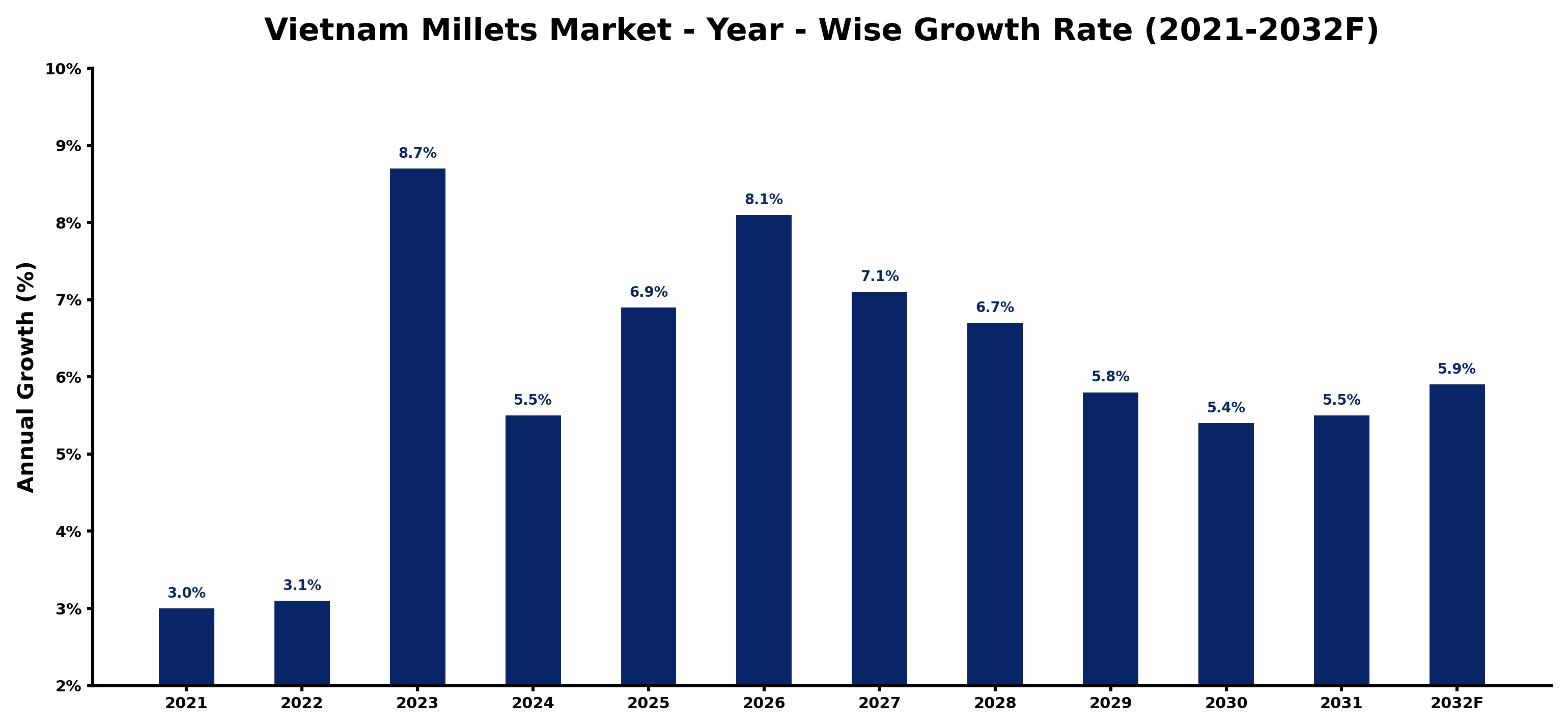
The table below presents the year‑wise growth rates along with the key drivers influencing the market
| Year | Growth Rate | Major Drivers |
| 2021 | 3.0% | Consumer awareness of nutrition |
| 2022 | 3.1% | Health trends influenced purchasing behavior |
| 2023 | 8.7% | Sustainable farming practices gained traction |
| 2024 | 5.5% | Increased demand for gluten-free options |
| 2025 | 6.9% | Local sourcing initiatives expanded market |
| 2026 | 8.1% | Innovative product offerings attracted consumers |
| 2027 | 7.1% | Export opportunities enhanced market growth |
| 2028 | 6.7% | Culinary diversity encouraged new recipes |
| 2029 | 5.8% | Nutritional benefits promoted by influencers |
| 2030 | 5.4% | E-commerce growth improved accessibility |
| 2031 | 5.5% | Partnerships with health organizations formed |
| 2032 | 5.9% | Cultural integration of millets increased |
Note - Market size estimations and growth projections presented in this report are based on 6Wresearch's advanced forecasting approach, validated with industry datasets as of June 2026.
Vietnam Millets Market Synopsis
In recent years, Vietnam has witnessed a noticeable shift in consumer preferences, with millets emerging as a popular choice for health-conscious individuals. The rising awareness of millets' nutritional benefits has catalyzed innovations, leading to their incorporation into various food products, including snacks and baked goods.
Moreover, the growing interest in gluten-free and vegan diets has bolstered millets' appeal, fostering a more diverse marketplace. As a result, stakeholders are increasingly invested in enhancing the visibility and availability of millet products, transforming this once-niche market into a burgeoning segment of the food industry.
Vietnam Millets Market Key Takeaways
- The Vietnam Millets Market is on an upward trajectory, with significant growth expected over the next decade.
- Health consciousness among consumers is a primary driver, leading to higher demand for nutritious alternatives.
- Government support in promoting millets as a sustainable crop is pivotal for the market's expansion.
- Challenges regarding consumer awareness and traditional grain preferences persist, but innovative products are gaining traction.
- The integration of millets into modern diets offers numerous opportunities for product development and market diversification.
Evaluation of Restraints in Vietnam Millets Market
Despite the promising growth, the Vietnam Millets Market faces notable constraints. A significant limitation is the prevailing consumer preference for rice and other staple grains, which overshadow the benefits of millets. Additionally, the lack of widespread knowledge about millets hampers their acceptance as a regular dietary component. Furthermore, scaling production to meet rising demand poses challenges in supply chain logistics, making it difficult for producers to distribute millets effectively across the market.
Vietnam Millets Market Trends
Emerging trends within the Vietnam Millets Market include a notable increase in product innovation, with various brands launching millet-based snacks, cereals, and bakery items. This trend aligns with the rising interest in healthy eating and organic products, catering to a more discerning consumer base. Additionally, the focus on sustainability in agriculture is prompting farmers to adopt millet cultivation, recognizing its climate-resilient properties and lower environmental impact.
Vietnam Millets Market Opportunities
Significant opportunities exist for growth and investment in the Vietnam Millets Market. The increasing consumer shift towards healthier food options presents a unique avenue for brands to develop innovative millet-based products. Collaborations with health-focused companies can further expand market reach. Additionally, education initiatives aimed at increasing consumer awareness can enhance the visibility of millets, promoting their acceptance as a dietary staple.
Government Initiatives in the Vietnam Millets Market
The Vietnamese government is actively supporting the millets market through various initiatives aimed at crop diversification and sustainable agricultural practices. These policies encourage farmers to cultivate millets and promote research and development in millet production. Public spending on agricultural programs is also directed towards increasing the resilience of millet crops, ensuring they become a viable alternative to traditional grains.
Future Insights of the Vietnam Millets Market
Looking ahead to the period from 2026 to 2032, the Vietnam Millets Market is poised for transformative growth. As health trends continue to influence consumer behavior, millets are expected to gain greater acceptance in the mainstream market. Innovations in product offerings and increasing governmental support are likely to create a robust environment for millet cultivation and consumption, positioning the market for sustained expansion.
Vietnam Millets Market Latest Developments (May 2025 - June 2026)
Recent developments in the Vietnam Millets Market indicate a focused shift towards health-oriented marketing strategies. Companies are launching campaigns highlighting the benefits of millets, resulting in a gradual increase in consumer engagement. Furthermore, collaborative projects with local farmers are being initiated to boost production and improve supply chain efficiency, responding effectively to the rising demand for millet products.
Vietnam Millets Market - Key Attractiveness of the Report
- 10 Years of Market Numbers
- Historical Data Starting from 2022 to 2025
- Base Year: 2025
- Forecast Data until 2032
- Key Performance Indicators Impacting the Market
- Major Upcoming Developments and Projects
Key Highlights of the Report:
- Vietnam Millets Market Outlook
- Market Size of Vietnam Millets Market, 2025
- Forecast of Vietnam Millets Market, 2032F
- Historical Data and Forecast of Vietnam Millets Revenues & Volume for the Period 2022-2032F
- Vietnam Millets Market Trend Evolution
- Vietnam Millets Market Drivers and Challenges
- Vietnam Millets Price Trends
- Vietnam Millets Porter's Five Forces
- Vietnam Millets Industry Life Cycle
- Historical Data and Forecast of Vietnam Millets Market Revenues & Volume By Type for the Period 2022-2032F
- Historical Data and Forecast of Vietnam Millets Market Revenues & Volume By Pearl Millet for the Period 2022-2032F
- Historical Data and Forecast of Vietnam Millets Market Revenues & Volume By Finger Millet for the Period 2022-2032F
- Historical Data and Forecast of Vietnam Millets Market Revenues & Volume By ProsoMillet for the Period 2022-2032F
- Historical Data and Forecast of Vietnam Millets Market Revenues & Volume By Others for the Period 2022-2032F
- Historical Data and Forecast of Vietnam Millets Market Revenues & Volume By Distribution Channel for the Period 2022-2032F
- Historical Data and Forecast of Vietnam Millets Market Revenues & Volume By Trade Association& Organization for the Period 2022-2032F
- Historical Data and Forecast of Vietnam Millets Market Revenues & Volume By Traditional Grocery Stores for the Period 2022-2032F
- Historical Data and Forecast of Vietnam Millets Market Revenues & Volume By Supermarket for the Period 2022-2032F
- Historical Data and Forecast of Vietnam Millets Market Revenues & Volume By Online Stores for the Period 2022-2032F
- Historical Data and Forecast of Vietnam Millets Market Revenues & Volume By Others for the Period 2022-2032F
- Historical Data and Forecast of Vietnam Millets Market Revenues & Volume By Application for the Period 2022-2032F
- Historical Data and Forecast of Vietnam Millets Market Revenues & Volume By Infant Food for the Period 2022-2032F
- Historical Data and Forecast of Vietnam Millets Market Revenues & Volume By Bakery Products for the Period 2022-2032F
- Historical Data and Forecast of Vietnam Millets Market Revenues & Volume By Beverages for the Period 2022-2032F
- Vietnam Millets Import Export Trade Statistics
- Market Opportunity Assessment By Type
- Market Opportunity Assessment By Distribution Channel
- Market Opportunity Assessment By Application
- Vietnam Millets Top Companies Market Share
- Vietnam Millets Competitive Benchmarking By Technical and Operational Parameters
- Vietnam Millets Company Profiles
- Vietnam Millets Key Strategic Recommendations






































