Vietnam Modular Kitchen Market Size, Share & Growth Rate
The Vietnam Modular Kitchen Market was estimated at USD 390 Million in 2025 and is projected to reach USD 550 Million by 2032, growing at a CAGR of 5.0% from 2026 to 2032. This growth trajectory is propelled by the rapid urbanization of Vietnam, where smaller living spaces have heightened the demand for space-efficient kitchen solutions. Additionally, the rising middle-class population, with their growing appetite for modern aesthetics and convenience, contributes significantly to the market expansion.
Vietnam Modular Kitchen Market Year-wise Growth Rate and Key Drivers
This graph highlights how the Vietnam Modular Kitchen Market has steadily grown over the years, supported by major growth factors.
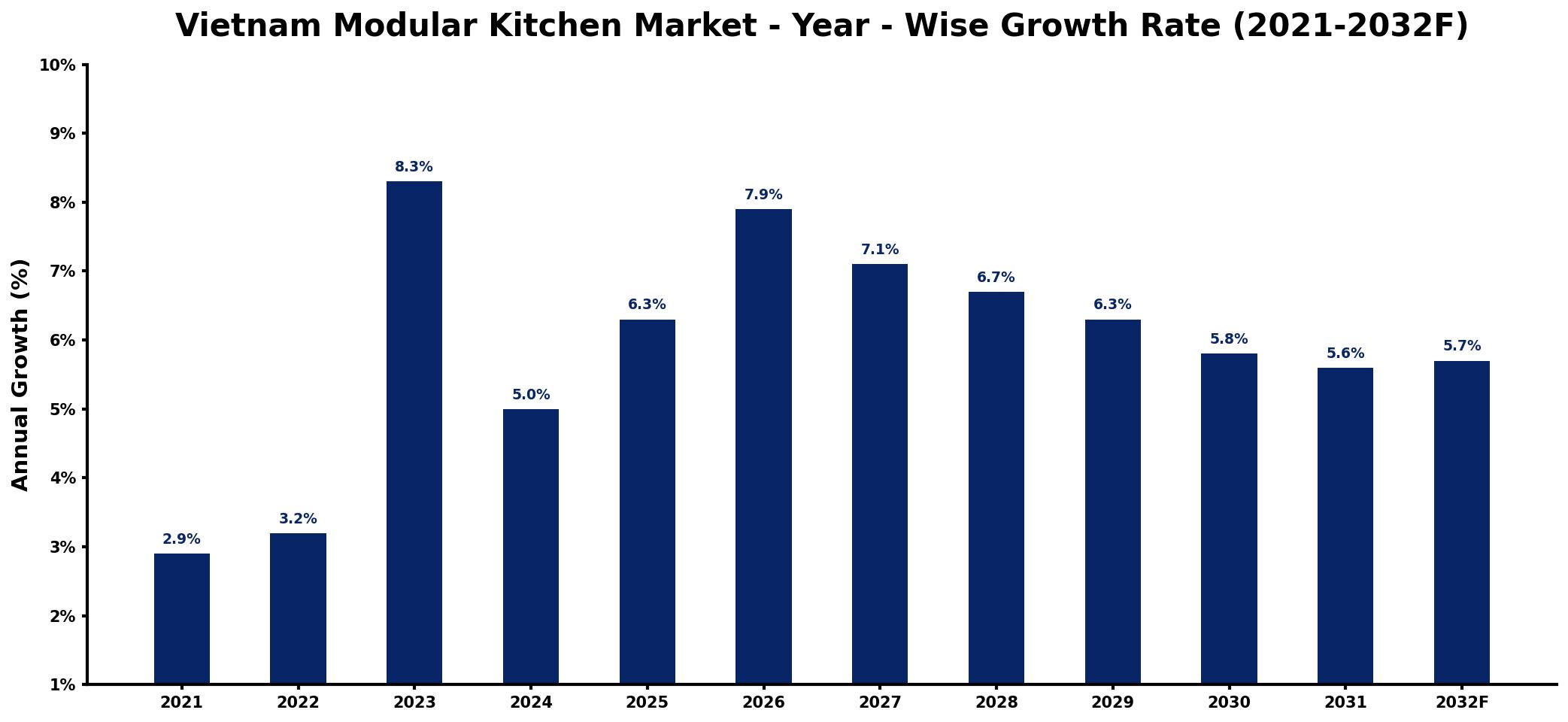
The table below presents the year‑wise growth rates along with the key drivers influencing the market
| Year | Growth Rate | Major Drivers |
| 2021 | 2.9% | Rising disposable income levels |
| 2022 | 3.2% | Growing urbanization trends continuing |
| 2023 | 8.3% | Increasing demand for customization |
| 2024 | 5.0% | Expansion of real estate projects |
| 2025 | 6.3% | Surge in renovation activities |
| 2026 | 7.9% | Growth in home improvement spending |
| 2027 | 7.1% | More focus on sustainable materials |
| 2028 | 6.7% | Technological advancements in design |
| 2029 | 6.3% | Higher consumer awareness initiatives |
| 2030 | 5.8% | Emergence of online retail channels |
| 2031 | 5.6% | Strengthening of local manufacturing bases |
| 2032 | 5.7% | Rising interest in multifunctional spaces |
Note: Market size estimations and growth projections presented in this report are based on 6Wresearch's proprietary forecasting methodology, utilizing the latest available industry data, government publications, and primary research inputs.
Vietnam Modular Kitchen Market Synopsis
The primary force shaping the Vietnam Modular Kitchen Market is urbanization, resulting in more compact living arrangements. This trend drives homeowners to seek customizable kitchen solutions that maximize space while reflecting personal style. As more Vietnamese consumers embrace modern lifestyles, the demand for modular kitchens that blend functionality with aesthetic appeal continues to rise.
In addition to urbanization, the influx of foreign brands has diversified product offerings, enhancing quality and innovation in kitchen design. This influx not only broadens consumer choices but also raises the competitive bar for local manufacturers. As a result, the market is evolving rapidly to meet the evolving tastes and preferences of contemporary Vietnamese households.
Vietnam Modular Kitchen Market Key Takeaways
- The market is experiencing significant growth driven by urbanization and a rising middle class.
- Customization options are increasingly in demand as consumers seek tailored kitchen solutions.
- Foreign brands are enhancing product quality and variety, appealing to modern consumers.
- Sustainability is becoming a priority, pushing manufacturers towards eco-friendly practices.
- Awareness initiatives are crucial for educating consumers about the advantages of modular kitchens.
Evaluation of Restraints in Vietnam Modular Kitchen Market
Despite the favorable conditions driving growth, several restraints challenge the Vietnam Modular Kitchen Market. One of the significant limitations lies in the need for extensive customization, which can complicate the balance between cost and consumer expectations. Additionally, the level of consumer awareness regarding modular kitchens' benefits is still developing. Raising this awareness is essential, as many potential customers remain unaware of how modular solutions can enhance efficiency and aesthetics. Furthermore, the competition from traditional kitchen designs continues to pose a challenge, as many consumers still prefer established layouts over newer, modular alternatives.
Vietnam Modular Kitchen Market Trends
Several key trends are shaping the Vietnam Modular Kitchen Market. Firstly, there is a noticeable shift toward open-concept kitchen designs, promoting a seamless blend between living and cooking spaces. This trend is complemented by the increasing popularity of multifunctional furniture that enhances space utilization. Additionally, eco-friendly materials are gaining traction, as consumers prioritize sustainability in their purchasing decisions. Finally, technological integration within kitchen designs, such as smart appliances and connectivity features, is becoming more prevalent, appealing to tech-savvy homeowners.
Vietnam Modular Kitchen Market Opportunities
The Vietnam Modular Kitchen Market presents various growth and investment opportunities. There is substantial potential in developing modular solutions tailored for small apartments and urban dwellings, where space is at a premium. Furthermore, local manufacturers can leverage rising trends in sustainability by incorporating eco-friendly materials and production techniques into their offerings. The growing interest in home renovation projects post-COVID-19 also presents an opportunity for market players to engage with a more home-focused consumer base. Lastly, educational marketing initiatives focusing on the long-term benefits of modular kitchens can help raise consumer awareness and drive sales.
Government Initiatives in the Vietnam Modular Kitchen Market
The Vietnamese government is increasingly supportive of the housing sector, which indirectly benefits the modular kitchen market. Policies aimed at urban development and infrastructure improvement encourage the construction of modern residential units where modular kitchens can thrive. Additionally, there are initiatives focused on promoting sustainable building practices, which align well with the growing demand for eco-friendly kitchen solutions. Such government support helps to create a favorable environment for modular kitchen manufacturers and consumers alike.
Future Insights of the Vietnam Modular Kitchen Market
Looking ahead to 2026-2032, the Vietnam Modular Kitchen Market is poised for dynamic growth. As urbanization continues, the focus on maximizing space efficiency will only intensify, driving further adoption of modular designs. Additionally, with the potential rise of e-commerce platforms for home furnishings, manufacturers have an opportunity to reach a broader audience. Continuous innovation, combined with heightened consumer awareness and preferences for sustainability, will shape the market landscape, ensuring that modular kitchens remain a key component of modern Vietnamese homes.
Vietnam Modular Kitchen Market Latest Developments (2025 - 2026)
Recent developments in the Vietnam Modular Kitchen Market indicate a growing trend toward collaboration between local manufacturers and international design firms. This partnership aims to fuse local craftsmanship with innovative global designs, enhancing the overall appeal of modular kitchens. Furthermore, there has been an uptick in consumer interest in online platforms for purchasing kitchen components, indicating a shift towards digital shopping experiences. As manufacturers respond to these trends, we anticipate a surge in product offerings that cater to diverse consumer preferences.
Vietnam Modular Kitchen Market - Key Attractiveness of the Report
- 10 Years of Market Numbers
- Historical Data Starting from 2022 to 2025
- Base Year: 2025
- Forecast Data until 2032
- Key Performance Indicators Impacting the Market
- Major Upcoming Developments and Projects
Key Highlights of the Report:
- Vietnam Modular Kitchen Market Outlook
- Market Size of Vietnam Modular Kitchen Market, 2025
- Forecast of Vietnam Modular Kitchen Market, 2032
- Historical Data and Forecast of Vietnam Modular Kitchen Revenues & Volume for the Period 2022-2032F
- Vietnam Modular Kitchen Market Trend Evolution
- Vietnam Modular Kitchen Market Drivers and Challenges
- Vietnam Modular Kitchen Price Trends
- Vietnam Modular Kitchen Porter's Five Forces
- Vietnam Modular Kitchen Industry Life Cycle
- Historical Data and Forecast of Vietnam Modular Kitchen Market Revenues & Volume By Product for the Period 2022-2032F
- Historical Data and Forecast of Vietnam Modular Kitchen Market Revenues & Volume By Floor Cabinet & Wall Cabinets for the Period 2022-2032F
- Historical Data and Forecast of Vietnam Modular Kitchen Market Revenues & Volume By Tall Storage Cabinets for the Period 2022-2032F
- Historical Data and Forecast of Vietnam Modular Kitchen Market Revenues & Volume By Others for the Period 2022-2032F
- Historical Data and Forecast of Vietnam Modular Kitchen Market Revenues & Volume By End-User for the Period 2022-2032F
- Historical Data and Forecast of Vietnam Modular Kitchen Market Revenues & Volume By Residential for the Period 2022-2032F
- Historical Data and Forecast of Vietnam Modular Kitchen Market Revenues & Volume By Commercial for the Period 2022-2032F
- Historical Data and Forecast of Vietnam Modular Kitchen Market Revenues & Volume By Distribution Channel for the Period 2022-2032F
- Historical Data and Forecast of Vietnam Modular Kitchen Market Revenues & Volume By Offline (Contractors, Builders, and Others) for the Period 2022-2032F
- Historical Data and Forecast of Vietnam Modular Kitchen Market Revenues & Volume By Online for the Period 2022-2032F
- Vietnam Modular Kitchen Import Export Trade Statistics
- Market Opportunity Assessment By Product
- Market Opportunity Assessment By End-User
- Market Opportunity Assessment By Distribution Channel
- Vietnam Modular Kitchen Top Companies Market Share
- Vietnam Modular Kitchen Competitive Benchmarking By Technical and Operational Parameters
- Vietnam Modular Kitchen Company Profiles
- Vietnam Modular Kitchen Key Strategic Recommendations






































