Vietnam Oil and Gas Hydraulic Equipment Market Size, Share & Growth Rate
The Vietnam Oil and Gas Hydraulic Equipment Market was estimated at USD 269 Million in 2025 and is projected to reach USD 378 Million by 2032, growing at a CAGR of 5.0% from 2026 to 2032. This growth trajectory is primarily driven by Vietnams strategic emphasis on enhancing domestic oil and gas production capabilities, particularly in offshore exploration and drilling activities. The increasing demand for advanced hydraulic systems that ensure operational efficiency is a direct response to the country's energy security objectives.
Vietnam Oil and Gas Hydraulic Equipment Market Year-wise Growth Rate and Key Drivers
This graph highlights how the Vietnam Oil and Gas Hydraulic Equipment Market has steadily grown over the years, supported by major growth factors.
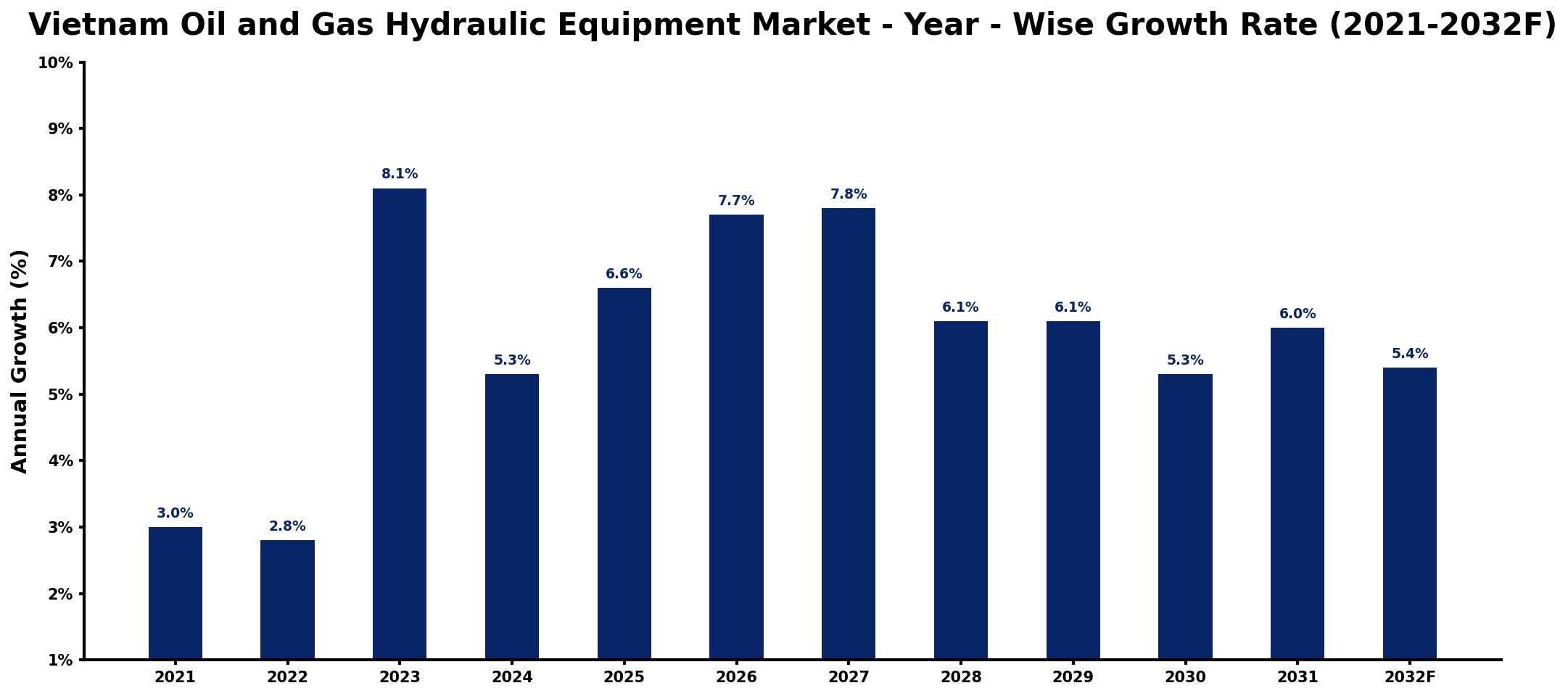
The table below presents the year‑wise growth rates along with the key drivers influencing the market
| Year | Growth Rate | Major Drivers |
| 2021 | 3.0% | Growing industrial infrastructure investments |
| 2022 | 2.8% | Increased demand from construction sector |
| 2023 | 8.1% | Expansion in renewable energy projects |
| 2024 | 5.3% | Rising investments in transportation networks |
| 2025 | 6.6% | Surge in manufacturing sector activities |
| 2026 | 7.7% | Growing offshore exploration initiatives |
| 2027 | 7.8% | Increased focus on automation technologies |
| 2028 | 6.1% | Rising urbanization and population growth |
| 2029 | 6.1% | rising demand from electronics |
| 2030 | 5.3% | growing downstream application demand |
| 2031 | 6.0% | Growing interest in smart cities |
| 2032 | 5.4% | stronger distribution network expansion |
Note: Market size estimations and growth projections presented in this report are based on 6Wresearch's proprietary forecasting methodology, utilizing the latest available industry data, government publications, and primary research inputs.
Vietnam Oil and Gas Hydraulic Equipment Market Synopsis
The most significant force currently shaping the Vietnam Oil and Gas Hydraulic Equipment Market is the expansion of offshore exploration and production activities. As the nation seeks to tap into its vast offshore reserves, the need for robust hydraulic solutions to support drilling, maintenance, and pipeline operations has never been greater.
In this evolving landscape, the emphasis on efficiency and reliability in hydraulic systems is paramount. Given the volatile nature of global oil prices and the geopolitical factors affecting supply chains, the local market must adapt quickly to maintain its competitive edge and ensure continued growth.
Vietnam Oil and Gas Hydraulic Equipment Market Key Takeaways
- The market is set for robust growth, fueled by increased offshore oil and gas exploration.
- Hydraulic equipment is crucial for various operations, including drilling and pipeline construction.
- Quality and safety standards are driving investment in research and development within the sector.
- Local companies face competition from international suppliers, emphasizing the need for innovation.
- Environmental regulations are influencing market dynamics, pushing for sustainable practices.
Evaluation of Restraints in Vietnam Oil and Gas Hydraulic Equipment Market
Despite its growth potential, the Vietnam Oil and Gas Hydraulic Equipment Market is constrained by several key factors. The direct correlation with the oil and gas industry's performance exposes the market to fluctuations due to volatile oil prices and geopolitical uncertainties. This volatility can lead to unpredictable demand and project delays. Furthermore, meeting the stringent safety and performance standards in hydraulic systems requires consistent investment in innovation, which may strain financial resources. Competition from international suppliers further complicates the landscape, as local players must focus on differentiating themselves through product development and superior service. Environmental concerns are also front and center, necessitating a shift towards more sustainable practices, a transition that can be resource-intensive.
Vietnam Oil and Gas Hydraulic Equipment Market Trends
Emerging trends within the Vietnam Oil and Gas Hydraulic Equipment Market include a marked shift towards the integration of smart technologies and automation in hydraulic systems. As operators seek greater efficiency and real-time monitoring capabilities, the adoption of IoT-enabled solutions is gaining traction. Moreover, there is a growing emphasis on sustainable and environmentally friendly equipment, driven by regulatory pressures and industry best practices. This transition not only aligns with global sustainability goals but also enhances operational reliability and reduces long-term costs.
Vietnam Oil and Gas Hydraulic Equipment Market Opportunities
Significant growth opportunities lie within the exploration of untapped offshore reserves, providing a fertile ground for hydraulic equipment suppliers. The increasing emphasis on renewable energy sources also presents avenues for diversification; companies can explore synergies between traditional oil and gas operations and emerging renewable energy technologies. Furthermore, investments in infrastructure projects to support the oil and gas industry will create additional demand for advanced hydraulic solutions.
Government Initiatives in the Vietnam Oil and Gas Hydraulic Equipment Market
The Vietnamese government has been proactive in promoting the oil and gas sector through various initiatives aimed at enhancing energy security and attracting foreign investment. Policies focusing on modernizing infrastructure, developing local capabilities in hydraulic technologies, and incentivizing research and innovation are pivotal. Additionally, public spending in the energy sector is increasingly directed toward sustainable practices, encouraging companies to align their operations with national energy goals.
Future Insights of the Vietnam Oil and Gas Hydraulic Equipment Market
Looking ahead to 2026-2032, the Vietnam Oil and Gas Hydraulic Equipment Market is expected to continue its upward trajectory, propelled by ongoing investments in offshore exploration and the push for more efficient technologies. As domestic production capacity expands, the demand for sophisticated hydraulic systems will be paramount. Furthermore, advancements in automation and smart technologies will redefine operational paradigms, resulting in enhanced productivity and safety. The market will likely remain responsive to global energy trends, adapting as necessary to the evolving demands of both traditional and renewable sectors.
Vietnam Oil and Gas Hydraulic Equipment Market Latest Developments (2025 - 2026)
In recent months, the Vietnam Oil and Gas Hydraulic Equipment Market has seen a shift towards collaborative projects between local firms and international technology providers, aimed at integrating advanced hydraulic solutions. There has been increased dialogue within the industry regarding standards and regulations to boost safety and sustainability efforts. Additionally, ongoing investments in workforce development highlight a commitment to building local expertise and innovation capabilities, aligning with the broader goals of the national energy strategy.
Vietnam Oil and Gas Hydraulic Equipment Market - Key Attractiveness of the Report
- 10 Years of Market Numbers
- Historical Data Starting from 2022 to 2025
- Base Year: 2025
- Forecast Data until 2032
- Key Performance Indicators Impacting the Market
- Major Upcoming Developments and Projects
Key Highlights of the Report:
- Vietnam Oil and Gas Hydraulic Equipment Market Outlook
- Market Size of Vietnam Oil and Gas Hydraulic Equipment Market, 2025
- Forecast of Vietnam Oil and Gas Hydraulic Equipment Market, 2032
- Historical Data and Forecast of Vietnam Oil and Gas Hydraulic Equipment Revenues & Volume for the Period 2022-2032F
- Vietnam Oil and Gas Hydraulic Equipment Market Trend Evolution
- Vietnam Oil and Gas Hydraulic Equipment Market Drivers and Challenges
- Vietnam Oil and Gas Hydraulic Equipment Price Trends
- Vietnam Oil and Gas Hydraulic Equipment Porter's Five Forces
- Vietnam Oil and Gas Hydraulic Equipment Industry Life Cycle
- Historical Data and Forecast of Vietnam Oil and Gas Hydraulic Equipment Market Revenues & Volume By Sector for the Period 2022-2032F
- Historical Data and Forecast of Vietnam Oil and Gas Hydraulic Equipment Market Revenues & Volume By Upstream for the Period 2022-2032F
- Historical Data and Forecast of Vietnam Oil and Gas Hydraulic Equipment Market Revenues & Volume By Mid-stream for the Period 2022-2032F
- Historical Data and Forecast of Vietnam Oil and Gas Hydraulic Equipment Market Revenues & Volume By Downstream for the Period 2022-2032F
- Historical Data and Forecast of Vietnam Oil and Gas Hydraulic Equipment Market Revenues & Volume By Location for the Period 2022-2032F
- Historical Data and Forecast of Vietnam Oil and Gas Hydraulic Equipment Market Revenues & Volume By Onshore for the Period 2022-2032F
- Historical Data and Forecast of Vietnam Oil and Gas Hydraulic Equipment Market Revenues & Volume By Offshore for the Period 2022-2032F
- Historical Data and Forecast of Vietnam Oil and Gas Hydraulic Equipment Market Revenues & Volume By Application for the Period 2022-2032F
- Historical Data and Forecast of Vietnam Oil and Gas Hydraulic Equipment Market Revenues & Volume By Drill Floor Hydraulics for the Period 2022-2032F
- Historical Data and Forecast of Vietnam Oil and Gas Hydraulic Equipment Market Revenues & Volume By Ballast Control System for the Period 2022-2032F
- Historical Data and Forecast of Vietnam Oil and Gas Hydraulic Equipment Market Revenues & Volume By Deck Crane Systems for the Period 2022-2032F
- Historical Data and Forecast of Vietnam Oil and Gas Hydraulic Equipment Market Revenues & Volume By Motion Compensation Systems for the Period 2022-2032F
- Historical Data and Forecast of Vietnam Oil and Gas Hydraulic Equipment Market Revenues & Volume By Top Drives for the Period 2022-2032F
- Historical Data and Forecast of Vietnam Oil and Gas Hydraulic Equipment Market Revenues & Volume By Manifolds for the Period 2022-2032F
- Historical Data and Forecast of Vietnam Oil and Gas Hydraulic Equipment Market Revenues & Volume By Winches for the Period 2022-2032F
- Historical Data and Forecast of Vietnam Oil and Gas Hydraulic Equipment Market Revenues & Volume By Others for the Period 2022-2032F
- Vietnam Oil and Gas Hydraulic Equipment Import Export Trade Statistics
- Market Opportunity Assessment By Sector
- Market Opportunity Assessment By Location
- Market Opportunity Assessment By Application
- Vietnam Oil and Gas Hydraulic Equipment Top Companies Market Share
- Vietnam Oil and Gas Hydraulic Equipment Competitive Benchmarking By Technical and Operational Parameters
- Vietnam Oil and Gas Hydraulic Equipment Company Profiles
- Vietnam Oil and Gas Hydraulic Equipment Key Strategic Recommendations






































