Vietnam Passive Fire Protection Market Size, Share & Growth Rate
The Vietnam Passive Fire Protection Market was estimated at USD 443 Million in 2025 and is projected to reach USD 623 Million by 2032, growing at a CAGR of 5.0% from 2026 to 2032. This growth trajectory is driven by an increasing emphasis on fire safety regulations and a surge in construction activities across urban centers. The evolving landscape of Vietnams industrial sector, marked by the development of high-rise buildings and infrastructure projects, has further underscored the necessity for effective passive fire protection measures.
Vietnam Passive Fire Protection Market Year-wise Growth Rate and Key Drivers
This graph highlights how the Vietnam Passive Fire Protection Market has steadily grown over the years, supported by major growth factors.
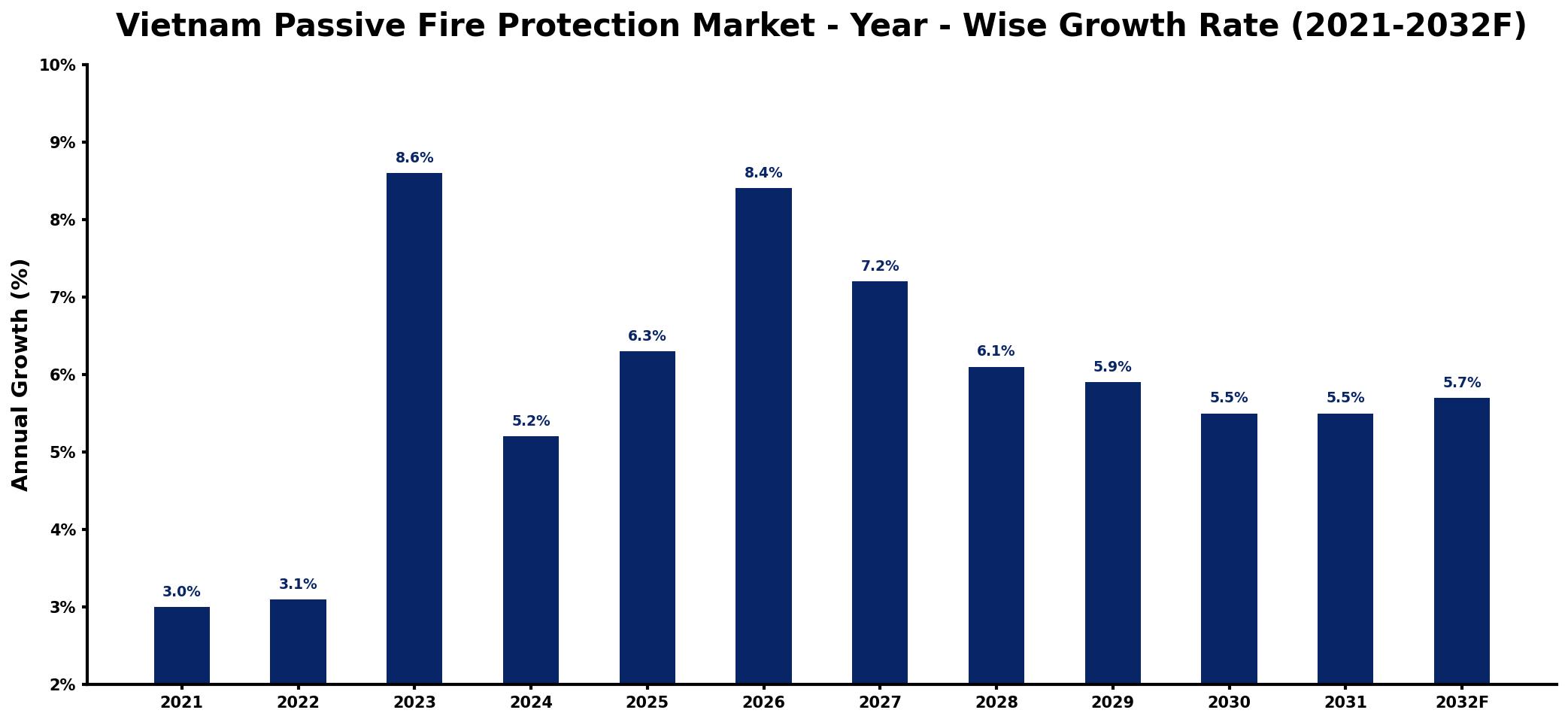
The table below presents the year‑wise growth rates along with the key drivers influencing the market
| Year | Growth Rate | Major Drivers |
| 2021 | 3.0% | Rising construction sector investments |
| 2022 | 3.1% | Increased safety regulations enforcement |
| 2023 | 8.6% | Growing awareness of safety standards |
| 2024 | 5.2% | Expansion of commercial real estate |
| 2025 | 6.3% | Surge in infrastructure development projects |
| 2026 | 8.4% | Enhanced building code requirements |
| 2027 | 7.2% | Technological advancements in materials |
| 2028 | 6.1% | Increased urbanization and population growth |
| 2029 | 5.9% | Rising demand for sustainable solutions |
| 2030 | 5.5% | Growth in industrial sector activities |
| 2031 | 5.5% | Development of smart building technologies |
| 2032 | 5.7% | Investment in disaster resilience initiatives |
Note: Market size estimations and growth projections presented in this report are based on 6Wresearch's proprietary forecasting methodology, utilizing the latest available industry data, government publications, and primary research inputs.
Vietnam Passive Fire Protection Market Synopsis
The Vietnamese construction market is witnessing a notable shift towards enhanced safety protocols, particularly in fire protection. Demand for fire-resistant materials such as fireproof coatings and fire-rated walls has escalated, driven by stringent government regulations and heightened awareness among stakeholders. This proactive approach is essential for ensuring the safety of both occupants and property in a rapidly urbanizing nation.
Additionally, with numerous high-rise and industrial facilities under development, the requirement for comprehensive fire protection systems has never been more critical. As urban infrastructure expands, the integration of passive fire protection solutions is becoming a fundamental aspect of project planning and execution, setting the stage for sustained market growth.
Vietnam Passive Fire Protection Market Key Takeaways
- The market is driven by increasing awareness and compliance with fire safety regulations.
- Urbanization and infrastructural expansion are key factors bolstering market demand.
- Insurance requirements are pushing for enhanced fire protection measures in new constructions.
- Investment in high-rise buildings and industrial facilities is a major growth catalyst.
- The market is adapting to new challenges posed by the COVID-19 pandemic, emphasizing virtual solutions.
Evaluation of Restraints in Vietnam Passive Fire Protection Market
While the Vietnam passive fire protection market is poised for growth, certain restraints exist that could hinder its potential. One primary challenge is ensuring compliance with the complex web of fire safety regulations and standards. The correct installation and maintenance of passive fire protection systems require skilled labor and stringent oversight, which can be difficult to manage, particularly amidst rapid construction timelines. Additionally, the lingering effects of the COVID-19 pandemic have introduced uncertainties in project financing and timelines, impacting overall demand in the short term.
Vietnam Passive Fire Protection Market Trends
Emerging trends in the Vietnam passive fire protection market include an increased reliance on advanced technologies such as smart fire safety systems, which integrate with building management systems to enhance monitoring and response times. Furthermore, the growing focus on sustainable construction practices is driving demand for environmentally friendly fire-resistant materials. Additionally, the industry's shift towards modular construction is facilitating quicker deployment of passive fire protection systems in new developments.
Vietnam Passive Fire Protection Market Opportunities
Significant growth opportunities lie within the expansion of urban infrastructure and industrial developments. As Vietnam continues to develop its cities, the need for comprehensive fire safety solutions is paramount. Investment in green building technologies also offers a lucrative avenue, as businesses seek to enhance their sustainability credentials while meeting fire safety standards. Moreover, enhancing awareness and education around fire safety measures can help drive demand for advanced solutions across various sectors.
Government Initiatives in the Vietnam Passive Fire Protection Market
The Vietnamese government is actively pursuing policies aimed at improving fire safety standards across the construction sector. This includes public spending on infrastructure projects that mandate the incorporation of passive fire protection systems. Initiatives designed to provide training and certification for construction professionals further support compliance with safety regulations. Additionally, government incentives for utilizing fire-resistant materials in public and private projects contribute to fostering a safer built environment.
Future Insights of the Vietnam Passive Fire Protection Market
Looking ahead to 2026-2032, the Vietnam passive fire protection market is expected to experience steady growth, buoyed by an increasing focus on safety in construction practices. As the regulatory landscape becomes more rigorous, companies will need to prioritize compliance and innovation in their product offerings. The rising trend towards high-rise buildings will necessitate advanced fire protection solutions, ensuring that the market evolves in line with the changing dynamics of urban development.
Vietnam Passive Fire Protection Market Latest Developments (2025 - 2026)
Recent developments in the Vietnam passive fire protection market indicate a strengthening focus on collaboration between manufacturers and construction firms to enhance fire safety measures. Companies are increasingly leveraging technology for improved training and product implementation strategies. Furthermore, there is a noticeable trend towards integrating fire protection systems with smart building technologies to ensure ongoing compliance and enhanced safety management, even in the face of evolving regulations.
Vietnam Passive Fire Protection Market - Key Attractiveness of the Report
- 10 Years of Market Numbers
- Historical Data Starting from 2022 to 2025
- Base Year: 2025
- Forecast Data until 2032
- Key Performance Indicators Impacting the Market
- Major Upcoming Developments and Projects
Key Highlights of the Report:
- Vietnam Passive Fire Protection Market Outlook
- Market Size of Vietnam Passive Fire Protection Market, 2025
- Forecast of Vietnam Passive Fire Protection Market, 2032
- Historical Data and Forecast of Vietnam Passive Fire Protection Revenues & Volume for the Period 2022-2032F
- Vietnam Passive Fire Protection Market Trend Evolution
- Vietnam Passive Fire Protection Market Drivers and Challenges
- Vietnam Passive Fire Protection Price Trends
- Vietnam Passive Fire Protection Porter's Five Forces
- Vietnam Passive Fire Protection Industry Life Cycle
- Historical Data and Forecast of Vietnam Passive Fire Protection Market Revenues & Volume By Product for the Period 2022-2032F
- Historical Data and Forecast of Vietnam Passive Fire Protection Market Revenues & Volume By Cementitious Materials for the Period 2022-2032F
- Historical Data and Forecast of Vietnam Passive Fire Protection Market Revenues & Volume By Intumescent Coatings for the Period 2022-2032F
- Historical Data and Forecast of Vietnam Passive Fire Protection Market Revenues & Volume By Fireproofing Cladding for the Period 2022-2032F
- Historical Data and Forecast of Vietnam Passive Fire Protection Market Revenues & Volume By Others for the Period 2022-2032F
- Historical Data and Forecast of Vietnam Passive Fire Protection Market Revenues & Volume By Application for the Period 2022-2032F
- Historical Data and Forecast of Vietnam Passive Fire Protection Market Revenues & Volume By Oil & Gas for the Period 2022-2032F
- Historical Data and Forecast of Vietnam Passive Fire Protection Market Revenues & Volume By Construction for the Period 2022-2032F
- Historical Data and Forecast of Vietnam Passive Fire Protection Market Revenues & Volume By Industrial for the Period 2022-2032F
- Historical Data and Forecast of Vietnam Passive Fire Protection Market Revenues & Volume By Warehousing for the Period 2022-2032F
- Historical Data and Forecast of Vietnam Passive Fire Protection Market Revenues & Volume By Others for the Period 2022-2032F
- Vietnam Passive Fire Protection Import Export Trade Statistics
- Market Opportunity Assessment By Product
- Market Opportunity Assessment By Application
- Vietnam Passive Fire Protection Top Companies Market Share
- Vietnam Passive Fire Protection Competitive Benchmarking By Technical and Operational Parameters
- Vietnam Passive Fire Protection Company Profiles
- Vietnam Passive Fire Protection Key Strategic Recommendations






































