Vietnam Processed Fruit Market Summary
The vietnam processed fruit market was estimated at USD 278 Million in 2025 and is projected to reach USD 391 Million by 2032, growing at a CAGR of 8.1% from 2026 to 2032.
Vietnam Processed Fruit Market Year-wise Growth Rate and Key Drivers
This graph highlights how the Vietnam Processed Fruit Market has steadily grown over the past five years, supported by major growth factors.
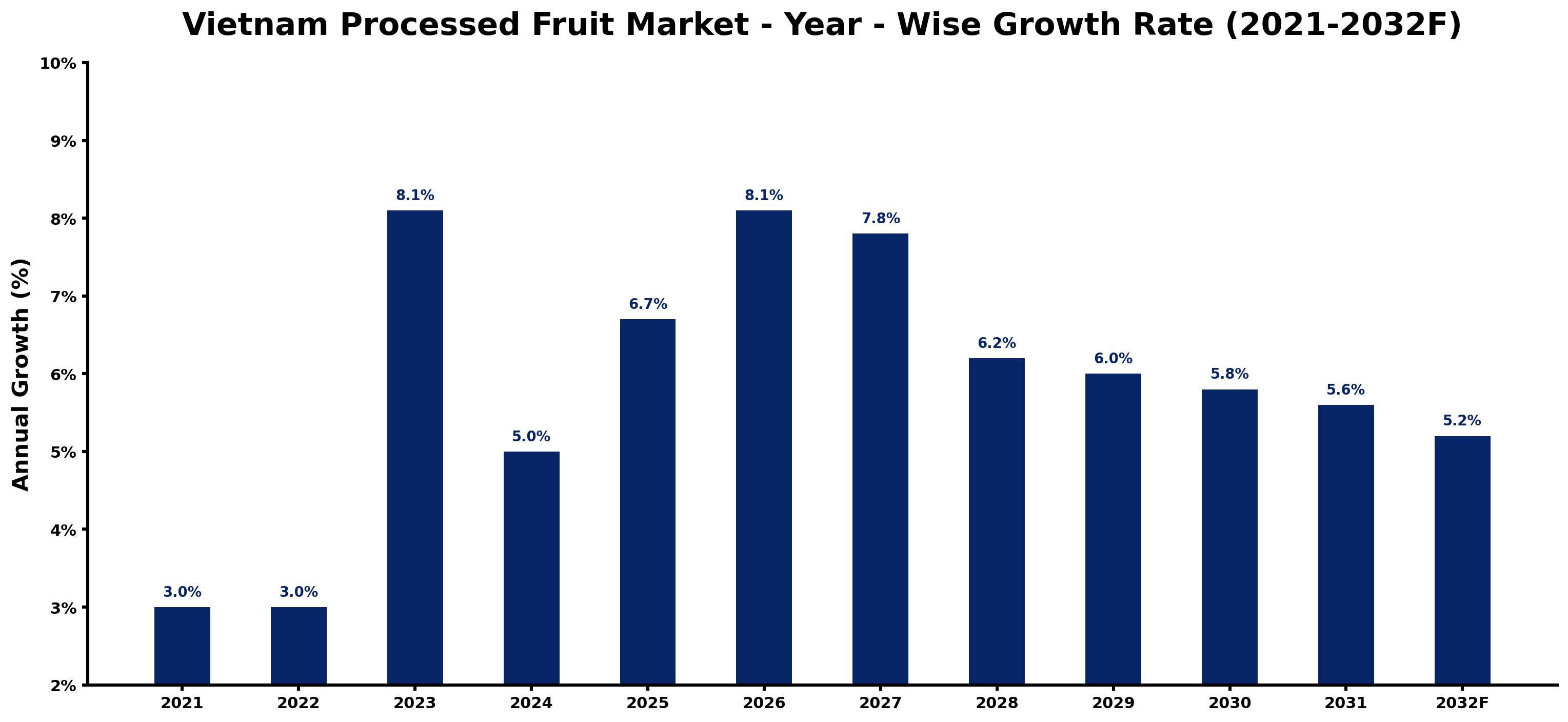
The table below presents the year wise growth rates along with the key drivers influencing the market
| Year | Growth Rate | Major Drivers |
| 2021 | 3.0% | Post-lockdown retail projects have invigorated the processed fruit sector in Vietnam. |
| 2022 | 3.0% | Rising health consciousness among consumers boosts interest in convenient fruit options. |
| 2023 | 8.1% | E-commerce platforms expand reach, facilitating easier access to processed fruit products. |
| 2024 | 5.0% | Local manufacturers increasingly leverage advanced technologies to improve production efficiency. |
| 2025 | 6.7% | Young urban populations show preference for innovative snack alternatives, driving product diversity. |
| 2026 | 8.1% | Supply chain enhancements create opportunities for fresh local produce integration into products. |
| 2027 | 7.8% | Market players are focusing on sustainable practices to attract eco-conscious consumers. |
| 2028 | 6.2% | Emerging food trends highlight unique flavors, prompting new product development initiatives. |
| 2029 | 6.0% | Investment in rural infrastructure enhances distribution channels for processed fruit products. |
| 2030 | 5.8% | Brand collaborations with local farmers strengthen community ties, enriching supply chains. |
| 2031 | 5.6% | Consumer demand encourages diversification into organic and health-oriented processed fruit lines. |
| 2032 | 5.2% | Global trade partnerships facilitate imports, expanding the variety available in Vietnamese markets. |
Note - Market size estimations and growth projections presented in this report are based on 6Wresearch's advanced forecasting approach, validated with industry datasets as of June 2026.
Vietnam Processed Fruit Market Synopsis
The Vietnam Processed Fruit Market is projected to reach 8.1% and witness significant growth during the forecast period (2026-2032). This flourishing segment of the food and beverage industry encompasses a diverse array of products including canned, frozen, and dried fruits. The increasing consumer preference for convenience and longer shelf life has amplified the popularity of processed fruit goods amid the rapidly changing lifestyles of urban populations. Factors such as rising disposable incomes, health consciousness, and urbanization are all contributing to this market's robust expansion.
Vietnam Processed Fruit Market Growth Drivers
The growth of the Vietnam Processed Fruit Market is propelled by several interlinked drivers. Firstly, urbanization in Vietnam is leading to transformative changes in consumer behavior.
- The increasing number of urban residents is correlating with a demand for convenient, ready-to-eat food options that processed fruits readily fulfill.
- Health awareness among consumers is on the rise, resulting in an emphasis on nutritious snacks, particularly dried and freeze-dried fruits, viewed as healthier alternatives.
- Modern retail channels are expanding throughout Vietnam, enhancing accessibility to processed fruit products, which encourages consumer trials and purchases.
- Increasing disposable incomes allow consumers to spend more on food products, favoring those that are convenient and perceived as premium options.
- The cultural shift towards snacking is nurturing consistent consumption of processed fruits as they fit seamlessly into on-the-go lifestyles.
Vietnam Processed Fruit Market Challenges and Restraints
Despite its potential for growth, the Vietnam Processed Fruit Market faces several challenges that could impact its trajectory.
- One prominent challenge includes the perishability of raw fruits, which necessitates advanced processing and storage capabilities to prevent wastage and retain nutritional value.
- The need for specialized infrastructure is paramount in maintaining product quality, yet many regions still lack adequate facilities, complicating the supply chain.
- Competition from imported processed fruit products is intensifying as international brands penetrate the Vietnamese market, potentially undermining local producers.
- Seasonal fluctuations and adverse weather conditions can disrupt local fruit supply chains, affecting the availability of high-quality raw materials for processing.
- Consumer preferences may vary widely, thus requiring constant innovation and adaptation to maintain market relevance amid evolving tastes and trends.
Vietnam Processed Fruit Market Government Investment and Initiatives
The government of Vietnam is heavily investing in initiatives that support the growth of the processed fruit market. Policies aimed at promoting agricultural modernization are being implemented to enhance quality and productivity. These initiatives are designed to:
- Encourage the establishment of modern processing facilities that can handle large volumes of fruit while maintaining quality standards.
- Provide financial incentives for farmers who adopt sustainable practices and engage in high-quality fruit production.
- Facilitate partnerships between local producers and academic institutions for research and development in food processing technologies.
- Support small and medium enterprises in the processed fruits sector through access to funding and training programs.
- Promote awareness of Vietnamese processed fruits in both domestic and international markets through trade fairs and promotional campaigns.
Vietnam Processed Fruit Market Latest Developments (May 2025 - June 2026)
Recent developments within the Vietnam Processed Fruit Market highlight a dynamic evolution as the industry adapts to changing conditions. The shift in consumer purchasing behavior, influenced by the lingering effects of the COVID-19 pandemic, has reshaped product offerings and marketing strategies. Notable changes include:
- A noticeable increase in online sales channels for processed fruit, as e-commerce continues to be a preferred shopping method for many consumers.
- Introducing new flavors and packaging formats to attract a younger demographic while catering to diverse consumer preferences.
- Collaborations between local manufacturers and international businesses aimed at enhancing product quality and expanding market reach.
- Increased focus on sustainability in production methods, including reduced use of preservatives and environmentally friendly packaging.
- Efforts to strengthen supply chains post-pandemic, ensuring that processed fruit products remain available year-round, regardless of agricultural production cycles.
Vietnam Processed Fruit Market - Key Attractiveness of the Report
- 10 Years of Market Numbers
- Historical Data Starting from 2022 to 2025
- Base Year: 2025
- Forecast Data until 2032
- Key Performance Indicators Impacting the Market
- Major Upcoming Developments and Projects
Key Highlights of the Report:
- Vietnam Processed Fruit Market Outlook
- Market Size of Vietnam Processed Fruit Market, 2025
- Forecast of Vietnam Processed Fruit Market, 2032
- Historical Data and Forecast of Vietnam Processed Fruit Revenues & Volume for the Period 2022-2032F
- Vietnam Processed Fruit Market Trend Evolution
- Vietnam Processed Fruit Market Drivers and Challenges
- Vietnam Processed Fruit Price Trends
- Vietnam Processed Fruit Porter's Five Forces
- Vietnam Processed Fruit Industry Life Cycle
- Historical Data and Forecast of Vietnam Processed Fruit Market Revenues & Volume By Product for the Period 2022-2032F
- Historical Data and Forecast of Vietnam Processed Fruit Market Revenues & Volume By Fresh for the Period 2022-2032F
- Historical Data and Forecast of Vietnam Processed Fruit Market Revenues & Volume By Fresh- Cut for the Period 2022-2032F
- Historical Data and Forecast of Vietnam Processed Fruit Market Revenues & Volume By Canned for the Period 2022-2032F
- Historical Data and Forecast of Vietnam Processed Fruit Market Revenues & Volume By Frozen for the Period 2022-2032F
- Historical Data and Forecast of Vietnam Processed Fruit Market Revenues & Volume By Drying &Dehydration for the Period 2022-2032F
- Historical Data and Forecast of Vietnam Processed Fruit Market Revenues & Volume By Processing Equipment for the Period 2022-2032F
- Historical Data and Forecast of Vietnam Processed Fruit Market Revenues & Volume By Pre-processing for the Period 2022-2032F
- Historical Data and Forecast of Vietnam Processed Fruit Market Revenues & Volume By Processing for the Period 2022-2032F
- Historical Data and Forecast of Vietnam Processed Fruit Market Revenues & Volume By Washing for the Period 2022-2032F
- Historical Data and Forecast of Vietnam Processed Fruit Market Revenues & Volume By Filling for the Period 2022-2032F
- Historical Data and Forecast of Vietnam Processed Fruit Market Revenues & Volume By Seasoning for the Period 2022-2032F
- Historical Data and Forecast of Vietnam Processed Fruit Market Revenues & Volume By Packaging for the Period 2022-2032F
- Vietnam Processed Fruit Import Export Trade Statistics
- Market Opportunity Assessment By Product
- Market Opportunity Assessment By Processing Equipment
- Vietnam Processed Fruit Top Companies Market Share
- Vietnam Processed Fruit Competitive Benchmarking By Technical and Operational Parameters
- Vietnam Processed Fruit Company Profiles
- Vietnam Processed Fruit Key Strategic Recommendations






































