Vietnam Processed Pork Market Size, Share & Growth Rate
The Vietnam Processed Pork Market was estimated at USD 470 Million in 2025 and is projected to reach USD 664 Million by 2032, growing at a CAGR of 5.1% from 2026 to 2032. This growth trajectory is primarily fueled by the rapid urbanization of Vietnam, which has created a burgeoning middle class eager for convenient meal options. As the pace of life accelerates, consumers increasingly seek ready-to-eat and easy-to-prepare pork products, positioning processed pork as a staple in modern Vietnamese households.
Vietnam Processed Pork Market Year-wise Growth Rate and Key Drivers
This graph highlights how the Vietnam Processed Pork Market has steadily grown over the years, supported by major growth factors.
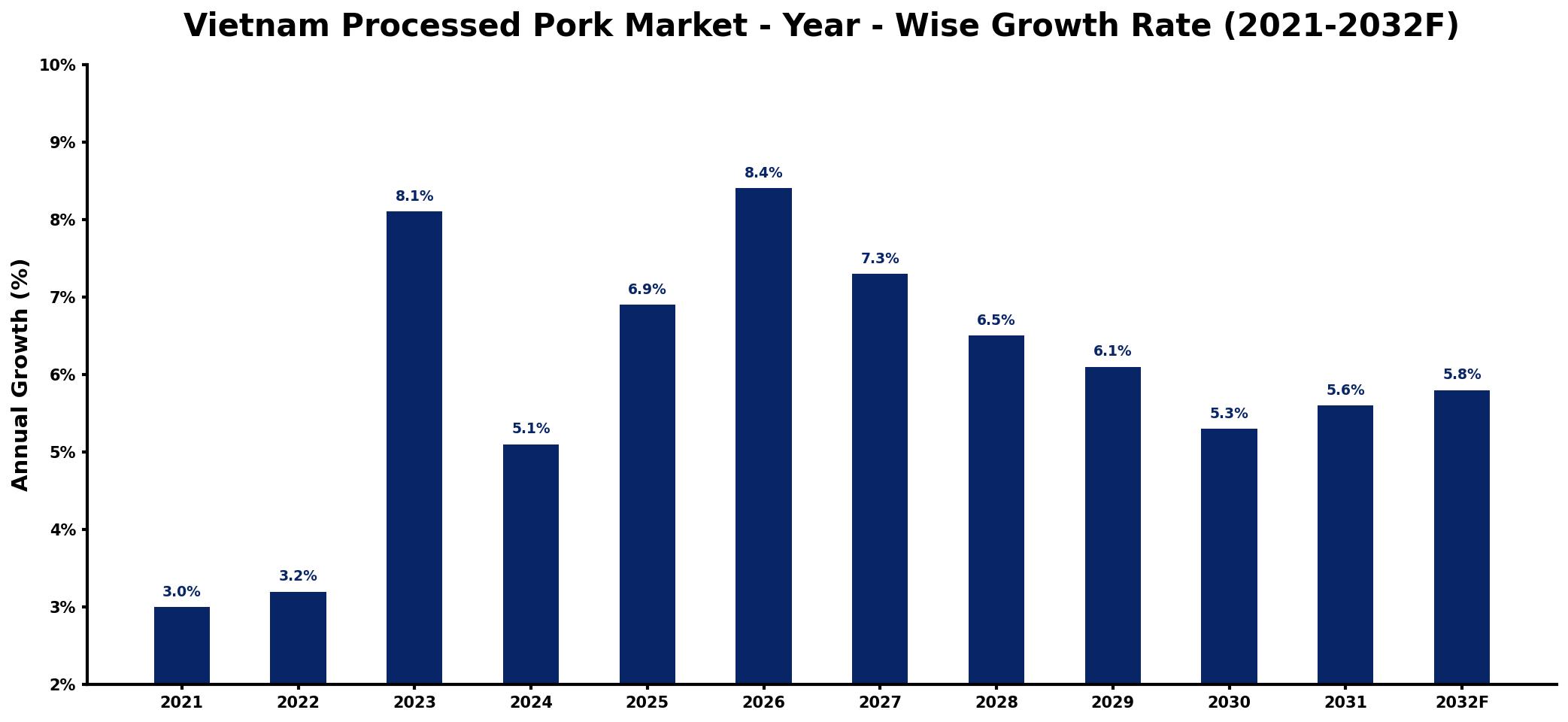
The table below presents the year‑wise growth rates along with the key drivers influencing the market
| Year | Growth Rate | Major Drivers |
| 2021 | 3.0% | Rising consumer health consciousness |
| 2022 | 3.2% | Increase in household spending power |
| 2023 | 8.1% | Growing demand for convenience foods |
| 2024 | 5.1% | Expansion of distribution channels |
| 2025 | 6.9% | increased production capacity utilization |
| 2026 | 8.4% | Adoption of modern retail formats |
| 2027 | 7.3% | Surge in online purchasing trends |
| 2028 | 6.5% | Growing popularity of meal kits |
| 2029 | 6.1% | Increased interest in local sourcing |
| 2030 | 5.3% | Rise in food safety awareness |
| 2031 | 5.6% | enhanced product quality standards |
| 2032 | 5.8% | Growth in culinary tourism experiences |
Note: Market size estimations and growth projections presented in this report are based on 6Wresearch's proprietary forecasting methodology, utilizing the latest available industry data, government publications, and primary research inputs.
Vietnam Processed Pork Market Synopsis
Urbanization stands as the strongest force currently shaping the Vietnam Processed Pork Market. As cities expand and lifestyles grow busier, processed pork products such as sausages, bacon, and canned pork are becoming essential staples, providing both convenience and flavor. Innovations in taste and packaging are catering to an increasingly diverse consumer base, further reinforcing the market's growth.
In addition to convenience, traditional Vietnamese cuisine plays a significant role in the sustained demand for processed pork items. With pork being a culinary staple, the integration of modernized processed forms aligns with both heritage and contemporary dining trends. However, while the market thrives, maintaining quality and safety standards remains vital to consumer trust.
Vietnam Processed Pork Market Key Takeaways
- The market is driven by a growing middle class, urbanization, and demand for convenient food options.
- Innovation in flavors and packaging is reshaping product offerings and attracting diverse consumer segments.
- Consumer preferences are leaning towards healthier alternatives, impacting manufacturers product development.
- Food safety and quality assurance remain crucial for brand reputation and market growth.
- The shift towards e-commerce and delivery services is becoming an essential distribution channel in the post-COVID landscape.
Evaluation of Restraints in Vietnam Processed Pork Market
Despite the overall positive outlook, the Vietnam processed pork market contends with significant restraints. Chief among these is the lingering concern regarding food safety, where consumers are increasingly wary of additives and preservatives used in processed pork products. To mitigate these concerns, manufacturers must adopt stringent hygiene and processing standards while ensuring transparency in labeling. Furthermore, the complex regulatory environment poses additional challenges in compliance, which can hinder the agility of producers in responding to market demands. Balancing traditional fresh pork competition with processed options also remains a challenge, necessitating innovative marketing strategies that resonate with health-conscious consumers.
Vietnam Processed Pork Market Trends
Current trends in the Vietnam processed pork market reveal a strong inclination towards health-conscious product development. Consumers are increasingly seeking options that are perceived as nutritious, prompting manufacturers to explore lower-fat, preservative-free alternatives. The integration of technology in production processes is also gaining traction, leading to enhanced flavor profiles and improved shelf life. Additionally, rising interest in online shopping platforms continues to shape consumer purchasing behaviors, with many opting for the convenience of home delivery services for their pork-based meals.
Vietnam Processed Pork Market Opportunities
The landscape for the Vietnam processed pork market is rich with opportunities for growth and investment. As the urban population expands, there is a clear demand for innovative pork products that blend traditional flavors with modern convenience. Opportunities also exist in the development of health-oriented products, catering to the growing segment of health-conscious consumers. Moreover, leveraging digital marketing and e-commerce channels can significantly enhance market reach, tapping into younger demographics that favor online shopping over traditional retail.
Government Initiatives in the Vietnam Processed Pork Market
The Vietnamese government is increasingly focusing on enhancing food safety standards and supporting the livestock sector, including processed pork. Public initiatives aimed at strengthening food production practices and regulatory frameworks are designed to bolster consumer confidence. Programs encouraging modern farming techniques and food processing methods are gaining traction, alongside public spending on infrastructure to improve logistics in distribution. Such governmental support is vital for fostering a stable and competitive market environment.
Future Insights of the Vietnam Processed Pork Market
Looking ahead to 2026-2032, the Vietnam processed pork market is expected to witness robust growth driven by continuous urbanization and the evolving culinary landscape. The integration of innovative processing technologies will likely enhance product offerings, making them more appealing to health-focused consumers. The increasing emphasis on sustainability and ethical sourcing in food production may also shape consumer preferences, leading manufacturers to adapt accordingly. Overall, the market stands poised for significant expansion as it aligns with both traditional culinary practices and modern consumer expectations.
Vietnam Processed Pork Market Latest Developments (2025 - 2026)
Recent developments in the Vietnam processed pork market indicate a shift towards enhanced food safety measures, with companies investing in better quality control processes to ensure consumer trust. Additionally, manufacturers are increasingly engaging in collaborative partnerships to develop new product lines that cater to specific dietary preferences. Online retail channels have also gained momentum, with several businesses launching targeted marketing campaigns aimed at the younger demographic to drive sales and brand loyalty.
Vietnam Processed Pork Market - Key Attractiveness of the Report
- 10 Years of Market Numbers
- Historical Data Starting from 2022 to 2025
- Base Year: 2025
- Forecast Data until 2032
- Key Performance Indicators Impacting the Market
- Major Upcoming Developments and Projects
Key Highlights of the Report:
- Vietnam Processed Pork Market Outlook
- Market Size of Vietnam Processed Pork Market, 2025
- Forecast of Vietnam Processed Pork Market, 2032
- Historical Data and Forecast of Vietnam Processed Pork Revenues & Volume for the Period 2022-2032F
- Vietnam Processed Pork Market Trend Evolution
- Vietnam Processed Pork Market Drivers and Challenges
- Vietnam Processed Pork Price Trends
- Vietnam Processed Pork Porter's Five Forces
- Vietnam Processed Pork Industry Life Cycle
- Historical Data and Forecast of Vietnam Processed Pork Market Revenues & Volume By Meat Product for the Period 2022-2032F
- Historical Data and Forecast of Vietnam Processed Pork Market Revenues & Volume By Cured Meat for the Period 2022-2032F
- Historical Data and Forecast of Vietnam Processed Pork Market Revenues & Volume By Uncured Meat for the Period 2022-2032F
- Historical Data and Forecast of Vietnam Processed Pork Market Revenues & Volume By Pork Meat for the Period 2022-2032F
- Historical Data and Forecast of Vietnam Processed Pork Market Revenues & Volume By Fresh Pork Meat for the Period 2022-2032F
- Historical Data and Forecast of Vietnam Processed Pork Market Revenues & Volume By Processed Pork Meat for the Period 2022-2032F
- Historical Data and Forecast of Vietnam Processed Pork Market Revenues & Volume By Packaging Type for the Period 2022-2032F
- Historical Data and Forecast of Vietnam Processed Pork Market Revenues & Volume By Chilled Processed Meat for the Period 2022-2032F
- Historical Data and Forecast of Vietnam Processed Pork Market Revenues & Volume By Frozen Processed Meat for the Period 2022-2032F
- Historical Data and Forecast of Vietnam Processed Pork Market Revenues & Volume By Canned Processed Meat for the Period 2022-2032F
- Historical Data and Forecast of Vietnam Processed Pork Market Revenues & Volume By Distribution for the Period 2022-2032F
- Historical Data and Forecast of Vietnam Processed Pork Market Revenues & Volume By Supermarket for the Period 2022-2032F
- Historical Data and Forecast of Vietnam Processed Pork Market Revenues & Volume By Convenience Stores for the Period 2022-2032F
- Historical Data and Forecast of Vietnam Processed Pork Market Revenues & Volume By Grocery Stores for the Period 2022-2032F
- Historical Data and Forecast of Vietnam Processed Pork Market Revenues & Volume By Individual Retailers for the Period 2022-2032F
- Historical Data and Forecast of Vietnam Processed Pork Market Revenues & Volume By Online Sales Channel for the Period 2022-2032F
- Vietnam Processed Pork Import Export Trade Statistics
- Market Opportunity Assessment By Meat Product
- Market Opportunity Assessment By Pork Meat
- Market Opportunity Assessment By Packaging Type
- Market Opportunity Assessment By Distribution
- Vietnam Processed Pork Top Companies Market Share
- Vietnam Processed Pork Competitive Benchmarking By Technical and Operational Parameters
- Vietnam Processed Pork Company Profiles
- Vietnam Processed Pork Key Strategic Recommendations






































