Vietnam Smart Building Market Size, Share & Growth Rate
The Vietnam Smart Building Market was estimated at USD 848 Million in 2025 and is projected to reach USD 1322 Million by 2032, growing at a CAGR of 6.5% from 2026 to 2032. This robust growth trajectory is primarily fueled by the rapid urbanization and an increasing shift towards efficient infrastructure solutions, as the country embraces the necessity for sustainable development. The surge in construction activities, coupled with government initiatives to promote smart city concepts, further accelerates the adoption of smart building technologies across various sectors.
Vietnam Smart Building Market Year-wise Growth Rate and Key Drivers
This graph highlights how the Vietnam Smart Building Market has steadily grown over the years, supported by major growth factors.
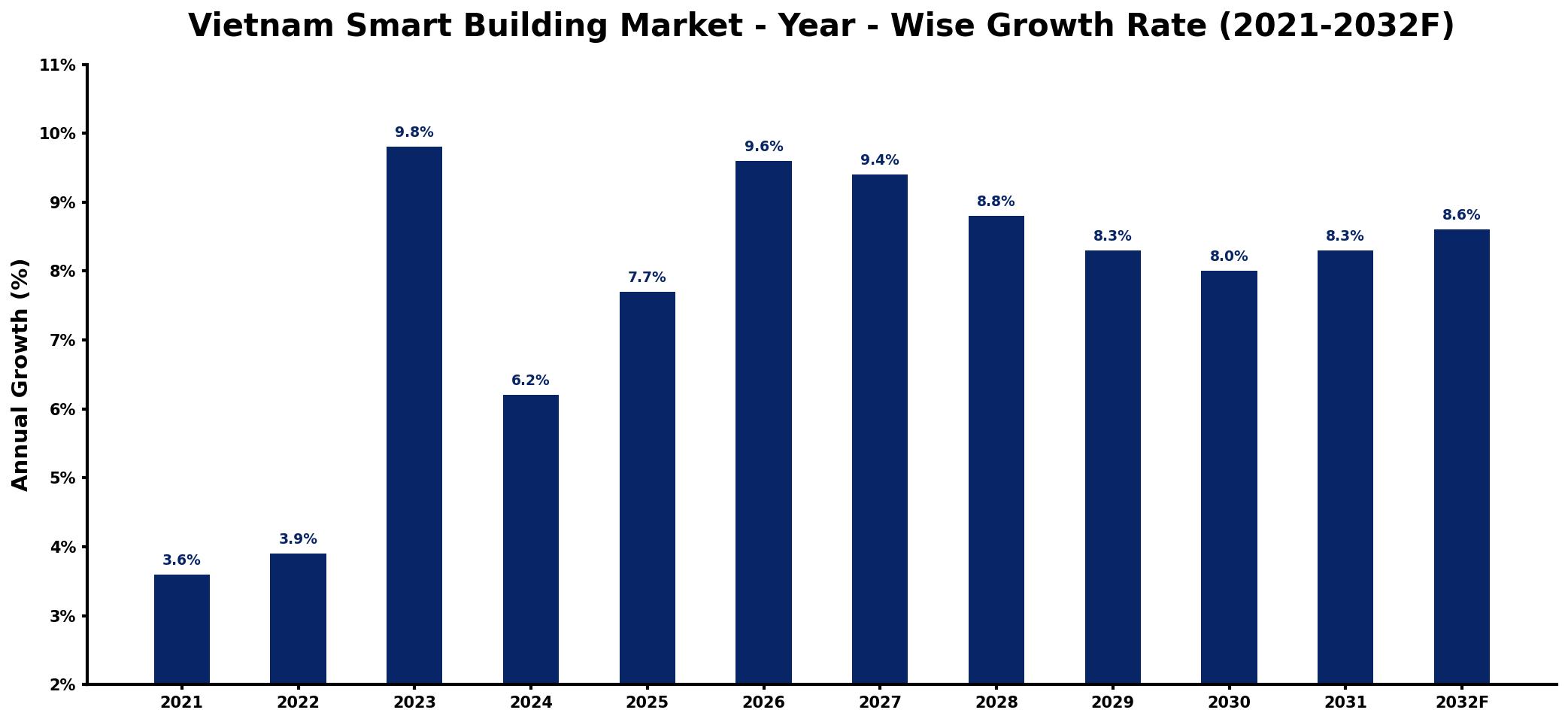
The table below presents the year‑wise growth rates along with the key drivers influencing the market
| Year | Growth Rate | Major Drivers |
| 2021 | 3.6% | Rising urbanization and infrastructure development |
| 2022 | 3.9% | Increased investment in technology solutions |
| 2023 | 9.8% | Growing demand for energy efficiency |
| 2024 | 6.2% | Expansion of IoT integration projects |
| 2025 | 7.7% | Surge in renewable energy adoption |
| 2026 | 9.6% | Enhanced focus on sustainability practices |
| 2027 | 9.4% | Growing interest in automation technologies |
| 2028 | 8.8% | Increase in regulatory support initiatives |
| 2029 | 8.3% | Emergence of innovative financing models |
| 2030 | 8.0% | Development of advanced analytics capabilities |
| 2031 | 8.3% | Strengthening of public-private partnerships |
| 2032 | 8.6% | Rising consumer awareness and education |
Note: Market size estimations and growth projections presented in this report are based on 6Wresearch's proprietary forecasting methodology, utilizing the latest available industry data, government publications, and primary research inputs.
Vietnam Smart Building Market Synopsis
In recent years, Vietnam has witnessed an impressive upturn in the smart building sector, characterized by a blend of technological innovation and strategic government policy support. From urban centers to emerging cities, the integration of IoT sensors and automation systems is redefining the landscape of modern infrastructure.
The growing emphasis on energy efficiency and occupant comfort drives the adoption of advanced building management systems. As property developers and owners prioritize smart solutions, the market positions itself as a vital segment within the broader construction industry, showcasing Vietnam's commitment to sustainable urban living.
Vietnam Smart Building Market Key Takeaways
- The market is positioned for substantial growth, driven by urbanization and modernization initiatives.
- Government policies are crucial in promoting smart city development, enabling better infrastructure.
- Technologies like IoT and building automation are essential in enhancing efficiency and security.
- Property developers increasingly seek smart solutions to meet evolving tenant expectations.
- Despite challenges, the market is gaining traction post-COVID-19, with a focus on contactless and automated systems.
Evaluation of Restraints in Vietnam Smart Building Market
While the Vietnam Smart Building Market shows considerable promise, several significant restraints hinder its expansion. High initial costs associated with implementing smart technologies present a barrier for many developers and property owners, who may hesitate to invest despite long-term benefits. Additionally, a lack of awareness surrounding the advantages of smart buildings can slow adoption rates.
Interoperability issues between different smart systems often complicate the seamless integration of diverse technologies. Furthermore, privacy and security concerns regarding data collected from smart building systems remain pivotal challenges. Lastly, the scarcity of skilled professionals in this field can impede the markets growth trajectory, restricting the deployment of innovative solutions.
Vietnam Smart Building Market Trends
As the market evolves, several trends are emerging that will shape its future. Firstly, the increasing integration of AI and machine learning in building management systems promises enhanced operational efficiencies and predictive maintenance capabilities. There is also a marked trend towards sustainable building practices, with green certifications becoming a key consideration for developers.
The demand for smart residential buildings is on the rise as homeowners seek technologies that optimize comfort and security. Moreover, as remote working continues to influence urban design, flexible and multifunctional spaces equipped with smart technologies are gaining prominence in both residential and commercial segments.
Vietnam Smart Building Market Opportunities
The Vietnam Smart Building Market presents numerous avenues for growth and investment. With the governments commitment to developing smart cities, there is ample opportunity for investors to support infrastructure projects that integrate advanced technologies. Moreover, as awareness of energy efficiency and sustainability grows, companies offering innovative smart solutions will find a receptive market.
Emerging startups focusing on niche technologies within the smart building domain, such as advanced security systems and energy management tools, can also tap into this flourishing market. The evolving expectations of consumers further create a robust landscape for smart building technologies that enhance living and working environments.
Government Initiatives in the Vietnam Smart Building Market
The Vietnamese government has actively pursued policies to support the development of smart cities, driving the growth of the smart building market. Initiatives include funding for infrastructure projects, regulatory frameworks that encourage the adoption of smart technologies, and collaborations with international entities to promote knowledge transfer and innovation.
Public spending in urban infrastructure has increased, reflecting a strategic priority to modernize cities and enhance the quality of urban living. These initiatives are not only aimed at improving energy efficiency but also at creating sustainable urban environments that can accommodate the needs of a growing population.
Future Insights of the Vietnam Smart Building Market
Looking ahead to the 2026-2032 period, the Vietnam Smart Building Market is poised for continued growth. The convergence of technological advancements with urbanization trends will likely enhance the appeal of smart buildings. With an expected surge in government investment in smart city initiatives, the integration of smart technologies will redefine urban living.
As stakeholders, including developers and city planners, adopt innovative solutions that prioritize sustainability, the market will experience further maturation. The increasing demand for enhanced occupant experiences will also drive innovations, making smart buildings not just functional but integral to modern urban life.
Vietnam Smart Building Market Latest Developments (2025 - 2026)
Recent developments in the Vietnam Smart Building Market indicate a shift towards more integrated solutions that prioritize user experience. Companies are increasingly focusing on research and development to bring cutting-edge smart technologies to the fore. Furthermore, there is a noticeable rise in collaborative efforts between tech firms and construction companies to create more effective smart building solutions.
In light of recent global events, there has been a marked emphasis on health and safety features within smart buildings, including advanced air filtration systems and touchless technologies. This trend reflects the changing priorities of consumers who are seeking safer living and working environments.
Vietnam Smart Building Market - Key Attractiveness of the Report
- 10 Years of Market Numbers
- Historical Data Starting from 2022 to 2025
- Base Year: 2025
- Forecast Data until 2032
- Key Performance Indicators Impacting the Market
- Major Upcoming Developments and Projects
Key Highlights of the Report:
- Vietnam Smart Building Market Outlook
- Market Size of Vietnam Smart Building Market, 2025
- Forecast of Vietnam Smart Building Market, 2032
- Historical Data and Forecast of Vietnam Smart Building Revenues & Volume for the Period 2022-2032F
- Vietnam Smart Building Market Trend Evolution
- Vietnam Smart Building Market Drivers and Challenges
- Vietnam Smart Building Price Trends
- Vietnam Smart Building Porter's Five Forces
- Vietnam Smart Building Industry Life Cycle
- Historical Data and Forecast of Vietnam Smart Building Market Revenues & Volume By Component for the Period 2022-2032F
- Historical Data and Forecast of Vietnam Smart Building Market Revenues & Volume By Solution for the Period 2022-2032F
- Historical Data and Forecast of Vietnam Smart Building Market Revenues & Volume By Services for the Period 2022-2032F
- Historical Data and Forecast of Vietnam Smart Building Market Revenues & Volume By Application for the Period 2022-2032F
- Historical Data and Forecast of Vietnam Smart Building Market Revenues & Volume By Residential for the Period 2022-2032F
- Historical Data and Forecast of Vietnam Smart Building Market Revenues & Volume By Commercial for the Period 2022-2032F
- Vietnam Smart Building Import Export Trade Statistics
- Market Opportunity Assessment By Component
- Market Opportunity Assessment By Application
- Vietnam Smart Building Top Companies Market Share
- Vietnam Smart Building Competitive Benchmarking By Technical and Operational Parameters
- Vietnam Smart Building Company Profiles
- Vietnam Smart Building Key Strategic Recommendations






































