Vietnam Sorghum Market Size, Share & Growth Rate
The Vietnam Sorghum Market was estimated at USD 576 Million in 2025 and is projected to reach USD 817 Million by 2032, growing at a CAGR of 5.1% from 2026 to 2032. This growth trajectory is primarily fueled by rising consumer interest in alternative grains due to health trends, as well as sorghum's adaptability in regions susceptible to drought. Additionally, the crop's multifunctionality as food, animal feed, and a biofuel source continues to pique interest among producers and businesses.
Vietnam Sorghum Market Year-wise Growth Rate and Key Drivers
This graph highlights how the Vietnam Sorghum Market has steadily grown over the years, supported by major growth factors.
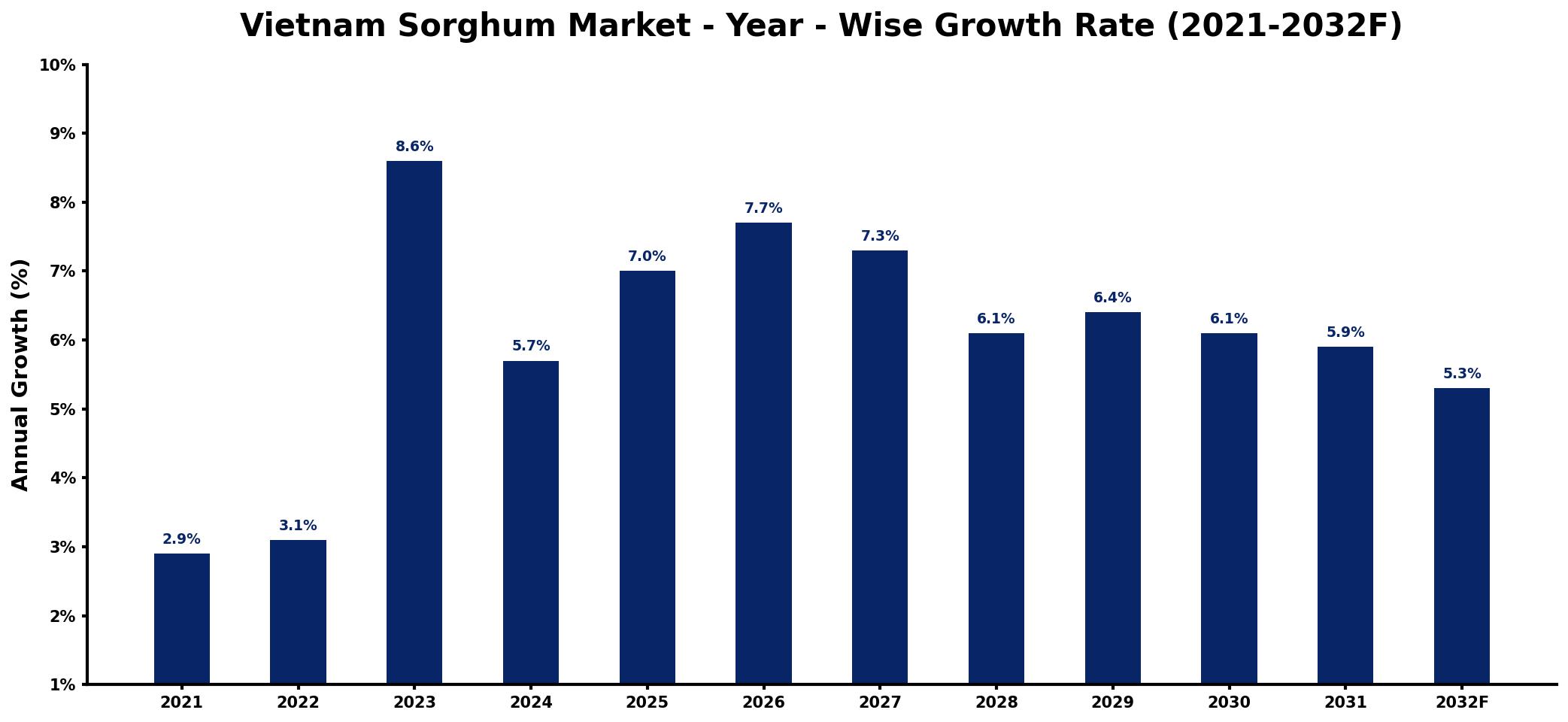
The table below presents the year‑wise growth rates along with the key drivers influencing the market
| Year | Growth Rate | Major Drivers |
| 2021 | 2.9% | Rising demand for alternative grains |
| 2022 | 3.1% | Increased investment in agriculture technology |
| 2023 | 8.6% | Expansion of local processing facilities |
| 2024 | 5.7% | Growing consumer interest in health |
| 2025 | 7.0% | Higher livestock feed requirements |
| 2026 | 7.7% | Boost in export opportunities |
| 2027 | 7.3% | Strengthening local agricultural cooperatives |
| 2028 | 6.1% | Enhanced government support programs |
| 2029 | 6.4% | Growing popularity of gluten-free options |
| 2030 | 6.1% | Increase in sustainable farming practices |
| 2031 | 5.9% | Diversification of crop rotation strategies |
| 2032 | 5.3% | Rise in organic farming initiatives |
Note: Market size estimations and growth projections presented in this report are based on 6Wresearch's proprietary forecasting methodology, utilizing the latest available industry data, government publications, and primary research inputs.
Vietnam Sorghum Market Synopsis
Sorghum has emerged as a promising crop in Vietnam's agricultural landscape, capturing attention for its resilience and diverse applications. The increasing adoption of sorghum is partly due to its ability to thrive in water-scarce environments, making it a viable option for farmers facing climate challenges.
Despite its rising prominence, sorghum remains a minor player compared to rice and maize in Vietnams agricultural sector. This presents an opportunity for education and marketing initiatives to enhance consumer awareness about its nutritional benefits, thereby stimulating demand in both food and feed markets.
Vietnam Sorghum Market Key Takeaways
- The Vietnam sorghum market is on an upward trajectory, driven by health-conscious consumer trends and the search for alternative grains.
- Climate resilience and drought tolerance position sorghum as an attractive crop in water-limited regions.
- Increased recognition of sorghum's potential in animal feed and biofuel production contributes to market growth.
- Marketing efforts and educational campaigns are crucial for raising consumer awareness and boosting demand.
- Challenges related to cultivation practices and competition from staple grains continue to shape the market landscape.
Evaluation of Restraints in Vietnam Sorghum Market
The growth of the Vietnam sorghum market is hindered by a few notable restraints. The lack of extensive experience among farmers in sorghum cultivation can result in variable crop quality and yields, impacting overall production. Moreover, consumer unfamiliarity with sorghums nutritional profile limits its acceptance in the market. Competing grains like rice and maize dominate consumer preference, challenging sorghum's market share. Additionally, maintaining consistent quality and supply in a fluctuating market further complicates growth prospects, necessitating robust quality control measures and regulatory compliance.
Vietnam Sorghum Market Trends
The Vietnam sorghum market is experiencing several trends that are shaping its future. There is a notable shift towards health-oriented dietary preferences, with consumers increasingly gravitating towards gluten-free options, which positions sorghum favorably. Moreover, advancements in agricultural technology, including improved cultivation techniques and pest management strategies, are enhancing yield and quality. The rising interest in sustainable farming practices is also fueling the market, as sorghum contributes to soil health and requires fewer inputs compared to traditional crops.
Vietnam Sorghum Market Opportunities
Significant growth and investment opportunities lie within the Vietnam sorghum market. The evolving landscape of food and feed demand creates openings for local farmers and investors to engage in sorghum cultivation and processing. Enhanced focus on organic and health-conscious products presents an avenue for businesses to develop sorghum-based food products, catering to niche markets. Additionally, the exploration of sorghum as a biofuel source aligns with global sustainability goals, attracting interest from the renewable energy sector.
Government Initiatives in the Vietnam Sorghum Market
The Vietnamese government is beginning to recognize the potential of sorghum as part of its agricultural strategy. Policies aimed at enhancing food security are gradually incorporating alternative crops like sorghum. Investment in research and development programs to optimize sorghum cultivation and processing is also being prioritized. Furthermore, government incentives for farmers adopting sustainable practices can foster increased sorghum production and utilization.
Future Insights of the Vietnam Sorghum Market
Looking ahead to the period between 2026 and 2032, the Vietnam sorghum market is poised for transformative growth. As consumer awareness rises and dietary preferences shift, the demand for sorghum is expected to increase significantly. Technological advancements and improved agricultural practices will likely enhance cultivation efficiency, addressing current quality issues. Additionally, ongoing government support and investment in infrastructure may provide the necessary boost to capitalize on sorghum's versatility as a food and feed resource.
Vietnam Sorghum Market Latest Developments (2025 - 2026)
Recent developments in the Vietnam sorghum market reflect a growing recognition of its potential. There have been initiatives aimed at educating farmers about best cultivation practices, which are expected to enhance yield consistency. Additionally, local food producers are starting to experiment with sorghum in various food applications, tapping into the trend for healthier, gluten-free alternatives. Furthermore, the dialogue around sustainable farming practices has encouraged investment in sorghum as a strategic crop.
Vietnam Sorghum Market - Key Attractiveness of the Report
- 10 Years of Market Numbers
- Historical Data Starting from 2022 to 2025
- Base Year: 2025
- Forecast Data until 2032
- Key Performance Indicators Impacting the Market
- Major Upcoming Developments and Projects
Key Highlights of the Report:
- Vietnam Sorghum Market Outlook
- Market Size of Vietnam Sorghum Market, 2025
- Forecast of Vietnam Sorghum Market, 2032
- Historical Data and Forecast of Vietnam Sorghum Revenues & Volume for the Period 2022-2032F
- Vietnam Sorghum Market Trend Evolution
- Vietnam Sorghum Market Drivers and Challenges
- Vietnam Sorghum Price Trends
- Vietnam Sorghum Porter's Five Forces
- Vietnam Sorghum Industry Life Cycle
- Historical Data and Forecast of Vietnam Sorghum Market Revenues & Volume By Type for the Period 2022-2032F
- Historical Data and Forecast of Vietnam Sorghum Market Revenues & Volume By Grain Sorghum for the Period 2022-2032F
- Historical Data and Forecast of Vietnam Sorghum Market Revenues & Volume By Forage Sorghum for the Period 2022-2032F
- Historical Data and Forecast of Vietnam Sorghum Market Revenues & Volume By Biomass Sorghum for the Period 2022-2032F
- Historical Data and Forecast of Vietnam Sorghum Market Revenues & Volume By Sweet Sorghum for the Period 2022-2032F
- Historical Data and Forecast of Vietnam Sorghum Market Revenues & Volume By Application for the Period 2022-2032F
- Historical Data and Forecast of Vietnam Sorghum Market Revenues & Volume By Biofuel for the Period 2022-2032F
- Historical Data and Forecast of Vietnam Sorghum Market Revenues & Volume By Food for the Period 2022-2032F
- Historical Data and Forecast of Vietnam Sorghum Market Revenues & Volume By Livestock Feed for the Period 2022-2032F
- Historical Data and Forecast of Vietnam Sorghum Market Revenues & Volume By Others for the Period 2022-2032F
- Vietnam Sorghum Import Export Trade Statistics
- Market Opportunity Assessment By Type
- Market Opportunity Assessment By Application
- Vietnam Sorghum Top Companies Market Share
- Vietnam Sorghum Competitive Benchmarking By Technical and Operational Parameters
- Vietnam Sorghum Company Profiles
- Vietnam Sorghum Key Strategic Recommendations






































