Vietnam Vinegar Market Size, Share & Growth Rate
The Vietnam Vinegar Market was estimated at USD 223 Million in 2025 and is projected to reach USD 315 Million by 2032, growing at a CAGR of 5.1% from 2026 to 2032. This promising trajectory is fueled by the increasing culinary diversity within Vietnam, where vinegar is a staple ingredient across various traditional dishes. The growing consumer inclination toward health and wellness is further propelling demand, as vinegar is widely recognized for its potential health benefits, including digestive health and blood sugar regulation.
Vietnam Vinegar Market Growth Rate Analysis (2021-2032)
The Vietnam vinegar market is experiencing a significant upward trend, with growth rates fluctuating from 3.0% in 2021 to an impressive 8.5% in 2023. This resurgence is largely driven by increasing consumer awareness of health benefits associated with vinegar, particularly amidst a rising trend in natural and organic products. The market is anticipated to stabilize at around 5.5% in 2024, before reaching 8.1% in 2026, as investments in modern food processing technologies enhance production efficiency. Additionally, government policies favoring domestic food production and quality standards are supporting this demand surge. However, growth will likely moderate to 5.9% by 2030, reflecting an maturing phase in consumer preferences.
Vietnam Vinegar Market Year-wise Growth Rate and Key Drivers
This graph highlights how the Vietnam Vinegar Market has steadily grown over the past five years, supported by major growth factors.
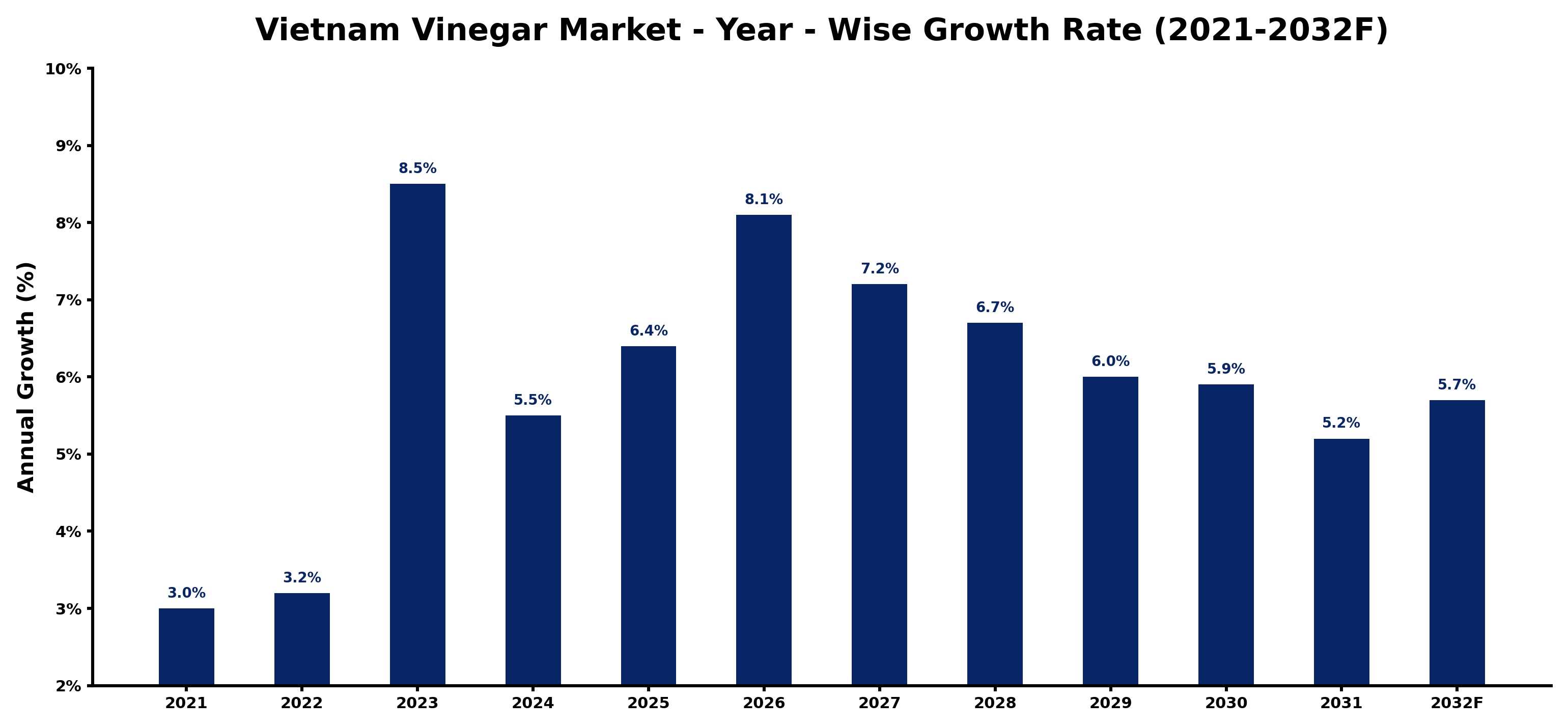
The table below presents the year‑wise growth rates along with the key drivers influencing the market
| Year | Growth Rate | Major Drivers |
| 2021 | 3.0% | Expansion of commercial construction activities |
| 2022 | 3.2% | Growing renewable energy integration projects |
| 2023 | 8.5% | Rapid growth in telecom and data center sectors |
| 2024 | 5.5% | Expansion of commercial construction activities |
| 2025 | 6.4% | Expansion of manufacturing activities |
| 2026 | 8.1% | Growing urbanization and commercial development |
| 2027 | 7.2% | Expansion of transportation and logistics networks |
| 2028 | 6.7% | Increasing industrial automation investments |
| 2029 | 6.0% | Increasing industrial automation investments |
| 2030 | 5.9% | Expansion of commercial construction activities |
| 2031 | 5.2% | Expansion of transportation and logistics networks |
| 2032 | 5.7% | Rising electricity demand across industries |
Note - Market size estimations and growth projections presented in this report are based on 6Wresearch’s advanced forecasting approach, validated with industry datasets as of June 2026.
Vietnam Vinegar Market Synopsis
In Vietnam, vinegar is more than just a condiment; it plays an essential role in the country's rich culinary heritage. With applications ranging from marinades to dressings and even traditional medicine, the market is witnessing a surge in interest, particularly for specialty and flavored vinegars that cater to adventurous palates.
As consumer preferences evolve, there is a noticeable shift towards gourmet products. This trend is accompanied by a rising number of producers introducing innovative variants, appealing to a health-conscious audience eager to explore the diverse possibilities that vinegar offers in their daily cooking.
Vietnam Vinegar Market Key Takeaways
- The market is on a robust growth path, driven by an increasing appreciation for traditional and modern culinary uses of vinegar.
- Health benefits associated with vinegar consumption are attracting a new demographic of health-conscious consumers.
- Innovative product offerings are reshaping consumer choices, with a notable rise in specialty and flavored vinegars.
- Quality control and branding are crucial factors for producers striving to compete with imported vinegars.
- Post-pandemic recovery is likely to bolster the market as consumers return to restaurants and food services while also maintaining home cooking practices.
Evaluation of Restraints in Vietnam Vinegar Market
Despite its growth potential, the Vietnam Vinegar Market contends with specific restraints that could hinder its progress. One significant challenge is the need for consistent quality control in vinegar production. With various producers entering the market, maintaining high standards is crucial to consumer trust and satisfaction. Additionally, navigating the competitive landscape, especially against imported products, requires effective branding strategies. Environmental sustainability also presents a challenge, as producers must adopt practices that align with global standards while meeting local demand.
Vietnam Vinegar Market Trends
Several trends are currently shaping the Vietnam Vinegar Market. The shift towards health-conscious consumption is leading to increased demand for organic and naturally produced vinegars. Furthermore, local producers are exploring unique flavors and blends, incorporating local ingredients that resonate with the Vietnamese palate. Social media and digital marketing are becoming pivotal in promoting these innovative products, capturing the interest of younger consumers who seek authenticity and quality in their culinary choices.
Vietnam Vinegar Market Opportunities
The Vietnam Vinegar Market presents numerous growth opportunities for savvy investors and producers. The rising trend of home cooking, amplified by recent global events, opens a pathway for specialty vinegars that can enhance flavor profiles at home. Additionally, the push for health-oriented products offers room for innovation in packaging and marketing, particularly for those highlighting the health benefits of vinegar. Exploring export opportunities for unique Vietnamese vinegars could also expand market reach beyond national borders.
Government Initiatives in the Vietnam Vinegar Market
Government policies play an integral role in shaping the Vietnam Vinegar Market. Initiatives aimed at promoting local agriculture and food production are encouraging the development of organic vinegar products. Public spending on food safety inspections and regulatory compliance is increasing, ensuring that production standards are met. Moreover, supportive frameworks for small and medium enterprises in the food sector are paving the way for innovation and growth within the vinegar market.
Future Insights of the Vietnam Vinegar Market
Looking ahead to 2026-2032, the Vietnam Vinegar Market is poised for dynamic growth. As consumers become more adventurous in their culinary practices and increasingly prioritize health, the demand for diverse vinegar products is expected to rise. Moreover, the anticipated rebound of the foodservice industry post-COVID will likely contribute to a renewed interest in premium vinegar offerings, further driving market expansion.
Vietnam Vinegar Market Latest Developments (May 2025 - June 2026)
Recent developments within the Vietnam Vinegar Market indicate a trend towards enhanced product diversity. Producers are focusing on innovative flavor combinations and natural fermentation processes to differentiate their offerings. Additionally, there has been a marked increase in collaboration between local farmers and vinegar producers, fostering a farm-to-table approach that emphasizes sustainability and quality. As the market adapts to new consumer expectations, continued evolution in marketing strategies is expected.
Vietnam Vinegar Market - Key Attractiveness of the Report
- 10 Years of Market Numbers
- Historical Data Starting from 2022 to 2025
- Base Year: 2025
- Forecast Data until 2032
- Key Performance Indicators Impacting the Market
- Major Upcoming Developments and Projects
Key Highlights of the Report:
- Vietnam Vinegar Market Outlook
- Market Size of Vietnam Vinegar Market, 2025
- Forecast of Vietnam Vinegar Market, 2032F
- Historical Data and Forecast of Vietnam Vinegar Revenues & Volume for the Period 2022-2032F
- Vietnam Vinegar Market Trend Evolution
- Vietnam Vinegar Market Drivers and Challenges
- Vietnam Vinegar Price Trends
- Vietnam Vinegar Porter's Five Forces
- Vietnam Vinegar Industry Life Cycle
- Historical Data and Forecast of Vietnam Vinegar Market Revenues & Volume By Product Type for the Period 2022-2032F
- Historical Data and Forecast of Vietnam Vinegar Market Revenues & Volume By Balsamic Vinegar for the Period 2022-2032F
- Historical Data and Forecast of Vietnam Vinegar Market Revenues & Volume By Red Wine Vinegar for the Period 2022-2032F
- Historical Data and Forecast of Vietnam Vinegar Market Revenues & Volume By Cider Vinegar for the Period 2022-2032F
- Historical Data and Forecast of Vietnam Vinegar Market Revenues & Volume By White Vinegar for the Period 2022-2032F
- Historical Data and Forecast of Vietnam Vinegar Market Revenues & Volume By Rice Vinegar for the Period 2022-2032F
- Historical Data and Forecast of Vietnam Vinegar Market Revenues & Volume By Others for the Period 2022-2032F
- Historical Data and Forecast of Vietnam Vinegar Market Revenues & Volume By Source for the Period 2022-2032F
- Historical Data and Forecast of Vietnam Vinegar Market Revenues & Volume By Natural for the Period 2022-2032F
- Historical Data and Forecast of Vietnam Vinegar Market Revenues & Volume By Synthetic for the Period 2022-2032F
- Historical Data and Forecast of Vietnam Vinegar Market Revenues & Volume By End-use for the Period 2022-2032F
- Historical Data and Forecast of Vietnam Vinegar Market Revenues & Volume By Institutional for the Period 2022-2032F
- Historical Data and Forecast of Vietnam Vinegar Market Revenues & Volume By Retail for the Period 2022-2032F
- Historical Data and Forecast of Vietnam Vinegar Market Revenues & Volume By Distribution Channel for the Period 2022-2032F
- Historical Data and Forecast of Vietnam Vinegar Market Revenues & Volume By Supermarkets and Hypermarkets for the Period 2022-2032F
- Historical Data and Forecast of Vietnam Vinegar Market Revenues & Volume By Convenience Stores for the Period 2022-2032F
- Historical Data and Forecast of Vietnam Vinegar Market Revenues & Volume By Specialty Stores for the Period 2022-2032F
- Historical Data and Forecast of Vietnam Vinegar Market Revenues & Volume By Online for the Period 2022-2032F
- Historical Data and Forecast of Vietnam Vinegar Market Revenues & Volume By Others for the Period 2022-2032F
- Vietnam Vinegar Import Export Trade Statistics
- Market Opportunity Assessment By Product Type
- Market Opportunity Assessment By Source
- Market Opportunity Assessment By End-use
- Market Opportunity Assessment By Distribution Channel
- Vietnam Vinegar Top Companies Market Share
- Vietnam Vinegar Competitive Benchmarking By Technical and Operational Parameters
- Vietnam Vinegar Company Profiles
- Vietnam Vinegar Key Strategic Recommendations






































