Zambia Insect Repellent Market: Top 5 Importing Countries and Market Competition (HHI) Analysis
In 2024, Zambia continued to rely on imports of insect repellent, with top exporters being China, South Africa, Hong Kong, India, and France. Despite the high concentration of market share indicated by the Herfindahl-Hirschman Index (HHI), the industry experienced a modest compound annual growth rate (CAGR) of 2.3% from 2020 to 2024. However, there was a sharp decline in growth rate from 2023 to 2024 at -46.04%, highlighting potential challenges or shifts in the market dynamics during that period. Monitoring these trends can provide valuable insights for stakeholders in the insect repellent import sector in Zambia.
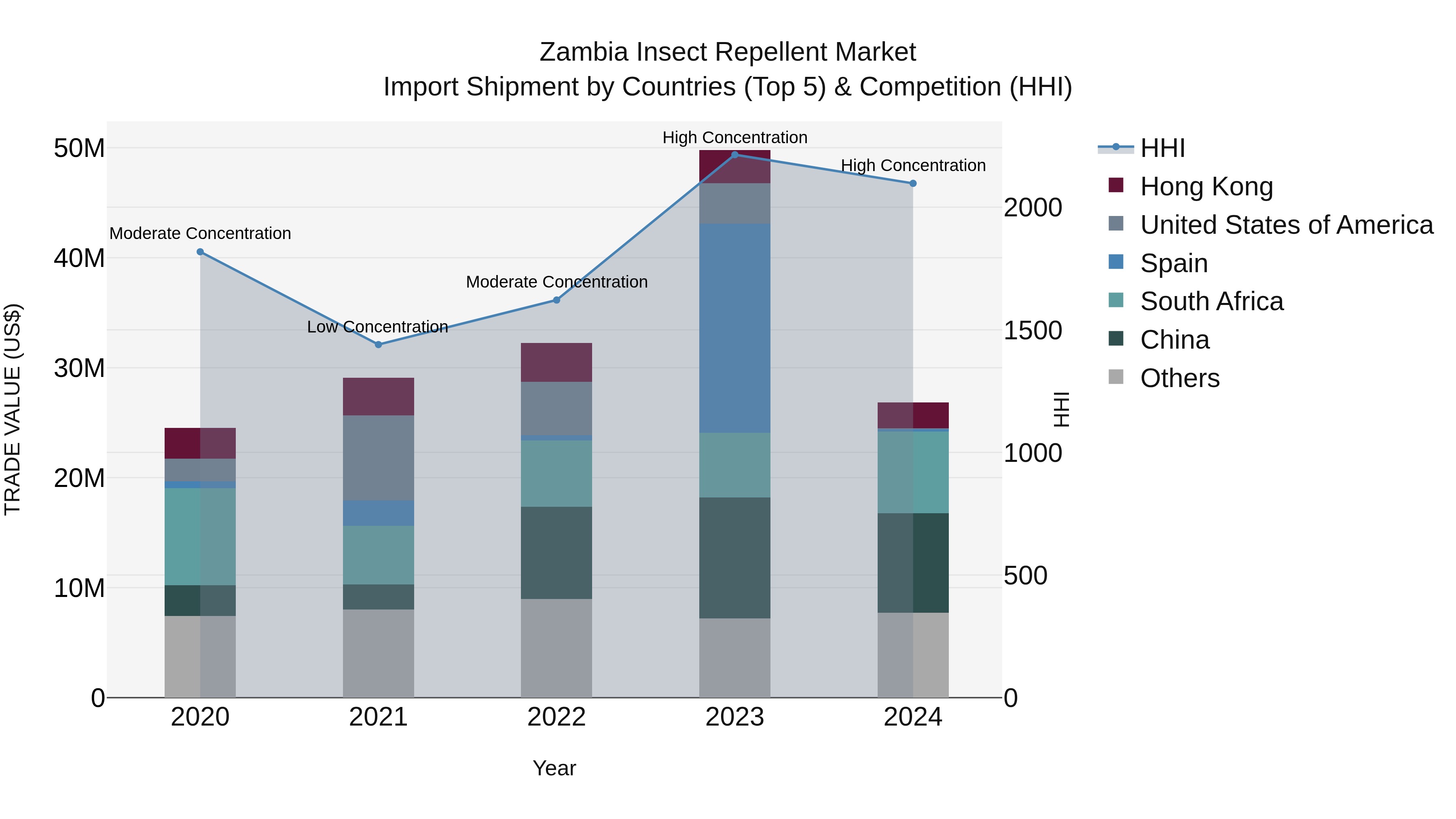
Zambia Insect Repellent Market Overview
The Zambia insect repellent market is primarily driven by the prevalent issue of malaria and other insect-borne diseases in the region. With a high demand for protection against mosquitoes and other insects, various products such as mosquito coils, sprays, creams, and lotions are popular among consumers. Key players in the market include multinational brands like OFF!, Raid, and local manufacturers offering affordable options. The market is witnessing a growing trend towards natural and eco-friendly repellents made from ingredients such as citronella and neem. Distribution channels range from supermarkets and pharmacies to local markets, with a significant portion of sales occurring during the rainy season when insect activity is at its peak. Marketing strategies often focus on the effectiveness and long-lasting protection provided by the products to appeal to the health-conscious consumer base.
Zambia Insect Repellent Market Trends and Opportunities
The Zambia insect repellent market is witnessing a growing trend towards natural and organic repellent products due to increasing awareness about the harmful effects of chemical-based repellents on health and the environment. Consumers are seeking products with ingredients like citronella, eucalyptus, and lemon essential oils for their repellent properties. There is also a rising demand for long-lasting and effective repellents to combat mosquito-borne diseases such as malaria and dengue fever. Opportunities in the market lie in developing innovative formulations, incorporating technology such as time-release mechanisms, and expanding distribution channels to reach rural areas where insect-borne diseases are more prevalent. Collaboration with health organizations and government initiatives to promote the use of insect repellents for disease prevention can also drive growth in the Zambia market.
Zambia Insect Repellent Market Challenges
In the Zambia Insect Repellent Market, some key challenges include limited awareness about the importance of using insect repellents to prevent diseases such as malaria, dengue fever, and Zika virus. Additionally, affordability can be a barrier for many consumers in purchasing insect repellent products, especially in rural areas where access to healthcare products may be limited. Distribution channels and logistics can also present challenges in reaching remote communities effectively. Furthermore, the presence of counterfeit or substandard products in the market poses a risk to public health and consumer trust. Overcoming these challenges would require targeted education campaigns, competitive pricing strategies, improved distribution networks, and stringent quality control measures to ensure the efficacy and safety of insect repellent products in Zambia.
Zambia Insect Repellent Market Drivers
The Zambia Insect Repellent Market is primarily driven by factors such as the increasing awareness about mosquito-borne diseases like malaria and dengue fever, leading to a growing demand for effective insect repellent products. The country`s tropical climate also contributes to a high prevalence of mosquitoes, further fueling the need for protection against insect bites. Additionally, rising disposable incomes and urbanization are expanding the consumer base for insect repellents in Zambia, as more individuals seek to safeguard themselves and their families from insect-related health risks. Innovative product formulations, convenient packaging, and aggressive marketing strategies by key players in the market are also influencing consumer purchasing decisions, driving the growth of the insect repellent industry in Zambia.
Zambia Insect Repellent Market Government Policies
Government policies related to the Zambia Insect Repellent Market primarily focus on ensuring the safety and efficacy of products, as well as promoting public health. The Zambia Environmental Management Agency (ZEMA) regulates the importation and distribution of insect repellents to ensure compliance with environmental standards. Additionally, the Zambia Bureau of Standards (ZABS) sets quality requirements for insect repellent products to safeguard consumers against potentially harmful ingredients. The Ministry of Health also plays a role in overseeing the use of insect repellents to prevent the spread of vector-borne diseases such as malaria and Zika virus. Overall, these government policies aim to maintain high product standards, protect public health, and promote the responsible use of insect repellents in Zambia.
Zambia Insect Repellent Market Future Outlook
The Zambia Insect Repellent Market is expected to witness steady growth in the coming years due to increasing awareness about vector-borne diseases such as malaria and dengue fever. The market is likely to be driven by rising demand for natural and eco-friendly insect repellents, as consumers become more conscious about the environmental impact of traditional chemical-based products. Additionally, the growing trend of outdoor activities and travel among the population is expected to further propel the market growth. Key players are likely to focus on product innovation and marketing strategies to cater to evolving consumer preferences and gain a competitive edge in the market. Overall, the Zambia Insect Repellent Market is poised for expansion, with opportunities for both local and international brands to capture a larger market share.
Key Highlights of the Report:
- Zambia Insect Repellent Market Outlook
- Market Size of Zambia Insect Repellent Market, 2024
- Forecast of Zambia Insect Repellent Market, 2031
- Historical Data and Forecast of Zambia Insect Repellent Revenues & Volume for the Period 2021- 2031
- Zambia Insect Repellent Market Trend Evolution
- Zambia Insect Repellent Market Drivers and Challenges
- Zambia Insect Repellent Price Trends
- Zambia Insect Repellent Porter's Five Forces
- Zambia Insect Repellent Industry Life Cycle
- Historical Data and Forecast of Zambia Insect Repellent Market Revenues & Volume By Type for the Period 2021- 2031
- Historical Data and Forecast of Zambia Insect Repellent Market Revenues & Volume By Mosquito Repellent for the Period 2021- 2031
- Historical Data and Forecast of Zambia Insect Repellent Market Revenues & Volume By Bugs Repellent for the Period 2021- 2031
- Historical Data and Forecast of Zambia Insect Repellent Market Revenues & Volume By Fly Repellent for the Period 2021- 2031
- Historical Data and Forecast of Zambia Insect Repellent Market Revenues & Volume By Others for the Period 2021- 2031
- Historical Data and Forecast of Zambia Insect Repellent Market Revenues & Volume By Product Type for the Period 2021- 2031
- Historical Data and Forecast of Zambia Insect Repellent Market Revenues & Volume By Vaporizers for the Period 2021- 2031
- Historical Data and Forecast of Zambia Insect Repellent Market Revenues & Volume By Spray for the Period 2021- 2031
- Historical Data and Forecast of Zambia Insect Repellent Market Revenues & Volume By Cream for the Period 2021- 2031
- Historical Data and Forecast of Zambia Insect Repellent Market Revenues & Volume By Others for the Period 2021- 2031
- Zambia Insect Repellent Import Export Trade Statistics
- Market Opportunity Assessment By Type
- Market Opportunity Assessment By Product Type
- Zambia Insect Repellent Top Companies Market Share
- Zambia Insect Repellent Competitive Benchmarking By Technical and Operational Parameters
- Zambia Insect Repellent Company Profiles
- Zambia Insect Repellent Key Strategic Recommendations






































