Burundi's Green Coffee Bean Exports to Existing Partners Could Reach USD 21.86 Million, While Unwrought Gold Opens USD 204.53 Million Across New Markets by 2031
The United States leads Burundi’s export potential at 45.30%, followed by China at 15.25%, while new-corridor opportunities are dominated by the UAE at 42.18% and India at 35.37%. Coffee and tea remain key established exports, but emerging opportunities are increasingly driven by unwrought gold and mineral ores targeting Gulf and Asian markets, indicating a potential shift toward a more mineral-focused export structure.
 Source: 6WExportGTM
The UAE and India Lead a New-Corridor Opportunity Nearly Ten Times the Size of Burundi's Established Trade
Burundi’s new-corridor export opportunities are led by the United Arab Emirates at USD 112.42 million, followed closely by India at USD 94.26 million, together representing the majority of identified potential. With USD 41.06 million contributed by China, and USD 9.13 million by the United States and USD 4.48 million by Malaysia, these are some of the emerging markets which demonstrate how Burundi can leverage on its potential to explore export markets for goods other than its current exports of coffee and tea, especially gold and minerals among others.
| Top 5 Existing Importers | Export Potential (USD Million) | Top 5 New Potential Importers | Export Potential (USD Million) |
| United States | 12.16 | United Arab Emirates | 112.42 |
| China | 4.09 | India | 94.26 |
| Japan | 3.03 | China | 41.06 |
| Switzerland | 1.42 | United States | 9.13 |
| United Kingdom | 1.21 | Malaysia | 4.48 |
Source: 6WExportGTM
The United States accounts for USD 12.16 million of Burundi's established export potential, nearly triple China's USD 4.09 million in second place. Japan ranks third at USD 3.03 million, with Switzerland and the United Kingdom rounding out the top five at USD 1.42 million and USD 1.21 million. This reflects Burundi's identity as a traditional coffee and tea exporter, with its highest-quality Arabica beans reaching specialty roasters in the United States, Japan and Switzerland.
Mineral Opportunities Dominate Burundi’s Emerging Export Markets, Led by Gold, Tin and Specialty Ores
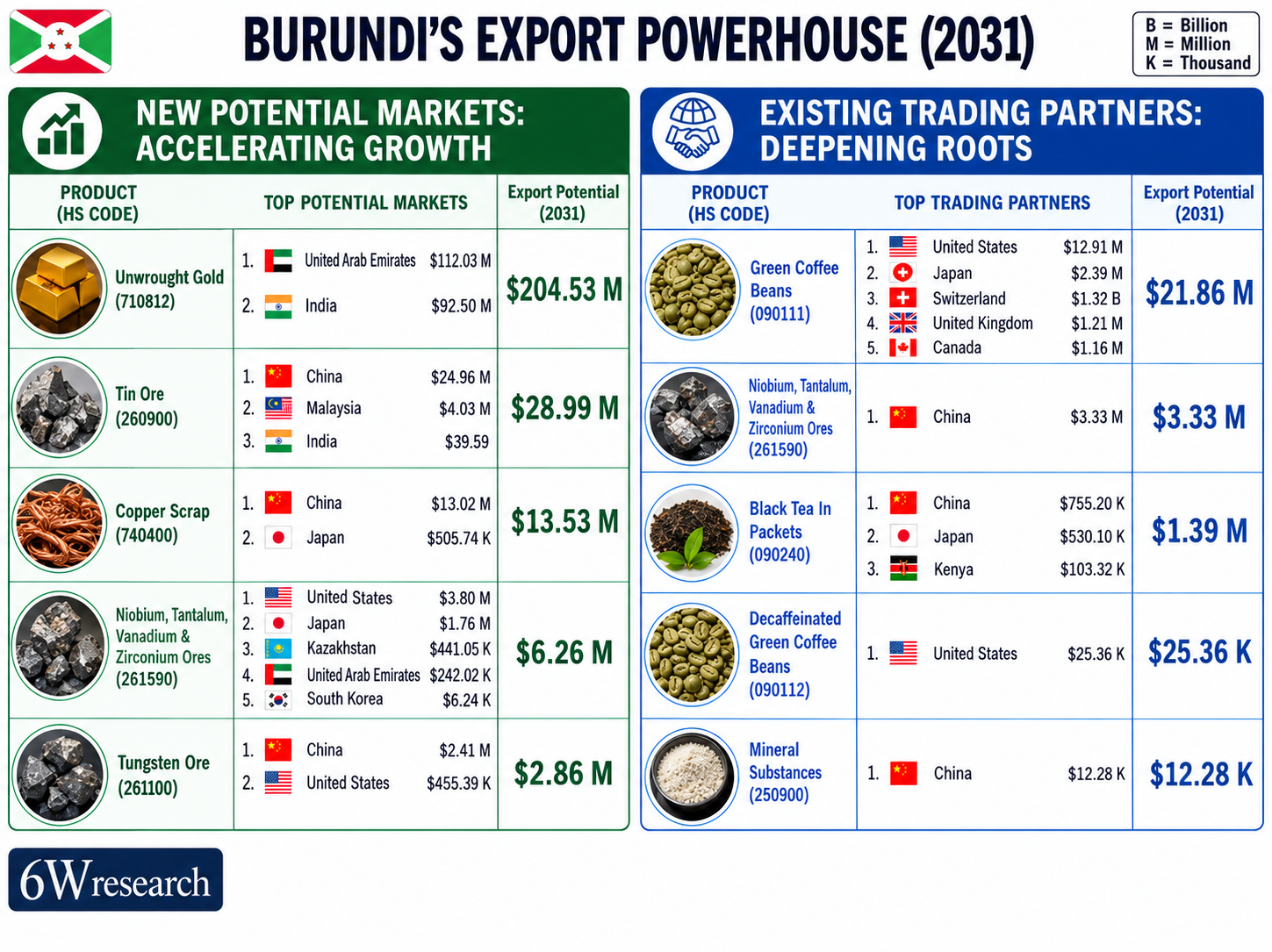
Unwrought gold represents Burundi's largest new-market opportunity by a wide margin at USD 204.53 million, led by the UAE at USD 112.03 million and India at USD 92.50 million. Both destinations are consistent with global gold-refining and bullion-trading infrastructure rather than end-use manufacturing, reflecting artisanal and small-scale gold production in Burundi and the wider Great Lakes region being drawn into two of the world's largest gold-import markets. The concentration of opportunity in these markets is driven by their established roles as international bullion hubs, where gold is typically aggregated, refined and redistributed through global trading networks. Enhancement of formal gold export channels and traceability may assist Burundi in deriving more benefit from the mineral potential in the country.
Tin ore and copper scrap account for USD 28.99 million and USD 13.53 million respectively. Tin ore is dominated by China with an import worth of USD 24.96 million followed by Malaysia, which stands second at an import level of USD 4.03 million. These two countries are major players when it comes to tin smelting and electronics manufacturing worldwide. For copper scrap, China takes first position in importing it to the tune of USD 13.02 million. This is because of the fact that China has an enormous capacity to recycle copper worldwide.
Niobium, tantalum, vanadium and zirconium ores and tungsten ore round out the new-corridor top five, contributing USD 6.26 million and USD 2.86 million. The United States owns the top opportunity in rare-metal ore or zirconium ore at USD 3.80 million, followed by Japan at USD 1.76 million, both economies with advanced electronics and aerospace industries requiring these specialty inputs. Tungsten ore is majorly led by China at USD 2.41 million. Across all five, Burundi's new-corridor opportunity is overwhelmingly a mineral story, anchored by gold but extending into tin, copper and rare-metal ores that have little overlap with the coffee-and-tea identity of established trade.
Coffee Anchors Burundi’s Established Trade, While Tea and Mineral Products Provide Limited Diversification
Green coffee beans represent Burundi's largest established export opportunity at USD 21.86 million, led by the United States at USD 12.01 million, Japan at USD 2.50 million and Switzerland at USD 1.40 million. The United States' dominant share reflects strong specialty-coffee demand for Burundi's high-altitude Arabica beans, with Japan, Switzerland, the United Kingdom and Canada rounding out a genuinely international, if modestly sized, roaster base. This diversified buyer presence is supported by Burundi’s reputation for premium-quality Arabica coffee, where quality differentiation and specialty positioning allow access to niche markets despite limited export volumes. Expanding processing capacity and maintaining quality standards could further strengthen Burundi’s position among specialty coffee buyers.
Niobium, tantalum, vanadium and zirconium ores and black tea in packets add a further USD 3.33 million and USD 1.39 million. The rare-metal ore is traded entirely to China, an early and highly concentrated relationship. Black tea is led by China at USD 755.20 thousand and Japan at USD 530.10 thousand, with Kenya, itself being a major regional tea auction hub, absorbing a smaller volume. China’s role in rare-metal imports reflects its dominant global processing capacity and demand for mineral inputs used in industrial and technology supply chains, while tea exports benefit from established Asian consumption markets and regional trading networks.
The decaffeinated green coffee beans and mineral substances make the fifth group that has a combined total worth of roughly USD 37.64 thousand. Together, all these five groups show that Burundi's trade is real but very small in terms of quantity, with only coffee dominating and tea being the second product of significance, followed by rare metals.
|
Burundi’s export outlook highlights a significant opportunity to unlock greater value from its mineral resources. While traditional exports remain centered on coffee and tea, the growing potential in gold and other minerals reflects the importance of stronger formalization, traceability and value-chain development. Improving governance and processing capabilities could help Burundi transform its mineral wealth into a more sustainable driver of export growth. 6WExportGTM Analysis |
Top Global Export Opportunities (2031), By Product
| Product | Export Opportunity (USD Billion) |
| Electronic Integrated Circuits | 685.7 |
| Refined Petroleum Oils | 668.4 |
| Light Petroleum Oils | 588.9 |
| Logic Electronic Integrated Circuits | 507.9 |
| Medicines | 381.2 |
| Gasoline Passenger Cars (1.5–3.0L) | 360.9 |
| Smartphones | 343.6 |
| Electronic Integrated Circuits with Memory | 333.2 |
| Data Transmission Equipment | 216.9 |
| Immunological Products | 209.6 |
Excludes naturally occurring products (e.g., crude oil, raw gold). Source: 6WExportGTM
Export prospects globally until 2031 will see more opportunities in electronics, integrated circuits, oil products, drugs, cars, cell phones, and technology equipment due to increased need for semiconductors, oil products, health-related products, and IT infrastructure. In regard to Burundi, this global trend implies that the country needs to look past its main exports of coffee, tea, gold and mineral ore in order to add more value. It may not be possible for Burundi to be seen as an exporter of high-end products in the immediate future, but the country can definitely meet global demands by processing minerals, agricultural, and commodities such as gold, tin, tantalum and agriculture products.
A Tripling Gold Trade and a Coffee Sector Riding Higher Prices: Two Developments Shaping Burundi's Export Base
Two trends will influence Burundi's future export prospects. In addition, gold exports in Burundi have tripled in a year, indicating the importance of mineral exports; nonetheless, according to the IMF, further reforms in governance are necessary in order to harness all the possible benefits from this industry. Moreover, the coffee sector is benefiting from an increase in global prices of coffee which is allowing the sector to export more, even with reform efforts aimed at increasing efficiency and competitiveness.
Burundi's Gold Exports Have Tripled in a Year, but the IMF Says Formalization and Transparency Reforms Are Still Needed
Burundi's gold exports have risen from approximately 400 kilograms in 2024 to around 1.2 tonnes in 2025 as seen in the 2026 Article IV consultation mission of the IMF owing to the increase in prices of gold in the international market and increased production levels. In the final quarter of 2025 alone, there have been exports of slightly over 200 kilograms of gold valued at over USD 27 million, together with other minerals whose value exceeds USD 7 million. The IMF explicitly credited higher gold and coffee prices, Burundi's two main exports, with helping moderate pressure on the country's foreign exchange market and reduce inflation from 45.5% in April 2025 to 10.8% in March 2026, but the Fund also called for progress on formalizing the artisanal mining sector, joining the Extractive Industries Transparency Initiative, and establishing a stable fiscal regime, echoing concerns raised by Burundian civil-society groups including OLUCOME about transparency in mineral-export revenue. For a new-corridor unwrought-gold opportunity already worth USD 204.53 million and led by the UAE and India, both markets repeatedly flagged in international reporting as major destinations for artisanal African gold, the pace and credibility of these formalization reforms will shape how much of this opportunity Burundi can capture through official channels.
|
Burundi’s rapid increase in formal gold exports highlights the growing role of minerals in reshaping its export structure. However, strengthening mining governance, improving artisanal sector formalization and ensuring transparent revenue management will be critical for converting this emerging gold opportunity into sustainable long-term export growth. Manish Pant, Senior Data Scientist, Data Science & Market Intelligence, 6Wresearch |
Higher International Coffee Prices Are Lifting Export Revenue, even as Burundi's Decades-Long Sector Reform Remains Unfinished
Coffee remains Burundi's signature export crop and a critical livelihood for hundreds of thousands of farming families, grown across more than 160 washing stations built up since major World Bank-backed investment in the 1980s. The sector has been under a slow, politically contentious liberalization process since 2006, when the government began allowing private ownership of washing stations and dry mills, a process that saw renewed government attention from 2020 onward with the establishment of a new regulatory body, ODECA, taking over most sector-oversight functions. The IMF's May 2026 Article IV statement specifically credited higher international coffee prices, alongside gold, with lifting Burundi's export revenue and foreign-exchange inflows over the past year, even as the underlying structural reform of the sector, balancing private investment with grower incomes, remains an ongoing and unresolved process after nearly two decades. For an established green-coffee export opportunity worth USD 21.86 million and led by the United States, Japan and Switzerland, sustaining the current price-driven revenue gains will depend on whether quality-focused reforms translate into durable, higher-value specialty-coffee positioning rather than a temporary price cycle.
|
Burundi’s coffee sector remains a strategic export asset, but future growth will depend on shifting from volume-driven exports toward higher-value specialty coffee positioning. Strengthening sector reforms, improving farmer incomes and enhancing quality standards will be essential to convert current price-supported gains into sustainable export competitiveness. Manisha Gupta, Data Analyst, Data Science & Market Intelligence, 6Wresearch |
The Takeaway
Burundi should treat its export outlook through 2031 as one of converting an already-visible mineral windfall into durable, formally captured revenue, since gold exports have already tripled in a year and the new-corridor suggests substantially more value is available if the sector is properly formalized. The path forward depends on pairing IMF-recommended mining-governance reforms with continued support for the coffee sector that has anchored Burundi's export identity for nearly a century.
Key strategic priorities for Burundi include:
- Accelerate gold-sector formalization and EITI membership: With the amount of gold exported by Burundi expected to triple to about 1.2 tonnes by 2025 and the new corridor for gold exports valued at USD 204.53 million being centered in the UAE and India, Burundi should take immediate action on the transparency and formalization measures recommended by the IMF.
- Build direct trading relationships with UAE and Indian gold buyers: Instead of allowing the gold to flow informally in the region and then enter the Dubai and Indian markets, Burundi should try and establish direct relations with gold buyers and refiners in these regions.
- Sustain coffee-sector quality investment through the current favorable price cycle: With an established green-coffee base worth USD 21.86 million benefiting from higher international prices, Burundi should use the current revenue upswing to fund quality-focused investment at washing stations, helping ensure gains prove durable rather than tied solely to a temporary price cycle.
- Diversify the rare-metal ore trade beyond a single buyer: Established niobium, tantalum, vanadium and zirconium ore exports go entirely to China, while the same product's new-corridor opportunity is led by the United States and Japan. Burundi should use this new-corridor demand to build a second rare-metal buyer relationship, reducing dependence on a single market for a strategically important input.
Overall, Burundi's export growth through 2031 will depend less on discovering new products to sell and more on how successfully the country formalizes a mineral sector that is already generating far more value than official trade data has historically captured a reminder that for a small, resource-rich economy like Burundi's, governance reform can matter as much as production growth itself.

Leadership Perspectives from Industry Events
Search
6Wresearch in the News
 Forbes
Citing 6Wresearch analytics to map global infrastructure and pharmaceutical industry trajectories.
 Bloomberg Law
Direct syndication of 6Wresearch's macro data points, capturing complex supply chain shifts.
 Reuters
Tracking industrial manufacturing adjustments and electronic security ecosystem scaling.
 Mint
Mint
Utilizing deep-tech sector market sizing to analyze global automation and robotics.
 The Economic Times
Anchoring features on industrial IoT growth metrics and connected smart-grid devices.
 Business Standard
Featuring strategic evaluations of Advanced Driver Assistance Systems (ADAS) and AI road safety.
 The Hindu
Spotlighting core commercial metrics ranging from unmanned aerial vehicles (UAVs) to consumer durables.
 Financial Express
Anchoring quarterly reviews on cross-border real estate tech and structural hardware manufacturing.
 Yahoo Finance
Syndicating the tracker's $30.1 billion untapped-market findings, spotlighting Japan, the US and China as India's top new-potential importers.
 India Today
Carrying the release on smartphones leading India's export potential to $94 billion by 2031, per 6WExportGTM data.
 Dailyhunt
Distributing the tracker findings to its regional readership, framing India's export diversification into Japan and Mexico.
 PR Newswire Original release
Publishing the full India Export Attractiveness Tracker 2026, detailing new trade corridors across iron ore, LCVs and pharmaceuticals.
 The Industrial
Highlighting the tracker's read on India's semiconductor ambitions and long-term chip-assembly export potential.
 PTI News
Reporting on the $66.81 billion pharmaceuticals export opportunity flagged in the tracker, amid looming US generic-drug tariffs.
 Tribune India
Covering the tracker's tariff-versus-regulation analysis across India's mature export markets in the US, China and UAE.
 ANI News
Amplifying the report's findings on polished diamonds, refined petroleum and medicines as India's core export engines.
 International Business Magazine
Covering the report's insight into how AEB, blind spot detection, and driver monitoring are reshaping India's ADAS market.
 Focus Gaming News
Highlighting the research forecast for Egypt's gambling market, projecting steady growth through 2032.
Thought Leadership and Analyst Meet





Our Clients








Latest Reports
- Bahrain Vehicle-Supported Bicycle Drive Chains Market (2026-2032)
- Azerbaijan Vehicle-Supported Bicycle Drive Chains Market (2026-2032)
- Australia Vehicle-Supported Bicycle Drive Chains Market (2026-2032)
- Argentina Vehicle-Supported Bicycle Drive Chains Market (2026-2032)
- Algeria Vehicle-Supported Bicycle Drive Chains Market (2026-2032)
- Zimbabwe Vehicle-Grade Aluminum Materials Market (2026-2032)
- Zambia Vehicle-Grade Aluminum Materials Market (2026-2032)
- Yemen Vehicle-Grade Aluminum Materials Market (2026-2032)
- Vanuatu Vehicle-Grade Aluminum Materials Market (2026-2032)
- Uzbekistan Vehicle-Grade Aluminum Materials Market (2026-2032)
Industry Events and Analyst Meet

EV India Expo 2026

HIMTEX 2026

India Refining Summit 2026

India EV Show 2026

EV tech India Expo 2026
Whitepaper
- Middle East & Africa Commercial Security Market Click here to view more.
- Middle East & Africa Fire Safety Systems & Equipment Market Click here to view more.
- GCC Drone Market Click here to view more.
- Middle East Lighting Fixture Market Click here to view more.
- GCC Physical & Perimeter Security Market Click here to view more.


