Ghana's Unwrought Gold Exports to Existing Partners Could Reach USD 3.85 Billion, While Crude Petroleum Opens USD 439.12 Million Across New Potential Markets by 2031
China leads Ghana's established export base at 35.46% of total export potential, more than triple of United States' 11.72% in second place. New-corridor markets are led by China again, this time at 59.81%, more than seven times the United States' 8.57% in second place. Gold, manganese and crude oil anchor Ghana's established trade, sold into Swiss refining hubs, Chinese industrial buyers and Western energy markets, while new-corridor opportunities are dominated by the same crude oil and gold reaching a fresh set of Southeast Asian and Gulf buyers, alongside a smaller but genuine palm oil and infant-food trade with China.
 Source: 6WExportGTM
China Leads Both Established and New Potential Markets by a Wide Margin
Ghana’s new-corridor export opportunities are strongly concentrated in China, which represents the largest potential importer with an estimated export potential of USD 3.03 billion. The United States follows with USD 0.43 billion, while Singapore, Malaysia and India provide additional opportunities of USD 0.39 billion, USD 0.24 billion and USD 0.19 billion, respectively. Such market distribution underscores the great potential that exists for Ghana to explore new markets other than the conventional ones by fostering closer business ties in Asia and North America, specifically mineral products, energy products, and processed goods.
| Top 5 Existing Importers | Export Potential (USD) | Top 5 New Potential Importers | Export Potential (USD) |
| China | 5.20 | China | 3.03 |
| United States | 1.72 | United States | 0.43 |
| India | 1.47 | Singapore | 0.39 |
| Switzerland | 1.45 | Malaysia | 0.24 |
| United Arab Emirates | 0.85 | India | 0.19 |
Source: 6WExportGTM
China accounts for USD 5.20 billion of Ghana's established export potential, more than triple the United States' USD 1.72 billion in second place. India ranks third at USD 1.47 billion, with Switzerland and the UAE rounding out the top five at USD 1.45 billion and USD 0.85 billion. This reflects Ghana's position as a major global gold, manganese and crude-oil exporter, with China anchoring demand for industrial minerals and Switzerland and the UAE serving as the classic gold-refining and bullion-trading destinations for Ghanaian gold.
Ghana’s Evolving Trade Corridors Create New Pathways for Oil, Gold, and Export Growth
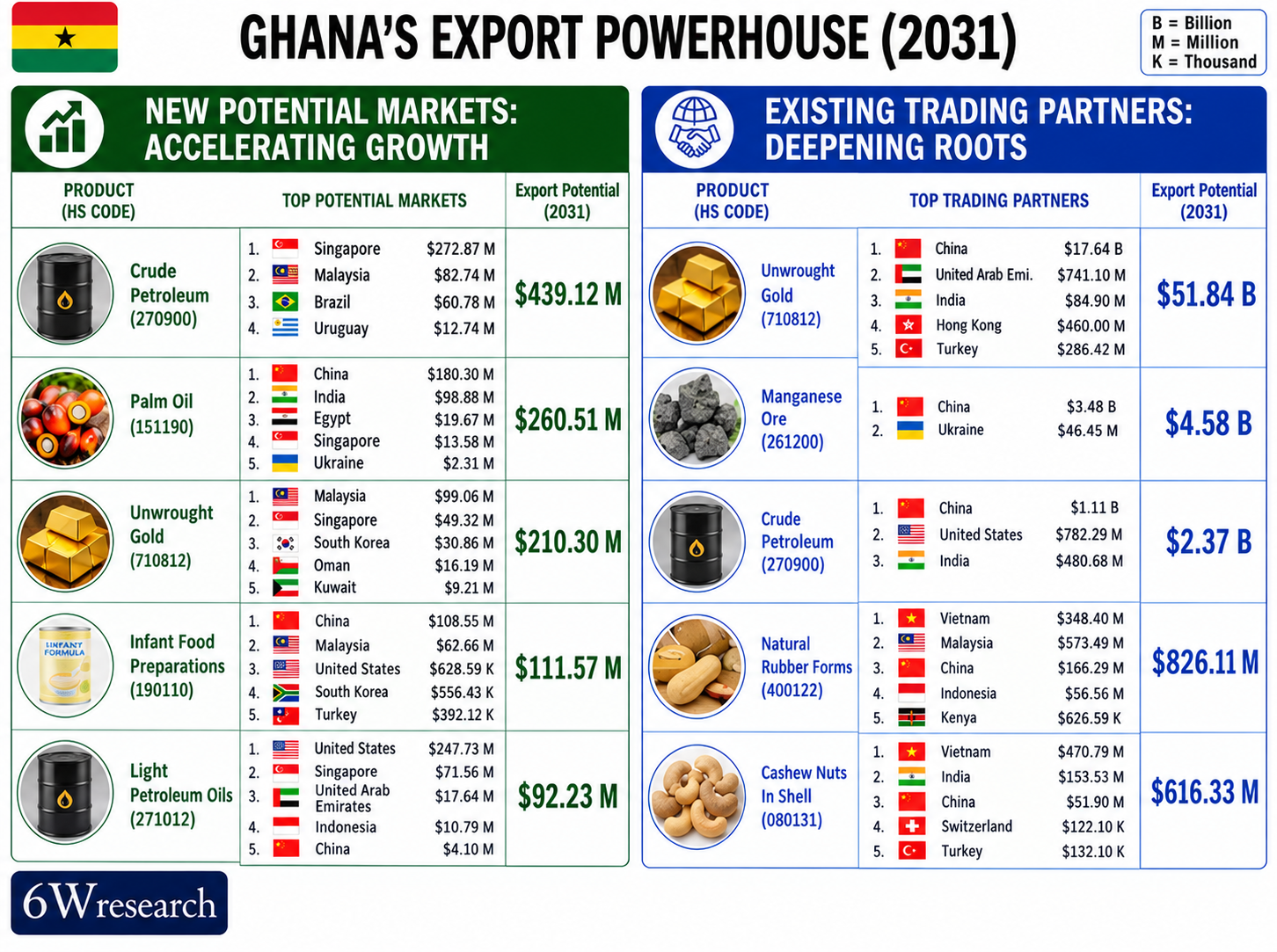
Crude petroleum represents Ghana’s largest new-corridor opportunity at USD 439.12 million, led by Singapore at USD 272.87 million, Malaysia at USD 92.74 million, and Brazil at USD 60.78 million. The emergence of these markets is further fueled by the role they play as prominent global refining, storage and trading centers, providing more avenues for crude exports from Ghana. Increasing exposure to markets in Southeast Asia and South America underscores the importance of Ghana as having the ability to diversify crude export destinations and increase connectivity to global energy trading networks.
Palm Oil and Unwrought Gold form some other export commodities worth USD 260.51 million and USD 210.30 million, respectively. The export of palm oil is largely driven by demands from China (USD 160.80 million) and India (USD 69.88 million), facilitated by increasing needs for consumption in major Asian countries and diversification of agricultural exports from Ghana. The export of unwrought gold through these emerging corridors is largely driven by demands from Malaysia (USD 99.06 million) and Singapore (USD 49.32 million).
Infant food preparations and light petroleum oils round out the new-corridor top five, contributing USD 111.57 million and USD 92.23 million. Infant food preparations are sold almost entirely to China at USD 106.55 million, a striking, singular consumer-goods relationship with no precedent in established trade while countries like Malaysia and United States make up for the smaller volumes. Light petroleum oils are led by the United States at USD 24.73 million and Singapore at USD 21.56 million. Across all five, Ghana's new-corridor opportunity mixes the same oil-and-gold resource base reaching new buyer geographies with two genuinely new categories, palm oil and infant food, that extend Ghana's export profile beyond minerals and energy.
Gold, Manganese and Crude Oil Remain the Foundation of Ghana's Established Trade
Unwrought gold represents Ghana's largest established export opportunity at USD 3.85 billion, led by Switzerland at USD 1.38 billion, the UAE at USD 741.11 million and India at USD 584.50 million. Switzerland's leading position reflects its role as the world's dominant gold-refining hub, while the UAE and India's substantial volumes point to major bullion-trading and consumer-gold markets, with Hong Kong and Turkey rounding out a genuinely global buyer base for Ghana's gold.
Manganese ore and crude petroleum add a further USD 3.58 billion and USD 2.37 billion. Manganese ore is sold almost entirely to China at USD 3.53 billion, reflecting China's dominant global steelmaking capacity and its demand for manganese as a critical alloying input, while Ukraine absorbs a negligible amount. Crude petroleum is led by China at USD 1.11 billion and the United States at USD 782.29 million, Ghana's two largest established crude-oil buyers.
Natural rubber forms and cashew nuts in shell complete the established top five, contributing USD 826.11 million and USD 616.33 million. Rubber is led by Vietnam at USD 348.40 million and Malaysia at USD 254.19 million, both major global tire and rubber-goods manufacturing economies. Cashew nuts are led by Vietnam at USD 478.76 million, extending the same processing relationship seen in rubber. Collectively, these five categories confirm that Ghana's established export advantage rests on a genuinely diversified base of precious metals, industrial minerals and agricultural raw materials, with China and Switzerland as the two most consequential buyers overall.
|
Ghana's export base is a story of concentrated dependence on China across minerals and a parallel, Switzerland-anchored gold-refining relationship. What's notable about the new potential markets is that China's dominance actually deepens rather than diversifies, even as gold and oil both find entirely new buyer geographies in Southeast Asia and Latin America. 6WExportGTM Analysis |
Top Global Export Opportunities (2031), By Product
| Product | Export Opportunity (USD Billion) |
| Electronic Integrated Circuits | 685.7 |
| Refined Petroleum Oils | 668.4 |
| Light Petroleum Oils | 588.9 |
| Logic Electronic Integrated Circuits | 507.9 |
| Medicines | 381.2 |
| Gasoline Passenger Cars (1.5–3.0L) | 360.9 |
| Smartphones | 343.6 |
| Electronic Integrated Circuits with Memory | 333.2 |
| Data Transmission Equipment | 216.9 |
| Immunological Products | 209.6 |
Excludes naturally occurring products (e.g., crude oil, raw gold). Source: 6WExportGTM
Global export opportunities through 2031 are expected to be concentrated in electronic integrated circuits, petroleum products, medicines, passenger vehicles, smartphones and digital communication equipment, reflecting rising demand for technology, energy security, healthcare and connectivity solutions. Ghana faces an opportunity through the aforementioned developments to break away from its dependence on the production and export of gold, petroleum, cocoa and minerals and venture into value added industries. While it would be difficult for Ghana to get into the manufacturing of electronic products or vehicles in the immediate future, it can take advantage of its comparative strengths in oil refining, mineral extraction, agro-processing and pharmaceuticals to increase its share of value in the global value chain.
A Gold Formalization Success and an Oil Sector in Recovery: Two Developments Shaping Ghana's Export Base
Two factors will affect the future of Ghanaian exports: The first is the advancement being made by the Gold Board in making artisanal gold exports formal, hence increasing transparency in Ghana’s gold export framework, while the second is the recovery of the oil industry following several years of reduced production levels in the sector.
GoldBod's Formalization Drive Has Nearly Doubled Ghana's Gold Export Earnings and Rebuilt Foreign Reserves
The Ghana Gold Board, set up for the purpose of institutionalizing the small-scale mining operations and consolidating all gold purchases, testing, and export, bought and exported gold amounting to about USD 16.11 billion during the period from January 2025 to May 2026, USD 9.8 billion of which was exported in 2025 alone. Total earnings of Ghana from its gold exports rose to about USD 20 billion in 2025, almost twice as high as the USD 10.3 billion of the year before, and contributed greatly to raising the national total export earnings to an unprecedented USD 31.1 billion. It is estimated that the small-scale mining sector alone exported 103 to 104 tons of gold in 2025, compared to 66.3 tons in 2024, mainly due to GoldBod’s aggregation model rather than high gold prices.
President Mahama credited the reforms with helping push Ghana's foreign reserves to a record USD 13.8 billion by early 2026, up from USD 8.9 billion at the end of 2024, while the Finance Ministry linked GoldBod exports to a 41% appreciation of the Ghanaian cedi against the US dollar in 2025. For an established gold export base already worth USD 3.85 billion, this formalization success represents a durable structural improvement in revenue capture rather than a one-off price effect, though officials themselves caution that roughly 61% of export earnings now concentrated in a single commodity leaves Ghana more exposed to any future gold-price correction.
|
Ghana’s GoldBod reforms mark a structural shift in the country’s gold trade by improving formalization, traceability and government revenue capture from artisanal mining. While the initiative strengthens Ghana’s position as a global gold exporter and improves foreign-exchange stability, the rising dependence on gold also reinforces the need to diversify exports into other mineral, agricultural and value-added sectors. Manish Pant, Senior Data Scientist, Data Science & Market Intelligence, 6Wresearch |
Ghana's Oil Production Is Recovering in 2026 After Six Consecutive Years of Decline
Ghana's crude oil output fell every year from a 2019 peak of 71.4 million barrels to just 37.3 million barrels in 2025, a decline of roughly 48% driven by natural reservoir depletion at the mature Jubilee, TEN and Sankofa-Gye Nyame fields and years of underinvestment in new drilling. That trend has begun to reverse in 2026: Kosmos Energy reported that a new drilling campaign at Jubilee, including the J76 well that added roughly 20,000 barrels per day, lifted average field production to 72,000 barrels per day in the second quarter of 2026, up from just 59,000 barrels per day in the fourth quarter of 2025, with a further well, J77, expected to push output toward 90,000 barrels per day.
Ghana has also extended the Jubilee and TEN licenses to 2040, increasing state-owned GNPC's future stake from 19.69% to 29.69%, and committed USD 2 billion to drilling 20 new wells across both fields, while Eni declared commerciality on its Eban-Akoma discovery in July 2025 and GNPC plans onshore Voltaian Basin exploration from October 2026. For an established crude-petroleum export base worth USD 2.37 billion and a new-corridor opportunity worth USD 439.12 million, this production recovery, if sustained, would directly support Ghana's oil-export figures after years of decline that Ghana's own Institute for Energy Security estimated cost the country USD 16.5 billion in lost revenue since 2019.
|
Ghana’s crude oil sector is showing early recovery after years of production decline caused by mature fields and underinvestment. New drilling activity, license extensions, increased state participation and exploration projects are expected to support future output growth and strengthen Ghana’s petroleum export potential. Manisha Gupta, Data Analyst, Data Science & Market Intelligence, 6Wresearch |
The Takeaway
Ghana should treat its export outlook through 2031 as one of consolidating a genuine gold-sector formalization success while working to sustain an early-stage oil-production recovery, since both developments directly affect the two largest categories in Ghana's established export base. The path forward depends on managing the concentration risk that comes with gold now representing the majority of export earnings, while ensuring the current Jubilee drilling campaign translates into a durable reversal of six years of production decline.
Key strategic priorities for Ghana include:
- Manage gold-price concentration risk even as formalization succeeds: Considering that gold is now contributing about 61% of Ghana's export revenue, Ghana needs to use the reserve buffer which has been accumulated due to the success of GoldBod in order to protect itself from any gold price correction in the future, rather than taking current levels of earnings as a benchmark.
- Sustain the Jubilee and TEN drilling programs to lock in the oil-production recovery: With production of Jubilee rising almost to double from 59,000 to about 90,000 barrels of oil per day in a period ranging from late 2025 to mid-2026, it would be wise for Ghana to ensure the completion of its drilling program for USD 2 billion for 20 wells.
- Diversify new-corridor crude-oil buyers beyond Singapore concentration: Singapore alone accounts for USD 272.87 million of Ghana's USD 439.12 million new-corridor crude-petroleum opportunity. Ghana should build direct relationships with Malaysia and Brazil, both of which are already present, to avoid over-reliance on a single Southeast Asian trading hub.
- Build on the new palm oil and infant-food relationships with China: Palm oil (USD 260.51 million) and infant food preparations (USD 111.57 million) represent genuinely new, non-mineral new-corridor categories with no established-trade precedent. Ghana should support continued investment in agricultural processing to convert this early Chinese demand into a durable, diversified trade relationship.
Overall, Ghana's export growth through 2031 will depend on consolidating two genuine turnarounds already underway, a formalized gold sector delivering record earnings and an oil sector beginning to recover from a multi-year decline, while managing the concentration risk that comes with gold now dominating the country's export earnings more than ever before.

Leadership Perspectives from Industry Events
Search
6Wresearch in the News
 Forbes
Citing 6Wresearch analytics to map global infrastructure and pharmaceutical industry trajectories.
 Bloomberg Law
Direct syndication of 6Wresearch's macro data points, capturing complex supply chain shifts.
 Reuters
Tracking industrial manufacturing adjustments and electronic security ecosystem scaling.
 Mint
Mint
Utilizing deep-tech sector market sizing to analyze global automation and robotics.
 The Economic Times
Anchoring features on industrial IoT growth metrics and connected smart-grid devices.
 Business Standard
Featuring strategic evaluations of Advanced Driver Assistance Systems (ADAS) and AI road safety.
 The Hindu
Spotlighting core commercial metrics ranging from unmanned aerial vehicles (UAVs) to consumer durables.
 Financial Express
Anchoring quarterly reviews on cross-border real estate tech and structural hardware manufacturing.
 Yahoo Finance
Syndicating the tracker's $30.1 billion untapped-market findings, spotlighting Japan, the US and China as India's top new-potential importers.
 India Today
Carrying the release on smartphones leading India's export potential to $94 billion by 2031, per 6WExportGTM data.
 Dailyhunt
Distributing the tracker findings to its regional readership, framing India's export diversification into Japan and Mexico.
 PR Newswire Original release
Publishing the full India Export Attractiveness Tracker 2026, detailing new trade corridors across iron ore, LCVs and pharmaceuticals.
 The Industrial
Highlighting the tracker's read on India's semiconductor ambitions and long-term chip-assembly export potential.
 PTI News
Reporting on the $66.81 billion pharmaceuticals export opportunity flagged in the tracker, amid looming US generic-drug tariffs.
 Tribune India
Covering the tracker's tariff-versus-regulation analysis across India's mature export markets in the US, China and UAE.
 ANI News
Amplifying the report's findings on polished diamonds, refined petroleum and medicines as India's core export engines.
 International Business Magazine
Covering the report's insight into how AEB, blind spot detection, and driver monitoring are reshaping India's ADAS market.
 Focus Gaming News
Highlighting the research forecast for Egypt's gambling market, projecting steady growth through 2032.
Thought Leadership and Analyst Meet





Our Clients








Latest Reports
- Bahrain Vehicle-Supported Bicycle Drive Chains Market (2026-2032)
- Azerbaijan Vehicle-Supported Bicycle Drive Chains Market (2026-2032)
- Australia Vehicle-Supported Bicycle Drive Chains Market (2026-2032)
- Argentina Vehicle-Supported Bicycle Drive Chains Market (2026-2032)
- Algeria Vehicle-Supported Bicycle Drive Chains Market (2026-2032)
- Zimbabwe Vehicle-Grade Aluminum Materials Market (2026-2032)
- Zambia Vehicle-Grade Aluminum Materials Market (2026-2032)
- Yemen Vehicle-Grade Aluminum Materials Market (2026-2032)
- Vanuatu Vehicle-Grade Aluminum Materials Market (2026-2032)
- Uzbekistan Vehicle-Grade Aluminum Materials Market (2026-2032)
Industry Events and Analyst Meet

EV India Expo 2026

HIMTEX 2026

India Refining Summit 2026

India EV Show 2026

EV tech India Expo 2026
Whitepaper
- Middle East & Africa Commercial Security Market Click here to view more.
- Middle East & Africa Fire Safety Systems & Equipment Market Click here to view more.
- GCC Drone Market Click here to view more.
- Middle East Lighting Fixture Market Click here to view more.
- GCC Physical & Perimeter Security Market Click here to view more.


