Portugal's Medicinal Formulations Exports to Existing Partners Could Reach USD 2.03 Billion, While Medium Petrol Cars Open USD 1.75 Billion Across New Markets by 2031
Portugal's export potential is expected to remain heavily concentrated around the United States, which accounts for 35.93% of the existing trading partners, followed by China at 12.04%, Canada at 5.81%, Japan at 4.67%, and Switzerland at 3.69%. In new potential markets, the United States and China together represent nearly 30% of additional opportunities, with Hong Kong, South Korea and Japan adding further diversification.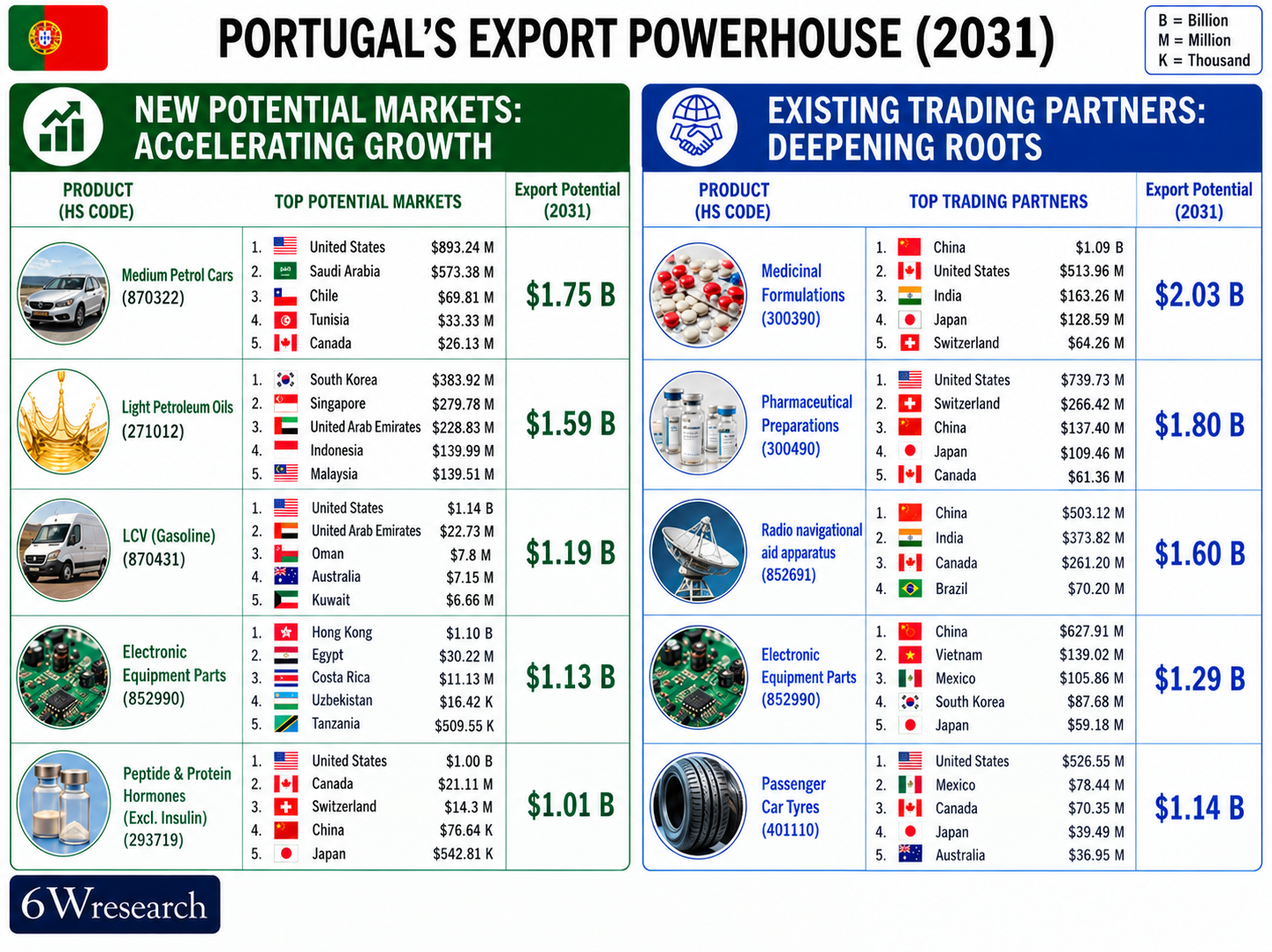 Source: 6WExportGTM
United States Leads Portugal's Existing Trading Partners by a Wide Margin, With Hong Kong a Strong Second Force in New Potential Markets
Portugal's new potential export opportunities remain led by the United States, valued at USD 5.62 billion, though its lead over other markets narrows considerably compared with the established base. Hong Kong follows as the second-largest new-corridor opportunity at USD 2.62 billion, reflecting its role as a global trading and re-export hub. China contributes a further USD 1.84 billion, followed by South Korea at USD 1.51 billion and Japan at USD 1.28 billion. These markets collectively represent significant diversification potential for Portugal's exporters, layering new East Asian and re-export hub relationships onto its traditionally US and Europe-anchored trade base.
| Top 5 Existing Importers | Export Potential (USD Billion) | Top 5 New Potential Importers | Export Potential (USD Billion) |
| United States | 23.60 | United States | 5.62 |
| China | 7.91 | Hong Kong | 2.62 |
| Canada | 3.82 | China | 1.84 |
| Japan | 3.07 | South Korea | 1.51 |
| Switzerland | 2.42 | Japan | 1.28 |
Source: 6WExportGTM
Pharmaceutical Preparations, Radio-Navigation Equipment and Auto Parts Round Out Portugal's Medicine-Anchored Established Trade
Medicinal formulations represent Portugal's largest established export opportunity at USD 2.03 billion, led by the United States at USD 1.09 billion, Canada at USD 0.51 billion and Saudi Arabia at USD 0.16 billion. The United States' dominant position reflects its status as the world's largest pharmaceutical market and Portugal's growing role as a European manufacturing base for generic and branded medicines, with Japan (USD 0.13 billion) and Switzerland (USD 0.06 billion) adding further high-value pharmaceutical trade relationships.
Pharmaceutical preparations, radio navigational aid apparatus and electronic equipment parts add a further USD 1.80 billion, USD 1.60 billion and USD 1.29 billion. Pharmaceutical preparations are led by the United States at USD 0.74 billion and Switzerland at USD 0.27 billion, echoing the medicinal formulations pattern. Radio navigational aid apparatus is led by the United States at USD 0.50 billion, China at USD 0.37 billion and Japan at USD 0.26 billion, reflecting Portugal's participation in global aerospace and navigation-equipment supply chains, while electronic equipment parts are instead led by China at USD 0.63 billion, with Vietnam and Mexico reflecting Portugal's integration into Asian and North American electronics manufacturing networks.
Passenger car tyres round out the established top five at USD 1.14 billion, led by the United States at USD 0.53 billion, with Mexico, Canada, Japan and Australia each contributing smaller volumes, reflecting Portugal's established automotive-component manufacturing base and its integration into North American vehicle supply chains. Collectively, these five categories confirm that Portugal's established export advantage rests on a diversified base of pharmaceuticals, electronics and automotive components, with the United States the single most consistent buyer across categories, though never to the point of complete dependence seen among single-commodity exporters.
Portugal's New Potential Markets Concentrate Around a Handful of Anchor Buyers
Medium petrol cars represent Portugal's largest new-corridor opportunity at USD 1.75 billion, led by the United States at USD 0.89 billion and Saudi Arabia at USD 0.57 billion, with Chile, Tunisia and Canada adding smaller volumes. This spread reflects genuinely new passenger-vehicle export relationships in the Gulf and Latin America, regions with limited historical exposure to Portuguese-assembled vehicles. Light petroleum oils add a further USD 1.59 billion, led by South Korea at USD 0.38 billion, Singapore at USD 0.28 billion and the United Arab Emirates at USD 0.23 billion, a genuinely new and geographically distinct set of Asian and Gulf refined-fuel trading relationships.
LCV (Gasoline) and electronic equipment parts contribute a further USD 1.19 billion and USD 1.13 billion in new-corridor potential. LCVs are led almost entirely by the United States at USD 1.14 billion, a highly concentrated but genuinely new commercial-vehicle export relationship. Electronic equipment parts in the new corridor are led just as heavily by Hong Kong at USD 1.10 billion, reflecting Hong Kong's role as a re-export and trading hub for onward distribution across Asia - a genuinely distinct channel from Portugal's China-anchored established electronics trade.
Peptide and protein hormones (excluding insulin) round out the new-corridor's top five at USD 1.01 billion, led overwhelmingly by the United States at USD 1.00 billion, underscoring the depth of US demand for Portugal's specialized pharmaceutical exports even within the new-corridor category. Across all five categories, Portugal's new-corridor opportunity looks less like a broad geographic spread and more like a small number of very large, concentrated relationships - United States-anchored vehicle and hormone trade, Hong Kong-anchored electronics - with light petroleum oils standing out as the one category showing a genuinely diversified Asian and Gulf buyer base.
|
Portugal's established export base is a story of diversified, higher-value manufacturing - pharmaceuticals, navigation electronics and automotive components - rather than concentration in a single commodity. The United States is the most consistent buyer across categories, but no single product or partner dominates the way raw commodities often do for other exporters. 6WExportGTM Analysis |
Top Global Export Opportunities (2031), By Product
| Product | Export Opportunity (USD Billion) |
| Electronic Integrated Circuits | 685.7 |
| Refined Petroleum Oils | 668.4 |
| Light Petroleum Oils | 588.9 |
| Logic Electronic Integrated Circuits | 507.9 |
| Medicines | 381.2 |
| Gasoline Passenger Cars (1.5–3.0L) | 360.9 |
| Smartphones | 343.6 |
| Electronic Integrated Circuits with Memory | 333.2 |
| Data Transmission Equipment | 216.9 |
| Immunological Products | 209.6 |
Excludes naturally occurring products (e.g., crude oil, raw gold). Source: 6WExportGTM
The global export landscape through 2031 is expected to be driven by high-value technology, energy, healthcare, and mobility products - several of which, including medicines, electronic components and automotive products, already feature prominently among Portugal's own established and new-corridor export categories. While global demand continues to concentrate around electronic integrated circuits, refined petroleum oils and smartphones, Portugal's existing strength in pharmaceutical preparations, radio-navigation electronics and passenger-vehicle components positions it to capture a growing share of this higher-value global demand rather than needing to pivot away from commodity exports, unlike more commodity-dependent economies. Leveraging its established pharmaceutical manufacturing base, integration into European and North American automotive supply chains, and participation in global electronics assembly networks, Portugal can strengthen its position by deepening downstream processing and specialized manufacturing capabilities, particularly in medicines, navigation equipment and refined energy products.
A Tariff Truce for Medicines and a Cheaper Road for Cars: Two development reshaping Portugal’s export base
Two developments are at play that will shape the Portuguese export outlook. The EU-US trade framework agreed in 2025 has largely kept pharmaceuticals outside the tariff net, while the baseline duty for most other goods is broad. On the other hand, a sharp reduction in US automotive tariffs since mid-2026 has made Portugal’s newer vehicle exports to the American market meaningfully more competitive. These factors illustrate both the robustness of Portugal’s established pharmaceutical trade and the positive prospects for its newer automotive relationships.
Portugal's Pharmaceutical Exports Have Largely Escaped the New EU-US Tariff Regime
The EU-US trade framework agreed in mid-2025 set a broad baseline duty on most European exports to the United States, but pharmaceuticals and electronics were carved out as exemptions, a decision that has proven especially valuable for Portugal given how heavily its established export base leans on medicines. Trade economists have since found that Portugal's effective tariff burden has settled among the lowest in the European Union, precisely because pharmaceutical products, which are exempt, make up such a large share of what Portugal actually ships to the US, in contrast to countries whose export mix is weighted toward steel, aluminium and other goods still facing steep duties. For an established medicinal formulations opportunity worth USD 2.03 billion, of which the United States alone accounts for USD 1.09 billion, alongside a further USD 1.80 billion in pharmaceutical preparations also led by the US, the pharmaceutical carve-out has preserved Portugal's single most important export relationship largely intact through 2031.
|
The pharmaceutical exemption is the single biggest reason Portugal's export outlook looks calmer than many of its EU peers: medicines and pharmaceutical preparations sit outside the new tariff regime entirely, and they happen to be exactly what Portugal sells most to the United States. That is a fortunate overlap rather than a guaranteed one, which is why it is worth watching closely if the exemption list is ever revisited. Manish Pant, Senior Data Scientist, Data Science & Market Intelligence, 6Wresearch |
A Sharp Cut in US Auto Tariffs Since Mid-2026 Brightens the Outlook for Portugal's Newer Vehicle Trade
US Section 232 tariffs on imported vehicles and auto parts took effect in April 2025 at a punishing rate approaching 27.5% for EU-built vehicles, before the EU-US trade deal moved EU-origin vehicles and parts onto a flat, all-inclusive 15% rate from July 2026, roughly halving the duty Portuguese-assembled vehicles face at the US border. Because Portugal's vehicle and commercial-vehicle exports to the US were only beginning to scale when the higher rate applied, the reduction arrives at a formative moment for these relationships rather than after they were already established, giving Portugal a meaningfully better entry cost just as new-corridor volumes are ramping up. For a medium petrol car opportunity worth USD 1.75 billion, led by the United States at USD 0.89 billion, and a light commercial vehicle opportunity worth USD 1.19 billion in which the US accounts for USD 1.14 billion, the lower tariff ceiling improves the economics of Portugal's fastest-growing new-corridor vehicle trade through 2031.
|
Portugal's vehicle exports to the US were still at an early stage when the tariff reduction came into effect. Since these trade relationships are not yet fully established, the lower tariff can help Portuguese exporters build stronger market presence, improve pricing competitiveness, and secure long-term business with US buyers. Manisha Gupta, Data Analyst, Data Science & Market Intelligence, 6Wresearch |
The Takeaway
Portugal's export outlook through 2031 rests on a diversified base of higher-value pharmaceuticals, electronics, navigation equipment and automotive components, anchored disproportionately by United States demand across both established and new potential market categories. Unlike commodity-dependent exporters, Portugal's risk is less about concentration in a single raw material and more about how much of its highest-value trade routes through one market; broadening its Asian and Gulf relationships, particularly in light petroleum oils and electronics, will matter more for diversification than finding new products to sell.
Key strategic priorities for Portugal include:
- Reduce reliance on United States demand across pharmaceutical and automotive categories: With the United States absorbing USD 1.09 billion of medicinal formulations, USD 0.74 billion of pharmaceutical preparations and USD 0.53 billion of passenger car tyres in the established base, Portugal should continue building out its Canadian, Swiss and Asian pharmaceutical relationships to reduce dependence on a single buyer.
- Convert the Hong Kong electronics relationship into a durable trading channel: Hong Kong's USD 1.10 billion new-corridor electronic equipment parts relationship represents a genuinely new and highly concentrated opportunity. Portugal should formalize direct trading agreements to convert early volumes into durable long-term contracts rather than relying on a single re-export hub.
- Build on the light petroleum oils relationship as a genuine diversification success: South Korea, Singapore, the United Arab Emirates, Indonesia and Malaysia together represent a broad and genuinely diversified new-corridor base for light petroleum oils; Portugal should use this pattern as a model for diversifying its more concentrated vehicle and hormone export relationships.
- Deepen Gulf and Latin American vehicle trade beyond the United States: Saudi Arabia's USD 0.57 billion new-corridor medium petrol car relationship, alongside smaller volumes from Chile and Tunisia, represents a genuinely new automotive export base; Portugal should prioritize formalizing these relationships to reduce the concentration risk evident in its United States-anchored LCV trade.

Leadership Perspectives from Industry Events
Search
6Wresearch in the News
 Forbes
Citing 6Wresearch analytics to map global infrastructure and pharmaceutical industry trajectories.
 Bloomberg Law
Direct syndication of 6Wresearch's macro data points, capturing complex supply chain shifts.
 Reuters
Tracking industrial manufacturing adjustments and electronic security ecosystem scaling.
 Mint
Mint
Utilizing deep-tech sector market sizing to analyze global automation and robotics.
 The Economic Times
Anchoring features on industrial IoT growth metrics and connected smart-grid devices.
 Business Standard
Featuring strategic evaluations of Advanced Driver Assistance Systems (ADAS) and AI road safety.
 The Hindu
Spotlighting core commercial metrics ranging from unmanned aerial vehicles (UAVs) to consumer durables.
 Financial Express
Anchoring quarterly reviews on cross-border real estate tech and structural hardware manufacturing.
 Yahoo Finance
Syndicating the tracker's $30.1 billion untapped-market findings, spotlighting Japan, the US and China as India's top new-potential importers.
 India Today
Carrying the release on smartphones leading India's export potential to $94 billion by 2031, per 6WExportGTM data.
 Dailyhunt
Distributing the tracker findings to its regional readership, framing India's export diversification into Japan and Mexico.
 PR Newswire Original release
Publishing the full India Export Attractiveness Tracker 2026, detailing new trade corridors across iron ore, LCVs and pharmaceuticals.
 The Industrial
Highlighting the tracker's read on India's semiconductor ambitions and long-term chip-assembly export potential.
 PTI News
Reporting on the $66.81 billion pharmaceuticals export opportunity flagged in the tracker, amid looming US generic-drug tariffs.
 Tribune India
Covering the tracker's tariff-versus-regulation analysis across India's mature export markets in the US, China and UAE.
 ANI News
Amplifying the report's findings on polished diamonds, refined petroleum and medicines as India's core export engines.
 International Business Magazine
Covering the report's insight into how AEB, blind spot detection, and driver monitoring are reshaping India's ADAS market.
 Focus Gaming News
Highlighting the research forecast for Egypt's gambling market, projecting steady growth through 2032.
Thought Leadership and Analyst Meet





Our Clients








Latest Reports
- Bahrain Vehicle-Supported Bicycle Drive Chains Market (2026-2032)
- Azerbaijan Vehicle-Supported Bicycle Drive Chains Market (2026-2032)
- Australia Vehicle-Supported Bicycle Drive Chains Market (2026-2032)
- Argentina Vehicle-Supported Bicycle Drive Chains Market (2026-2032)
- Algeria Vehicle-Supported Bicycle Drive Chains Market (2026-2032)
- Zimbabwe Vehicle-Grade Aluminum Materials Market (2026-2032)
- Zambia Vehicle-Grade Aluminum Materials Market (2026-2032)
- Yemen Vehicle-Grade Aluminum Materials Market (2026-2032)
- Vanuatu Vehicle-Grade Aluminum Materials Market (2026-2032)
- Uzbekistan Vehicle-Grade Aluminum Materials Market (2026-2032)
Industry Events and Analyst Meet

EV India Expo 2026

HIMTEX 2026

India Refining Summit 2026

India EV Show 2026

EV tech India Expo 2026
Whitepaper
- Middle East & Africa Commercial Security Market Click here to view more.
- Middle East & Africa Fire Safety Systems & Equipment Market Click here to view more.
- GCC Drone Market Click here to view more.
- Middle East Lighting Fixture Market Click here to view more.
- GCC Physical & Perimeter Security Market Click here to view more.


