Senegal's Cashew Nut Exports to Existing Partners Could Reach USD 568.84 Million, While Refined Petroleum Oils Open USD 1.20 Billion Across New Markets by 2031
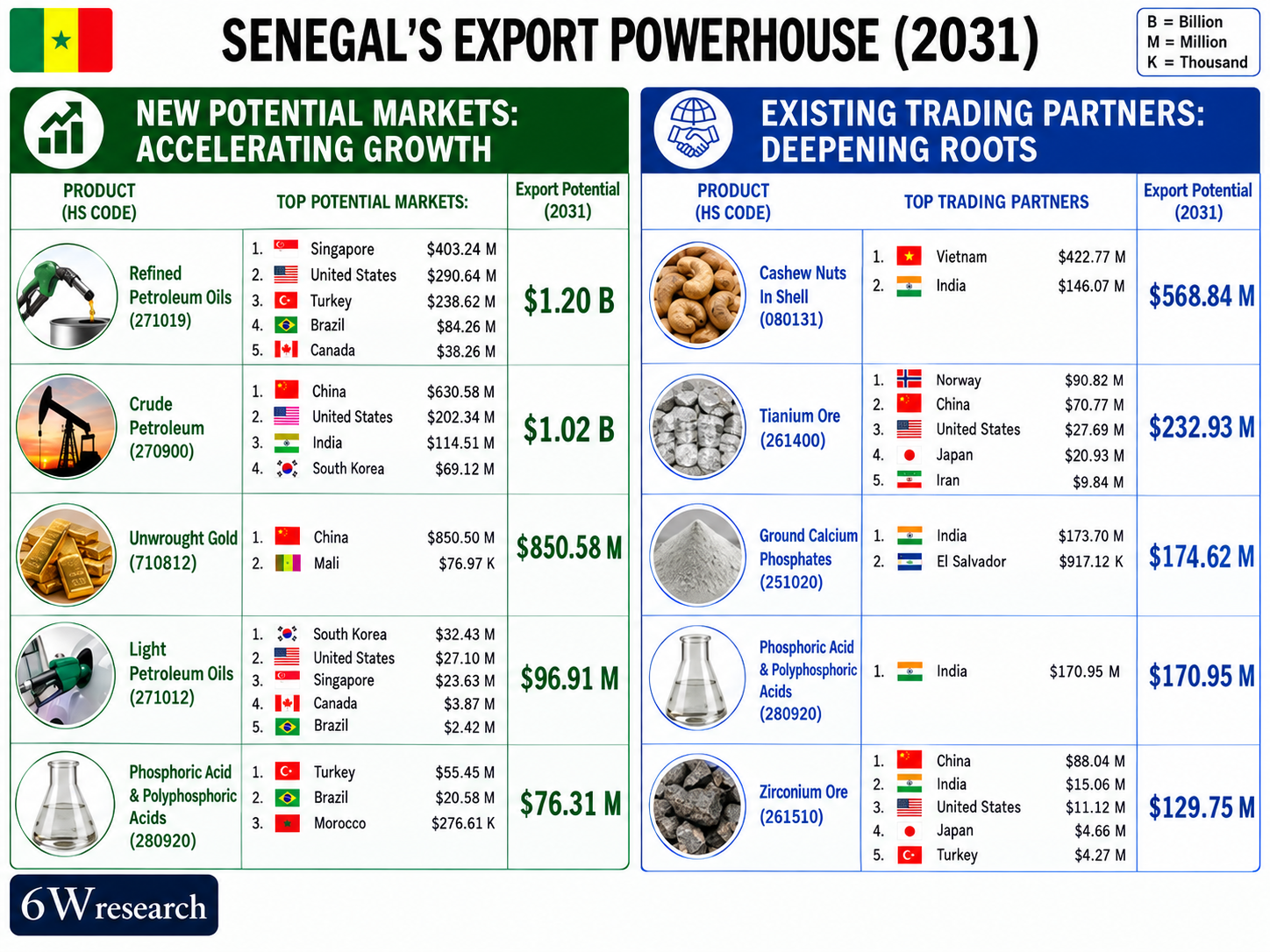
India leads Senegal’s established export base at 26.72%, followed by Vietnam at 21.50% and China at 15.37%. New potential markets are more concentrated, with the United States accounting for 38.59% and China for 31.13%. Established exports are anchored by cashew nuts, titanium ore and phosphate products, while emerging opportunities increasingly reflect Senegal’s growing oil and gas sector. The shift toward refined petroleum, crude oil and gold exports highlights a potentially transformative change in Senegal’s trade opportunities and its structure, alongside its traditional agriculture and mineral base.
 Source: 6WExportGTM
United States Leads New Potential Markets Transformed by Senegal's Emerging Oil and Gas Sector
Senegal’s new-corridor export opportunities are led by the United States at 38.59%, followed by China at 31.13%, together accounting for nearly 70% of the identified potential. Singapore has a share of 8.96%, whereas Turkey and India have shares of 6.08% and 3.24%, respectively. This analysis clearly indicates high potential for increasing the export footprint of Senegal in North America, Asia, and new trade routes, where the United States and China provide the greatest scope.
| Top 5 Existing Leading Importers | Share of Category | Top 5 New Potential Importers | Share of Category |
| India | 26.72% | United States | 38.59% |
| Vietnam | 21.50% | China | 31.13% |
| China | 15.37% | Singapore | 8.96% |
| United States | 7.64% | Turkey | 6.08% |
| Norway | 4.64% | India | 3.24% |
Source: 6WExportGTM
India accounts for 26.72% of Senegal's established export potential, narrowly ahead of Vietnam at 21.50% and China at 15.37%. The United States and Norway round out the top five at 7.64% and 4.64%. This reflects Senegal's role as a significant cashew, titanium and phosphate exporter feeding South and Southeast Asian processing industries, alongside smaller volumes of specialty minerals reaching Western markets.
A New Oil, Gas and Gold Corridor to the US, China and Singapore Headlines Senegal's New Potential Market Opportunities
Refined petroleum oils represent Senegal's largest new-corridor opportunity at USD 1.20 billion, led by Singapore at USD 403.42 million, the United States at USD 290.64 million and Turkey at USD 238.62 million. This broad, multi-continental buyer base is a genuinely new category for Senegal, reflecting the country's rapid emergence as a petroleum exporter following the start of offshore production, with output finding its way into major global fuel-trading hubs.
Crude petroleum and unwrought gold add a further USD 1.02 billion and USD 850.58 million. Crude petroleum is led by China at USD 630.58 million and the United States at USD 202.34 million, direct evidence of Senegal's new offshore oil reaching two of the world's largest crude-consuming economies. Unwrought gold is sold almost entirely to China at USD 850.50 million, reflecting fast-growing Senegalese gold production finding its way to Chinese bullion and industrial buyers.
Light petroleum oils and phosphoric acid round out the new-corridor top five, contributing USD 96.91 million and USD 76.31 million. Light petroleum oils are led by South Korea at USD 32.43 million and the United States at USD 27.10 million, extending Senegal's new petroleum-export identity into a further product category. Phosphoric acid is led by Turkey at USD 55.45 million, building on Senegal's established phosphate-processing base. Across all five, Senegal's new-corridor opportunity is overwhelmingly defined by its new status as an oil, gas and gold exporter, a fundamentally different export profile from the agriculture and minerals base that anchors established trade.
Cashews, Titanium and Phosphates Remain the Foundation of Senegal's Asia-Anchored Established Trade
Cashew nuts in shell represent Senegal's largest established export opportunity at USD 568.84 million, led by Vietnam at USD 422.77 million and India at USD 146.07 million. Vietnam's dominant share reflects its position as the world's largest cashew-processing hub, importing raw nuts from West African origins including Senegal for shelling, roasting and re-export, with India's substantial volume drawing on its own long-established cashew-processing industry.
Titanium ore and ground calcium phosphates add a further USD 232.93 million and USD 174.62 million. Titanium ores include Norway at USD 90.82 million and China at USD 70.77 million, two nations that use this type of mineral as a buyer for titanium dioxide pigments. Ground calcium phosphates include India, which stands out as the only buyer at USD 173.70 million, due to their agricultural needs.
Phosphoric acid and zirconium ore complete the established top five, contributing USD 170.95 million and USD 129.75 million. Phosphoric acid is sold entirely to India, extending the same fertilizer-feedstock relationship seen in ground phosphates. Zirconium ore is led by China at USD 88.04 million and India at USD 15.06 million, both major ceramics and specialty-materials manufacturing economies. Collectively, these five categories confirm that Senegal's established export advantage rests on a genuinely diversified mix of agriculture and industrial minerals, sold predominantly into South and Southeast Asian processing industries.
|
Senegal's established trade is a story of raw materials feeding Asian processing industries: cashews to Vietnam, phosphates and titanium inputs to India and China. The new-corridor picture is a completely different country, built almost entirely on oil, gas and gold that didn't meaningfully exist in Senegal's export mix even a few years ago. 6WExportGTM Analysis |
Top Global Export Opportunities (2031), By Product
| Product | Export Opportunity (USD Billion) |
| Electronic Integrated Circuits | 685.7 |
| Refined Petroleum Oils | 668.4 |
| Light Petroleum Oils | 588.9 |
| Logic Electronic Integrated Circuits | 507.9 |
| Medicines | 381.2 |
| Gasoline Passenger Cars (1.5–3.0L) | 360.9 |
| Smartphones | 343.6 |
| Electronic Integrated Circuits with Memory | 333.2 |
| Data Transmission Equipment | 216.9 |
| Immunological Products | 209.6 |
Excludes naturally occurring products (e.g., crude oil, raw gold). Source: 6WExportGTM
Senegal’s export opportunity is increasingly aligned with several of the world’s fastest-growing traded product categories, particularly refined and light petroleum products, which complement the country’s emerging oil and gas production base. Beyond hydrocarbons, global demand for medicines, electronic components, data-transmission equipment and automotive products highlights potential diversification areas. Senegal could leverage its improving industrial and logistics infrastructure to gradually move beyond its traditional agricultural and mineral export base, while developing higher-value processing and manufactured exports linked to expanding global demand.
What Senegal Already Sells and Where
Oil & Gas forms Senegal's largest established trade sector at USD 2.06 billion, led by refined petroleum oils at 50.67% share, with crude petroleum adding 37.01% share. Precious Metals rank second at USD 0.93 billion, led by unwrought gold at 98.50% share, with semi-manufactured gold adding 1.45% share. Seafood & Fisheries follow at USD 0.54 billion, led by prepared tuna at 19.77% share, with fresh aquatic species adding 16.73% share together confirming that Senegal's current export base has already been transformed by its new hydrocarbon and gold sectors, with fisheries providing a genuine, longstanding third pillar.
| Sector | Exports (USD Billion) | Leading Products / Share |
| Oil & Gas | 2.06 | Refined Petroleum Oils (50.67%), Crude Petroleum (37.01%) |
| Precious Metals | 0.93 | Unwrought Gold (98.50%), Semi Manufactured Gold (1.45%) |
| Seafood & Fisheries | 0.54 | Prepared Tuna (19.77%), Fresh Aquatic Species (16.73%) |
Source: UN Comtrade
Mali is Senegal's largest destination market at USD 1.31 billion, led by refined petroleum oils at a 43.42% share and light petroleum oils at 15.86%, reflecting Senegal's role as the logistics gateway for landlocked Mali's fuel imports via the port of Dakar. Switzerland ranks second at USD 0.76 billion, led by unwrought gold at a 95.31% share and natural calcium phosphates at 1.83%, while China follows at USD 0.72 billion, led by crude petroleum at a 67.21% share and groundnut products at 12.91% a pattern that shows Senegal's current export capacity split between regional West African fuel re-export, Swiss gold-refining channels, and a fast-growing direct crude-oil relationship with China.
| Country | Exports (USD Billion) | Leading Products / Share |
| Mali | 1.31 | Refined Petroleum Oils (43.42%), Light Petroleum Oils (15.86%) |
| Switzerland | 0.76 | Unwrought Gold (95.31%), Natural Calcium Phosphates (1.83%) |
| China | 0.72 | Crude Petroleum (67.21%), Groundnut Products (12.91%) |
Source: UN Comtrade
An Oil-and-Gas Debut and a Gold Boom: Two Developments Shaping Senegal's Export Base
Two developments are driving Senegal’s evolving export structure: the rapid expansion of offshore oil and LNG production following the launch of the Sangomar and Greater Tortue Ahmeyim projects, and the strong growth of the gold-mining sector, which has boosted non-monetary gold exports amid elevated global gold prices.
Senegal's Offshore Oil and LNG Projects Have Moved from First Production to Sustained Export Growth
Senegal’s hydrocarbon sector has undergone a rapid transition from project development to active export, with first offshore oil production from the Sangomar field in June 2024 and the first LNG cargo from the Greater Tortue Ahmeyim project in April 2025. This has seen Senegal emerge as a hydrocarbon exporting country within a relatively short period. Sangomar exhibited good production performance with 17.9 million barrels produced in the first half of 2026, although the government increased its production forecast for the year to 31.6 million barrels. The field continues to produce about 100,000 barrels of oil per day through high levels of operational efficiency. Additionally, the GTA project shipped out 24 LNG cargoes from February 2025 to February 2026. Further upside is supported by Petrosen’s USD 100 million onshore exploration campaign and government efforts to advance the Yakaar-Teranga gas resource, estimated at around 25 trillion cubic feet. With petroleum already representing a major new-corridor opportunity, Senegal’s hydrocarbon export base remains in an early growth phase with significant expansion potential.
|
Senegal’s rapid oil and LNG ramp-up is transforming its export profile, with strong early production, expanding LNG shipments and new exploration creating substantial scope for hydrocarbons to become a long-term pillar of the country’s export economy. Manish Pant, Senior Data Scientist, Data Science & Market Intelligence, 6Wresearch |
A Gold-Mining Boom Led by the Sabodala-Massawa Complex Is Pushing Senegal Up Africa's Producer Rankings
The gold sector in Senegal is taking shape due to the growing production, growth in processing capacity, new mining operations, and unprecedented high gold prices globally. The gold production of Sabodala-Massawa mine project stood at 10.4 tonnes in 2025. It should be noted that mining operations constitute about 31% of exports and 4% of GDP in Senegal, showing how important this sector is economically. The expansion of BIOX plant in Sabodala Massawa in 2024 by Endeavor mining resulted in the increase in gold production by 1.35 million ounces for USD 576 per ounce. Managem’s recently launched Boto mine will increase production by 5 tons annually, contributing to the growth of Senegal’s industrial gold production. The above-mentioned trends occur against the backdrop of the price of gold exceeding USD 5,000 per ounce, thus increasing potential export value. Gold non-monetary exports amounted to CFA 206.8 billion in December 2025, which is more than twice the figure in the preceding month. Having an export opportunity for gold of USD 916.73 million and USD 850.50 million in the new corridor with China, increasing production and prices may strengthen Senegal’s position in global gold markets.
|
Senegal’s expanding gold production base is creating a stronger export engine, with new mining capacity and elevated global prices supporting higher export values. The growing opportunity with China further indicates scope to diversify Senegal’s gold buyer base and strengthen its position in international precious-metals trade. Manisha Gupta, Data Analyst, Data Science & Market Intelligence, 6Wresearch |
The Takeaway
Senegal should treat its export outlook through 2031 as one of managing an unusually fast structural transformation, since the country has moved from an agriculture-and-minerals export base to a genuine oil, gas and gold producer within roughly two years, with both sectors still in early growth phases. The path forward depends on using this hydrocarbon and gold windfall to strengthen, rather than crowd out, the cashew, titanium and phosphate trade that has anchored established exports for far longer.
Key strategic priorities for Senegal include:
- Build long-term contracts around Sangomar and GTA's proven output growth: With Sangomar's 2026 production target revised upward to 31.6 million barrels and GTA sustaining regular LNG cargo exports, Senegal should prioritize converting current spot and short-term sales, currently reflected in a USD 2.32 billion new-corridor petroleum opportunity, into longer-term offtake agreements that lock in revenue visibility.
- Diversify gold-export buyers beyond near-total dependence on China: China absorbs USD 850.50 million of Senegal's new-corridor unwrought-gold opportunity, out of 850.58 million total. Senegal should encourage its expanding gold-mining sector to build more varied international bullion-trading relationships as new mines like Boto reach production.
- Protect agricultural and mineral processing investment amid the hydrocarbon boom: Cashew nuts (USD 568.84 million) and phosphate-related products (a combined USD 345.57 million across ground phosphates and phosphoric acid) remain significant established export categories. Senegal should ensure fiscal and investment attention doesn't shift entirely toward oil, gas and gold at the expense of these longer-standing, more diversified export industries.
- Use rising hydrocarbon revenue to fund value-addition in cashew processing: Senegal currently exports raw cashew nuts to Vietnam and India for processing rather than capturing that value domestically. Senegal should direct a portion of its new oil and gas revenue toward building domestic cashew-processing capacity to capture more value from a crop it already grows competitively.
Overall, Senegal's export growth through 2031 will depend on successfully managing the transition from an agricultural and mineral exporter to a genuine oil, gas and gold producer a reminder that for a country experiencing this kind of structural change, the pace of new-sector growth needs to be matched by continued investment in the industries that built the export base in the first place.

Leadership Perspectives from Industry Events
Search
6Wresearch in the News
 Forbes
Citing 6Wresearch analytics to map global infrastructure and pharmaceutical industry trajectories.
 Bloomberg Law
Direct syndication of 6Wresearch's macro data points, capturing complex supply chain shifts.
 Reuters
Tracking industrial manufacturing adjustments and electronic security ecosystem scaling.
 Mint
Mint
Utilizing deep-tech sector market sizing to analyze global automation and robotics.
 The Economic Times
Anchoring features on industrial IoT growth metrics and connected smart-grid devices.
 Business Standard
Featuring strategic evaluations of Advanced Driver Assistance Systems (ADAS) and AI road safety.
 The Hindu
Spotlighting core commercial metrics ranging from unmanned aerial vehicles (UAVs) to consumer durables.
 Financial Express
Anchoring quarterly reviews on cross-border real estate tech and structural hardware manufacturing.
 Yahoo Finance
Syndicating the tracker's $30.1 billion untapped-market findings, spotlighting Japan, the US and China as India's top new-potential importers.
 India Today
Carrying the release on smartphones leading India's export potential to $94 billion by 2031, per 6WExportGTM data.
 Dailyhunt
Distributing the tracker findings to its regional readership, framing India's export diversification into Japan and Mexico.
 PR Newswire Original release
Publishing the full India Export Attractiveness Tracker 2026, detailing new trade corridors across iron ore, LCVs and pharmaceuticals.
 The Industrial
Highlighting the tracker's read on India's semiconductor ambitions and long-term chip-assembly export potential.
 PTI News
Reporting on the $66.81 billion pharmaceuticals export opportunity flagged in the tracker, amid looming US generic-drug tariffs.
 Tribune India
Covering the tracker's tariff-versus-regulation analysis across India's mature export markets in the US, China and UAE.
 ANI News
Amplifying the report's findings on polished diamonds, refined petroleum and medicines as India's core export engines.
 International Business Magazine
Covering the report's insight into how AEB, blind spot detection, and driver monitoring are reshaping India's ADAS market.
 Focus Gaming News
Highlighting the research forecast for Egypt's gambling market, projecting steady growth through 2032.
Thought Leadership and Analyst Meet





Our Clients








Latest Reports
- Bahrain Vehicle-Supported Bicycle Drive Chains Market (2026-2032)
- Azerbaijan Vehicle-Supported Bicycle Drive Chains Market (2026-2032)
- Australia Vehicle-Supported Bicycle Drive Chains Market (2026-2032)
- Argentina Vehicle-Supported Bicycle Drive Chains Market (2026-2032)
- Algeria Vehicle-Supported Bicycle Drive Chains Market (2026-2032)
- Zimbabwe Vehicle-Grade Aluminum Materials Market (2026-2032)
- Zambia Vehicle-Grade Aluminum Materials Market (2026-2032)
- Yemen Vehicle-Grade Aluminum Materials Market (2026-2032)
- Vanuatu Vehicle-Grade Aluminum Materials Market (2026-2032)
- Uzbekistan Vehicle-Grade Aluminum Materials Market (2026-2032)
Industry Events and Analyst Meet

EV India Expo 2026

HIMTEX 2026

India Refining Summit 2026

India EV Show 2026

EV tech India Expo 2026
Whitepaper
- Middle East & Africa Commercial Security Market Click here to view more.
- Middle East & Africa Fire Safety Systems & Equipment Market Click here to view more.
- GCC Drone Market Click here to view more.
- Middle East Lighting Fixture Market Click here to view more.
- GCC Physical & Perimeter Security Market Click here to view more.


