Botswana’s Uncut Gem Diamonds Exports to Existing Partners Could Reach USD 3.40 Billion, While Cut and Polished Diamonds Open USD 456.84 Million Across New Markets by 2031.
Botswana’s export potential remains anchored by established demand from India and China, which together account for 58.0% of established opportunities, while new potential markets are more concentrated, with Israel alone representing 38.31%. India contributes a further 22.58% of new-market potential, followed by the United States at 15.39%, highlighting scope to broaden Botswana’s export reach beyond its traditional Asian trading partners.
Source: 6WExportGTM
India Narrowly Tops Established Demand While Israel Commands Botswana’s New-Corridor Diamond Trade
Botswana’s new-market export opportunities are led by Israel, with an estimated export potential of USD 0.56 billion, followed by India at USD 0.33 billion and the United States at USD 0.23 billion. China and South Korea offer additional opportunities of USD 0.08 billion and USD 0.06 billion, respectively. The new market mix reveals the potential of Botswana to grow beyond traditional markets through increased trade connections in the Middle East, Asia, and North America, especially through its minerals, diamonds, and copper exports.
| Top 5 Existing Importers | Export Potential (USD Billion) | Top 5 New Potential Importers | Export Potential (USD Billion) |
| India | 2.02 | Israel | 0.56 |
| China | 1.93 | India | 0.33 |
| United Arab Emirates | 1.22 | United States | 0.23 |
| United States | 0.54 | China | 0.08 |
| Namibia | 0.54 | South Korea | 0.06 |
Source: 6WExportGTM
Botswana’s established export opportunities are led by India at USD 2.02 billion and China at USD 1.93 billion, followed by the United Arab Emirates at USD 1.22 billion. Both the United States and Namibia have an export potential worth USD 0.54 billion. Such a ready market can be attributed to Botswana’s good trading ties with countries from Asia, the Middle East, North America, and Southern Africa owing to its expertise in the exportation of minerals and diamonds. Such markets form a good platform through which Botswana can consolidate its trading ties and boost the export of commodities.
Botswana’s New Potential Markets Extend from Diamonds and Coal to Automotive and Electrical Components
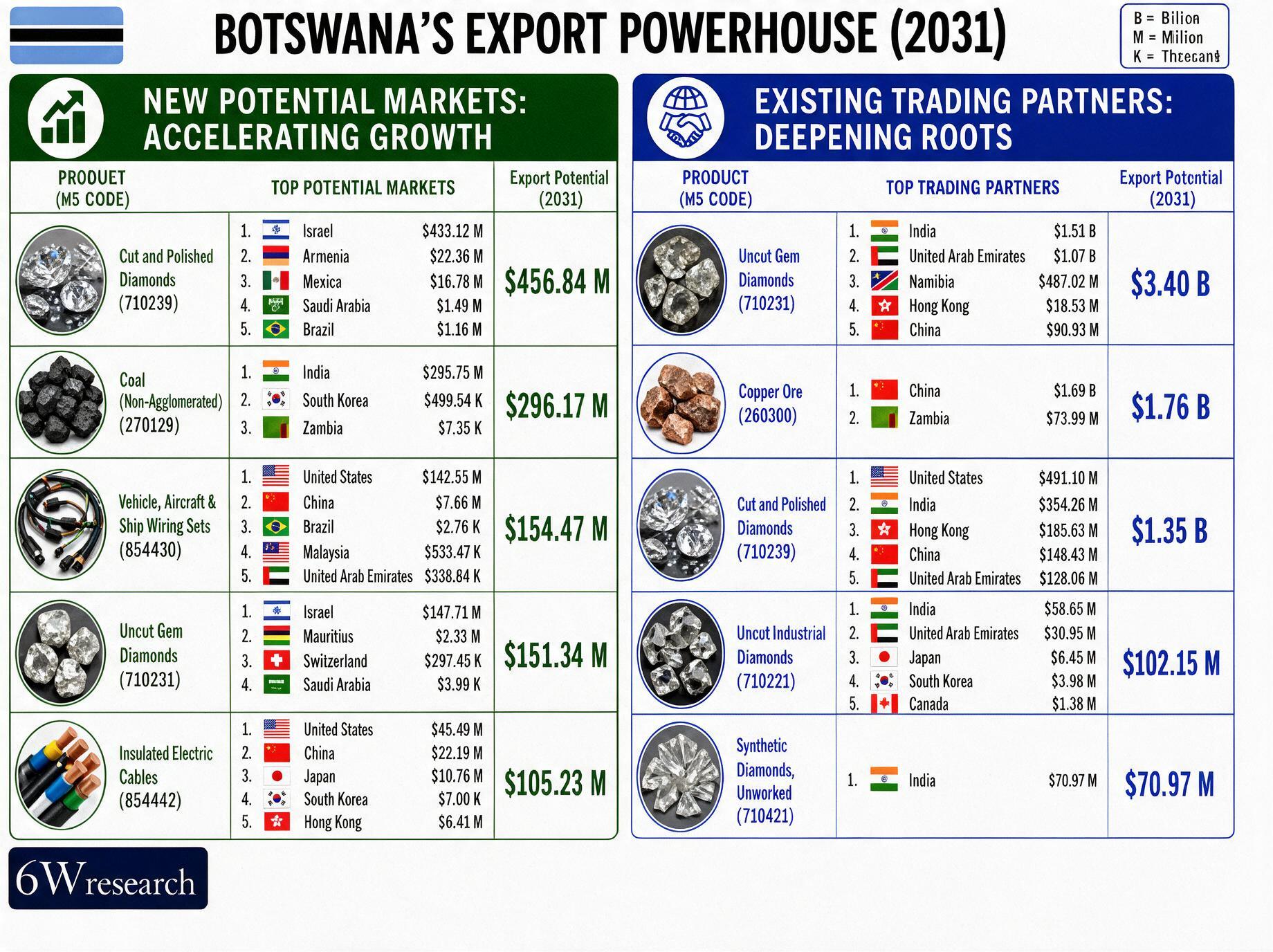
Cut and polished diamonds represent Botswana’s largest new-corridor export opportunity at USD 456.84 million, driven overwhelmingly by Israel at USD 413.12 million. The strong concentration reflects Botswana’s established diamond-cutting and polishing capabilities, while Israel’s position as a major global diamond-trading and processing center creates a natural market for higher-value stones. Armenia and Mexico provide smaller opportunities, indicating scope to diversify Botswana’s polished-diamond customer base beyond its existing markets.
Coal represents a further USD 296.17 million opportunity, with India accounting for almost the entire opportunity, reflecting India’s large and sustained demand for thermal coal and Botswana’s substantial coal resource base. Vehicle, aircraft and ship wiring sets contribute USD 154.47 million, led by the United States at USD 142.51 million. This will be made possible due to the existence of component manufacturing industries in Botswana, along with their possibility of being incorporated within the global automotive industry value chain.
Unprocessed gem diamonds make up an additional USD 151.34 million with Israel making a contribution of USD 147.71 million. This demonstrates that there is high complementarity between Botswana’s diamond mining base and Israel’s diamond processing/trading industry. The third largest exported item is insulated electric cables worth USD 105.23 million with the United States accounting for USD 45.49 million.
Diamonds and Copper Anchor Botswana’s Established Export Base, with Coal and Wiring Sets Playing Smaller Roles
Uncut gem diamonds represent Botswana’s largest established export opportunity at USD 3.40 billion, led by India at USD 1.53 billion and UAE at USD 1.07 billion. The strong demand reflects Botswana’s established rough-diamond production base and the role of India and the UAE as major global diamond-cutting, processing and trading centers. Namibia, Hong Kong and China provide additional markets, offering some diversification beyond Botswana’s two largest destinations.
Copper ore represents a further USD 1.76 billion opportunity, with China accounting for USD 1.69 billion. This concentration is supported by China’s large copper-refining and manufacturing base, while Botswana’s expanding copper-mining activity provides the underlying supply potential. Zambia contributes a smaller opportunity, reflecting scope to develop regional copper trade alongside the dominant Chinese market.
Cut and polished diamonds contribute USD 1.35 billion, led by the United States at USD 491.10 million, followed by India at USD 354.26 million and Hong Kong at USD 165.63 million. This represents an opportunity for Botswana due to its ability to benefit from diamond processing in addition to access to large markets for jewelry and trade. Industrial diamonds not cut total USD 102.15 million, mostly from India and UAE, driven by demand for their industrial uses. Artificial diamonds make up USD 70.97 million, all from India.
| Botswana’s established trade is a diamond and copper story almost to the exclusion of everything else, but the new-corridor data shows the beginnings of something more varied an Israeli diamond-trading relationship forming fast, Indian industrial demand extending into coal and copper, and a small but real US manufacturing corridor in wiring sets. None of these are large enough yet to change Botswana’s overall dependence on diamonds, but they are the clearest sign in the data of where genuine diversification could come from. 6WExportGTM Analysis |
Top Global Export Opportunities (2031), By Product
| Product | Export Opportunity (USD Billion) |
| Electronic Integrated Circuits | 685.7 |
| Refined Petroleum Oils | 668.4 |
| Light Petroleum Oils | 588.9 |
| Logic Electronic Integrated Circuits | 507.9 |
| Medicines | 381.2 |
| Gasoline Passenger Cars (1.5–3.0L) | 360.9 |
| Smartphones | 343.6 |
| Electronic Integrated Circuits with Memory | 333.2 |
| Data Transmission Equipment | 216.9 |
| Immunological Products | 209.6 |
Excludes naturally occurring products (e.g., crude oil, raw gold). Source: 6WExportGTM
Botswana’s current trade basket is concentrated in diamonds, copper, coal, and automotive wiring products, while the global opportunity landscape is increasingly driven by electronics, energy products, healthcare, and automotive goods. This suggests that Botswana’s strongest immediate export potential remains in its established mineral and automotive manufacturing capabilities, while the growing global demand for electrical equipment, data-transmission products, medicines, and automotive components could support gradual diversification into higher-value manufactured exports.
Two Developments Shaping Botswana’s Export Base: A Diamond-Sector Overhaul and a US Tariff Rollercoaster
Two developments are directly shaping Botswana’s export outlook. First, the ongoing restructuring of diamond-sector governance since early 2025 has implications for both rough and cut and polished diamond exports. Second, continued US tariff volatility has altered market-access conditions for Botswana’s diamonds and manufactured goods, affecting trade with one of its key export destinations.
A Diamond-Sector Governance Overhaul Reshapes Botswana’s USD 5.35 Billion Diamond Base
In February 2025, Botswana and De Beers formally signed a long-delayed new sales agreement after six years of negotiation, raising the government-owned Okavango Diamond Company’s share of Debswana’s rough-diamond production from 25% to 30% immediately, rising to 40% within five years and potentially 50% by the 2031s, while extending Debswana’s mining licenses to 2054. The deal came as the global diamond industry endured a prolonged slump driven by the rise of lab-grown alternatives, a slowdown in Chinese luxury demand, and separately by US tariffs disrupting India’s diamond-cutting industry; Botswana’s own diamond production fell 28% year-on-year in 2024 and a further 3.2% in the first nine months of 2025, while inventories swelled to roughly double the government’s normal ceiling. The overhaul has continued through 2026: parent company Anglo American is in the process of divesting De Beers entirely, with a consortium structure reportedly under consideration that could give Botswana potentially alongside Namibia and Angola an equity stake in the business itself, and in June 2026 former African Development Bank president Akinwumi Adesina was named chair of a new Diamonds for Development Fund tied to the transaction. For a country whose uncut and polished diamonds together represent USD 5.35 billion in established 2031 export potential, the direction of this overhaul toward greater domestic ownership, marketing control and beneficiation is arguably as consequential as underlying demand trends themselves.
|
Botswana’s diamond-sector restructuring could materially strengthen its long-term export position by increasing domestic control over rough-diamond marketing, beneficiation and ownership. As the industry faces weaker global demand, lab-grown competition and elevated inventories, greater participation across the value chain could help Botswana capture more value, diversify buyer relationships and reduce its historical dependence on external diamond companies. Manish Pant, Senior Data Scientist, Data Science & Market Intelligence, 6Wresearch |
A Year of US Tariff Swings Tests Botswana’s USD 544 Million American Relationship
Botswana’s trade with the United States endured one of the more volatile tariff paths of any US partner in 2025–26. An initial reciprocal rate of 37% was imposed in April 2025 the first time US tariffs had applied to Botswana’s diamonds at all threatening roughly USD 500 million in annual mineral exports that had previously entered duty-free; bilateral talks lowered the effective rate to 15% from August 2025, and Botswana separately offered the US priority access to its critical minerals in exchange for duty-free diamond treatment, though no final agreement was reached. The rate shifted again in February 2026 to a 10% temporary Section 122 surcharge, before that measure expired on 24 July 2026 following a US Supreme Court ruling, restoring Botswana’s duty-free access under the African Growth and Opportunity Act (AGOA) a reprieve that directly benefits the USD 491.10 million cut and polished diamond relationship with US and USD 142.51 million new-corridor wiring set trade. The relief is explicitly temporary: AGOA itself is set to expire on 31 December 2026, and Botswana’s Ministry of Trade has urged exporters to use the window while it lasts, even as renewal talks in Washington remain unresolved and India’s own 10% US tariff continues to weigh indirectly on Botswana’s rough-diamond supply chain given how much of its output is still cut and polished there.
|
Three tariff regimes in fourteen months is not a policy environment Botswana can plan around it is one it has to hedge against. Duty-free access is back for now, protecting USD 491.10 million of established polished-diamond trade with the US, but with AGOA itself expiring at year-end, this relief should be treated as a window to lock in buyers, not as a resolved risk. Manisha Gupta, Data Analyst, Data Science & Market Intelligence, 6Wresearch |
The Takeaway
Botswana’s export base remains highly concentrated, with uncut and cut and polished diamonds accounting for the majority of its established export potential, while copper ore contributes much of the remaining opportunity. The new-corridor opportunity is more diversified, spanning an emerging Israeli diamond-trading relationship, Indian industrial demand, and a smaller US manufacturing corridor. Botswana’s strategic priority is to leverage greater control over its diamond value chain and strengthen market access to build durable, diversified buyer relationships.
Key strategic priorities for Botswana include:
- Protect the India, China and UAE established core, since these three buyers alone represent USD 2.02 billion, USD 1.93 billion and USD 1.22 billion respectively together over 75% of the USD 6.81 billion established total concentrated almost entirely in diamond-cutting and copper-refining relationships that leave little room for demand shocks in any one economy.
- Capture the Israeli diamond-trade shift while it is open, given Israel’s USD 561.22 million in new-corridor demand across both rough (USD 147.71 million) and polished (USD 413.12 million) diamonds reflects a structural shift in global cutting and trading flows partly driven by US tariff disruption to India, making deeper direct relationships with Ramat Gan trading houses a time-sensitive priority.
- Use the AGOA window before it closes, since the US represents USD 544.39 million in established demand and USD 225.53 million in new-corridor demand led by USD 142.51 million in wiring sets, all of which depend on duty-free access that expires alongside AGOA on 31 December 2026 absent a renewal.
- Accelerate domestic beneficiation as governance control expands, using Okavango Diamond Company’s rising share of Debswana production and Botswana’s potential equity stake in De Beers to capture more of the USD 1.81 billion cut and polished value chain domestically, rather than continuing to export the bulk of production as USD 3.55 billion of unprocessed rough stones.
Ultimately, Botswana’s 2031 export outlook is fundamentally a diamond-and-copper story shaped as much by boardroom deals and tariff schedules as by geology, and the country’s ability to convert this year’s governance overhaul and trade-policy windows into durable relationships will determine whether its established base grows or merely holds steady.

Leadership Perspectives from Industry Events
Search
6Wresearch in the News
 Forbes
Citing 6Wresearch analytics to map global infrastructure and pharmaceutical industry trajectories.
 Bloomberg Law
Direct syndication of 6Wresearch's macro data points, capturing complex supply chain shifts.
 Reuters
Tracking industrial manufacturing adjustments and electronic security ecosystem scaling.
 Mint
Mint
Utilizing deep-tech sector market sizing to analyze global automation and robotics.
 The Economic Times
Anchoring features on industrial IoT growth metrics and connected smart-grid devices.
 Business Standard
Featuring strategic evaluations of Advanced Driver Assistance Systems (ADAS) and AI road safety.
 The Hindu
Spotlighting core commercial metrics ranging from unmanned aerial vehicles (UAVs) to consumer durables.
 Financial Express
Anchoring quarterly reviews on cross-border real estate tech and structural hardware manufacturing.
 Yahoo Finance
Syndicating the tracker's $30.1 billion untapped-market findings, spotlighting Japan, the US and China as India's top new-potential importers.
 India Today
Carrying the release on smartphones leading India's export potential to $94 billion by 2031, per 6WExportGTM data.
 Dailyhunt
Distributing the tracker findings to its regional readership, framing India's export diversification into Japan and Mexico.
 PR Newswire Original release
Publishing the full India Export Attractiveness Tracker 2026, detailing new trade corridors across iron ore, LCVs and pharmaceuticals.
 The Industrial
Highlighting the tracker's read on India's semiconductor ambitions and long-term chip-assembly export potential.
 PTI News
Reporting on the $66.81 billion pharmaceuticals export opportunity flagged in the tracker, amid looming US generic-drug tariffs.
 Tribune India
Covering the tracker's tariff-versus-regulation analysis across India's mature export markets in the US, China and UAE.
 ANI News
Amplifying the report's findings on polished diamonds, refined petroleum and medicines as India's core export engines.
 International Business Magazine
Covering the report's insight into how AEB, blind spot detection, and driver monitoring are reshaping India's ADAS market.
 Focus Gaming News
Highlighting the research forecast for Egypt's gambling market, projecting steady growth through 2032.
Thought Leadership and Analyst Meet





Our Clients








Latest Reports
- Austria X-ray Imaging Devices Market (2026-2032)
- Armenia X-ray Imaging Devices Market (2026-2032)
- Antigua and Barbuda X-ray Imaging Devices Market (2026-2032)
- Angola X-ray Imaging Devices Market (2026-2032)
- Andorra X-ray Imaging Devices Market (2026-2032)
- Albania X-ray Imaging Devices Market (2026-2032)
- Afghanistan X-ray Imaging Devices Market (2026-2032)
- United States (US) X-ray Imaging Devices Market (2026-2032)
- United Kingdom (UK) X-ray Imaging Devices Market (2026-2032)
- United Arab Emirates (UAE) X-ray Imaging Devices Market (2026-2032)
Industry Events and Analyst Meet

EV India Expo 2026

HIMTEX 2026

India Refining Summit 2026

India EV Show 2026

EV tech India Expo 2026
Whitepaper
- Middle East & Africa Commercial Security Market Click here to view more.
- Middle East & Africa Fire Safety Systems & Equipment Market Click here to view more.
- GCC Drone Market Click here to view more.
- Middle East Lighting Fixture Market Click here to view more.
- GCC Physical & Perimeter Security Market Click here to view more.


