Brunei’s Para Xylene Exports to Existing Partners Could Reach USD 1.36 Billion, While Crude Petroleum Opens USD 5.97 Billion Across New Markets by 2031.
Para xylene leads Brunei’s established export base, though China alone commands over half of all established demand, nearly five times Japan’s share in second place, whereas in the new-corridor opportunity China again leads at over 63%, more than four times the United States in second place, reflecting an enormous, single crude-oil relationship that now dominates Brunei’s export opportunities in terms of new-corridor.
Source: 6WExportGTM
China Dominates Both Established and New-Corridor Trade, But Even More Overwhelmingly in the Latter
Among new-corridor buyers, China leads by an enormous margin at USD 5.40 billion, more than four times the United States at USD 1.24 billion in second place. South Korea (USD 893.55 million), India (USD 383.22 million) and the United Arab Emirates (USD 211.29 million) round out a top five that captures nearly all of the USD 8.52 billion new-corridor category, with China’s single relationship alone worth more than the entire established category described below.
| Top 5 Existing Importers | Export Potential (USD Billion) | Top 5 New Potential Importers | Export Potential (USD Billion) |
| China | 1.90 | China | 5.40 |
| Japan | 0.40 | United States | 1.24 |
| South Korea | 0.22 | South Korea | 0.89 |
| Singapore | 0.20 | India | 0.38 |
| Malaysia | 0.20 | United Arab Emirates | 0.21 |
Source: 6WExportGTM
Brunei Darussalam’s established export opportunities are primarily concentrated across major Asian energy markets, led by China at USD 1.90 billion, followed by Japan at USD 0.40 billion and South Korea at USD 0.22 billion. Singapore and Malaysia contribute additional opportunities of USD 0.20 billion each, supported by their roles as regional refining, trading, and energy hubs. Brunei’s export position in LNG, crude petroleum, refined petroleum products and petrochemicals is strong and supported by long-standing regional partnerships that will continue to support market access.
An Enormous New Crude-Oil Relationship with China Headlines Brunei’s New-Corridor Opportunities
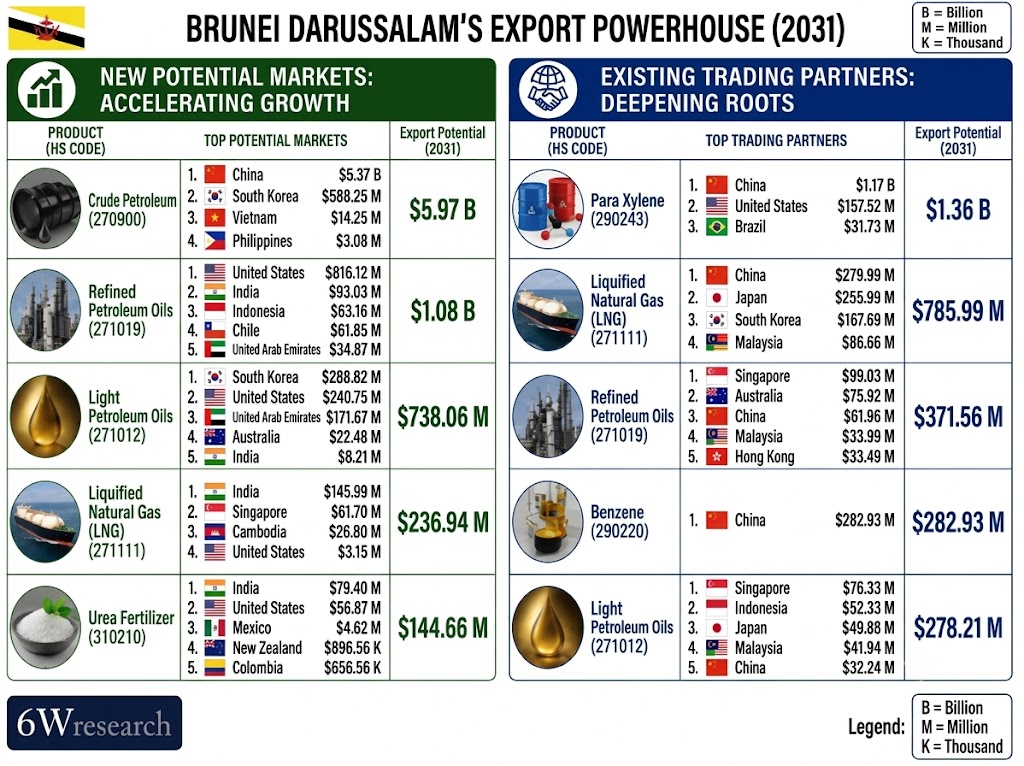
Crude petroleum represents Brunei’s largest future export opportunity at USD 5.97 billion, led by China at USD 5.37 billion and South Korea at USD 588.25 million. The scale of this opportunity is significant compared with Brunei’s current crude production capacity of approximately 100,000 barrels per day, suggesting that future potential may be supported by a combination of upstream developments, enhanced trade flows, and Brunei’s strategic role in regional energy logistics. The country’s deepwater infrastructure, including Pulau Muara Besar, could further strengthen its position as a regional crude-processing, trading, and transshipment hub, expanding opportunities beyond traditional domestic production volumes.
Refined petroleum oils and light petroleum oils add a further USD 1.08 billion and USD 738.06 million. Refined petroleum oils are led by the United States at USD 816.12 million and India at USD 93.05 million, a genuinely different buyer base from Brunei’s established refined-products trade, which is anchored in Singapore and Australia. Light petroleum oils are led by South Korea at USD 288.02 million and the United States at USD 240.75 million, again pointing to new demand centers distinct from Brunei’s established Singapore-and-Indonesia-led trade in the same product.
LNG and urea fertilizer round out the new-corridor top five, contributing USD 236.94 million and USD 144.66 million. New-corridor LNG is led by India at USD 145.29 million and Singapore at USD 61.70 million, a genuinely different buyer base from the established Japan-and-South-Korea-anchored LNG trade. Urea fertilizer is led by India at USD 79.40 million and the United States at USD 56.87 million, a small but entirely new product opportunity for Brunei. Across all five, Brunei’s new-corridor opportunity is overwhelmingly an extension of its hydrocarbon export identity into new buyer geographies, dominated by one exceptionally large crude-oil relationship with China.
Para Xylene and LNG Remain the Foundation of Brunei’s China-and-Japan-Anchored Established Trade
Para xylene represents Brunei’s largest established export opportunity at USD 1.36 billion, led by China at USD 1.17 billion, the United States at USD 157.52 million and Brazil at USD 31.73 million. China’s overwhelming share directly reflects the Hengyi Industries refinery and petrochemical complex at Pulau Muara Besar, a Chinese-Brunei joint venture that produces para-xylene as a key polyester-manufacturing feedstock for shipment back to Chinese textile and packaging industries.
Liquefied natural gas and refined petroleum oils add a further USD 785.99 million and USD 371.56 million. LNG is led by China at USD 279.39 million, Japan at USD 252.55 million and South Korea at USD 167.69 million, reflecting Brunei LNG’s decades-long role as one of Asia’s original LNG exporters to Northeast Asian utilities. Refined petroleum oils are led by Singapore at USD 99.03 million and Australia at USD 75.92 million, both regional fuel-trading and distribution hubs.
Benzene and light petroleum oils complete the established top five, contributing USD 282.93 million and USD 278.21 million. Benzene is sold entirely to China, another direct output of the Hengyi petrochemical complex. Light petroleum oils are led by Singapore at USD 76.33 million and Indonesia at USD 52.33 million. Brunei’s established export advantage rests on a genuine dual identity: legacy LNG exports to Northeast Asia, and a fast-growing Chinese petrochemical-feedstock relationship built almost entirely around the Hengyi refinery complex.
|
Brunei Darussalam’s export potential remains anchored in crude petroleum, LNG, refined fuels, and petrochemicals, with China emerging as a key demand center across multiple products. Growing opportunities in South Korea, India, and the United States indicate scope for broader market diversification, while downstream expansion and stronger regional energy linkages could further enhance Brunei’s export growth. 6WExportGTM Analysis |
Top Global Export Opportunities (2031), By Product
| Product | Export Opportunity (USD Billion) |
| Electronic Integrated Circuits | 685.7 |
| Refined Petroleum Oils | 668.4 |
| Light Petroleum Oils | 588.9 |
| Logic Electronic Integrated Circuits | 507.9 |
| Medicines | 381.2 |
| Gasoline Passenger Cars (1.5–3.0L) | 360.9 |
| Smartphones | 343.6 |
| Electronic Integrated Circuits with Memory | 333.2 |
| Data Transmission Equipment | 216.9 |
| Immunological Products | 209.6 |
Excludes naturally occurring products (e.g., crude oil, raw gold). Source: 6WExportGTM
Electronics, energy, pharmaceuticals, automotive and digital infrastructure products will be led by semiconductors, refined petroleum and advanced technology components, which are expected to dominate global export opportunities through 2031. These world trends are very much in line with the existing strengths of Brunei Darussalam in LNG, crude petroleum, refined petroleum products and petrochemicals. The country is well placed to take advantage of global energy demand trends while exploiting downstream investments such as petrochemical expansion to capture higher value opportunities across refined fuels and chemicals. While technology-driven categories dominate global growth opportunities, Brunei’s near-term export advantage remains centered on energy security, regional supply chains, and value-added hydrocarbon products.
A USD 13.65 Billion Refinery Expansion and an Ambitious Crude-Oil Growth Story: Two Developments Shaping Brunei’s Export Base
Two key developments are shaping Brunei’s export outlook. The first is the ongoing expansion of Hengyi Petrochemical’s refinery and petrochemical complex, which should increase downstream production capacity and underpin growth in refined fuels and chemical exports. The second is Brunei’s focus on increasing crude-oil production and expanding trading capabilities, creating opportunities to deepen its role in regional energy markets.
Hengyi’s USD 13.65 Billion Phase 2 Expansion Will More Than Double Brunei’s Refining Capacity by 2028
The expansion of Hengyi Petrochemical’s Pulau Muara Besar refinery and petrochemical complex is a major step to strengthen Brunei’s downstream energy sector. The project will include new petrochemical plants such as an ethylene cracker, purified terephthalic acid and polyethylene terephthalate plants and will greatly expand refining capacity. The expanded complex is expected to further increase the production of key export products such as diesel, para-xylene, benzene and polypropylene, building on Brunei’s existing petrochemical trade with China. The project is one of the country’s largest foreign investments and a key component of the Wawasan Brunei 2035 strategy. It is anticipated to add value to Brunei’s energy sector, create local jobs and enhance the country’s position in regional petrochemical supply chains. For Brunei’s established product’s opportunity para-xylene and benzene exports, the expansion provides a strong foundation for increasing downstream exports and deepening long-term trade relationships with major Asian markets.
|
Hengyi’s refinery expansion strengthens Brunei’s shift from a traditional energy exporter toward a more value-added petrochemical hub, increasing downstream production capacity and creating opportunities to deepen regional trade linkages, particularly across Asian markets. Manish Pant, Senior Data Scientist, Data Science & Market Intelligence, 6Wresearch |
Brunei’s Modest Crude Output Makes the USD 5.97 Billion New-Corridor China Opportunity an Ambitious Growth Story to Watch
The crude oil sector in Brunei provides a strong basis for future export growth, with reserves estimated at around 1.1 billion barrels in 2024, and Brunei Shell Petroleum continuing to work to maintain and increase output through enhanced recovery techniques and offshore exploration. The country averaged some 84,000 barrels per day in the first half of 2025. Average crude production in 2025 was something in the order of 100,000 barrels per day, providing a solid base for future growth. The potential to export USD 5.97 billion in crude petroleum by 2031 signals upside from increased upstream activity, new offshore developments and Brunei’s growing role in regional energy trade. In addition to domestic production growth, strategic infrastructure such as the Pulau Muara Besar facility could strengthen Brunei’s position as a regional crude processing, trading, and transshipment hub, enabling the country to capture broader opportunities across Asian energy markets.
|
Brunei’s crude petroleum opportunity highlights the potential for the country to move beyond traditional production-based exports by combining upstream growth with its strategic role in regional energy logistics. Manisha Gupta, Data Analyst, Data Science & Market Intelligence, 6Wresearch |
The Takeaway
Brunei should treat its export outlook through 2031 as one of consolidating a well-funded, concrete petrochemical expansion while treating its crude-oil new-corridor opportunity as an ambitious growth scenario rather than a near-certain outcome. The path forward depends on ensuring the Hengyi expansion delivers genuine domestic economic diversification benefits, while pursuing the upstream and trading investments that would be needed to approach the scale of new-corridor crude opportunity.
Key strategic priorities for Brunei include:
- Maximize domestic value capture from the Hengyi Phase 2 expansion, With the refinery expansion set to significantly increase Brunei’s downstream capacity and an established para-xylene and benzene export base, Brunei should prioritize maximizing local economic benefits through employment generation, domestic supplier development, and technology-transfer initiatives, supporting broader industrial diversification
- Pursue the upstream and trading investments needed to approach the new-corridor crude opportunity, with current crude production around 100,000 barrels per day but a USD 5.97 billion new-corridor crude-petroleum opportunity implied for China, Brunei should continue supporting Brunei Shell Petroleum’s enhanced-recovery and new-block exploration efforts while exploring Pulau Muara Besar’s potential as a regional crude-trading hub.
- Protect the legacy Japan-and-South-Korea LNG relationship amid growing China focus, with LNG exports of USD 0.79 billion remaining led by China, Japan and South Korea combined, Brunei should ensure continued investment in Brunei LNG’s aging infrastructure to protect its decades-long Northeast Asian utility relationships from being deprioritized.
- Diversify beyond hydrocarbons under the Wawasan Brunei 2035 framework, with oil and gas-linked products accounting for the overwhelming majority of both established and new-corridor trade, Brunei should continue pursuing the food, tourism and ICT diversification pillars set out in its Economic Blueprint, using Hengyi-linked employment and investment as a foundation rather than an end point.
Overall, Brunei’s export growth through 2031 will depend on successfully executing a concrete, well-funded petrochemical expansion while working toward the more speculative crude-oil growth story implied by the new-corridor opportunity a reminder that for a small, hydrocarbon-concentrated economy like Brunei’s, the credibility gap between confirmed investment and forecast opportunity is itself an important thing to track.

Leadership Perspectives from Industry Events
Search
6Wresearch in the News
 Forbes
Citing 6Wresearch analytics to map global infrastructure and pharmaceutical industry trajectories.
 Bloomberg Law
Direct syndication of 6Wresearch's macro data points, capturing complex supply chain shifts.
 Reuters
Tracking industrial manufacturing adjustments and electronic security ecosystem scaling.
 Mint
Mint
Utilizing deep-tech sector market sizing to analyze global automation and robotics.
 The Economic Times
Anchoring features on industrial IoT growth metrics and connected smart-grid devices.
 Business Standard
Featuring strategic evaluations of Advanced Driver Assistance Systems (ADAS) and AI road safety.
 The Hindu
Spotlighting core commercial metrics ranging from unmanned aerial vehicles (UAVs) to consumer durables.
 Financial Express
Anchoring quarterly reviews on cross-border real estate tech and structural hardware manufacturing.
 Yahoo Finance
Syndicating the tracker's $30.1 billion untapped-market findings, spotlighting Japan, the US and China as India's top new-potential importers.
 India Today
Carrying the release on smartphones leading India's export potential to $94 billion by 2031, per 6WExportGTM data.
 Dailyhunt
Distributing the tracker findings to its regional readership, framing India's export diversification into Japan and Mexico.
 PR Newswire Original release
Publishing the full India Export Attractiveness Tracker 2026, detailing new trade corridors across iron ore, LCVs and pharmaceuticals.
 The Industrial
Highlighting the tracker's read on India's semiconductor ambitions and long-term chip-assembly export potential.
 PTI News
Reporting on the $66.81 billion pharmaceuticals export opportunity flagged in the tracker, amid looming US generic-drug tariffs.
 Tribune India
Covering the tracker's tariff-versus-regulation analysis across India's mature export markets in the US, China and UAE.
 ANI News
Amplifying the report's findings on polished diamonds, refined petroleum and medicines as India's core export engines.
 International Business Magazine
Covering the report's insight into how AEB, blind spot detection, and driver monitoring are reshaping India's ADAS market.
 Focus Gaming News
Highlighting the research forecast for Egypt's gambling market, projecting steady growth through 2032.
Thought Leadership and Analyst Meet





Our Clients








Latest Reports
- Austria X-ray Imaging Devices Market (2026-2032)
- Armenia X-ray Imaging Devices Market (2026-2032)
- Antigua and Barbuda X-ray Imaging Devices Market (2026-2032)
- Angola X-ray Imaging Devices Market (2026-2032)
- Andorra X-ray Imaging Devices Market (2026-2032)
- Albania X-ray Imaging Devices Market (2026-2032)
- Afghanistan X-ray Imaging Devices Market (2026-2032)
- United States (US) X-ray Imaging Devices Market (2026-2032)
- United Kingdom (UK) X-ray Imaging Devices Market (2026-2032)
- United Arab Emirates (UAE) X-ray Imaging Devices Market (2026-2032)
Industry Events and Analyst Meet

EV India Expo 2026

HIMTEX 2026

India Refining Summit 2026

India EV Show 2026

EV tech India Expo 2026
Whitepaper
- Middle East & Africa Commercial Security Market Click here to view more.
- Middle East & Africa Fire Safety Systems & Equipment Market Click here to view more.
- GCC Drone Market Click here to view more.
- Middle East Lighting Fixture Market Click here to view more.
- GCC Physical & Perimeter Security Market Click here to view more.


