Estonia's Measuring and Checking Instrument Exports to Existing Partners Could Reach USD 866.90 Million, While Computer Parts Open USD 235.24 Million Across New Markets by 2031
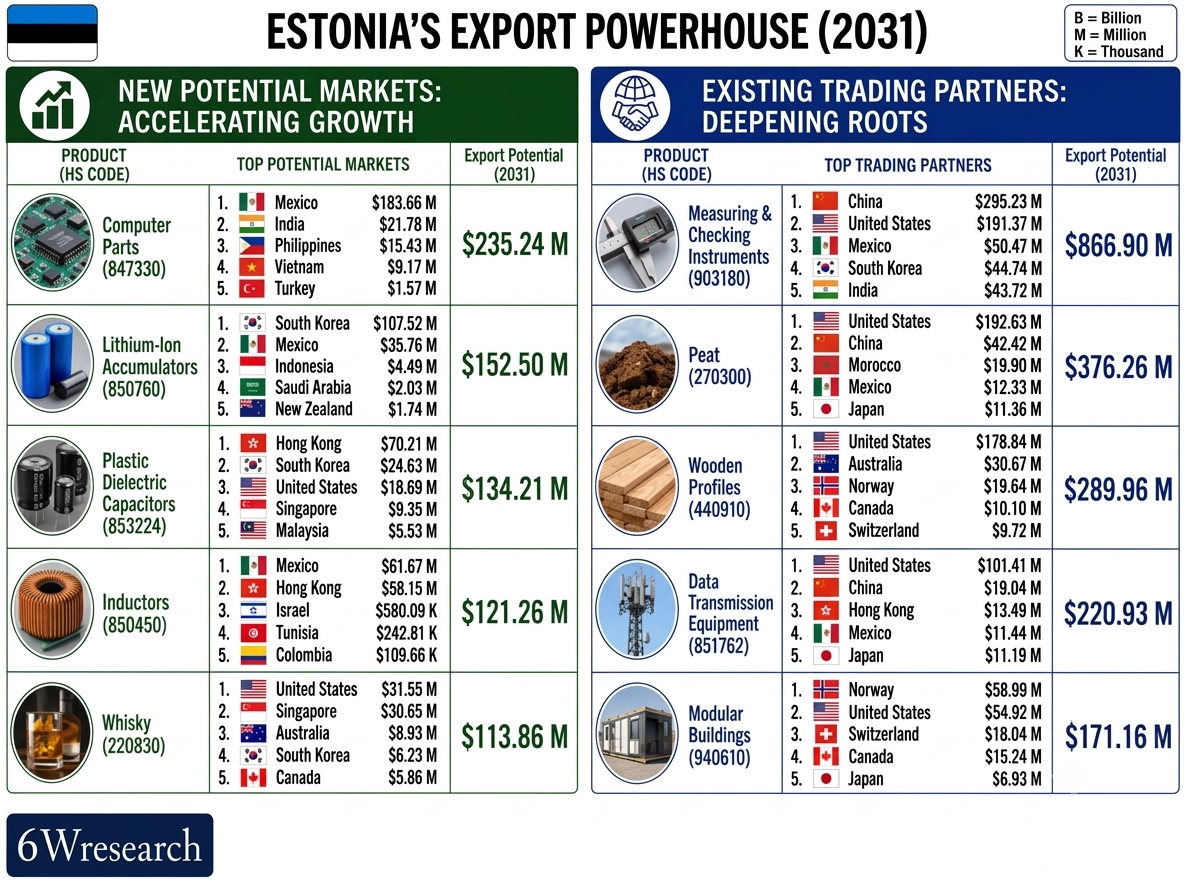
Estonia’s export potential remains anchored by the United States at 34.62%, followed by China at 21.06%, while emerging opportunities are led by the United States at 31.63% and South Korea at 8.17%. Established strengths include precision instruments, peat, and timber, while future growth increasingly centers on electronics, batteries, capacitors, and other advanced components, supporting Estonia’s shift toward higher-value technology exports.
Source: 6WExportGTM
The United States Leads Both Established and New-Corridor Trade, With a Very Different product line
Estonia’s emerging export opportunities are led by the United States at USD 4.25 billion, followed by South Korea at USD 1.10 billion and China at USD 0.89 billion. Mexico and Hong Kong add further potential of USD 0.83 billion and USD 0.78 billion, respectively. The spread across North American and Asian markets highlights strong opportunities for Estonia to expand its electronics, battery, electrical-component, and advanced manufacturing exports beyond traditional European markets. There are different product line
| Top 5 Existing Importers | Export Potential (USD Billion) | Top 5 New Potential Importers | Export Potential (USD Billion) |
| United States | 3.52 | United States | 4.25 |
| China | 2.14 | South Korea | 1.10 |
| Japan | 0.55 | China | 0.89 |
| Canada | 0.43 | Mexico | 0.83 |
| Switzerland | 0.41 | Hong Kong | 0.78 |
Source: 6WExportGTM
The United States accounts for USD 3.52 billion of Estonia's established export potential, more than double China's USD 2.14 billion in second place. Japan ranks third at USD 0.55 billion, with Canada and Switzerland rounding out the top five at USD 0.43 billion and USD 0.41 billion. This reflects Estonia's position as a precision-instrument and timber exporter, with the United States absorbing the largest share of measuring equipment, peat and wood products, and China representing a fast-growing secondary market for the same categories.
Electronics Components Reaching Mexico, South Korea and Hong Kong Headline Estonia's New-Corridor Opportunities
Computer parts represent Estonia's largest new-corridor opportunity at USD 235.24 million, led by Mexico at USD 183.66 million, India at USD 21.78 million and the Philippines at USD 15.43 million. Mexico's dominant share likely reflects North American electronics-assembly nearshoring, positioning Estonian component makers as suppliers into Mexican manufacturing plants serving the US market. India and the Philippines also offer expanding electronics-manufacturing ecosystems, creating additional demand for imported computer components and supporting Estonia's potential to diversify its electronics exports.
Lithium-ion accumulators and plastic dielectric capacitors add a further USD 152.50 million and USD 134.21 million. Batteries are led by South Korea at USD 107.52 million and Mexico at USD 35.76 million, both major battery-cell and electronics-assembly economies, where growing EV and energy-storage production can support demand for imported battery components and technologies. Capacitors are led by Hong Kong at USD 70.21 million and South Korea at USD 24.63 million, both significant electronics-component trading and manufacturing hubs, creating opportunities for Estonia to integrate into established regional component supply chains.
Inductors and whisky round out the new-corridor top five, contributing USD 121.26 million and USD 113.86 million. Inductors are led by Mexico at USD 61.67 million and Hong Kong at USD 58.15 million, with demand supported by automotive electronics, power-management systems, and consumer devices. Whisky, the only genuinely non-electronics new-corridor product, is led by the United States at USD 31.55 million and Singapore at USD 30.65 million, reflecting established premium-spirit distribution networks and consumer demand. Across all five, Estonia's new-corridor opportunity is overwhelmingly built on electronics components and battery technology reaching new manufacturing hubs.
Precision Instruments, Peat and Timber Remain the Foundation of Estonia's US-and-China-Anchored Established Trade
Measuring and checking instruments represent Estonia's largest established export opportunity, valued at USD 866.90 million, led by China at USD 295.23 million, the United States at USD 191.37 million, and Mexico at USD 50.47 million. China's leading position reflects strong demand for precision measurement equipment across its extensive manufacturing, electronics and industrial base, where quality control and process monitoring remain critical priorities. The volumes coming from the United States and Mexico point to similar drivers — demand tied to advanced manufacturing, automotive production and industrial quality-control applications — giving Estonia access to a genuinely diverse set of industrial supply chains.
Peat and wooden profiles add a further USD 376.26 million and USD 289.96 million respectively. Peat demand is led by the United States at USD 192.63 million and China at USD 42.42 million, drawing on Estonia's standing as one of the world's most peat-rich countries and a major exporter of horticultural substrate. Demand here is underpinned by commercial horticulture and rising requirements for controlled growing media. Wooden profiles are led by the United States at USD 178.84 million and Australia at USD 30.67 million, an extension of Estonia's established timber-processing base into construction, interior finishing and furniture applications, where demand for processed wood products has stayed consistently strong.
Data transmission equipment and modular buildings round out the established top five, contributing USD 220.93 million and USD 171.16 million. Data transmission equipment is led by the United States at USD 101.41 million and China at USD 19.04 million, reflecting sustained demand for networking and communications infrastructure across increasingly digitalised economies. Modular buildings are led by Norway at USD 58.99 million and the United States at USD 54.92 million, built on Estonia's prefabricated-construction expertise and a growing preference for faster, factory-based construction methods in both Nordic and North American markets. Taken together, these five categories confirm that Estonia's established export strength rests on a genuinely diversified mix — precision manufacturing, natural resources, ICT equipment and construction products — with the United States standing out as a consistent buyer across nearly every category.
|
Estonia’s 2031 export landscape highlights a strong opportunity to evolve from its established precision manufacturing, timber, and resource-based exports toward higher-value electronics and energy-storage technologies. Growing opportunities in computer parts, lithium-ion accumulators, capacitors, and inductors across Asian and North American markets could strengthen Estonia’s position in global technology supply chains while reducing reliance on traditional export categories. 6WExportGTM Analysis |
Top Global Export Opportunities (2031), By Product
| Product | Export Opportunity (USD Billion) |
| Electronic Integrated Circuits | 685.7 |
| Refined Petroleum Oils | 668.4 |
| Light Petroleum Oils | 588.9 |
| Logic Electronic Integrated Circuits | 507.9 |
| Medicines | 381.2 |
| Gasoline Passenger Cars (1.5–3.0L) | 360.9 |
| Smartphones | 343.6 |
| Electronic Integrated Circuits with Memory | 333.2 |
| Data Transmission Equipment | 216.9 |
| Immunological Products | 209.6 |
Excludes naturally occurring products (e.g., crude oil, raw gold). Source: 6WExportGTM
Global export opportunities through 2031 are expected to be concentrated in high-value technology, energy, pharmaceutical, automotive, and electronics products, particularly semiconductors, refined petroleum, medicines, passenger vehicles, and digital equipment. Estonia is well positioned to benefit from this global shift through its strengths in data transmission equipment, precision instruments, lithium-ion batteries, electrical components, and advanced timber products, supporting expansion into higher-value technology and manufacturing supply chains.
What Estonia Already Sells and Where
Building materials, telecommunications equipment and forestry & timber are the main products of the Estonia export base with USD 1.74 billion, USD 1.14 billion and USD 0.91 billion exports. The most important subsegments in building materials are modular buildings (20.22%) and wooden profiles (12.89%). In telecommunications, the most important subsegments are data transmission equipment (47.13%) and smartphones (40.78%). Forestry exports are anchored by wood pellets at 27.81% and pine sawn wood at 12.91%, highlighting Estonia’s strengths in prefabricated construction, digital equipment, and value-added timber products.
| Sector | Exports (USD Billion) | Leading Products / Share |
| Building Materials | 1.74 | Modular Buildings (20.22%), Wooden Profiles (12.89%) |
| Telecommunications Equipment | 1.14 | Data Transmission Equipment (47.13%), Smartphones (40.78%) |
| Forestry & Timber | 0.91 | Wood Pellets (27.81%), Pine Sawn Wood (12.91%) |
Source: UN Comtrade
Finland is Estonia's largest destination market at USD 3.01 billion, led by miscellaneous trade goods at a 10.45% share and motor generator parts at 3.16%, reflecting deep cross-Gulf industrial integration between the two countries. Latvia ranks second at USD 2.12 billion, led by electrical energy at a 10.78% share and miscellaneous trade goods at 10.27%, while Sweden follows at USD 1.69 billion, led by miscellaneous trade goods at a 7.95% share and data transmission equipment at 7.00% a pattern that shows Estonia's current export capacity deeply anchored in Nordic and Baltic regional trade.
| Country | Exports (USD Billion) | Leading Products / Share |
| Finland | 3.01 | Miscellaneous Trade Goods (10.45%), Motor Generator Parts (3.16%) |
| Latvia | 2.12 | Electrical Energy (10.78%), Miscellaneous Trade Goods (10.27%) |
| Sweden | 1.69 | Miscellaneous Trade Goods (7.95%), Data Transmission Equipment (7.00%) |
Source: UN Comtrade
A Battery-Tech Champion Scaling Abroad and a Peat Industry Under Climate Pressure: Two Developments Shaping Estonia's Export Base
Two key developments are shaping Estonia’s export outlook. First, Skeleton Technologies, a leading Estonian battery and supercapacitor company, is expanding manufacturing capacity in Germany and Finland, strengthening Estonia’s role in advanced energy technologies while shifting large-scale production abroad. Second, increasing EU climate and environmental pressure on peat extraction could influence the future of one of Estonia’s established export industries, encouraging greater diversification toward higher-value and more sustainable products.
Estonia's Flagship Battery-Tech Company Is Scaling Production in Germany and Finland Rather Than at Home
Skeleton Technologies, the Tallinn-founded supercapacitor and battery-technology company, strengthened Estonia’s position in advanced energy technologies by opening two major production facilities in November 2025: a USD 255.5 million supercapacitor factory in Leipzig, Germany, capable of producing up to 12 million cells annually and creating 420 jobs, and a 1 GW SuperBattery facility in Varkaus, Finland, supported by a USD 58.1 million investment. These investments will extend Estonia’s technology ecosystem into key European manufacturing hubs, while maintaining R&D, innovation and corporate capability in Tallinn. Estonia’s export opportunities for lithium-ion batteries and capacitors are estimated at USD 286.71 million, with South Korea, Mexico and Hong Kong as the key markets. Estonia is well positioned to leverage its technology expertise and international partnerships to capitalize on the growing demand from AI data centers, electrification and advanced energy-storage applications.
|
Estonia’s future export pipeline is increasingly moving beyond traditional timber and resource-based products, with computer parts, lithium-ion accumulators, capacitors, and inductors creating a stronger foothold in electronics and energy-storage value chains. Manish Pant, Senior Data Scientist, Data Science & Market Intelligence, 6Wresearch |
Mounting EU Climate Pressure on Peat Extraction Threatens One of Estonia's Oldest Established Export Categories
Estonia's peat industry presents a somewhat unusual profile: a substantial international export base that is now facing mounting regulatory pressure. Peatlands cover more than a fifth of the country's territory, and Estonia currently supplies peat to around 120 countries, reflecting broad and well-established market access. 6WExportGTM estimates export potential at approximately USD 376.26 million by 2031, with the United States and China as the leading demand centres. The nature of this opportunity is shifting, however. EU member states are tightening restrictions on horticultural peat and actively promoting alternatives such as wood fibre, bark and compost, and Germany's planned reduction in peat use through 2031 illustrates how far this shift has already progressed. As a result, Estonia's future peat opportunity is likely to rest less on expanding demand broadly and more on preserving access to non-EU markets while adapting its product portfolio to meet tightening environmental requirements.
|
While established exports remain strongly connected to China and the United States, emerging opportunities extend into Mexico, South Korea, Hong Kong, India, and the Philippines, indicating Estonia’s potential to build a broader and more geographically diversified export network. Manisha Gupta, Data Analyst, Data Science & Market Intelligence, 6Wresearch |
The Takeaway
Estonia’s export prospects through 2031 will largely depend on its shift from traditional exports – musical instruments, timber, peat – to electronics, batteries and other advanced technology. Retaining a larger share of battery and electronics value domestically, while reducing dependence on peat, would meaningfully strengthen export resilience and support long-term, sustainable growth.
Key strategic priorities for Estonia include:
- Work to anchor more battery and electronics manufacturing capacity domestically: With Skeleton Technologies' major 2025 factory investments landing in Germany and Finland rather than Estonia, and new-corridor battery-and-capacitor exports already worth USD 286.71 million, Estonia should examine what incentives or infrastructure gaps are driving manufacturing investment abroad and address them directly.
- Begin proactively diversifying away from peat ahead of EU regulatory tightening: With Germany's 2026 and 2031 peat phase-out deadlines signaling the likely direction of broader EU policy, and an established peat export base worth USD 376.26 million, Estonia should accelerate investment in the wood-fibre, bark and compost substitute markets already gaining traction elsewhere in Europe.
- Build on the New Mexico-anchored electronics-component relationship: Mexico leads three of Estonia's five new-corridor product categories, computer parts, lithium-ion accumulators and inductors, likely reflecting North American nearshoring demand. Estonia should formalize these relationships through direct trade agreements linked to Mexican electronics-assembly growth.
- Leverage the Nordic-Baltic regional trade base while building global diversification: With Finland, Latvia and Sweden together representing a substantial share of Estonia's current actual exports, Estonia should continue leveraging this deeply integrated regional base as a stable foundation while pursuing the more geographically diverse growth opportunities visible in the new-corridor opportunities.
Overall, Estonia's export growth through 2031 will depend on successfully navigating a shift from its traditional instruments-and-natural-resources identity toward electronics and battery technology, all while proactively managing the climate-policy risk facing its peat industry a reminder that for a small, innovation-driven economy like Estonia's, where the next generation of manufacturing investment lands matters as much as where today's exports go.

Leadership Perspectives from Industry Events
Search
6Wresearch in the News
 Forbes
Citing 6Wresearch analytics to map global infrastructure and pharmaceutical industry trajectories.
 Bloomberg Law
Direct syndication of 6Wresearch's macro data points, capturing complex supply chain shifts.
 Reuters
Tracking industrial manufacturing adjustments and electronic security ecosystem scaling.
 Mint
Mint
Utilizing deep-tech sector market sizing to analyze global automation and robotics.
 The Economic Times
Anchoring features on industrial IoT growth metrics and connected smart-grid devices.
 Business Standard
Featuring strategic evaluations of Advanced Driver Assistance Systems (ADAS) and AI road safety.
 The Hindu
Spotlighting core commercial metrics ranging from unmanned aerial vehicles (UAVs) to consumer durables.
 Financial Express
Anchoring quarterly reviews on cross-border real estate tech and structural hardware manufacturing.
 Yahoo Finance
Syndicating the tracker's $30.1 billion untapped-market findings, spotlighting Japan, the US and China as India's top new-potential importers.
 India Today
Carrying the release on smartphones leading India's export potential to $94 billion by 2031, per 6WExportGTM data.
 Dailyhunt
Distributing the tracker findings to its regional readership, framing India's export diversification into Japan and Mexico.
 PR Newswire Original release
Publishing the full India Export Attractiveness Tracker 2026, detailing new trade corridors across iron ore, LCVs and pharmaceuticals.
 The Industrial
Highlighting the tracker's read on India's semiconductor ambitions and long-term chip-assembly export potential.
 PTI News
Reporting on the $66.81 billion pharmaceuticals export opportunity flagged in the tracker, amid looming US generic-drug tariffs.
 Tribune India
Covering the tracker's tariff-versus-regulation analysis across India's mature export markets in the US, China and UAE.
 ANI News
Amplifying the report's findings on polished diamonds, refined petroleum and medicines as India's core export engines.
 International Business Magazine
Covering the report's insight into how AEB, blind spot detection, and driver monitoring are reshaping India's ADAS market.
 Focus Gaming News
Highlighting the research forecast for Egypt's gambling market, projecting steady growth through 2032.
Thought Leadership and Analyst Meet





Our Clients








Latest Reports
- Austria X-ray Imaging Devices Market (2026-2032)
- Armenia X-ray Imaging Devices Market (2026-2032)
- Antigua and Barbuda X-ray Imaging Devices Market (2026-2032)
- Angola X-ray Imaging Devices Market (2026-2032)
- Andorra X-ray Imaging Devices Market (2026-2032)
- Albania X-ray Imaging Devices Market (2026-2032)
- Afghanistan X-ray Imaging Devices Market (2026-2032)
- United States (US) X-ray Imaging Devices Market (2026-2032)
- United Kingdom (UK) X-ray Imaging Devices Market (2026-2032)
- United Arab Emirates (UAE) X-ray Imaging Devices Market (2026-2032)
Industry Events and Analyst Meet

EV India Expo 2026

HIMTEX 2026

India Refining Summit 2026

India EV Show 2026

EV tech India Expo 2026
Whitepaper
- Middle East & Africa Commercial Security Market Click here to view more.
- Middle East & Africa Fire Safety Systems & Equipment Market Click here to view more.
- GCC Drone Market Click here to view more.
- Middle East Lighting Fixture Market Click here to view more.
- GCC Physical & Perimeter Security Market Click here to view more.


