Oman's Crude Petroleum Exports to Existing Partners Could Reach USD 14.14 Billion, While Light Petroleum Oils Open USD 2.05 Billion Across New Markets by 2031
China leads Oman’s established export potential at 28.90%, followed by India at 12.08%, while new-corridor opportunities are led by the United States at 21.23% and China at 16.67%. The strength of Oman’s export potential remains centered on crude petroleum, refined products, LNG and fertilizers, with future growth driven mainly by expanding these energy-linked exports into new markets and strengthening trade diversification.
Source: 6WExportGTM
The United States Narrowly Leads a More Contested New-Corridor Field for Oman
Oman’s new export potential is led by the United States at USD 2.23 billion, followed by China at USD 1.75 billion and India at USD 1.26 billion. These markets reflect strong demand for Oman’s core strengths in energy products, petrochemicals and industrial materials, while opportunities in Hong Kong (USD 620 million) and Canada (USD 610 million) further expand Oman’s diversification potential. The presence of major Asian and North American buyers highlights opportunities to strengthen energy-linked trade relationships beyond traditional markets.
| Top 5 Existing Leading Importers | Export Potential (USD Billion) | Top 5 New Potential Importers | Export Potential (USD Billion) |
| China | 15.18 | United States | 2.23 |
| India | 6.34 | China | 1.75 |
| Japan | 4.96 | India | 1.26 |
| South Korea | 4.25 | Hong Kong | 0.62 |
| Singapore | 2.51 | Canada | 0.61 |
Source: 6WExportGTM
China accounts for USD 15.18 billion of Oman's established export potential, more than double India's USD 6.34 billion in second place. Japan ranks third at USD 4.96 billion, with South Korea and Singapore contributing USD 4.25 billion and USD 2.51 billion. This reflects Oman's position as a hydrocarbon exporter feeding East and South Asia's largest refining and industrial economies, with China's massive refining capacity anchoring the relationship and Japan, South Korea and Singapore absorbing further crude and petroleum-product volumes as regional processing and trading hubs.
A US-Anchored Petroleum Corridor Headlines Oman's New-Corridor Opportunities
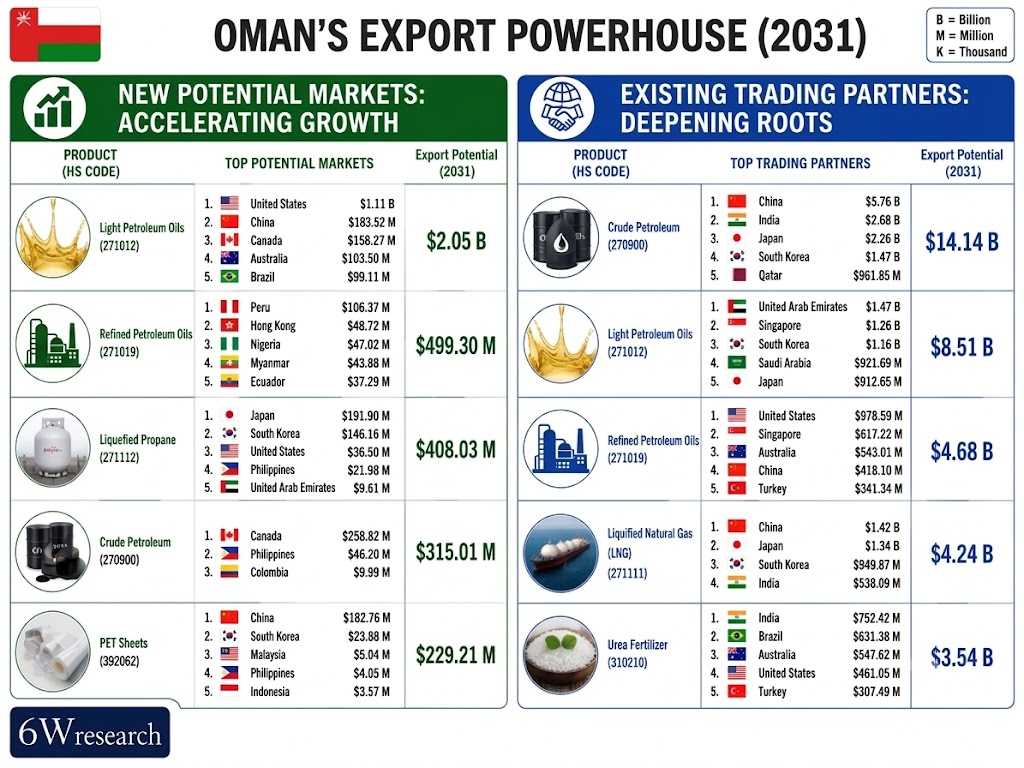
Light petroleum oils represent Oman's largest new-corridor opportunity at USD 2.05 billion, led by the United States at USD 1.11 billion, followed by China at USD 183.52 million and Canada at USD 158.27 million. The US opportunity is a sign of Oman's potential to leverage its refining capabilities to push more petroleum products in one of the world's biggest energy consuming markets. China and Canada add further diversification value here, as both are global buyers actively seeking dependable suppliers of refined energy products.
Refined petroleum oils and liquefied propane add a further USD 499.30 million and USD 408.03 million respectively. Refined petroleum oil opportunities are fairly spread out — Peru at USD 106.37 million, Hong Kong at USD 48.72 million, Nigeria at USD 47.02 million, Myanmar at USD 43.88 million, and Ecuador at USD 37.29 million — which suggests room to expand into emerging fuel markets and regional trading hubs rather than relying on one or two large buyers. Liquefied propane opportunities are more concentrated, led by Japan at USD 191.90 million and South Korea at USD 146.16 million, with some additional potential in the United States at USD 36.50 million, reflecting steady demand from Asian petrochemical industries and other energy-importing economies.
Crude petroleum and PET sheets round out Oman's top five new-corridor opportunities, contributing USD 315.01 million and USD 229.21 million respectively. Crude petroleum opportunity is led by Canada at USD 258.82 million, which hints at room to diversify crude sales beyond the usual Asian buyer base toward North American markets. PET sheets are dominated by China at USD 182.76 million, with South Korea at USD 23.88 million and Malaysia at USD 5.04 million trailing behind, supported by demand from packaging and plastics-processing industries. Overall, Oman's new-corridor opportunities stay closely tied to its existing energy and petrochemical strengths, with the real upside coming from reaching new buyers across Asia, North America, and emerging markets rather than new product lines.
Crude Petroleum and LNG Remain the Foundation of Oman's Asia-Anchored Established Trade
Oman’s largest future export opportunity within its existing trade corridors is crude petroleum, worth USD 14.14 billion. The biggest potential exporter is China with USD 5.76 billion, followed by India with USD 2.68 billion and Japan with USD 2.26 billion. These are markets with existing energy trade relationships with Oman, and their continued demand for reliable crude supply provides a solid basis for potential export growth. In addition, South Korea and Qatar are important players in Oman’s wider networks of petroleum exports.
Light petroleum oils and refined petroleum oils bring additional future potential of USD 8.51 billion and USD 4.68 billion respectively, spread across Oman's existing and prospective buyer markets. Light petroleum oil opportunity is led by the UAE at USD 1.47 billion, Singapore at USD 1.26 billion, and South Korea at USD 1.16 billion — all markets where Oman could deepen downstream petroleum trade given their strength as regional refining and energy hubs. Refined petroleum oils show potential across the United States (USD 978.59 million), Singapore (USD 617.22 million), Australia (USD 543.01 million), and China (USD 418.10 million), pointing to real scope for Oman to grow its value-added petroleum export business further.
LNG and urea fertilisers round out Oman's top five future export opportunities, with potential of USD 4.24 billion and USD 3.54 billion respectively. LNG demand is concentrated in China at USD 1.42 billion, Japan at USD 1.34 billion, and South Korea at USD 949.87 million, backed by long-term Asian energy demand and Oman's already-established gas export capacity. Urea fertiliser opportunity is led by India at USD 752.42 million and Brazil at USD 631.38 million, followed by Australia at USD 547.62 million and the United States at USD 461.05 million — reflecting Oman's ability to lean on its natural gas advantage and grow fertiliser exports across major agricultural markets worldwide.
| Oman's export base is a story of concentrated dependence on hydrocarbons sold into Asia, with China as the clear anchor buyer across crude, LNG and petroleum products alike. What's notable about the new-corridor opportunity is that it isn't really a new set of products it's largely the same crude and refined petroleum trade reaching the United States, where Oman already has a duty-free pathway, it has yet to fully exploit.6WExportGTM Analysis |
Top Global Export Opportunities (2031), By Product
| Product | Export Opportunity (USD Billion) |
| Electronic Integrated Circuits | 685.7 |
| Refined Petroleum Oils | 668.4 |
| Light Petroleum Oils | 588.9 |
| Logic Electronic Integrated Circuits | 507.9 |
| Medicines | 381.2 |
| Gasoline Passenger Cars (1.5–3.0L) | 360.9 |
| Smartphones | 343.6 |
| Electronic Integrated Circuits with Memory | 333.2 |
| Data Transmission Equipment | 216.9 |
| Immunological Products | 209.6 |
Excludes naturally occurring products (e.g., crude oil, raw gold). Source: 6WExportGTM
By 2031, Oman’s export opportunities remain strongly aligned with global demand for energy, refined fuels and petrochemical products, with refined petroleum oils, light petroleum oils, LNG and fertilizers representing the country’s most relevant growth categories. Rising global energy security needs, demand for diversified fuel suppliers and expanding industrial consumption create opportunities for Oman to strengthen its position in hydrocarbon value chains. Beyond traditional energy exports, products such as urea fertilizers and PET-based materials highlight Oman’s potential to expand into higher-value downstream industries supported by its integrated industrial infrastructure and strategic location.
What Oman Already Sells and Where
Oil & Gas forms Oman's largest established trade sector at USD 47.04 billion, led by crude petroleum at 54.79% share, with light petroleum oils 30.15% share. Iron & Steel ranks a distant second at USD 2.02 billion, led by twisted steel bars at 33.70% share, with semi-finished steel billets adding 21.62% share. Metallic Ores follow at USD 1.97 billion, led by agglomerated iron ore concentrates at 88.97% share, with non-agglomerated iron ore concentrates adding 7.35% share together confirming that Oman's export base is overwhelmingly hydrocarbon-driven, with iron, steel and ore trade providing a genuine, if much smaller, secondary pillar.
| Sector | Exports (USD Billion) | Leading Products / Share |
| Oil & Gas | 47.04 | Crude Petroleum (54.79%), Light Petroleum Oils (30.15%) |
| Iron & Steel | 2.02 | Twisted Steel Bars (33.70%), Semi-Finished Steel Billets (21.62%) |
| Metallic Ores | 1.97 | Iron Ore Concentrates, Agglomerated (88.97%), Iron Ore Concentrates (Non-Agglomerated) (7.35%) |
Source: UN Comtrade
The largest share of Oman's current exports, USD 44.51 billion, is recorded against an unspecified-destination category rather than a single named country, led by crude petroleum at a 57.89% share and light petroleum oils at 27.33% a pattern common among bulk crude and petroleum-product exporters, where cargo is frequently resold via trading intermediaries or transferred ship-to-ship before its final destination is confirmed. Among named country partners, the UAE is Oman's largest at USD 4.20 billion, led by twisted steel bars at a 12.85% share and floating platforms at 7.64%, while Saudi Arabia follows at USD 2.33 billion, led by agglomerated iron ore concentrates at a 36.33% share and semi-finished steel products at 13.32% a pattern that shows Oman's directly trackable export capacity concentrated in regional GCC industrial and construction supply chains.
| Country | Exports (USD Billion) | Leading Products / Share |
| Not Elsewhere Specified | 44.51 | Crude Petroleum (57.89%), Light Petroleum Oils (27.33%) |
| United Arab Emirates | 4.20 | Twisted Steel Bars (12.85%), Floating Platforms (7.64%) |
| Saudi Arabia | 2.33 | Iron Ore Concentrates, agglomerated (36.33%), Semi-Finished Steel Products (13.32%) |
Source: UN Comtrade
Gulf Shipping Risk and an Underused US Trade Deal: Two Developments Shaping Oman's Export Base
In general, there are two developments now underway help explain the pressures and opportunities Oman’s future potential: repeated 2026 disruptions to Gulf shipping routes around the Strait of Hormuz, which threaten the tanker flows Oman's oil and gas trade depends on, and the tension between Oman's long-standing free trade agreement with the United States and newer US tariff measures layered on top of it, which together shape how much of the US new-corridor opportunity Oman can actually realize.
Strait of Hormuz Disruptions Have Repeatedly Threatened Gulf Oil Shipping Through 2026
Regional instability in 2026 has created uncertainty for Oman’s energy export outlook, with disruptions around the Strait of Hormuz affecting tanker movements, shipping costs, insurance premiums and regional supply-chain reliability. Although Oman benefits from strategic ports outside the Strait, including Arabian Sea access, broader Gulf disruptions continue to influence energy trade conditions and buyer sentiment. With Oman’s current crude and petroleum-product export base of roughly around USD 28 billion, prolonged geopolitical uncertainty and potential logistics constraints could slow future export growth by increasing transaction costs and limiting supply expansion. However, Oman’s diversified port infrastructure, downstream investments and established relationships with major Asian energy buyers provide resilience against short-term disruptions.
| Oman’s future export growth remains strongly anchored in its energy and petrochemical strengths, with crude petroleum, light petroleum oils, refined products and LNG continuing to attract significant demand from major Asian energy markets. At the same time, emerging opportunities in markets such as the United States, Canada and China highlight potential for broader geographic diversification.Manish Pant, Senior Data Scientist, Data Science & Market Intelligence, 6Wresearch |
Oman's Free Trade Agreement with the US Now Coexists with New Tariff Measures, Creating Genuine Uncertainty
Oman has held a comprehensive free trade agreement with the United States since 2009, under which nearly all industrial and consumer goods trade duty-free, and it remains one of just a handful of Middle Eastern countries with such an agreement. Despite this, Washington imposed a 10% reciprocal tariff on Omani goods in April 2025, reaffirmed in July 2025, with the rate later replaced by a Section 301 forced-labor tariff after the US Supreme Court struck down the original measure in February 2026; aluminum, one of Oman's established non-oil exports, faces an additional 50% tariff under separate Section 232 measures regardless of the FTA. The net effect is a genuinely confusing picture for Omani exporters: a two-decade-old duty-free framework now operates alongside newer tariff layers that apply regardless of FTA status for specific product categories, even as the new-corridor opportunity above shows the United States as Oman's single largest new-corridor buyer at USD 2.23 billion, led by light petroleum oils.
| Oman is gradually expanding beyond crude exports by strengthening downstream value chains through products such as refined petroleum oils, urea fertilizers, liquefied propane and PET materials. This shift indicates a move toward higher-value industrial exports, leveraging the country’s natural resources, refining capacity and strategic location between Asian, African and Middle Eastern markets.Manisha Gupta, Data Analyst, Data Science & Market Intelligence, 6Wresearch |
The Takeaway
Oman should treat its export outlook through 2031 as one of consolidating hydrocarbon relationships while managing genuine external risk, since its established and new-corridor trade both rest overwhelmingly on crude oil and petroleum products, and two of the biggest variables shaping that trade Gulf shipping security and US tariff treatment are largely outside Oman's direct control. The path forward depends on protecting the Asian refining relationships that anchor current exports while working to convert the underused US free trade agreement into durable new-corridor volume.
Key strategic priorities for Oman include:
- Convert the US free trade agreement into real new-corridor volume: The United States is already Oman's largest new-corridor market at USD 2.23 billion, led by light petroleum oils, and this is happening even with newer tariff measures layered on top of what's technically a duty-free FTA framework. Oman would do well to work directly with Washington to get clarity on how the legacy agreement actually interacts with Section 301 and Section 232 measures — resolving that ambiguity alone could unlock a meaningfully larger share of the US opportunity.
- Diversify shipping routes and insurance arrangements to manage Gulf instability: Strait of Hormuz disruptions have repeatedly affected regional tanker flows through 2026, and with Oman's combined crude and petroleum-product established trade worth USD 27.33 billion, there's a lot riding on keeping that flow uninterrupted. Oman should keep leaning into Arabian Sea shipping routes that bypass the Strait wherever feasible, and work with regional partners on shared insurance and security arrangements rather than going it alone.
- Protect and grow the LNG relationship with long-term Asian off takers: LNG exports of USD 4.24 billion are concentrated among China, Japan and South Korea under established long-term contracts. Oman should prioritize renewing and expanding these offtake agreements as a stable counterweight to the more volatile spot-market dynamics affecting crude and refined products.
- Build out non-hydrocarbon exports from a genuinely low base: Iron & Steel (USD 2.02 billion) and Metallic Ores (USD 1.97 billion) together represent a small fraction of Oman's USD 47.04 billion Oil & Gas sector. Oman should continue to support downstream steel and ore-processing investment as a long-term diversification hedge, even as hydrocarbons remain the dominant export driver through 2031.
Overall, Oman's export growth through 2031 will depend less on discovering new products to sell and more on how well the country navigates external risks to its existing hydrocarbon trade a reminder that for a Gulf oil-and-gas exporter, regional security and great-power trade policy now matter as much as anything happening in the country's own refineries and gas fields.

Leadership Perspectives from Industry Events
Search
6Wresearch in the News
 Forbes
Citing 6Wresearch analytics to map global infrastructure and pharmaceutical industry trajectories.
 Bloomberg Law
Direct syndication of 6Wresearch's macro data points, capturing complex supply chain shifts.
 Reuters
Tracking industrial manufacturing adjustments and electronic security ecosystem scaling.
 Mint
Mint
Utilizing deep-tech sector market sizing to analyze global automation and robotics.
 The Economic Times
Anchoring features on industrial IoT growth metrics and connected smart-grid devices.
 Business Standard
Featuring strategic evaluations of Advanced Driver Assistance Systems (ADAS) and AI road safety.
 The Hindu
Spotlighting core commercial metrics ranging from unmanned aerial vehicles (UAVs) to consumer durables.
 Financial Express
Anchoring quarterly reviews on cross-border real estate tech and structural hardware manufacturing.
 Yahoo Finance
Syndicating the tracker's $30.1 billion untapped-market findings, spotlighting Japan, the US and China as India's top new-potential importers.
 India Today
Carrying the release on smartphones leading India's export potential to $94 billion by 2031, per 6WExportGTM data.
 Dailyhunt
Distributing the tracker findings to its regional readership, framing India's export diversification into Japan and Mexico.
 PR Newswire Original release
Publishing the full India Export Attractiveness Tracker 2026, detailing new trade corridors across iron ore, LCVs and pharmaceuticals.
 The Industrial
Highlighting the tracker's read on India's semiconductor ambitions and long-term chip-assembly export potential.
 PTI News
Reporting on the $66.81 billion pharmaceuticals export opportunity flagged in the tracker, amid looming US generic-drug tariffs.
 Tribune India
Covering the tracker's tariff-versus-regulation analysis across India's mature export markets in the US, China and UAE.
 ANI News
Amplifying the report's findings on polished diamonds, refined petroleum and medicines as India's core export engines.
 International Business Magazine
Covering the report's insight into how AEB, blind spot detection, and driver monitoring are reshaping India's ADAS market.
 Focus Gaming News
Highlighting the research forecast for Egypt's gambling market, projecting steady growth through 2032.
Thought Leadership and Analyst Meet





Our Clients








Latest Reports
- Austria X-ray Imaging Devices Market (2026-2032)
- Armenia X-ray Imaging Devices Market (2026-2032)
- Antigua and Barbuda X-ray Imaging Devices Market (2026-2032)
- Angola X-ray Imaging Devices Market (2026-2032)
- Andorra X-ray Imaging Devices Market (2026-2032)
- Albania X-ray Imaging Devices Market (2026-2032)
- Afghanistan X-ray Imaging Devices Market (2026-2032)
- United States (US) X-ray Imaging Devices Market (2026-2032)
- United Kingdom (UK) X-ray Imaging Devices Market (2026-2032)
- United Arab Emirates (UAE) X-ray Imaging Devices Market (2026-2032)
Industry Events and Analyst Meet

EV India Expo 2026

HIMTEX 2026

India Refining Summit 2026

India EV Show 2026

EV tech India Expo 2026
Whitepaper
- Middle East & Africa Commercial Security Market Click here to view more.
- Middle East & Africa Fire Safety Systems & Equipment Market Click here to view more.
- GCC Drone Market Click here to view more.
- Middle East Lighting Fixture Market Click here to view more.
- GCC Physical & Perimeter Security Market Click here to view more.


