Papua New Guinea’s Liquified Natural Gas (LNG) Exports to Existing Partners Could Reach USD 2.24 Billion, While Unwrought Gold Opens USD 5.62 Billion Across New Markets by 2031.
China dominates Papua New Guinea’s established export potential at 50.74%, followed by Japan at 15.54%, India at 14.47%, and South Korea at 9.58%. Emerging opportunities are led by Switzerland at 80.09%, with India, the United States, Singapore, and China contributing smaller shares, indicating a highly concentrated but geographically broader future export landscape.
Source: 6WExportGTM
Switzerland’s Gold-Refining Demand Dwarfs Even China’s Established Dominance
Papua New Guinea’s export opportunities are led by Switzerland at USD 5.47 billion, reflecting strong potential for PNG’s gold and other precious-metal exports through Switzerland’s globally important refining and trading hub. India at USD 0.37 billion and the United States at USD 0.32 billion provide additional opportunities across minerals, energy, and agricultural commodities. Singapore at USD 0.19 billion benefits from its role as a major regional trading and refining hub, while China at USD 0.15 billion offers further demand from its large industrial and resource-processing base.
Established demand is led by China at USD 3.90 billion, more than three times second-placed Japan’s USD 1.20 billion. India (USD 1.11 billion) and South Korea (USD 737.08 million) follow closely behind each other, while Malaysia rounds out the top five at USD 171.70 million a top five worth USD 7.69 billion overall, with China alone contributing more than half of that total.
| Top 5 Existing Importers | Export Potential (USD Billion) | Top 5 New Potential Importers | Export Potential (USD Billion) |
| China | 3.90 | Switzerland | 5.47 |
| Japan | 1.20 | India | 0.37 |
| India | 1.11 | United States | 0.32 |
| South Korea | 0.74 | Singapore | 0.19 |
| Malaysia | 0.17 | China | 0.15 |
Source: 6WExportGTM
Papua New Guinea’s Gold, LNG, and Palm Oil Opportunities Expand Across Switzerland and Asian Markets
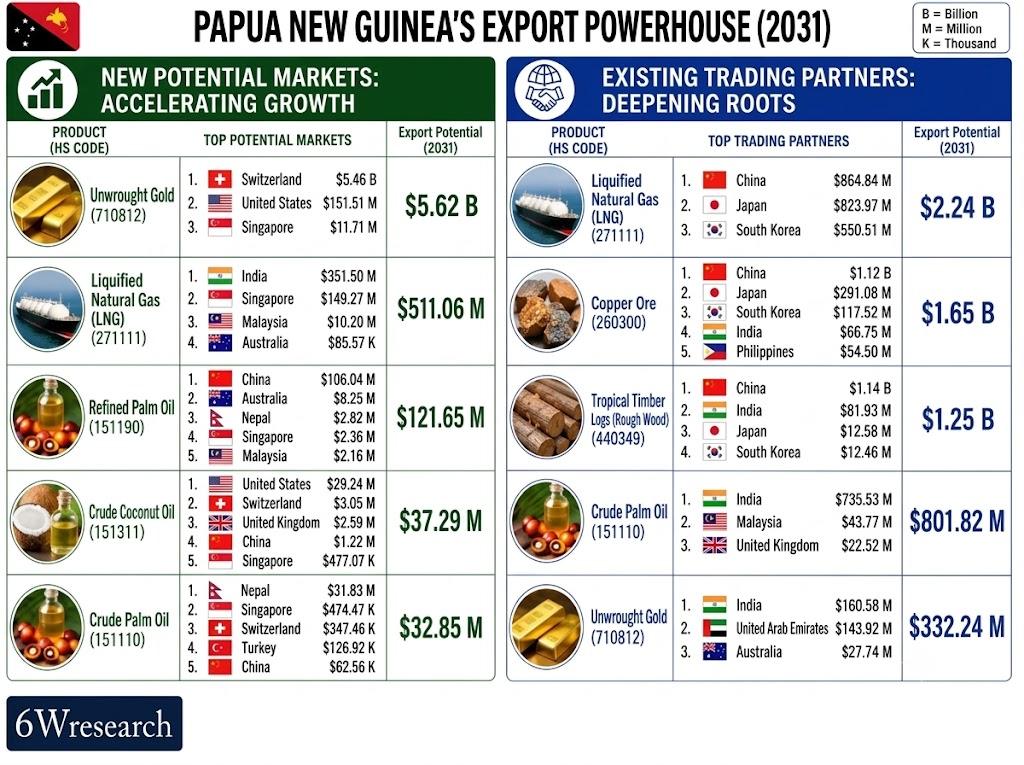
Unwrought gold is the leading new-corridor product by a vast margin at USD 5.62 billion, led almost entirely by Switzerland (USD 5.46 billion), with the United States (USD 151.51 million) and Singapore (USD 11.71 million) comparatively marginal. Switzerland’s leading position reflects its role as a major global gold-refining and trading hub, creating a potentially attractive outlet for Papua New Guinea’s expanding gold production. As output from major and emerging mines increases, PNG could potentially diversify beyond its traditional Australian refining route and access Switzerland’s established bullion-processing and global distribution network.
Liquified natural gas and refined palm oil together account for another USD 632.71 million of new-corridor potential. LNG’s USD 511.06 million in new-corridor value is led by India (USD 351.50 million) and Singapore (USD 149.27 million), reflecting India’s rapidly expanding LNG-import infrastructure and gas-fired power buildout a genuinely different buyer base from the Northeast Asian utilities that dominate established LNG trade with Singapore’s share reflecting its role as a regional LNG-trading and bunkering hub. Refined palm oil’s USD 121.65 million is led by China (USD 106.04 million), reflecting China’s vast food-processing and oleochemical industry absorbing a higher-value-added product distinct from the crude palm oil that dominates established trade to India.
Crude coconut oil and crude palm oil new-corridor close out the top five products with new markets. Crude coconut oil’s USD 37.29 million is led by the United States (USD 29.24 million), suggesting growing US natural-foods and cosmetics-industry demand for coconut oil as a specialty ingredient a genuinely new product line with no established-trade equivalent. Crude palm oil’s USD 32.85 million in new-corridor value is led by Nepal (USD 31.83 million). Taken together, the five products confirm that Papua New Guinea’s new-corridor opportunity is really a single-product, single-buyer phenomenon: the Switzerland-gold relationship alone dwarfs LNG diversification into India, refined palm oil into China, and the small coconut- and palm-oil lines combined.
LNG, Copper, and Timber Anchor Papua New Guinea’s Established Export Opportunities Across Asian Markets
Liquefied natural gas is Papua New Guinea’s largest established export opportunity at USD 2.24 billion, led by China at USD 864.84 million, Japan at USD 823.97 million, and South Korea at USD 550.51 million. PNG’s LNG exports benefit from established long-term supply relationships with major Northeast Asian buyers, supported by China’s expanding gas demand, Japan’s strong LNG import requirements, and South Korea’s continued reliance on natural gas for power generation and industry.
Copper ore and tropical timber logs together contribute USD 2.90 billion to Papua New Guinea’s established export opportunity. Copper ore accounts for USD 1.65 billion, led by China at USD 1.12 billion, Japan at USD 291.08 million, and South Korea at USD 117.52 million, reflecting strong demand from their large copper-smelting and non-ferrous metals industries, supported by PNG’s established mining base. Tropical timber logs contribute USD 1.25 billion, with China at USD 1.14 billion as the dominant buyer, driven by its furniture and construction industries, while India at USD 81.93 million provides a smaller secondary market.
Crude palm oil and unwrought gold close out Papua New Guinea’s top five established export opportunities at USD 801.82 million and USD 332.24 million, respectively. Crude palm oil is led by India at USD 735.53 million, reflecting its position as the world’s largest vegetable-oil importer, while Malaysia at USD 43.77 million provides a smaller regional refining and trading outlet. Demand for unwrought gold is more diversified with India (USD 160.58 million), the UAE (USD 143.92 million) and Australia (USD 27.74 million) being the top three countries, driven by jewelry and investment demand, Dubai’s position as a gold-trading hub and Australia as a refining country. Overall, PNG’s established exports remain centered on natural resources, with gold showing the broadest geographic reach among the major products.
|
Papua New Guinea’s export outlook remains strongly anchored in LNG, copper, timber, palm oil, and gold, with established trade concentrated across major Asian buyers such as China, Japan, India, and South Korea. However, the emerging opportunity shows a notable shift toward gold in Switzerland, alongside LNG and palm-oil opportunities in India, Singapore, and China, indicating scope to diversify both products and destination markets. 6WExportGTM Analysis |
Top Global Export Opportunities (2031), By Product
| Product | Export Opportunity (USD Billion) |
| Electronic Integrated Circuits | 685.7 |
| Refined Petroleum Oils | 668.4 |
| Light Petroleum Oils | 588.9 |
| Logic Electronic Integrated Circuits | 507.9 |
| Medicines | 381.2 |
| Gasoline Passenger Cars (1.5–3.0L) | 360.9 |
| Smartphones | 343.6 |
| Electronic Integrated Circuits with Memory | 333.2 |
| Data Transmission Equipment | 216.9 |
| Immunological Products | 209.6 |
Excludes naturally occurring products (e.g., crude oil, raw gold). Source: 6WExportGTM
Global export opportunities through 2031 are expected to remain concentrated in electronics, energy, pharmaceuticals, automotive, and digital technologies, with semiconductors and petroleum products among the largest categories. Papua New Guinea’s best fit is with its existing LNG, copper, gold and agricultural export base, and it may capitalize on the rise in global demand for energy and resource-processing inputs to enhance its position in international supply chains. Opportunities in battery materials, refined agricultural products, and resource-linked industrial inputs could also support gradual diversification beyond traditional commodity exports.
Two Developments Shaping Papua New Guinea’s Export Base: An LNG Expansion Decision and a Gold Production Ramp-Up
Two developments are shaping Papua New Guinea’s export outlook. The first is the pending final investment decision on the Papua LNG project, which could significantly expand national LNG export capacity and strengthen an already important export stream. The second is the ramp-up in gold production following the Porgera mine’s reopening, supporting greater export volumes and creating opportunities to deepen relationships with global refining and trading hubs such as Switzerland.
Papua LNG Expansion Strengthens Papua New Guinea’s Position in Global Energy Markets
TotalEnergies, ExxonMobil and Santos are inching toward a final investment decision on Papua LNG, and the target right now is Q4 2026, following a competitive bidding round that helped bring development costs down somewhat. The plan is to add three liquefaction trains, around 4 million tonnes a year combined, which would sit next to ExxonMobil's existing PNG LNG plant and push overall export capacity higher. Worth noting — the current PNG LNG operation has actually been performing really well, running at an annualized 8.7 million tonnes with reliability above 98% in Q2 2026, which says a lot about how solid PNG's operational track record already is in this space. There's also a domestic ownership angle here: Kumul Petroleum Holdings along with the Mineral Resources Development Company are set to hold a combined stake of up to roughly 22.5% once FID clears. And with China, Japan and South Korea all continuing to pull LNG demand from the region, this project could go a long way toward cementing PNG as a reliable long-term energy supplier and expanding its ability to capture future regional LNG demand.
|
The Papua LNG project represents a major opportunity to strengthen Papua New Guinea’s LNG position by expanding production capacity, attracting investment, and deepening supply relationships with key Asian energy markets. Manish Pant, Senior Data Scientist, Data Science & Market Intelligence, 6Wresearch |
Papua New Guinea’s Gold Sector Gains Momentum Through Mine Expansion and Global Market Integration
Papua New Guinea’s gold sector is experiencing renewed momentum due to the reopening of the Porgera mine and expansion activities at the K92 mining operation. Porgera — one of the biggest gold mines anywhere in the world — restarted in 2023 under New Porgera Limited, a structure specifically set up so PNG's government and local landowners actually get a real stake in the economics, not just royalties. In the first half of 2026, the mine paid out sizeable dividends, highlighting that this isn't a marginal contributor anymore. Production is likely to keep climbing as more capacity comes online, and PNG still has substantial reserves left in the ground, so there's real runway here. All of that is creating room for PNG to build a bigger presence in global bullion markets — Switzerland especially stands out, given it's one of the world's top gold-refining hubs, and deepening that relationship could help PNG plug more directly into international precious-metals supply chains. As both mining capacity and export volumes keep growing, gold is expected to remain a key driver of PNG’s resource-based export growth while supporting broader economic development.
|
The reopening of Porgera and expansion of PNG’s gold production capacity are strengthening the country’s position in global gold markets, creating opportunities to deepen links with international refining hubs and diversify export destinations. Manisha Gupta, Data Analyst, Data Science & Market Intelligence, 6Wresearch |
The Takeaway
PNG's export base is still very much resource-led — LNG, copper, timber and palm oil remain the backbone of its trade relationships with major Asian markets. What's newer is gold's rising role, particularly through its links to global refining and trading hubs. Going forward, the strategic play for PNG is fairly clear: lean into the expanding LNG capacity and the growing mining sector to pull more value out of what it already has, while working steadily toward a trade network that's more diversified and less exposed to any single commodity swing.
Key strategic priorities for Papua New Guinea include:
- Prepare state participation for a positive Papua LNG FID, since a final investment decision expected by Q4 2026 would add roughly 4 million tonnes of annual capacity to a product already worth USD 2.24 billion in established demand, with the state positioned to take up to a combined 22.5% equity stake through Kumul Petroleum and the Mineral Resources Development Company.
- Build domestic gold-refining capacity to capture more of the Swiss relationship’s value, given the USD 5.46 billion new-corridor gold relationship with Switzerland already dwarfs the USD 332.24 million established gold line, and every ounce refined offshore represents value-added capture PNG is not retaining domestically.
- Diversify LNG buyers beyond the existing three-country concentration, since China, Japan and South Korea already account for USD 2.24 billion combined in established LNG demand, while India’s USD 351.50 million in new-corridor LNG demand shows a genuinely new buyer relationship worth deepening ahead of the Papua LNG expansion.
- Address deforestation risk in the tropical timber trade, since tropical timber logs’ USD 1.25 billion in established value is overwhelmingly a single relationship with China (USD 1.14 billion), a concentration that leaves the product line exposed to both buyer-side sustainability scrutiny and reputational risk tied to rainforest depletion.
Ultimately, Papua New Guinea’s 2031 export outlook depends on whether the country can use a scaling gold sector and a transformative LNG investment decision to build genuine value-added capacity at home, rather than simply channeling ever-larger volumes of raw resources through the same narrow set of Asian and Swiss buyers that already dominate its trade.

Leadership Perspectives from Industry Events
Search
6Wresearch in the News
 Forbes
Citing 6Wresearch analytics to map global infrastructure and pharmaceutical industry trajectories.
 Bloomberg Law
Direct syndication of 6Wresearch's macro data points, capturing complex supply chain shifts.
 Reuters
Tracking industrial manufacturing adjustments and electronic security ecosystem scaling.
 Mint
Mint
Utilizing deep-tech sector market sizing to analyze global automation and robotics.
 The Economic Times
Anchoring features on industrial IoT growth metrics and connected smart-grid devices.
 Business Standard
Featuring strategic evaluations of Advanced Driver Assistance Systems (ADAS) and AI road safety.
 The Hindu
Spotlighting core commercial metrics ranging from unmanned aerial vehicles (UAVs) to consumer durables.
 Financial Express
Anchoring quarterly reviews on cross-border real estate tech and structural hardware manufacturing.
 Yahoo Finance
Syndicating the tracker's $30.1 billion untapped-market findings, spotlighting Japan, the US and China as India's top new-potential importers.
 India Today
Carrying the release on smartphones leading India's export potential to $94 billion by 2031, per 6WExportGTM data.
 Dailyhunt
Distributing the tracker findings to its regional readership, framing India's export diversification into Japan and Mexico.
 PR Newswire Original release
Publishing the full India Export Attractiveness Tracker 2026, detailing new trade corridors across iron ore, LCVs and pharmaceuticals.
 The Industrial
Highlighting the tracker's read on India's semiconductor ambitions and long-term chip-assembly export potential.
 PTI News
Reporting on the $66.81 billion pharmaceuticals export opportunity flagged in the tracker, amid looming US generic-drug tariffs.
 Tribune India
Covering the tracker's tariff-versus-regulation analysis across India's mature export markets in the US, China and UAE.
 ANI News
Amplifying the report's findings on polished diamonds, refined petroleum and medicines as India's core export engines.
 International Business Magazine
Covering the report's insight into how AEB, blind spot detection, and driver monitoring are reshaping India's ADAS market.
 Focus Gaming News
Highlighting the research forecast for Egypt's gambling market, projecting steady growth through 2032.
Thought Leadership and Analyst Meet





Our Clients








Latest Reports
- Austria X-ray Imaging Devices Market (2026-2032)
- Armenia X-ray Imaging Devices Market (2026-2032)
- Antigua and Barbuda X-ray Imaging Devices Market (2026-2032)
- Angola X-ray Imaging Devices Market (2026-2032)
- Andorra X-ray Imaging Devices Market (2026-2032)
- Albania X-ray Imaging Devices Market (2026-2032)
- Afghanistan X-ray Imaging Devices Market (2026-2032)
- United States (US) X-ray Imaging Devices Market (2026-2032)
- United Kingdom (UK) X-ray Imaging Devices Market (2026-2032)
- United Arab Emirates (UAE) X-ray Imaging Devices Market (2026-2032)
Industry Events and Analyst Meet

EV India Expo 2026

HIMTEX 2026

India Refining Summit 2026

India EV Show 2026

EV tech India Expo 2026
Whitepaper
- Middle East & Africa Commercial Security Market Click here to view more.
- Middle East & Africa Fire Safety Systems & Equipment Market Click here to view more.
- GCC Drone Market Click here to view more.
- Middle East Lighting Fixture Market Click here to view more.
- GCC Physical & Perimeter Security Market Click here to view more.


