Peru's Copper Ore Exports to Existing Partners Could Reach USD 21.95 Billion, While Iron Ore Opens USD 553.26 million Across New Markets by 2031
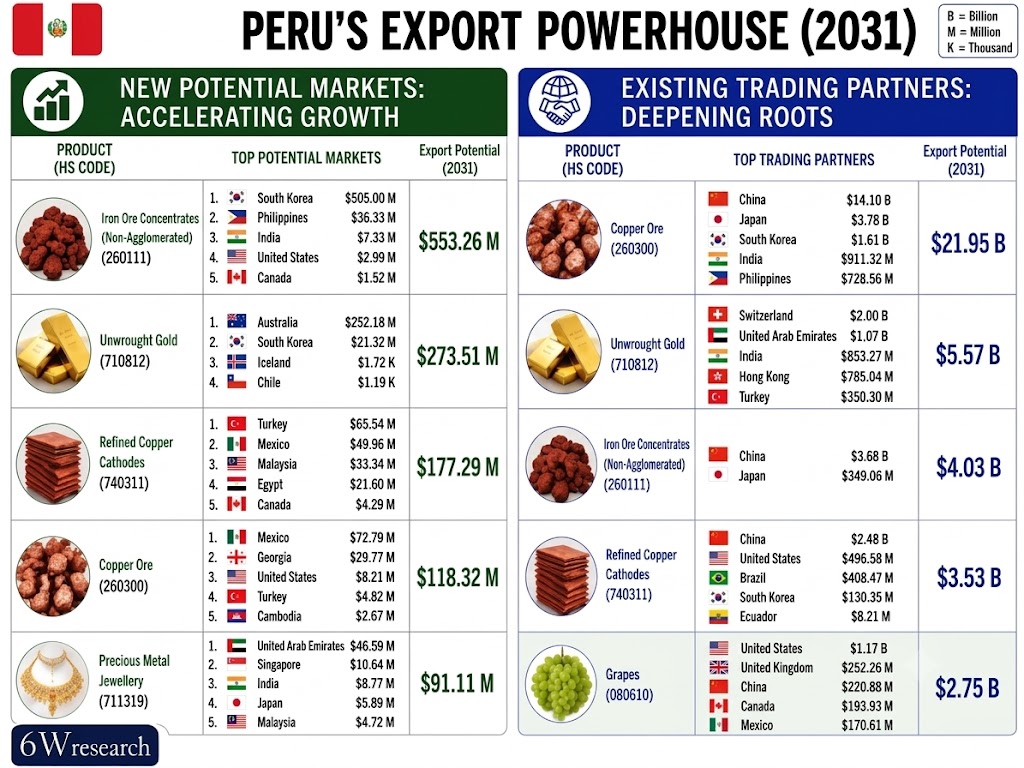
China remains the largest anchor of Peru’s established export base, accounting for 42.72% of total export potential, followed by the United States at 15.17%. New-corridor opportunities are more diversified, led by South Korea, Australia, and China. The expansion of Peru’s future export potential is driven primarily by existing strengths in copper, gold, iron ore, and refined copper, with diversification occurring mainly through new buyer markets rather than new product categories.
Source: 6WExportGTM
South Korea Narrowly Leads a More Contested New-Corridor Field for Peru
Peru’s new potential export corridors are led by South Korea, representing USD 0.63 billion in export opportunity, followed closely by Australia at USD 0.41 billion and China at USD 0.40 billion. These markets present promising potential for Peru to increase its mineral exports, especially copper and other resource-based products, supported by demand from industrial and energy-transition sectors. India and Turkey bring additional diversification opportunities across emerging markets, contributing USD 0.30 billion and USD 0.33 billion, respectively. The mix of these destinations is indicative of Peru’s ability to expand its export market to new clients outside of its traditional customer base through its competitive advantages in mining, metals and value-added mineral products.
| Top 5 Existing Importers | Export Potential (USD Billion) | Top 5 New Potential Importers | Export Potential (USD Billion) |
| China | 28.70 | South Korea | 0.63 |
| United States | 10.19 | Australia | 0.41 |
| Japan | 6.07 | China | 0.40 |
| South Korea | 3.81 | Turkey | 0.33 |
| Switzerland | 2.33 | India | 0.30 |
Source: 6WExportGTM
China accounts for USD 28.70 billion of Peru's established export potential, nearly triple the United States' USD 10.19 billion in second place. Japan ranks third at USD 6.07 billion, with South Korea and Switzerland contributing USD 3.81 billion and USD 2.33 billion. This reflects Peru's position as a leading global mineral exporter feeding China's enormous refining and manufacturing base, with Japan, South Korea and Switzerland absorbing smaller but consistent volumes of ore, refined metal and gold for their own industrial and bullion-trading needs.
The Same Metals Reaching New Buyers Headline Peru's New-Corridor Opportunities
Iron ore concentrates (non-agglomerated) turn out to be Peru's single biggest opportunity in new trade corridors, worth around USD 553 million. South Korea accounts for most of that, at USD 505 million, with the Philippines a distant second at USD 36 million and India trailing at USD 7 million. South Korea’s leading position indicates its large steelmaking industry and its efforts to diversify iron ore sourcing beyond from its usual suppliers such as Australia and Brazil, creating an opportunity for Peru to establish a stronger presence in Korean raw material supply chains.
Gold and refined copper cathodes are the next two biggest opportunities, worth USD 274 million and USD 177 million respectively. On the gold side, Australia stands out clearly, accounting for USD 252 million of that figure — not surprising given it's one of the world's major gold producers and has the bullion-processing capacity to take on more supply without much friction. Copper cathodes tell a different story — the buyer base here is much more spread out, with Turkey leading at USD 66 million, followed by Mexico at USD 50 million and Malaysia at USD 33 million. That spread really points to broader industrial demand picking up for refined copper well beyond the markets Peru has traditionally relied on.
Rounding out the top five are copper ore and precious metal jewellery, worth USD 118 million and USD 91 million. Copper ore demand is led by Mexico at USD 73 million and Georgia at USD 30 million — both markets that make sense given their regional processing capacity and existing trade networks. Jewellery is the one category here that breaks the pattern, since it sits outside Peru's usual mineral export lineup. The UAE leads that opportunity at USD 47 million, with Singapore following at USD 11 million, which tracks given how central both are to global jewellery manufacturing, trading, and luxury retail. Put it all together, and the picture is fairly clear — Peru's real opportunity right now isn't about breaking into new product categories, it's about taking what it already does well and finding strengths into new markets.
Copper and Gold Remain the Foundation of Peru's China-Anchored Established Trade
Copper ore represents Peru’s largest established export opportunity at USD 21.95 billion, led by China at USD 14.10 billion, followed by Japan at USD 3.78 billion and South Korea at USD 1.61 billion. China’s dominant position reflects its role as the world’s largest copper consumer and processing hub, while Japan and South Korea remain key destinations due to their established smelting capacity and continued reliance on imported copper concentrates. India and the Philippines provide additional opportunities, highlighting Peru’s importance as a major Pacific-facing supplier of copper resources.
Unwrought gold and iron ore concentrates make up the next tier of Peru's established export opportunities at USD 5.57 billion and USD 4.03 billion respectively. In terms of gold opportunities, Switzerland leads with USD 2.00 billion, followed by the UAE at USD 1.07 billion and India at USD 853 million — a split that lines up with Switzerland's role as a refining hub, and the UAE and India's weight as bullion trading and consumption markets. Iron ore concentrates by contrast are concentrated almost entirely in one buyer: China accounts for USD 3.68 billion of the total, driven by the scale of its steel sector and its ongoing need for imported ore.
Rounding out the top five are refined copper cathodes and grapes, worth USD 3.53 billion and USD 2.75 billion. China again leads on refined copper cathodes at USD 2.48 billion with the US at USD 497 million and Brazil at USD 408 million behind it, pointing to steady industrial demand across several manufacturing economies, rather than one dominant buyer. Grapes are the standout agricultural category here — the US leads at USD 1.17 billion, followed by the UK at USD 252 million and China at USD 221 million, supported by consistent demand for Peru's counter seasonal produce exports. Taken together, these numbers reinforce how much of Peru's export base still runs through mining, with agriculture functioning as the main counterweight built on established consumer markets abroad.
|
Peru’s export opportunity through 2031 is defined by strengthening market access for its existing commodity advantages rather than shifting away from its resource base. 6WExportGTM analysis indicates that the country’s biggest opportunity lies in leveraging its globally competitive copper, gold, and iron ore supply chains while expanding into underpenetrated markets across Asia, the Middle East, and emerging industrial economies. The ability to diversify buyers, improve downstream value addition, and strengthen logistics infrastructure will be critical for Peru to convert resource strength into long-term export resilience. 6WExportGTM Analysis |
Top Global Export Opportunities (2031), By Product
| Product | Export Opportunity (USD Billion) |
| Electronic Integrated Circuits | 685.7 |
| Refined Petroleum Oils | 668.4 |
| Light Petroleum Oils | 588.9 |
| Logic Electronic Integrated Circuits | 507.9 |
| Medicines | 381.2 |
| Gasoline Passenger Cars (1.5–3.0L) | 360.9 |
| Smartphones | 343.6 |
| Electronic Integrated Circuits with Memory | 333.2 |
| Data Transmission Equipment | 216.9 |
| Immunological Products | 209.6 |
Excludes naturally occurring products (e.g., crude oil, raw gold). Source: 6WExportGTM
The global export landscape through 2031 highlights a strong shift toward technology-intensive, refined industrial, healthcare, and advanced manufacturing products, while Peru’s current export strength remains concentrated in mining and agricultural commodities. With copper ore, refined copper cathodes, unwrought gold, iron ore concentrates, and grapes forming the core of Peru’s export base, the country is well positioned to benefit from rising global demand for industrial inputs linked to electrification, infrastructure, and manufacturing growth. Opportunities in sectors such as Refined petroleum oils, electronic components, medicines and data transmission equipment are among the areas for future diversification in downstream processing, industrial development and higher-value manufacturing. Leveraging its mineral resource advantage, strategic trade partnerships, and expanding agricultural capabilities, Peru can strengthen participation in global value chains while gradually reducing dependence on raw commodity exports.
What Peru Already Sells and Where
Metallic Ores form Peru's largest established trade sector at USD 28.94 billion, led by copper ore at 70.79% share, with zinc ore adding 6.08% share. Precious Metals rank second at USD 13.11 billion, led by unwrought gold at 97.31% share, with unwrought silver adding 2.68% share. Fruits follow at USD 6.43 billion, led by cranberries a 34.41% share, with grapes adding 26.86% share together confirming that Peru's export base is anchored in mining, with a genuine and fast-growing fruit-export industry providing real diversification.
| Sector | Exports (USD Billion) | Leading Products / Share |
| Metallic Ores | 28.94 | Copper Ore (70.79%), Zinc Ore (6.08%) |
| Precious Metals | 13.11 | Unwrought Gold (97.31%), Unwrought Silver (2.68%) |
| Fruits | 6.43 | Cranberries (34.41%), Grapes (26.86%) |
Source: UN Comtrade
China is Peru's largest destination market at USD 24.84 billion, led by copper ore at a 62.13% share and non-agglomerated iron ore concentrates at 6.86%. The United States ranks second at USD 9.58 billion, led by cranberries at a 12.79% share and grapes at 9.07%, while India follows at USD 4.69 billion, led by unwrought gold at an 89.45% share and copper ore at 7.93% a pattern that shows Peru's current export capacity split between a dominant Chinese mineral’s relationship, a genuine US fruit-export market, and an emerging Indian gold-trading relationship.
| Country | Exports (USD Billion) | Leading Products / Share |
| China | 24.84 | Copper Ore (62.13%), Iron Ore Concentrates, Non-Agg. (6.86%) |
| United States | 9.58 | Cranberries (12.79%), Grapes (9.07%) |
| India | 4.69 | Unwrought Gold (89.45%), Copper Ore (7.93%) |
Source: UN Comtrade
A China-Built Megaport and a Looming US Copper Tariff: Two Developments Shaping Peru's Export Base
There are two developments important which are shaping Peru’s export outlook: the opening and continued expansion of the Chinese-built Chancay megaport, which is transforming Peru’s connectivity with Asian markets and improving mineral export logistics, and the potential extension of Section 232 tariffs to refined copper, which could create uncertainty for copper cathode exporters and influence future trade flows with key markets. These developments highlight both the opportunities from enhanced infrastructure and the challenges arising from evolving trade policies.
The China-Built Chancay Megaport Is Deepening Peru's Trade Ties with Beijing, and Drawing US Scrutiny
The USD 3.5 billion Chancay megaport, 60% owned by China's COSCO Shipping and inaugurated by President Xi Jinping in November 2024, has cut ocean transit time between Shanghai and Peru from roughly 35-42 days to about 23 days on direct sailings, with COSCO and Peruvian officials estimating logistics-cost reductions of up to 20% on some routes. The port is designed to move copper and other minerals directly to Asia while bringing Chinese vehicles, machinery and electronics back into South America, and COSCO holds exclusive operating rights for up to 60 years under the original concession agreement. The arrangement has drawn sustained US concern: in February 2026, the State Department publicly warned Peru after a Peruvian court ruling limited the national transport regulator's oversight of the China-operated terminal, a decision COSCO is appealing, while Washington has separately floated the idea of applying China-level tariffs to goods routed through Chinese-controlled ports. For an established China relationship having a potential of worth USD 28.70 billion and anchored in copper and iron ore, Chancay represents both a genuine efficiency gains for Peru's mineral exports and a growing point of friction in Peru's relationship with the United States.
|
New corridor opportunities are focused on intensifying existing mineral strengths into additional markets rather than creating entirely new export categories. Iron ore concentrates, unwrought gold, refined copper cathodes, and copper ore lead future opportunities, with markets such as South Korea, Australia, Turkey, Mexico, and the UAE providing diversification beyond traditional buyers. Manish Pant, Senior Data Scientist, Data Science & Market Intelligence, 6Wresearch |
Refined Copper Cathodes Are Exempt from US Copper Tariffs for Now, but a 2027 Duty Decision Looms
The United States imposed a 50% Section 232 tariff on semi-finished copper products and copper-intensive derivatives in August 2025, later expanded in April 2026 to apply to the full customs value of covered goods rather than just their metal content. Critically, refined copper cathodes, ores, concentrates and scrap remain exempt from these tariffs for now, meaning Peru's cathode exports to the US, worth USD 0.50 billion in established trade, currently move duty-free despite the US-Peru Trade Promotion Agreement offering no separate shield against Section 232 measures. That exemption has an expiration date attached: the Commerce Department must deliver an updated report on US refining capacity by June 30, 2026, after which the White House may impose a phased universal duty on refined copper starting at 15% in 2027 and rising to 30% in 2028. Given that Peru's Antamina, Cerro Verde and Las Bambas mines already rank among the largest US copper suppliers, any extension of tariffs to cathodes would land directly on a combined opportunity worth USD 3.71 billion across Peru's established and new-corridor refined-copper trade.
|
Peru’s export ecosystem combines resource-driven strengths with emerging diversification opportunities. While mining products dominate established trade, agricultural exports such as grapes provide a complementary growth avenue, with the United States, United Kingdom, and China emerging as key markets. This creates a balanced opportunity between industrial commodities and consumer-oriented exports. Manisha Gupta, Data Analyst, Data Science & Market Intelligence, 6Wresearch |
The Takeaway
Peru should treat its export outlook through 2031 as one of managing concentrated mineral dependence on China while preparing for genuine policy uncertainty in its two other major relationships, since new infrastructure is deepening Chinese trade ties even as it draws US scrutiny, and a favorable US tariff exemption on refined copper carries a real 2027 expiration risk. The path forward depends on protecting the China-anchored mineral trade that dominates current exports while using the new-corridor data to build genuinely durable relationships with South Korea, Australia and other emerging buyers.
Key strategic priorities for Peru include:
- Convert new-corridor iron ore demand from South Korea into a durable relationship: South Korea already leads Peru's new-corridor iron ore opportunity at USD 0.50 billion, more than 91% of the total opportunity. Peru should pursue direct long-term supply agreements with Korean steelmakers before this early demand is captured by competing suppliers.
- Prepare for the 2027 refined-copper tariff decision now, not after it is announced: With Section 232 duties on refined copper potentially rising to 15% in 2027 and 30% in 2028, and a combined USD 3.71 billion of Peru's copper-cathode trade with the US at stake, Peruvian producers should begin diversifying cathode buyers toward Turkey, Mexico and Malaysia, all of which already appear in the new-corridor data.
- Use Chancay's efficiency gains without over-concentrating in China: The Chancay megaport materially lowers the cost of reaching Chinese buyers, but with China already absorbing 42.72% of established export potential, Peru should treat the port's capacity as a platform for reaching a broader set of Asian buyers, including South Korea and Southeast Asia, rather than deepening Chinese dependence further.
- Build on the US fruit-export relationship as a genuine counterweight to mineral dependence: Cranberries and grapes together represent a meaningful share of Peru's USD 9.58 billion United States relationship, one of the few established categories not dominated by China. Peru should continue investing in counter-seasonal fruit production and cold-chain logistics to grow this diversified, non-mineral export pillar.
Overall, Peru's export growth through 2031 will depend less on discovering new products to sell and more on how well the country manages its deepening infrastructure ties to China alongside genuine policy uncertainty in Washington a reminder that for a mineral-concentrated economy, the durability of buyer relationships matters as much as the minerals themselves.

Leadership Perspectives from Industry Events
Search
6Wresearch in the News
 Forbes
Citing 6Wresearch analytics to map global infrastructure and pharmaceutical industry trajectories.
 Bloomberg Law
Direct syndication of 6Wresearch's macro data points, capturing complex supply chain shifts.
 Reuters
Tracking industrial manufacturing adjustments and electronic security ecosystem scaling.
 Mint
Mint
Utilizing deep-tech sector market sizing to analyze global automation and robotics.
 The Economic Times
Anchoring features on industrial IoT growth metrics and connected smart-grid devices.
 Business Standard
Featuring strategic evaluations of Advanced Driver Assistance Systems (ADAS) and AI road safety.
 The Hindu
Spotlighting core commercial metrics ranging from unmanned aerial vehicles (UAVs) to consumer durables.
 Financial Express
Anchoring quarterly reviews on cross-border real estate tech and structural hardware manufacturing.
 Yahoo Finance
Syndicating the tracker's $30.1 billion untapped-market findings, spotlighting Japan, the US and China as India's top new-potential importers.
 India Today
Carrying the release on smartphones leading India's export potential to $94 billion by 2031, per 6WExportGTM data.
 Dailyhunt
Distributing the tracker findings to its regional readership, framing India's export diversification into Japan and Mexico.
 PR Newswire Original release
Publishing the full India Export Attractiveness Tracker 2026, detailing new trade corridors across iron ore, LCVs and pharmaceuticals.
 The Industrial
Highlighting the tracker's read on India's semiconductor ambitions and long-term chip-assembly export potential.
 PTI News
Reporting on the $66.81 billion pharmaceuticals export opportunity flagged in the tracker, amid looming US generic-drug tariffs.
 Tribune India
Covering the tracker's tariff-versus-regulation analysis across India's mature export markets in the US, China and UAE.
 ANI News
Amplifying the report's findings on polished diamonds, refined petroleum and medicines as India's core export engines.
 International Business Magazine
Covering the report's insight into how AEB, blind spot detection, and driver monitoring are reshaping India's ADAS market.
 Focus Gaming News
Highlighting the research forecast for Egypt's gambling market, projecting steady growth through 2032.
Thought Leadership and Analyst Meet





Our Clients








Latest Reports
- Austria X-ray Imaging Devices Market (2026-2032)
- Armenia X-ray Imaging Devices Market (2026-2032)
- Antigua and Barbuda X-ray Imaging Devices Market (2026-2032)
- Angola X-ray Imaging Devices Market (2026-2032)
- Andorra X-ray Imaging Devices Market (2026-2032)
- Albania X-ray Imaging Devices Market (2026-2032)
- Afghanistan X-ray Imaging Devices Market (2026-2032)
- United States (US) X-ray Imaging Devices Market (2026-2032)
- United Kingdom (UK) X-ray Imaging Devices Market (2026-2032)
- United Arab Emirates (UAE) X-ray Imaging Devices Market (2026-2032)
Industry Events and Analyst Meet

EV India Expo 2026

HIMTEX 2026

India Refining Summit 2026

India EV Show 2026

EV tech India Expo 2026
Whitepaper
- Middle East & Africa Commercial Security Market Click here to view more.
- Middle East & Africa Fire Safety Systems & Equipment Market Click here to view more.
- GCC Drone Market Click here to view more.
- Middle East Lighting Fixture Market Click here to view more.
- GCC Physical & Perimeter Security Market Click here to view more.


