Tanzania’s Cashew Nuts in Shell Exports to Existing Partners Could Reach USD 1.17 Billion, While Unwrought Gold Opens USD 947.65 Million Across New Markets by 2031.
Tanzania’s export potential is led by China at 21.16% and India at 19.91%, followed by Vietnam at 13.29%, while new-corridor markets are more concentrated with Hong Kong accounting for 31.74%, followed by China at 12.43%. The distribution highlights Tanzania’s strong dependence on Asian markets, with emerging opportunities extending toward Singapore, Canada and the United States
Source: 6WExportGTM
China Narrowly Tops Established Demand While Hong Kong Commands Tanzania’s New-Corridor Gold Trade
Tanzania’s new-corridor export opportunities are led by Hong Kong at USD 0.85 billion, representing the largest potential market among emerging destinations. China follows with USD 0.33 billion, while Singapore, Canada and the United States offer additional opportunities of USD 0.22 billion, USD 0.21 billion and USD 0.20 billion, respectively. These markets highlight Tanzania’s potential to expand beyond traditional trading partners by strengthening exports across minerals, agricultural commodities and value-added products, while deepening commercial links with major Asian and North American markets.
| Top 5 Existing Importers | Export Potential (USD Billion) | Top 5 New Potential Importers | Export Potential (USD Billion) |
| China | 1.56 | Hong Kong | 0.85 |
| India | 1.47 | China | 0.33 |
| Vietnam | 0.98 | Singapore | 0.22 |
| United Arab Emirates | 0.64 | Canada | 0.21 |
| Rwanda | 0.54 | United States | 0.20 |
Source: 6WExportGTM
China was the largest market for Tanzania’s established export opportunities at USD 1.56 billion, followed by India at USD 1.47 billion, emphasizing the relevance of Asian markets in Tanzania’s trade landscape. Vietnam is next with USD 0.98 billion. The United Arab Emirates and Rwanda provide further opportunities of USD 0.64 billion and USD 0.54 billion, respectively. These established markets reflect Tanzania’s strong export linkages across minerals, agricultural commodities and regional trade networks, providing a foundation for further expansion and value-added exports.
Gold Finds New Trading Routes While Manganese Ore Emerges from Nothing
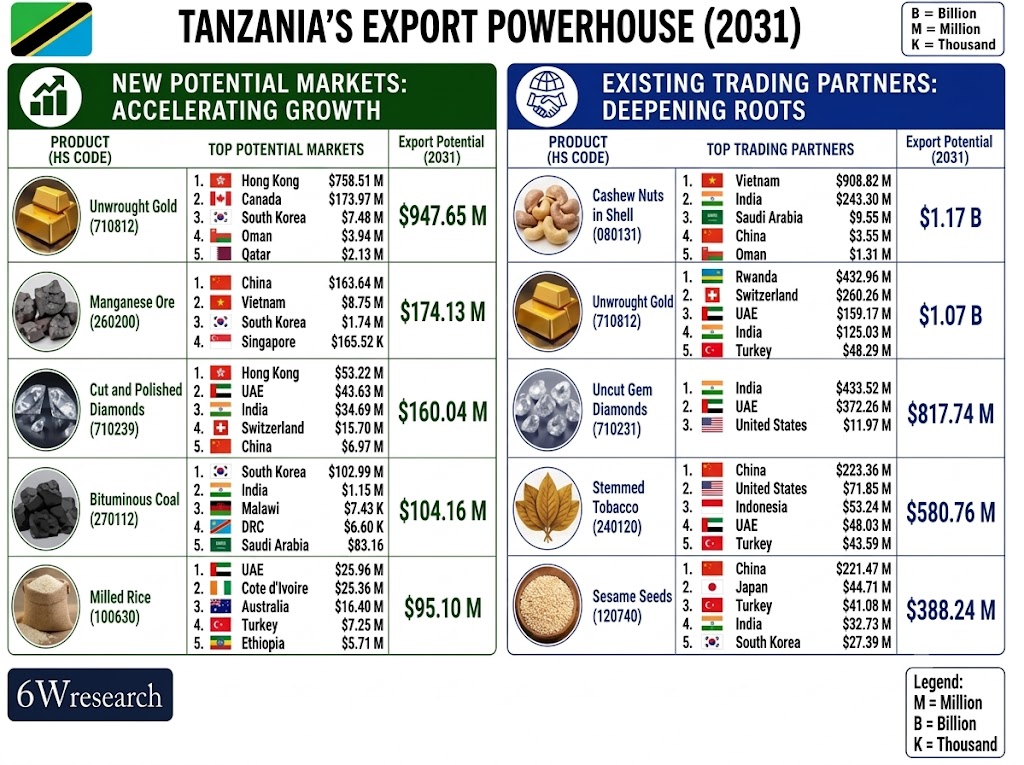
Unwrought gold is the leading new-corridor product at USD 947.65 million, led by Hong Kong at USD 758.51 million and Canada at USD 173.97 million, with South Korea a distant third at USD 7.48 million. Hong Kong’s dominance reflects its role as a major global bullion-trading and refining gateway feeding mainland Chinese gold demand a distinct function from the buyers anchoring Tanzania’s established gold base, where Rwanda and Switzerland dominate. Canada’s position likely reflects its major gold-refining capacity, with Canadian refiners diversifying feedstock sourcing amid tight global supply, while South Korea’s smaller purchases reflect jewelry and electronics-sector demand.
Manganese ore and cut and polished diamonds together account for another USD 334.17 million of new-corridor potential. Manganese ore’s USD 174.13 million is overwhelmingly a single relationship with China (USD 163.64 million), consistent with China’s vast steel and battery-manufacturing demand for the mineral and notably, manganese ore does not appear anywhere among Tanzania’s established top-five products, making this the clearest signal in the data of a genuinely new export category rather than an old commodity finding new buyers. Cut and polished diamonds’ USD 160.04 million in new-corridor value is led by Hong Kong (USD 53.22 million), the UAE (USD 43.63 million) and India (USD 34.69 million) the same specialized diamond-trading and jewelry hubs that anchor Tanzania’s established rough-diamond trade, now reaching for polished stones as well.
Bituminous coal and milled rice close out the new-corridor top five. Coal’s USD 104.16 million is led almost entirely by South Korea (USD 102.99 million), reflecting Korean utilities and steelmakers diversifying coal-sourcing amid global supply shifts. Milled rice’s USD 95.10 million is spread more evenly across the UAE (USD 25.96 million), Cote d’Ivoire (USD 25.36 million) and Australia (USD 16.40 million) the UAE reflecting Gulf food-security-driven import demand, Cote d’Ivoire reflecting intra-African trade growth, and Australia a smaller, likely re-export-linked relationship. Taken together, the five products confirm that Tanzania’s new-corridor opportunity is genuinely mixed: a fast-forming gold-trading shift toward Hong Kong and Canada, an entirely new mineral category in manganese ore, and diversifying buyers for established diamonds and grains alike.
A Genuinely Diversified Mix of Agriculture and Minerals
Cashew nuts in shell’s USD 1.17 billion established base is led by Vietnam (USD 908.82 million) and India (USD 243.30 million), with Saudi Arabia a distant third at USD 9.55 million. Vietnam’s dominance reflects its position as the world’s largest cashew-processing and re-export hub, importing vast volumes of raw nuts to feed its shelling and roasting industry before re-exporting kernels to Europe and North America; India plays a similar dual role as both a processing center and a fast-growing domestic consumption market; and Saudi Arabia represents a smaller direct Gulf consumption and re-export market.
Unwrought gold (USD 1.07 billion) and uncut gem diamonds (USD 817.74 million) together contribute another USD 1.88 billion. Gold’s top buyers Rwanda (USD 432.96 million), Switzerland (USD 260.26 million) and the UAE (USD 159.17 million) reflect three distinct roles: Rwanda’s outsized position likely reflects cross-border gold aggregation and re-export trade within the Great Lakes region, Switzerland hosts the world’s largest LBMA-accredited gold refineries, and the UAE functions as a regional trading and re-export gateway through Dubai’s gold souk and free-trade zones. Diamond buyers are more concentrated still: India (USD 433.52 million) processes the majority of global rough-diamond supply at its Surat cutting centers, while the UAE (USD 372.26 million) trades and re-exports rough stones through the Dubai Diamond Exchange.
Stemmed tobacco (USD 580.76 million) and sesame seeds (USD 388.24 million) close out the top five. Tobacco’s buyers China (USD 223.36 million), the United States (USD 71.85 million) and Indonesia (USD 53.24 million) reflect China’s vast state-run cigarette-manufacturing industry, US manufacturers sourcing blending leaf, and Indonesia’s large kretek clove-cigarette industry. Sesame seeds are led by China (USD 221.47 million), Japan (USD 44.71 million) and Turkey (USD 41.08 million) reflecting Chinese oil-pressing and confectionery demand, Japan’s culinary sesame-oil market, and Turkey’s tahini and halva industries. Read together, the established base reveals something unusual among the countries in this series: real diversification across five genuinely different products, even though each product individually still concentrates around two or three dominant processing or trading hubs.
|
Tanzania’s established trade tells a more balanced story than most of its peers five real products across agriculture and minerals, not one commodity doing all the work. But the new-corridor data shows where the next chapter is being written: gold finding an entirely new trading route through Hong Kong and Canada, and manganese ore appearing from nothing to become a genuine fifth pillar in the making. The question for Tanzania is whether it can protect that underlying diversification even as gold’s boom pulls more attention and capital toward a single mineral. 6WExportGTM Analysis |
Top Global Export Opportunities (2031), By Product
| Product | Export Opportunity (USD Billion) |
| Electronic Integrated Circuits | 685.7 |
| Refined Petroleum Oils | 668.4 |
| Light Petroleum Oils | 588.9 |
| Logic Electronic Integrated Circuits | 507.9 |
| Medicines | 381.2 |
| Gasoline Passenger Cars (1.5–3.0L) | 360.9 |
| Smartphones | 343.6 |
| Electronic Integrated Circuits with Memory | 333.2 |
| Data Transmission Equipment | 216.9 |
| Immunological Products | 209.6 |
Excludes naturally occurring products (e.g., crude oil, raw gold). Source: 6WExportGTM
Global export opportunities through 2031 are expected to be driven by electronic integrated circuits, petroleum products, medicines, passenger vehicles, smartphones and data transmission equipment, reflecting global shifts toward digitalization, energy security, healthcare expansion and advanced manufacturing. For Tanzania, these trends highlight the opportunity to move beyond its traditional export base of gold, minerals, agricultural commodities and energy resources by developing more value-added industries. Tanzania is not yet established as a significant exporter of high-technology products but it can derive indirect benefits through greater mineral beneficiation, agro-processing, petroleum-related industries and manufacturing capabilities. Expanding processing capacity for products such as gold, diamonds, copper, cashew, coffee and other agricultural commodities can help Tanzania capture greater value within global supply chains and diversify its export portfolio beyond raw commodity exports.
What Tanzania Already Sells and Where
Current actual trade confirms gold’s outsized weight in Tanzania’s export economy well beyond the 2031 forecast. Precious metals lead all sectors at USD 3.48 billion, driven overwhelmingly by unwrought gold alone at USD 3.23 billion (92.64% of the sector), with semi-manufactured gold contributing a smaller USD 192.51 million. Fruits rank a distant second at USD 618.87 million, led by cashew nuts in shell at USD 541.68 million (87.53%), with avocados a much smaller USD 49.81 million (8.05%). Tobacco ranks third at USD 545.62 million, almost entirely stemmed tobacco at USD 478.62 million (87.72%), alongside a modest cigarettes line of USD 29.91 million (5.48%).
| Sector | Exports (USD Billion) | Leading Products (USD Million/Billion) |
| Precious Metals | 3.48 | Unwrought Gold: $3.23B; Semi Manufactured Gold: $192.51M |
| Fruits | 0.62 | Cashew Nuts In Shell: $541.68M; Avocados: $49.81M |
| Tobacco | 0.55 | Stemmed Tobacco: $478.62M; Cigarettes: $29.91M |
Source: UN Comtrade
By destination, South Africa is Tanzania’s largest current export market at USD 2.29 billion, almost entirely unwrought gold at USD 2.226 billion (97.09%) a figure so concentrated it most plausibly reflects gold routed through South African refining and trading infrastructure rather than direct South African consumption alongside a marginal USD 19.37 million (0.84%) in stemmed tobacco. India ranks second at USD 1.64 billion, split between unwrought gold at USD 437.30 million (26.71%) and cashew nuts in shell at USD 251.85 million (15.38%), reflecting its dual role as both a gold market and a cashew-processing hub. The United Arab Emirates ranks third at USD 625.15 million, led by unwrought gold at USD 334.52 million (53.51%) and semi-manufactured gold at USD 96.37 million (15.41%), consistent with Dubai’s established position as a regional gold-trading and re-export center.
| Country | Exports (USD Billion) | Leading Products (USD Million/Billion) |
| South Africa | 2.29 | Unwrought Gold: $2.23B; Stemmed Tobacco: $19.37M |
| India | 1.64 | Unwrought Gold: $437.30M; Cashew Nuts In Shell: $251.85M |
| United Arab Emirates | 0.63 | Unwrought Gold: $334.52M; Semi Manufactured Gold: $96.37M |
Source: UN Comtrade
Two Developments Shaping Tanzania’s Export Base: A Gold Boom and a Cashew Value-Addition Push
Two developments now bear directly on the numbers above. The first is a record gold boom that has pushed the metal to nearly half of Tanzania’s goods export earnings, raising real questions about over-concentration in a base that otherwise looks genuinely diversified. The second is a long-discussed push, now backed by a firm 2026/27 target, to process cashews domestically rather than exporting the crop raw to Vietnam and India a shift that would touch the USD 1.17 billion cashew nuts in shell line directly.
A Record Gold Boom Fuels Tanzania’s Combined USD 2.02 Billion Gold Opportunity
Tanzania’s gold sector generated a record USD 5.27 billion in export earnings in the year ending April 2026, up sharply from USD 3.82 billion in the equivalent prior-year period, driven by both extraordinary global bullion prices spot gold traded near USD 4,089 per troy ounce as of late June 2026 and continued production growth at large-scale mines including Geita, Bulyanhulu, North Mara (operated under the Barrick-government Twiga Minerals joint venture) and the expanding Buckreef project. National production reached a record 60 metric tonnes in 2024, up 9% year-on-year, with growth continuing through 2025. Gold now accounts for nearly half of all goods export revenue, and industry experts including figures at the Tanzania Chamber of Mines have explicitly warned that this growing dependence on a single mineral exposes the country to future price shocks, calling for accelerated development of other strategic minerals. The government has responded in part by allocating 10% of mining-sector revenue to fund advanced mineral exploration aimed at identifying new mineral-rich areas beyond gold. For a country whose gold lines already represent USD 3.23 billion in current sector trade and a combined USD 2.02 billion across established (USD 1.07 billion) and new-corridor (USD 947.65 million) 2031 potential, how this boom is managed as a springboard for diversification or a further deepening of concentration will shape the entire export base’s resilience.
|
Tanzania’s gold surge is strengthening export earnings, but the growing dependence on a single mineral makes diversification into other strategic minerals increasingly important for long-term trade resilience. Manish Pant, Senior Data Scientist, Data Science & Market Intelligence, 6Wresearch |
A Cashew Value-Addition Push Targets Tanzania’s USD 1.17 Billion Raw-Nut Trade
Tanzania currently exports an estimated 94–95% of its cashew crop as unprocessed raw nuts, sent almost entirely to Vietnam and India for shelling and roasting before the resulting kernels reach European and North American consumers a pattern reflected directly in the established data, where Vietnam (USD 908.82 million) and India (USD 243.30 million) together take more than 98% of Tanzania’s USD 1.17 billion cashew nuts in shell line. Tanzania’s agriculture ministry has been working to finalize a modern cashew-processing facility in the Mtwara region, part of a longer-running government push to have all exported cashew processed domestically starting the 2026/27 season rather than shipped raw, with that target year now imminent. The timing may favor Tanzania: Vietnam’s own raw-cashew import bill surged 38% to USD 4.01 billion through October 2025 against export revenue of just USD 4.25 billion, an unusually thin margin that underscores how little value processing countries actually retain once input costs are counted, while Tanzania stood out in the 2025/26 marketing year as the only major African producer seeing a production upswing amid otherwise tightening global supply giving it rare near-term leverage in price and volume negotiations with the same two buyers that dominate its established trade.
|
Tanzania’s cashew sector has significant value-addition potential, as its current raw nut export model transfers most processing benefits to overseas markets. Expanding domestic processing capacity could help Tanzania capture higher margins, strengthen its position in global cashew supply chains and reduce dependence on Vietnam and India as processing hubs. Manisha Gupta, Data Analyst, Data Science & Market Intelligence, 6Wresearch |
The Takeaway
Tanzania’s export base is unusually diversified for a resource-linked economy: five genuinely different established products spanning agriculture and minerals generate a combined USD 3.94 billion in top-five 2031 potential, while the USD 2.68 billion new-corridor opportunity mixes a fast-forming gold-trading shift with manganese ore’s emergence as a wholly new category. The strategic task for Tanzania is to protect that underlying diversification even as a record gold boom concentrates attention and capital on a single mineral, while moving decisively on the cashew-processing push before this season’s supply advantage fades.
Key strategic priorities for Tanzania include:
- Guard against gold over-concentration while it booms, since unwrought gold already represents USD 3.23 billion (92.64%) of current precious-metals trade and a combined USD 2.02 billion of established and new-corridor 2031 potential, making continued investment in the cashew, tobacco, sesame and diamond lines the more resilient long-term strategy even amid record prices.
- Capture the Hong Kong and Canada gold-trading relationships, given these two buyers alone represent USD 758.51 million and USD 173.97 million of new-corridor gold demand respectively, distinct from the Rwanda, Switzerland and UAE relationships anchoring the established USD 1.07 billion gold base.
- Move quickly on cashew value-addition, since Tanzania’s rare production upswing amid tight global supply and Vietnam’s thin processing margins create a limited window to shift meaningful value out of the USD 908.82 million currently flowing to Vietnam and the USD 243.30 million flowing to India as unprocessed nuts.
- Build on manganese ore’s emergence as a genuinely new category, since its USD 174.13 million in new-corridor demand, led by China’s USD 163.64 million, does not appear anywhere among Tanzania’s established top-five products, making it the clearest candidate in the data for real export diversification rather than incremental growth in existing lines.
Ultimately, Tanzania’s 2031 export outlook rests on two parallel bets: whether the current gold boom can be managed as a springboard for genuine diversification rather than a source of deepening concentration, and whether the long-discussed push to process cashews domestically can finally succeed now that both a firm deadline and a favorable supply position are in place.

Leadership Perspectives from Industry Events
Search
6Wresearch in the News
 Forbes
Citing 6Wresearch analytics to map global infrastructure and pharmaceutical industry trajectories.
 Bloomberg Law
Direct syndication of 6Wresearch's macro data points, capturing complex supply chain shifts.
 Reuters
Tracking industrial manufacturing adjustments and electronic security ecosystem scaling.
 Mint
Mint
Utilizing deep-tech sector market sizing to analyze global automation and robotics.
 The Economic Times
Anchoring features on industrial IoT growth metrics and connected smart-grid devices.
 Business Standard
Featuring strategic evaluations of Advanced Driver Assistance Systems (ADAS) and AI road safety.
 The Hindu
Spotlighting core commercial metrics ranging from unmanned aerial vehicles (UAVs) to consumer durables.
 Financial Express
Anchoring quarterly reviews on cross-border real estate tech and structural hardware manufacturing.
 Yahoo Finance
Syndicating the tracker's $30.1 billion untapped-market findings, spotlighting Japan, the US and China as India's top new-potential importers.
 India Today
Carrying the release on smartphones leading India's export potential to $94 billion by 2031, per 6WExportGTM data.
 Dailyhunt
Distributing the tracker findings to its regional readership, framing India's export diversification into Japan and Mexico.
 PR Newswire Original release
Publishing the full India Export Attractiveness Tracker 2026, detailing new trade corridors across iron ore, LCVs and pharmaceuticals.
 The Industrial
Highlighting the tracker's read on India's semiconductor ambitions and long-term chip-assembly export potential.
 PTI News
Reporting on the $66.81 billion pharmaceuticals export opportunity flagged in the tracker, amid looming US generic-drug tariffs.
 Tribune India
Covering the tracker's tariff-versus-regulation analysis across India's mature export markets in the US, China and UAE.
 ANI News
Amplifying the report's findings on polished diamonds, refined petroleum and medicines as India's core export engines.
 International Business Magazine
Covering the report's insight into how AEB, blind spot detection, and driver monitoring are reshaping India's ADAS market.
 Focus Gaming News
Highlighting the research forecast for Egypt's gambling market, projecting steady growth through 2032.
Thought Leadership and Analyst Meet





Our Clients








Latest Reports
- Austria X-ray Imaging Devices Market (2026-2032)
- Armenia X-ray Imaging Devices Market (2026-2032)
- Antigua and Barbuda X-ray Imaging Devices Market (2026-2032)
- Angola X-ray Imaging Devices Market (2026-2032)
- Andorra X-ray Imaging Devices Market (2026-2032)
- Albania X-ray Imaging Devices Market (2026-2032)
- Afghanistan X-ray Imaging Devices Market (2026-2032)
- United States (US) X-ray Imaging Devices Market (2026-2032)
- United Kingdom (UK) X-ray Imaging Devices Market (2026-2032)
- United Arab Emirates (UAE) X-ray Imaging Devices Market (2026-2032)
Industry Events and Analyst Meet

EV India Expo 2026

HIMTEX 2026

India Refining Summit 2026

India EV Show 2026

EV tech India Expo 2026
Whitepaper
- Middle East & Africa Commercial Security Market Click here to view more.
- Middle East & Africa Fire Safety Systems & Equipment Market Click here to view more.
- GCC Drone Market Click here to view more.
- Middle East Lighting Fixture Market Click here to view more.
- GCC Physical & Perimeter Security Market Click here to view more.


