El Salvador’s Tantalum Fixed Capacitors Exports to Existing Partners Could Reach USD 430.59 Million, While Pharmaceutical Preparations Open USD 198.37 Million Across New Markets by 2031.
El Salvador’s export opportunities remain highly concentrated in the United States at 49.16%, while emerging markets show a more diversified structure with Switzerland leading at 11.94%, followed closely by the United States at 11.58%, Japan at 8.02%, and China at 7.96%, highlighting potential to broaden export destinations.
Source: 6WExportGTM
Switzerland Narrowly Leads a Tightly Bunched New-Corridor Field While the United States Commands Established Trade
El Salvador's emerging export opportunities point toward real room for diversification, particularly across developed and higher-value markets. Switzerland comes out slightly ahead at USD 0.37 billion, with the United States close behind at USD 0.36 billion. Switzerland's numbers here mostly trace back to demand for specialised manufactured goods and higher-value products, while the US remains a strategically important market simply because of how deeply integrated trade already is between the two countries, helped along by regional trade frameworks. Japan and China follow next, each sitting at USD 0.25 billion, and both point to genuine potential for El Salvador to push further into Asian markets through electronics, textiles, and industrial supply chains. South Korea adds another USD 0.20 billion on top of that, which strengthens the case for El Salvador getting more involved in technology-driven and manufacturing-focused trade networks. Put together, these markets suggest El Salvador has a real opportunity to move past its traditional regional partners and build a more meaningful presence within global value chains.
| Top 5 Existing Importers | Export Potential (USD Billion) | Top 5 New Potential Importers | Export Potential (USD Billion) |
| United States | 2.67 | Switzerland | 0.37 |
| China | 0.58 | United States | 0.36 |
| Canada | 0.36 | Japan | 0.25 |
| Guatemala | 0.26 | China | 0.25 |
| Japan | 0.19 | South Korea | 0.20 |
Source: 6WExportGTM
El Salvador’s established export opportunities remain strongly anchored in the United States, accounting for USD 2.67 billion, reflecting deep integration with North American supply chains, particularly across apparel, electronics components, automotive wiring, and manufactured goods. China follows at USD 0.58 billion, driven mainly by demand for industrial products and components, while Canada contributes a further USD 0.36 billion through complementary trade ties with North American markets. Guatemala, as a regional partner, adds USD 0.26 billion, underscoring how much weight Central American trade networks still carry, while Japan rounds things out at USD 0.19 billion, pointing to opportunity in electronics and specialised manufacturing. Overall, El Salvador’s established export base demonstrates strong connectivity with the US market while maintaining opportunities for gradual geographic diversification.
El Salvador’s New Export Corridors Expand from Pharmaceuticals and Automotive Components to Textile and Consumer Products
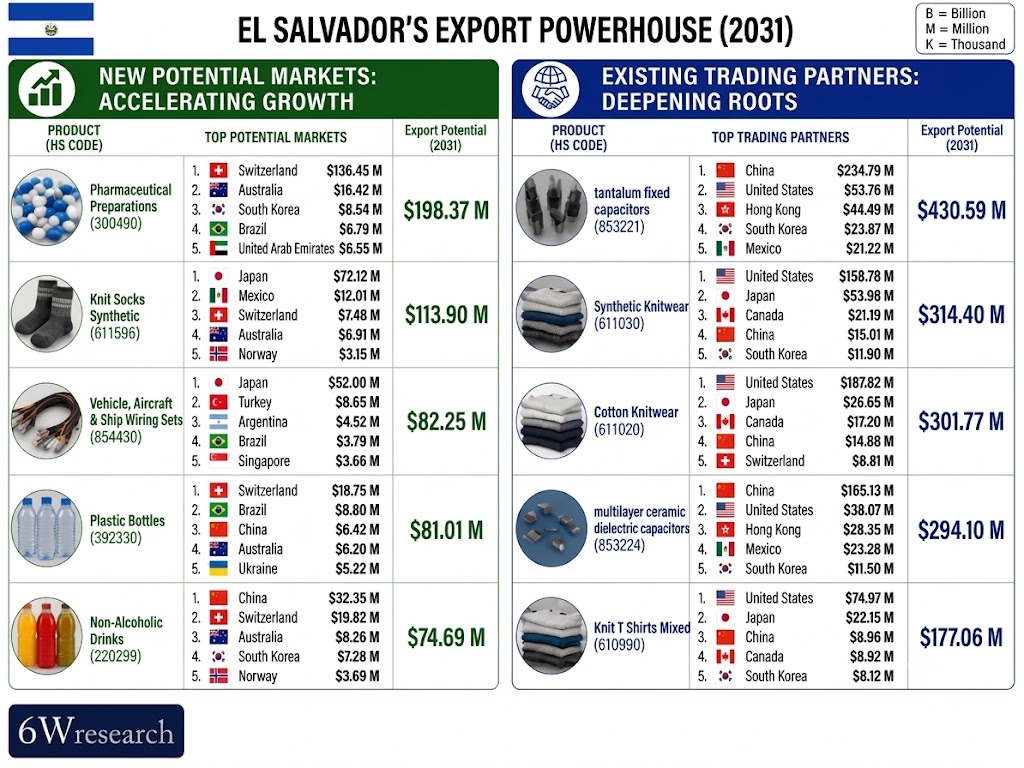
Pharmaceutical preparations are the leading new-corridor product at USD 198.37 million, led by Switzerland (USD 136.45 million), Australia (USD 16.42 million) and South Korea (USD 8.54 million). Switzerland is home to major global pharmaceutical companies that source and trade finished-dose products through complex intra-firm and contract-manufacturing networks, and El Salvador has developed a modest but growing pharmaceutical-manufacturing base that could plausibly feed into these global supply chains; Australia’s and South Korea’s smaller purchases likely reflect specific generic-drug import demand.
Knit socks synthetic and vehicle wiring sets together account for another USD 196.15 million of new-corridor potential. Synthetic socks’ USD 113.90 million is led by Japan (USD 72.12 million) and Mexico (USD 12.01 million), reflecting Japan’s large apparel-retail market diversifying hosiery sourcing beyond traditional Asian suppliers and leveraging El Salvador’s existing textile-manufacturing expertise for a specific new product category. Vehicle wiring sets’ USD 82.25 million is led by Japan (USD 52.00 million) and Turkey (USD 8.65 million), pointing to Japanese automakers sourcing harness components from a new manufacturing base as part of broader supply-chain diversification.
Plastic bottles and non-alcoholic drinks close out the new-corridor top five. Plastic bottles’ USD 81.01 million is led by Switzerland (USD 18.75 million) and Brazil (USD 8.80 million), likely linked to beverage- and pharmaceutical-packaging supply chains. Non-alcoholic drinks’ USD 74.69 million is led by China (USD 32.35 million) and Switzerland (USD 19.82 million), reflecting China’s expanding appetite for imported specialty beverages. Taken together, the five products show El Salvador’s new-corridor opportunity mixing a major pharmaceutical-trading relationship with Switzerland, textile and automotive-component diversification into Japan, and a smaller beverage-and-packaging line into China a meaningfully broader industrial base than the electronics-and-apparel concentration defining its established trade.
El Salvador’s Established Exports Driven by Electronics Components and US-Focused Apparel Manufacturing
Tantalum fixed capacitors, El Salvador’s largest established product at USD 430.59 million, are led by China (USD 234.79 million), the United States (USD 53.76 million) and Hong Kong (USD 44.49 million). El Salvador hosts one of the world’s largest tantalum-capacitor plants, operating within the country’s free-trade-zone framework, and China’s overwhelming share likely reflects integration into China’s vast electronics-manufacturing supply chains, with the US and Hong Kong representing more direct OEM and trading-hub relationships respectively.
Synthetic knitwear (USD 314.40 million) and cotton knitwear (USD 301.77 million) together contribute another USD 616.17 million. Both product lines are led overwhelmingly by the United States (USD 158.78 million and USD 187.82 million respectively), with Japan and Canada rounding out smaller secondary relationships in each case a pattern reflecting El Salvador’s longstanding apparel-manufacturing sector, built around CAFTA-DR trade preferences and decades of nearshored garment investment feeding the US retail market directly.
Multilayer ceramic dielectric capacitors (USD 294.10 million) and knit T-shirts mixed (USD 177.06 million) close out the top five. Ceramic capacitors are led by China (USD 165.13 million), the United States (USD 38.07 million) and Hong Kong (USD 28.35 million), an almost identical buyer profile to tantalum capacitors reflecting the same electronics-assembly base and integration into Asian supply chains. Knit T-shirts are led by the United States (USD 74.97 million), Japan (USD 22.15 million) and China (USD 8.96 million), another CAFTA-DR-linked apparel line overwhelmingly US-bound. Read together, established trade reveals two distinct clusters a US and CAFTA DR anchored apparel base, and a China and Asia anchored electronics component base that together define an export profile spanning textiles and electronics but still funneling overwhelmingly through just two markets, the United States and China.
|
El Salvador’s export base is evolving from a traditional electronics and apparel-driven model toward broader opportunities in pharmaceuticals, automotive components, and packaging. Existing strengths in manufacturing networks and trade access provide a foundation for expanding into higher-value global supply chains. 6WExportGTM Analysis |
Top Global Export Opportunities (2031), By Product
| Product | Export Opportunity (USD Billion) |
| Electronic Integrated Circuits | 685.7 |
| Refined Petroleum Oils | 668.4 |
| Light Petroleum Oils | 588.9 |
| Logic Electronic Integrated Circuits | 507.9 |
| Medicines | 381.2 |
| Gasoline Passenger Cars (1.5–3.0L) | 360.9 |
| Smartphones | 343.6 |
| Electronic Integrated Circuits with Memory | 333.2 |
| Data Transmission Equipment | 216.9 |
| Immunological Products | 209.6 |
Excludes naturally occurring products (e.g., crude oil, raw gold). Source: 6WExportGTM
Global export growth through 2031 is likely to be led by advanced electronics, pharmaceuticals, automotive technology, and energy products. For El Salvador, that lines up fairly well with what it already does — electronics components, automotive wiring, pharmaceuticals, and broader manufacturing supply chains. There's real opportunity to grow demand for electronic components, assembly work, and healthcare products, especially given the country's free-trade access and its proximity to North American markets. Direct semiconductor manufacturing probably isn't in the cards anytime soon, but electronics assembly, component production, and other higher-value manufacturing work could still support export diversification and deeper ties to global supply chains.
Two Developments Shaping El Salvador’s Export Base: A Textile Tariff Reversal and a Capacitor Nearshoring Rebound
Two developments stand out when looking at El Salvador's export outlook right now. The first is an improvement in US tariff conditions, which strengthens the competitiveness of CAFTA-DR-compliant textile and apparel exports — a category that's long been a major pillar of the country's trade base. The second is the continued growth of electronics-component manufacturing, driven largely by nearshoring and rising demand from global supply chains, which is pushing El Salvador further into higher-value industrial exports.
A Reversal in US Tariff Policy Restores Duty-Free Access for El Salvador’s USD 793 Million Apparel Cluster
El Salvador’s textile and apparel sector is positioned for renewed growth following improved US trade conditions that reinforce its competitive advantage under the CAFTA-DR framework. In 2026, the restoration of duty-free treatment for qualifying textile and apparel shipments strengthened the outlook for a key export cluster comprising synthetic knitwear (USD 314.40 million), cotton knitwear (USD 301.77 million), and knit T-shirts (USD 177.06 million), together representing USD 793.23 million in export potential. Supported by tariff stability, nearshoring trends, and buyers seeking closer regional supply chains, El Salvador is expected to regain momentum in apparel exports. The sector recorded USD 1.68 billion in cumulative textile exports through October 2025, and industry expectations of 2–3% growth by the end of 2026 reflect improving market confidence and renewed sourcing interest from international buyers.
|
El Salvador’s textile sector demonstrates the value of nearshoring and trade-policy stability, with restored CAFTA-DR benefits strengthening its position as a competitive apparel supplier. The combination of tariff advantages, established manufacturing capabilities, and proximity to US buyers creates a strong foundation for renewed export growth. Manish Pant, Senior Data Scientist, Data Science & Market Intelligence, 6Wresearch |
A Nearshoring-Driven Rebound in Capacitor Exports Reinforces El Salvador’s Largest Established Product
El Salvador's capacitor industry is a good example of what successful integration into global electronics supply chains actually looks like. A lot of that comes down to Kyocera AVX's facility in the San Bartolo Free Zone in Ilopango — one of the largest tantalum-capacitor manufacturing plants anywhere in the world. It's been operating since 1977, employs around 4,500 workers, and turns out roughly 300 million capacitor units a week for international markets. That manufacturing base has made El Salvador a genuinely competitive electronics-component hub, with tantalum fixed capacitors generating USD 430.59 million and multilayer ceramic dielectric capacitors contributing a further USD 294.10 million — together accounting for USD 724.69 million in established export potential. Rising nearshoring activity and broader supply-chain diversification have added further momentum too, with capacitor exports rebounding 36.6% in early 2026. Continued investment in industrial infrastructure and manufacturing capacity should let El Salvador capture even more of the opportunity coming out of shifts in global electronics supply chains.
|
El Salvador’s capacitor industry demonstrates its potential as a nearshoring-driven electronics hub, with a long-established manufacturing ecosystem supporting high-value component exports. Continued investment in industrial capacity and supply-chain infrastructure can help the country capture rising global demand for electronics components and deepen integration into advanced manufacturing networks. Manisha Gupta, Data Analyst, Data Science & Market Intelligence, 6Wresearch |
The Takeaway
El Salvador’s export landscape is built around two established pillars with a combined USD 1.52 billion in top-five potential: a US-focused apparel ecosystem supported by CAFTA-DR advantages and an electronics-component base integrated into Asian supply chains. The USD 3.11 billion new-corridor opportunity reflects broader diversification, spanning markets such as Switzerland, the United States, Japan, China, and South Korea, with growth opportunities across pharmaceuticals, automotive components, and textiles. Going forward, El Salvador’s focus will be on leveraging restored textile trade advantages, expanding nearshoring-driven electronics growth, and strengthening industrial infrastructure to support long-term export expansion.
Key strategic priorities for El Salvador include:
- Capitalize on restored textile duty-free access quickly. The January 2026 Reciprocal Trade Agreement restores CAFTA-DR duty-free treatment for an apparel cluster worth USD 793.23 million — but cumulative 2025 textile exports were already down more than USD 300 million year-on-year, which suggests the actual recovery window may be narrower than the policy relief alone would imply.
- Invest in industrial and free-trade-zone infrastructure, given El Salvador’s 2.6 million square meters of industrial space is a fraction of regional competitors, and a 36.6% rebound in capacitor exports shows nearshoring demand that existing capacity may not be able to fully absorb without new development.
- Deepen the Swiss pharmaceutical relationship, since Switzerland’s USD 136.45 million in new-corridor pharmaceutical demand already represents the single largest new-corridor product relationship, worth building into a longer-term supply arrangement rather than treating as an opportunistic one-off.
- Diversify capacitor buyers beyond China, given China already accounts for USD 234.79 million and USD 165.13 million of El Salvador’s two established capacitor lines respectively, while the US, Hong Kong and South Korea represent smaller but genuine alternative relationships worth expanding.
Ultimately, El Salvador’s 2031 export outlook depends on whether the country can convert a reversed tariff policy and a nearshoring-driven manufacturing rebound into durable gains, while building the industrial infrastructure needed to accommodate demand that current capacity constraints may otherwise leave on the table.

Leadership Perspectives from Industry Events
Search
6Wresearch in the News
 Forbes
Citing 6Wresearch analytics to map global infrastructure and pharmaceutical industry trajectories.
 Bloomberg Law
Direct syndication of 6Wresearch's macro data points, capturing complex supply chain shifts.
 Reuters
Tracking industrial manufacturing adjustments and electronic security ecosystem scaling.
 Mint
Mint
Utilizing deep-tech sector market sizing to analyze global automation and robotics.
 The Economic Times
Anchoring features on industrial IoT growth metrics and connected smart-grid devices.
 Business Standard
Featuring strategic evaluations of Advanced Driver Assistance Systems (ADAS) and AI road safety.
 The Hindu
Spotlighting core commercial metrics ranging from unmanned aerial vehicles (UAVs) to consumer durables.
 Financial Express
Anchoring quarterly reviews on cross-border real estate tech and structural hardware manufacturing.
 Yahoo Finance
Syndicating the tracker's $30.1 billion untapped-market findings, spotlighting Japan, the US and China as India's top new-potential importers.
 India Today
Carrying the release on smartphones leading India's export potential to $94 billion by 2031, per 6WExportGTM data.
 Dailyhunt
Distributing the tracker findings to its regional readership, framing India's export diversification into Japan and Mexico.
 PR Newswire Original release
Publishing the full India Export Attractiveness Tracker 2026, detailing new trade corridors across iron ore, LCVs and pharmaceuticals.
 The Industrial
Highlighting the tracker's read on India's semiconductor ambitions and long-term chip-assembly export potential.
 PTI News
Reporting on the $66.81 billion pharmaceuticals export opportunity flagged in the tracker, amid looming US generic-drug tariffs.
 Tribune India
Covering the tracker's tariff-versus-regulation analysis across India's mature export markets in the US, China and UAE.
 ANI News
Amplifying the report's findings on polished diamonds, refined petroleum and medicines as India's core export engines.
 International Business Magazine
Covering the report's insight into how AEB, blind spot detection, and driver monitoring are reshaping India's ADAS market.
 Focus Gaming News
Highlighting the research forecast for Egypt's gambling market, projecting steady growth through 2032.
Thought Leadership and Analyst Meet





Our Clients








Latest Reports
- Austria X-ray Imaging Devices Market (2026-2032)
- Armenia X-ray Imaging Devices Market (2026-2032)
- Antigua and Barbuda X-ray Imaging Devices Market (2026-2032)
- Angola X-ray Imaging Devices Market (2026-2032)
- Andorra X-ray Imaging Devices Market (2026-2032)
- Albania X-ray Imaging Devices Market (2026-2032)
- Afghanistan X-ray Imaging Devices Market (2026-2032)
- United States (US) X-ray Imaging Devices Market (2026-2032)
- United Kingdom (UK) X-ray Imaging Devices Market (2026-2032)
- United Arab Emirates (UAE) X-ray Imaging Devices Market (2026-2032)
Industry Events and Analyst Meet

EV India Expo 2026

HIMTEX 2026

India Refining Summit 2026

India EV Show 2026

EV tech India Expo 2026
Whitepaper
- Middle East & Africa Commercial Security Market Click here to view more.
- Middle East & Africa Fire Safety Systems & Equipment Market Click here to view more.
- GCC Drone Market Click here to view more.
- Middle East Lighting Fixture Market Click here to view more.
- GCC Physical & Perimeter Security Market Click here to view more.


