North Macedonia’s Precious Metal Supported Catalysts Exports to Existing Partners Could Reach USD 914.31 Million, While Airbag Modules Open USD 401.85 Million Across New Markets by 2031.
The United States remains North Macedonia’s largest established export destination, accounting for 49.28% of export potential, followed by China at 22.94%. Emerging opportunities show a more diversified landscape, with the United States contributing 30.13%, China 13.22%, and growing demand from Japan, Hong Kong, and South Korea collectively strengthening market diversification beyond traditional trade relationships.
Source: 6WExportGTM
The United States Dominates Established Demand While New-Corridor Buyers Cluster Closer Together
Among North Macedonia's export opportunities, the United States leads by a clear margin, with export potential put at USD 1.44 billion, followed by China at USD 0.63 billion. Japan, Hong Kong and South Korea round out the list of growth markets, each sitting somewhere around USD 0.28-0.29 billion. What's driving these opportunities largely comes down to North Macedonia's existing strengths — automotive components, electrical equipment, catalysts, and a growing footprint in technology-related products. Building out these relationships further could help North Macedonia move beyond its traditional reliance on European trade and carve out a stronger position within global industrial supply chains.
| Top 5 Existing Importers | Export Potential (USD Billion) | Top 5 New Potential Importers | Export Potential (USD Billion) |
| United States | 2.58 | United States | 1.44 |
| China | 1.20 | China | 0.63 |
| Canada | 0.25 | Japan | 0.29 |
| South Korea | 0.21 | Hong Kong | 0.28 |
| Turkey | 0.18 | South Korea | 0.28 |
Source: 6WExportGTM
Within North Macedonia's existing trade relationships, the United States again leads on export opportunity, with potential put at USD 2.58 billion, followed by China at USD 1.20 billion. Canada, South Korea and Turkey round out the additional strategic markets, with opportunities of USD 0.25 billion, USD 0.21 billion and USD 0.18 billion respectively. These markets draw on North Macedonia's established strengths in automotive components, catalysts, electrical equipment and industrial products. Deepening these existing trade linkages could help North Macedonia expand its role in global manufacturing supply chains while pushing further into higher-value export categories.
North Macedonia’s Emerging Export Opportunities Expand Across Automotive Safety, Battery, and Electronics Supply Chains
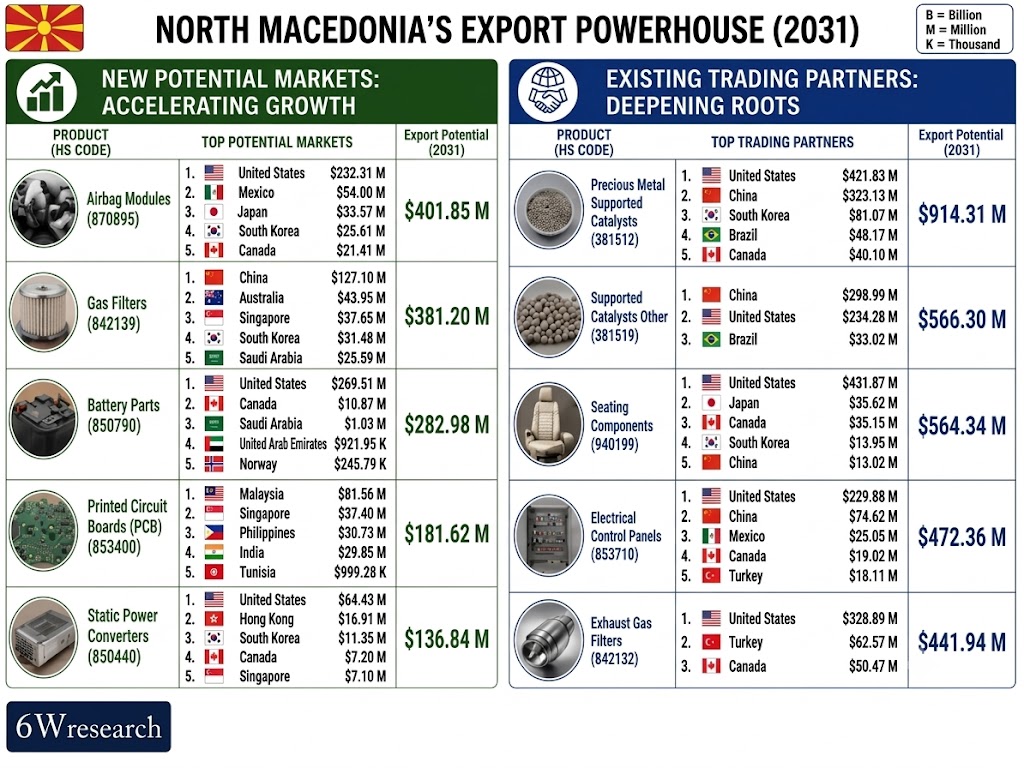
Airbag modules are the leading new-corridor product at USD 401.85 million, led by the United States (USD 232.31 million), Mexico (USD 54.00 million) and Japan (USD 33.57 million). The US and Mexico together reflect deeply integrated North American automotive supply chains under USMCA, with airbag-module assembly plants sourcing safety-critical components across the border; Japan’s presence likely reflects North Macedonia supplying components to Japanese-brand vehicle assembly operations through regional or European subsidiary plants.
Gas filters and battery parts together account for another USD 664.18 million of new-corridor potential. Gas filters’ USD 381.20 million is led by China (USD 127.10 million), Australia (USD 43.95 million) and Singapore (USD 37.65 million), reflecting China’s vast industrial and automotive filtration-manufacturing base alongside a mix of mining-related demand in Australia and re-export trading activity in Singapore. Battery parts’ USD 282.98 million is overwhelmingly a single relationship with the United States (USD 269.51 million, or 95% of the line), consistent with the US electric-vehicle and battery-manufacturing boom creating fresh demand for imported components as domestic gigafactory capacity ramps up faster than domestic supply chains can mature.
Printed circuit boards and static power converters close out the new-corridor top five. Printed circuit boards’ USD 181.62 million is led by Malaysia (USD 81.56 million), Singapore (USD 37.40 million) and the Philippines (USD 30.73 million) classic Southeast Asian electronics-assembly hubs importing PCB inputs for consumer-electronics and semiconductor-packaging operations. Static power converters’ USD 136.84 million is led by the United States (USD 64.43 million), Hong Kong (USD 16.91 million) and South Korea (USD 11.35 million), reflecting US data-center and renewable-energy infrastructure demand alongside Hong Kong’s electronics-trading role. Taken together, the five products show a new-corridor opportunity that blends North American automotive-safety components with a genuinely new footprint in Southeast Asian electronics-assembly hubs a meaningfully different composition from the established base’s automotive-parts concentration.
North Macedonia’s Export Strength Is Anchored by Automotive Components and Emission-Control Technologies
Precious metal supported catalysts, North Macedonia’s largest established product at USD 914.31 million, are led by the United States (USD 421.83 million), China (USD 323.13 million) and South Korea (USD 81.07 million). Catalytic converters are essential automotive emissions-control components, and North Macedonia hosts Johnson Matthey’s largest and most advanced global catalyst factory, supplying roughly one in three new vehicles sold in Europe; that same plant feeds both the US automotive OEM and aftermarket sector and China’s large, emissions-compliant vehicle fleet, while South Korea’s smaller share reflects its own substantial domestic automotive-manufacturing base.
Supported catalysts other (USD 566.30 million) and seating components (USD 564.34 million) together contribute another USD 1.13 billion. The other-catalysts line is led by China (USD 298.99 million) and the United States (USD 234.28 million), likely reflecting a different, more diesel or industrial-catalyst product mix than the precious-metal-heavy line above. Seating components are led by the United States (USD 431.87 million), Japan (USD 35.62 million) and Canada (USD 35.15 million), consistent with North Macedonia’s automotive-parts manufacturing sector feeding directly into the US vehicle-assembly supply chain, with Japan and Canada reflecting smaller OEM-specific sourcing relationships.
Electrical control panels (USD 472.36 million) and exhaust gas filters (USD 441.94 million) close out the top five. Control panels are led by the United States (USD 229.88 million), China (USD 74.62 million) and Mexico (USD 25.05 million), again showing North American automotive supply-chain integration through Mexico’s presence. Exhaust gas filters are led by the United States (USD 328.89 million), Turkey (USD 62.57 million) and Canada (USD 50.47 million), with Turkey’s large domestic vehicle-assembly sector serving as a secondary buyer. Read together, the established base is overwhelmingly an automotive-parts and emissions-control story, with the United States anchoring nearly every product line a concentration that leaves North Macedonia’s established trade heavily exposed to US automotive demand and policy shifts.
|
North Macedonia’s established trade is really a bet on one country and one industry: automotive catalysts and parts flowing overwhelmingly to the United States. The new-corridor opportunities shows two different diversification paths forming deeper North American automotive-safety integration through Mexico, and a genuinely new footprint in Southeast Asian electronics-assembly hubs that barely exist in the established numbers at all. 6WExportGTM Analysis |
Top Global Export Opportunities (2031), By Product
| Product | Export Opportunity (USD Billion) |
| Electronic Integrated Circuits | 685.7 |
| Refined Petroleum Oils | 668.4 |
| Light Petroleum Oils | 588.9 |
| Logic Electronic Integrated Circuits | 507.9 |
| Medicines | 381.2 |
| Gasoline Passenger Cars (1.5–3.0L) | 360.9 |
| Smartphones | 343.6 |
| Electronic Integrated Circuits with Memory | 333.2 |
| Data Transmission Equipment | 216.9 |
| Immunological Products | 209.6 |
Excludes naturally occurring products (e.g., crude oil, raw gold). Source: 6WExportGTM
Global export opportunities through 2031 are expected to be led by technology-intensive and high-value products, including semiconductors, pharmaceuticals, automotive products, and digital equipment. In comparison, North Macedonia’s export opportunities are concentrated in closely aligned industrial segments such as automotive components, catalysts, electrical control systems, battery parts, and power electronics. Leveraging its European manufacturing integration, skilled workforce, and growing industrial base can enable North Macedonia to capture opportunities linked to vehicle electrification, advanced manufacturing, and technology-driven supply chains.
Two Developments Shaping North Macedonia’s Export Base: A US Tariff Deal and a Long-Term Catalyst Question
Two developments are really worth watching when it comes to North Macedonia's export outlook right now. One is the recently strengthened trade framework with the US, which should ease tariff pressure and open up better market access in a relationship that already carries a lot of export potential. The other is less about policy and more about industry direction — North Macedonia's strong catalytic converter business is facing a slow but real shift as the global auto industry moves toward EVs, and that's going to push the country to start diversifying into things like battery components, power electronics, and newer automotive tech over time.
A New US Trade Framework Cuts North Macedonia’s Tariff Rate, But Not to Zero
Trade conditions with the United States improved following the February 12, 2026 reciprocal trade framework agreement, which lowered tariff pressure and strengthened market access on both sides. Exports had previously faced a 33% tariff as of April 2025. Under the revised arrangement, that rate has come down to a 15% reciprocal tariff, and select products now qualify for zero tariffs altogether. North Macedonia, for its part, removed customs duties on US industrial and agricultural imports. The result is greater certainty across the categories that matter most to the country's export base — catalysts, automotive components, electrical control systems, and increasingly, battery-related products. Given how significant a share of North Macedonia's overall export potential the US already represents, these improved terms should support competitiveness and deepen the country's integration into global supply chains. Cooperation is also expanding in adjacent areas, including energy security and LNG connectivity, which adds further substance to the relationship beyond trade alone.
|
The US–North Macedonia trade framework provides a positive boost to export competitiveness by reducing tariff barriers and improving market certainty for key sectors such as catalysts, automotive components, electrical equipment, and battery-related products. While further tariff reductions and product-level clarity remain important, the agreement strengthens North Macedonia’s position within global manufacturing supply chains and supports continued export growth. Manish Pant, Senior Data Scientist, Data Science & Market Intelligence, 6Wresearch |
The Long-Term EV Transition Tests North Macedonia’s Largest Export Product
Catalysts remain one of North Macedonia's most significant industrial strengths. Precious metal supported catalysts, together with other supported catalyst products, account for close to USD 1.48 billion in established export potential. Much of this rests on Johnson Matthey's facility in Skopje, considered one of the company's largest and most advanced automotive catalyst manufacturing sites worldwide. Between 2025 and 2026, Johnson Matthey went through a restructuring that, notably, reinforced rather than diluted this focus — the company divested its separate Catalyst Technologies business to Honeywell while keeping automotive catalyst operations under its Clean Air and PGM Services strategy. That is a reasonably positive signal for the stability of North Macedonia's catalyst ecosystem going forward. The global automotive sector is, of course, moving toward electrification over the longer term, but near-term demand remains fairly well supported, helped along by stricter emission regulations such as Euro 7 and continued demand for hybrid and combustion vehicles alike. With its advanced manufacturing base, skilled workforce, and close ties to European automotive supply chains, North Macedonia is reasonably well placed to keep capturing opportunity in emission-control technology, even as it works, gradually, toward adjacent areas like battery components, power electronics, and next-generation automotive solutions.
|
North Macedonia’s catalyst industry represents a key export advantage, supported by advanced manufacturing capabilities and integration into global automotive supply chains. While the transition toward electric vehicles creates long-term challenges for traditional catalyst demand, near-term regulatory requirements and hybrid vehicle growth provide a window to leverage existing expertise while expanding into emerging automotive technologies. Manisha Gupta, Data Analyst, Data Science & Market Intelligence, 6Wresearch |
The Takeaway
North Macedonia's export base leans heavily on automotive components and catalysts, which leaves the country fairly exposed to swings in the automotive sector and to a relatively narrow set of trading partners. That said, there's genuine room to diversify — electronics, automotive safety systems, and more advanced manufacturing all offer real pathways forward. The strategic priority here is twofold: hold onto competitiveness in the industries North Macedonia already leads in, while pushing into newer, technology-driven supply chains that reduce how concentrated the export base currently is.
Key strategic priorities for North Macedonia include:
- Press for expanded product coverage under the 0% tariff annex, since the United States already represents USD 2.58 billion (49.28%) of established demand by 2031 and USD 1.44 billion of new-corridor demand, and the list of products eligible for the framework agreement’s zero-tariff rate remains only partially defined.
- Diversify beyond catalytic converters ahead of the EV transition, given precious metal supported catalysts and supported catalysts other together represent roughly 28% of the entire established base, tied almost entirely to a global combustion-vehicle market forecast to shrink to about 70% of total sales by 2031.
- Build on the Southeast Asian electronics-assembly relationships, since printed circuit boards (USD 181.62 million) and static power converters (USD 136.84 million) already connect North Macedonia to Malaysia, Singapore and the Philippines markets with no meaningful presence in the country’s established top five.
- Deepen North American automotive-safety integration through Mexico, since airbag modules’ USD 401.85 million new-corridor value is already anchored by USD 232.31 million from the US and USD 54.00 million from Mexico, a USMCA-linked supply chain distinct from the seating and control-panel exports that dominate established US trade.
Ultimately, North Macedonia’s 2031 export outlook depends on how well it can convert a still-elevated US tariff rate and a maturing catalytic-converter franchise into a more diversified base, using the new-corridor momentum already visible in electronics and North American automotive-safety components as the foundation.

Leadership Perspectives from Industry Events
Search
6Wresearch in the News
 Forbes
Citing 6Wresearch analytics to map global infrastructure and pharmaceutical industry trajectories.
 Bloomberg Law
Direct syndication of 6Wresearch's macro data points, capturing complex supply chain shifts.
 Reuters
Tracking industrial manufacturing adjustments and electronic security ecosystem scaling.
 Mint
Mint
Utilizing deep-tech sector market sizing to analyze global automation and robotics.
 The Economic Times
Anchoring features on industrial IoT growth metrics and connected smart-grid devices.
 Business Standard
Featuring strategic evaluations of Advanced Driver Assistance Systems (ADAS) and AI road safety.
 The Hindu
Spotlighting core commercial metrics ranging from unmanned aerial vehicles (UAVs) to consumer durables.
 Financial Express
Anchoring quarterly reviews on cross-border real estate tech and structural hardware manufacturing.
 Yahoo Finance
Syndicating the tracker's $30.1 billion untapped-market findings, spotlighting Japan, the US and China as India's top new-potential importers.
 India Today
Carrying the release on smartphones leading India's export potential to $94 billion by 2031, per 6WExportGTM data.
 Dailyhunt
Distributing the tracker findings to its regional readership, framing India's export diversification into Japan and Mexico.
 PR Newswire Original release
Publishing the full India Export Attractiveness Tracker 2026, detailing new trade corridors across iron ore, LCVs and pharmaceuticals.
 The Industrial
Highlighting the tracker's read on India's semiconductor ambitions and long-term chip-assembly export potential.
 PTI News
Reporting on the $66.81 billion pharmaceuticals export opportunity flagged in the tracker, amid looming US generic-drug tariffs.
 Tribune India
Covering the tracker's tariff-versus-regulation analysis across India's mature export markets in the US, China and UAE.
 ANI News
Amplifying the report's findings on polished diamonds, refined petroleum and medicines as India's core export engines.
 International Business Magazine
Covering the report's insight into how AEB, blind spot detection, and driver monitoring are reshaping India's ADAS market.
 Focus Gaming News
Highlighting the research forecast for Egypt's gambling market, projecting steady growth through 2032.
Thought Leadership and Analyst Meet





Our Clients








Latest Reports
- Austria X-ray Imaging Devices Market (2026-2032)
- Armenia X-ray Imaging Devices Market (2026-2032)
- Antigua and Barbuda X-ray Imaging Devices Market (2026-2032)
- Angola X-ray Imaging Devices Market (2026-2032)
- Andorra X-ray Imaging Devices Market (2026-2032)
- Albania X-ray Imaging Devices Market (2026-2032)
- Afghanistan X-ray Imaging Devices Market (2026-2032)
- United States (US) X-ray Imaging Devices Market (2026-2032)
- United Kingdom (UK) X-ray Imaging Devices Market (2026-2032)
- United Arab Emirates (UAE) X-ray Imaging Devices Market (2026-2032)
Industry Events and Analyst Meet

EV India Expo 2026

HIMTEX 2026

India Refining Summit 2026

India EV Show 2026

EV tech India Expo 2026
Whitepaper
- Middle East & Africa Commercial Security Market Click here to view more.
- Middle East & Africa Fire Safety Systems & Equipment Market Click here to view more.
- GCC Drone Market Click here to view more.
- Middle East Lighting Fixture Market Click here to view more.
- GCC Physical & Perimeter Security Market Click here to view more.


