Integrated Circuits Anchor South Korea's USD 320.8B Export Potential, While New Product Lines Unlock USD 22.4B Opportunity by 2031
Looking to 2031, China retains the largest single share of South Korea’s existing export capacity at 35.3%. However, Mexico and the United States are emerging as the most promising frontiers for entirely new product categories—signaling a strategic pivot from deepening legacy trade to forging new commercial avenues.
 Source: 6WExportGTM
The Emerging Growth Corridor: Mexico, the United States and China
Among South Korea's existing trading partners, China and the United States dominate export potential for 2031, accounting for 35.3% and 16.3% of total potential respectively together representing more than half of all identified opportunity among current partners. Hong Kong, Singapore, and Mexico round out the top five, contributing single-digit shares each. This concentration underscores South Korea's continued reliance on its established, high-volume trade corridors in North Asia and North America as the primary engines of near-term export growth.
| Top 5 Current Leading Importers | Export Potential (USD Bn) | Top 5 New Potential Importers for New Product Lines | Export Potential (USD Bn) |
| China | 302.65 | Mexico | 1.79 |
| United States | 139.98 | United States | 1.49 |
| Hong Kong | 80.24 | China | 1.32 |
| Singapore | 40.06 | India | 1.27 |
| Mexico | 32.73 | Brazil | 0.87 |
Source: 6WExportGTM
On the new potential markets front, Mexico leads with 8.3% of total untapped potential, followed closely by the United States, China, India, and Brazil each contributing between 4% and 7%. Notably, the presence of the US and China here, alongside their existing-partner status, suggests significant unrealized potential in product lines not yet traded. India and Brazil's emergence signals promising diversification avenues, positioning South Korea to broaden its export footprint beyond traditional partners by 2031.
Where New Trade Corridors Open First
Light petroleum oils, Liquefied propane and Refined petroleum oils lead the way. While South Korea currently minimal trade with some countries signaling meaningful headroom for diversification into markets across the Middle East, Latin America, Africa, and South Asia that have so far remained peripheral to Korea's export footprint. An analysis by 6WExportGTM shows substantial untapped export opportunities projected to emerge by 2031, creating significant scope for market diversification.
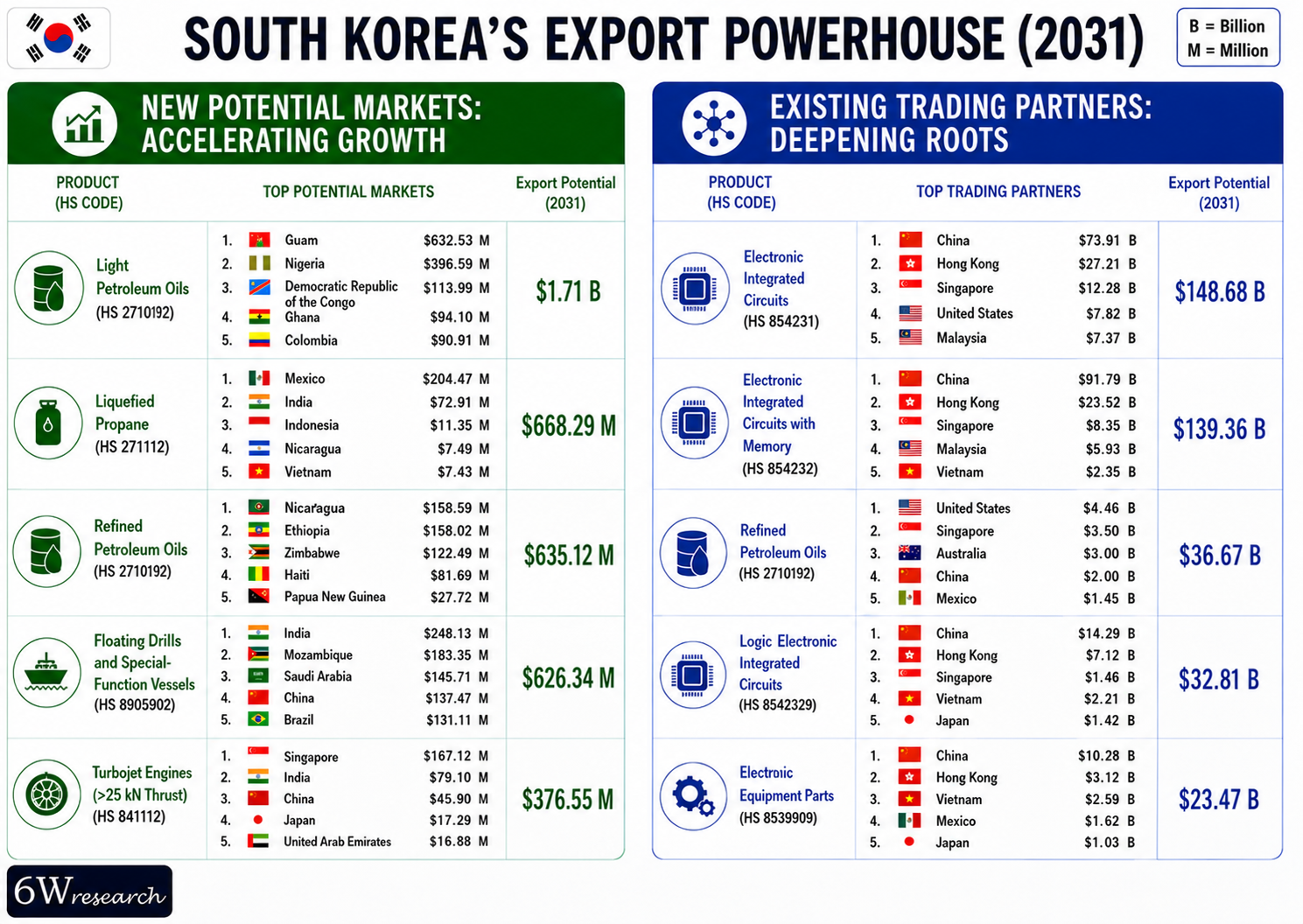
Light Petroleum Oils represent the single largest new opportunity, offering approximately USD 1.71 billion in export potential by 2031, according to analysis by 6WExportGTM, a part of 6Wresearch, with the top five destination markets accounting for roughly USD 1.15 billion of that total. Oman leads decisively at USD 532.53 million, reflecting Oman's expanding petrochemical and industrial base and its reliance on imported refined fuel blends to support downstream processing notably, Oman already registers meaningful current trade value in this line, suggesting Korea has an existing toehold to build from rather than a market to enter cold. Nigeria follows at USD 304.59 million, where chronic domestic refining shortfalls continue to widen the gap between consumption and local supply, currently with negligible bilateral trade recorded. The Democratic Republic of the Congo (USD 113.9 million), Ghana (USD 104.1 million), and Colombia (USD 90.0 million) round out the top five, each starting from an essentially blank trade base and drawing on rising energy demand tied to infrastructure build-out and urbanization.
Liquefied Propane adds a further approximately USD 668.29 million in potential, with the top five markets contributing roughly USD 644.1 million an unusually high concentration reflecting the dominance of a single buyer. Mexico alone accounts for USD 604.47 million, driven by strong residential and industrial LPG demand amid constrained domestic production, with current bilateral trade still effectively at zero. India (USD 12.9 million), Indonesia (USD 11.35 million), Nicaragua (USD 7.93 million), and Vietnam (USD 7.43 million) contribute smaller but strategically useful volumes tied to expanding household and industrial fuel use. Korea's integrated petrochemical complexes and shipping infrastructure give it a logistical edge in serving distant, high-volume buyers such as Mexico, supporting a shift toward longer-haul, higher-value LPG trade relationships.
Refined Petroleum Oils contribute approximately USD 635.12 million, with the top five markets responsible for roughly USD 565.5 million. Mauritania (USD 158.59 million) leads from a zero-trade base, narrowly ahead of Ethiopia (USD 158.02 million), which already shows a small amount of recorded current trade. Zimbabwe (USD 122.49 million) and Mali (USD 88.69 million) reflect fuel-import dependency across underdeveloped downstream infrastructure with no current trade footprint, while Papua New Guinea (USD 37.72 million) stands out for already carrying a notable current trade value relative to its potential pointing to an active, if underdeveloped, corridor. Korea's refining scale and export logistics network offer
The Products Anchoring Export Potential: Integrated Circuits and Refined Petroleum Oils
Electronic Integrated Circuits remain South Korea's single largest opportunity. While South Korea maintains active bilateral trade across key global partners—such as semiconductor supply chains with China and Taiwan, automobile shipments to the United States, or intermediate manufacturing parts to Vietnam—analysis shows substantial ongoing demand across these core markets, reinforcing the country's world-class competitive advantage in advanced electronics, automotive engineering, and energy.
Electronic Integrated Circuits represent the country's largest export opportunity, reaching USD 148.68 billion by 2031, according to analysis by 6WExportGTM, a part of 6Wresearch, with the top five importing countries accounting for USD 128.4 billion of this total. China leads decisively at USD 73.9 billion, reflecting deep integration between Korean chip manufacturers and Chinese electronics assembly operations. Hong Kong follows at USD 27.2 billion, functioning as a critical re-export gateway into broader Asian demand, while Singapore (USD 12.18 billion) benefits from its role as a regional semiconductor trading and logistics hub. The United States (USD 7.82 billion) and Malaysia (USD 7.31 billion) add further depth, tied respectively to advanced technology demand and established chip-testing and packaging ecosystems. Korea's mature semiconductor manufacturing base and economies of scale reinforce its position as a global leader in this category.
Electronic Integrated Circuits with Memory contribute a further USD 139.36 billion, with the top five markets responsible for USD 131.3 billion underscoring an exceptionally concentrated demand base. China again leads at USD 91.79 billion, driven by its vast electronics manufacturing sector's reliance on imported memory components. Hong Kong (USD 23.52 billion) and Singapore (USD 8.25 billion) continue to serve as regional distribution points, while Malaysia (USD 5.53 billion) and Vietnam (USD 2.26 billion) reflect the growing footprint of electronics assembly relocating across Southeast Asia. Korea's technology leadership in memory chip fabrication deepens its integration into these expanding regional supply chains.
South Korea’s dominant export driver remains its advanced semiconductor portfolio—led by integrated circuits and memory chips—heavily integrated into electronics assembly hubs across China and Hong Kong. This core tech foundation is complemented by expanding logic IC and electronic parts supply chains into Southeast Asia, alongside a steady refined petroleum footprint serving major energy-trading partners like the US, Singapore, and Australia.
South Korea’s dominant export driver remains its advanced semiconductor portfolio—led by integrated circuits and memory chips—heavily integrated into electronics assembly hubs across China and Hong Kong. This core tech foundation is complemented by expanding logic IC and electronic parts supply chains into Southeast Asia, alongside a steady refined petroleum footprint serving major energy-trading partners like the US, Singapore, and Australia.
Where South Korea Should Focus Next
South Korea's strongest priorities lie not in expanding trade volume but in converting its 2025–2026 strategic alignment with the United States into durable, high-value positions, led by shipbuilding execution, semiconductor onshoring management, and energy diversification through LNG and nuclear exports.
Semiconductors, Energy, and Shipbuilding: Korea's Three Pillars of Strategic Positioning
Semiconductors, meanwhile, remain central to Korea's export identity, but the priority has shifted from shipping more chips to managing a structural transition toward onshored production and IP-driven value capture, as Samsung and SK Hynix expand US-based fabrication and packaging capacity to stay inside preferential tariff treatment, backed by USD 200 billion in strategic investment flowing into US semiconductor R&D partnerships, alongside diversification efforts such as the "Chip 4" alliance and a USD 37.9 billion domestic raw-material investment plan aimed at building resilience against renewed US tariff escalation. Energy diversification rounds out this positioning, anchored by a USD 100 billion commitment to US LNG purchases and Korea's growing nuclear reactor export ambitions, offering a hedge against semiconductor-cycle volatility while reinforcing long-term trade stability as Korea assumes a leadership role in global renewable energy cooperation through its incoming IRENA chairmanship. Shipbuilding stands out as Korea's lowest-risk opportunity, with Korean firms committing roughly USD 150 billion toward US shipyards and defense contracts as part of the broader USD 350 billion investment pact directly addressing the US Navy's maintenance backlog and positioning Hanwha Ocean and HD Hyundai as long-term partners rather than one-time suppliers, while the proposed "Bridge Strategy" lets Korea build early vessels domestically until American shipyard capacity comes online.
Semiconductors remain the core engine of Korea’s export strategy, with onshoring, supply-chain diversification, and sustained global demand strengthening the sector’s long-term resilience. Energy exports provide the second growth pillar as countries diversify fuel supplies and reinforce energy security. Shipbuilding offers the fastest route from commitment to revenue, benefiting from strong order books and comparatively limited exposure to China-related export-control disputes.
Manish Pant, Senior Data Scientist, Data Science & Market Intelligence, 6Wresearch
Korea's competitiveness now depends less on export volume and more on securing favorable positioning across advanced chip packaging, LNG supply commitments, and nuclear export partnerships a combination of guaranteed demand, engineering credibility, and diversified risk that strengthens Korea's hand across all three sectors simultaneously.
Manisha Gupta, Data Analyst, Data Science & Market Intelligence, 6Wresearch
Top Global Export Opportunities (2031), By Product
| Product | Export Opportunity (USD Bn) |
| Electronic Integrated Circuits | 685.7 |
| Refined Petroleum Oils | 668.4 |
| Light Petroleum Oils | 588.9 |
| Logic Electronic Integrated Circuits | 507.9 |
| Medicines | 381.2 |
| Gasoline Passenger Cars (1.5–3.0L) | 360.9 |
| Smartphones | 343.6 |
| Electronic Integrated Circuits with Memory | 333.2 |
| Data Transmission Equipment | 216.9 |
| Human Vaccines | 209.6 |
Excludes naturally occurring products (e.g. crude oil, raw gold). Source: 6WExportGTM
Globally, the largest export opportunities beyond naturally occurring products are concentrated in electronics, energy and pharmaceuticals highlighting the growing dominance of semiconductors, advanced manufacturing and high-value technology products in global trade.
South Korea’s Existing Export Powerhouses
Semiconductors lead South Korea's export sectors by a wide margin, with a sector trade value of USD 133.93 billion, driven overwhelmingly by electronic integrated circuits with memory (53.77% share) and electronic integrated circuits (26.76% share). Passenger vehicles follow at USD 68.32 billion, led by gasoline passenger cars in the 1.5–3.0L range (30.78% share) and hybrid petrol cars (16.49% share). Oil & gas rounds out the top three at USD 50.69 billion, driven by refined petroleum oils (68.54% share) and light petroleum oils (29.14% share). These products trade at high volumes because Korea's chipmakers dominate global memory fabrication capacity, feeding electronics assembly hubs in China, Hong Kong, and Southeast Asia; its automakers combine competitive pricing, advanced hybrid technology, and strong brand recognition to sustain demand across the US, China, and other large consumer markets with rising vehicle ownership and replacement demand; and its refining sector leverages advanced processing infrastructure to serve fuel-import-dependent economies across Asia.
| Sector | Exports | Leading Products / Share |
| Semiconductors | USD 133.93B | Electronic Integrated Circuits with Memory (53.77%), Electronic Integrated Circuits (26.76%) |
| Passenger Vehicles | USD 68.32B | Gasoline Passenger Cars 1.5–3.0L (30.78%), Hybrid Petrol Cars (16.49%) |
| Oil & Gas | USD 50.69B | Refined Petroleum Oils (68.54%), Light Petroleum Oils (29.14%) |
Source: UN Comtrade
By destination market, China is South Korea's largest trading partner at USD 132.9 billion, led by Electronic Integrated Circuits with Memory (USD 25.8 billion), reflecting deep supply-chain integration between Korean chipmakers and China's electronics manufacturing base. The United States follows at USD 128.4 billion, led by Gasoline Passenger Cars 1.5–3.0L (USD 11.3 billion), supported by strong consumer demand and Korea's established automotive brand presence. Vietnam ranks third at USD 58.3 billion, led by OLED Display Modules (USD 10.2 billion), tied to Korea's extensive electronics assembly and component operations based in the country.
| Country | Exports | Leading Products / Share |
| China | USD 132.90B | Electronic Integrated Circuits with Memory (19.42%) |
| United States | USD 128.36B | Gasoline Passenger Cars 1.5–3.0L (8.79%) |
| Vietnam | USD 58.32B | OLED Display Modules (17.46%) |
Source: UN Comtrade
Trade Policy Becomes the Next Competitive Advantage
Low Tariffs, Lower Barriers
South Korea's top export potential remains heavily anchored in its world-class semiconductor industry, with electronic and electronic integrated circuits with memory serving as the primary drivers of future trade value. This position is sustained by deep, structural integration with key Asian assembly ecosystems and distribution hubs, most notably China, Hong Kong, and Singapore, which absorb the vast majority of Korea's high-tech chip output.
Building on this foundational strength, South Korea continues to expand its supply of logic ICs and specialized electronic equipment parts into emerging Southeast Asian manufacturing centers like Vietnam and Malaysia, as well as nearshoring hubs in Mexico. Alongside its dominance in advanced electronics, Korea's scale in heavy refining supports a substantial energy footprint, securing high-value petroleum trade flows with key international partners, including the United States, Australia, and regional energy hubs.
Tariff Landscape: New Potential Trading Partners
| Country | Product | Applied Import Tariff |
| Oman | Light Petroleum Oils | 5% |
| Nigeria | Light Petroleum Oils | 0% |
| Ethiopia | Refined Petroleum Oils | 0% |
| Ghana | Light Petroleum Oils | 0% |
| Saudi Arabia | Floating Docks & Special Vessels | 0% |
Source: MacMap (ITC)
Zero Tariffs, Zero Room to Relax
For the United States specifically, semiconductors remain a live policy variable. A global 25% Section 232 tariff on certain semiconductor imports took effect in January 2026, though under the U.S.-Korea Strategic Trade and Investment Deal finalized in November 2025, sector-specific limits were set on future semiconductor tariffs pending further negotiation, and Seoul also secured most-favored-nation status for potential Section 232 tariffs on semiconductors. Industry reporting corroborates that chip exemptions from broader US tariffs have helped drive record Korean semiconductor shipments even as other sectors absorb duties. That underlying protection was tested directly on 24 July 2026, when the US replaced its expiring 10% global tariff with new Section 301 duties on 60 trading partners over forced-labor enforcement, placing Korea in the 12.5% tier alongside Japan and Switzerland; Seoul had called the rate "unwarranted" given its existing bilateral deal, and Washington subsequently reaffirmed that the new duty stacks within, not on top of, the 15% all-in tariff ceiling secured in last year's agreement with a separate "overproduction" Section 301 case naming Korea still pending under the same ceiling. Should a comprehensive Korea-US FTA-style semiconductor carve-out be formalized, it would lock in preferential treatment below the 25% Section 232 ceiling, insulating the Memory and Electronic IC lines from future rate hikes and strengthening South Korea's position as a preferred AI-chip supplier relative to non-FTA competitors. With China, no FTA upgrade is currently under discussion for semiconductors specifically, but given China's 0% applied tariff already in place, the priority for exporters lies less in further tariff reduction and more in managing the 46 trade remedy measures that could restrict volumes regardless of duty rates. Singapore, as an ASEAN-Korea FTA partner, already offers preferential access, and any deepening of digital/semiconductor-specific protocols there would primarily reduce customs friction rather than tariff cost, since rates are already at zero.
| Country | Product | Applied Import Tariff |
| China | Electronic Integrated Circuits with Memory | 0% |
| China | Electronic Integrated Circuits | 0% |
| United States | Electronic Integrated Circuits | 0% |
| Singapore | Electronic Integrated Circuits with Memory | 0% |
| Malaysia | Electronic Integrated Circuits | 0% |
Source: MacMap (ITC)
The Bottom Line
South Korea’s future export competitiveness cannot rely on zero-tariff access alone most of its primary Asian tech corridors (China, Hong Kong, Singapore) are already tariff-free, meaning future growth is a test of supply-chain resilience and regulatory maneuvering rather than duty reduction. The strategic playbook is clear: capture immediate volume in zero-friction, emerging energy and industrial markets (Oman, Nigeria, Ghana) while actively navigating trade remedies, non-tariff measures, and potential Section 232 carve-outs in major economies like China and the United States because safeguarding high-tech supply chains against regulatory friction is where the next $350+ billion in semiconductor and energy trade potential will ultimately be secure.

Leadership Perspectives from Industry Events
Search
Thought Leadership and Analyst Meet





Our Clients








6WResearch In News
- Integrated Circuits Anchor South Korea's USD 320.8B Export Potential, While New Product Lines Unlock USD 22.4B Opportunity by 2031
- Thailand's USD 25.5 Billion Logic IC Opportunity Is Just the Beginning: New Product Lines Could Unlock Another USD 17.9 Billion in 2031
- Smartphones Lead India's Exports potential at $94 Billion by 2031 — But $30.1 Billion in Untapped Markets Is the Real Story
- India Air Conditioner Market Set for Strong Rebound in 2026 After Weather-Led Correction and GST-Driven Recovery: 6Wresearch
- ADAS in India: How Automatic Emergency Braking, Blind Spot Detection & Driver Monitoring are Transforming Road Safety
- Doha a strategic location for EV manufacturing hub: IPA Qatar
Latest Reports
- Gabon Citrullinemia Type-1 Market (2026-2032)
- Finland Citrullinemia Type-1 Market (2026-2032)
- Fiji Citrullinemia Type-1 Market (2026-2032)
- Ethiopia Citrullinemia Type-1 Market (2026-2032)
- Estonia Citrullinemia Type-1 Market (2026-2032)
- Eritrea Citrullinemia Type-1 Market (2026-2032)
- Equatorial Guinea Citrullinemia Type-1 Market (2026-2032)
- El Salvador Citrullinemia Type-1 Market (2026-2032)
- Ecuador Citrullinemia Type-1 Market (2026-2032)
- Dominica Citrullinemia Type-1 Market (2026-2032)
Industry Events and Analyst Meet

EV India Expo 2026

HIMTEX 2026

India Refining Summit 2026

India EV Show 2026

EV tech India Expo 2026
Whitepaper
- Middle East & Africa Commercial Security Market Click here to view more.
- Middle East & Africa Fire Safety Systems & Equipment Market Click here to view more.
- GCC Drone Market Click here to view more.
- Middle East Lighting Fixture Market Click here to view more.
- GCC Physical & Perimeter Security Market Click here to view more.


