Chile's Copper Ore Exports to Existing Partners Could Reach USD 27.21 Billion, While Refined Petroleum Oils Open USD 1.09 Billion Across New Markets by 2031
China dominates Chile’s export potential, accounting for 47.14% of the country’s established export opportunities, far ahead of the United States at 10.92%. New market opportunities are more diversified, led by South Korea at 10.98%, followed by the UAE, Singapore, China and Turkey. Copper ore, refined copper cathodes and lithium carbonate remain core export strengths, while refined fuels and gold highlight future diversification opportunities through 2031.
 Source: 6WExportGTM
South Korea and the UAE Lead a Far More Fragmented New-Corridor Market Than Chile's China-Dominated Established Trade
South Korea emerges as Chile’s largest new potential export market with USD 0.80 billion in opportunity, followed closely by the United Arab Emirates (USD 0.76 billion) and Singapore (USD 0.65 billion). China and Turkey add further diversification opportunities with USD 0.62 billion and USD 0.57 billion, respectively. The relatively balanced distribution among top buyers highlights Chile’s potential to expand beyond its traditional export destinations by developing new trade corridors across Asia and the Middle East, particularly for emerging opportunities linked to minerals, energy and value-added commodities.
| Top 5 Existing Leading Importers | Export Potential (USD Billion) | Top 5 New Potential Importers | Export Potential (USD Billion) |
| China | 47.89 | South Korea | 0.80 |
| United States | 11.10 | United Arab Emirates | 0.76 |
| Japan | 8.78 | Singapore | 0.65 |
| South Korea | 6.18 | China | 0.62 |
| Brazil | 4.28 | Turkey | 0.57 |
Source: 6WExportGTM
China accounts for USD 47.89 billion of Chile's established export potential nearly half of the entire established total and more than four times the United States' USD 11.10 billion in second place. Japan and South Korea contribute USD 8.78 billion and USD 6.18 billion, with Brazil rounding out the top five at USD 4.28 billion. This extreme concentration reflects Chile's role as the world's dominant copper supplier to Chinese manufacturing and construction, with Japan, South Korea and Brazil providing meaningful but structurally secondary demand across the same core commodity categories.
New Export Corridors Position Refined Fuels, Gold, and Minerals as Chile's Next Growth Drivers
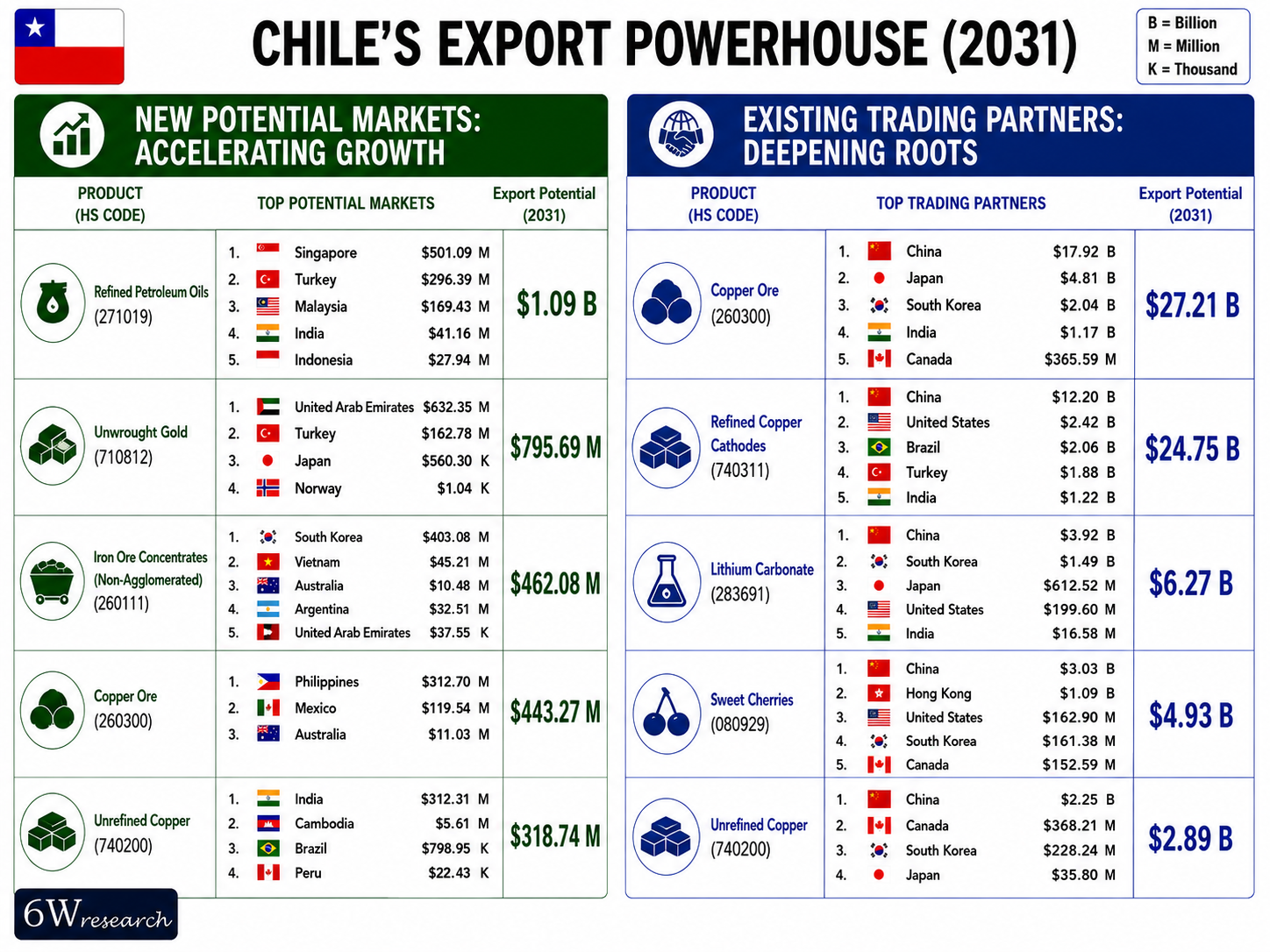
Refined petroleum oils represent Chile's largest new-corridor opportunity at USD 1.09 billion, led by Singapore at USD 501.09 million and Turkey at USD 296.39 million, followed by Malaysia, India and Indonesia. This trading hub heavy buyer base is consistent with Chile's existing domestic refining capacity centered on ENAP's Biobío-region operations finding outlets among Asian and Gulf-adjacent trading centers rather than reflecting any large new production capability.
Unwrought gold and iron ore concentrates add a further USD 795.69 million and USD 462.08 million. Gold is led almost entirely by the United Arab Emirates at USD 632.35 million, with Turkey providing a smaller secondary volume, a pattern consistent with Chile's modest but genuine gold by-product output from its copper operations finding a natural home in Gulf bullion-trading centers. Iron ore concentrates are led by South Korea at USD 403.08 million, with Vietnam, Australia and Argentina contributing smaller amounts, extending a mining category where Chile's Atacama iron deposits have historically played a secondary role behind copper.
Copper ore and unrefined copper directed at new destinations round out the new-corridor top five, though at a smaller scale than their established counterparts. New market opportunity in copper ore contributes USD 443.27 million, led by the Philippines at USD 312.70 million and Mexico at USD 119.54 million, while unrefined copper into new markets adds USD 318.74 million, led almost entirely by India at USD 312.31 million. Overall, Chile's 2031 new-corridor expansion looks set to be defined by extending its refining and copper-processing base into a genuinely diverse set of Asian and Gulf buyers, rather than depending on any single new relationship.
Copper and Lithium Overwhelmingly Define Chile's Established Trade, With Fruit Providing a Genuine Third Layer
Copper ore represents Chile's largest established export opportunity at USD 27.21 billion, led by China at USD 17.92 billion and Japan at USD 4.81 billion, followed by South Korea, India and Canada. This buyer base reflects Chile's standing as the world's largest copper producer and holder of the largest known reserves, supplying concentrate directly to Asian smelting and manufacturing hubs that have built their industrial capacity around reliable Chilean supply.
Refined copper cathodes and lithium carbonate add a further USD 24.75 billion and USD 6.27 billion. Refined copper cathodes are led by China at USD 12.20 billion and the United States at USD 2.42 billion, followed by Brazil, Turkey and India, reflecting Chile's substantial downstream smelting and refining capacity converting concentrate into higher-value, LME-grade metal. Lithium carbonate is led by China at USD 3.92 billion and South Korea at USD 1.49 billion, followed by Japan and the United States, consistent with Chile's position as the world's second-largest lithium producer, drawing on brine operations in the Salar de Atacama that supply battery-grade material directly to Asian cell manufacturers.
Sweet cherries and unrefined copper complete the established top five. Sweet cherries contribute USD 4.93 billion, led overwhelmingly by China at USD 3.03 billion and Hong Kong at USD 1.09 billion, with the United States, South Korea and Canada providing a small remainder reflecting Chile's position as the world's dominant supplier of fresh cherries to Chinese New Year demand. Unrefined copper adds USD 2.89 billion, led by China at USD 2.25 billion, with Canada, South Korea and Japan rounding out a smaller remainder. Collectively, these five categories confirm that Chile's established export advantage rests on two dominant structural pillars copper mining and refining, and lithium brine extraction with fresh fruit exports forming a genuine, if much smaller, third pillar built on comparative agricultural advantage rather than mineral wealth.
|
Chile's export edge continues to rest on the sheer scale of its copper and lithium resource base rather than on any single trading relationship. The world's largest copper reserves and one of the world's largest lithium-producing regions give the country a structural advantage that no single new market can easily replicate, even as a genuinely diverse set of Asian and Gulf buyers opens smaller but real diversification opportunities beyond its overwhelming dependence on China. 6WExportGTM Analysis |
What Chile Already Sells and Where
Metallic ores form Chile's largest established trade sector at USD 33.97 billion, led by copper ore at USD 30.49 billion and a dominant 89.76% share, followed by molybdenum ore at USD 1.46 billion and a 4.30% share. Copper products rank second at USD 19.76 billion, with refined copper cathodes contributing USD 17.23 billion and an 87.18% share, while unrefined copper adds USD 2.11 billion and 10.66%. Fruits follow at USD 9.29 billion, led by sweet cherries at USD 3.52 billion and a 37.85% share, with grapes adding USD 1.35 billion and 14.56% together confirming that Chile's export base is overwhelmingly built around copper mining and processing, with fresh fruit forming a distinct, much smaller third sector.
| Sector | Exports (USD Billion) | Leading Products / Share |
| Metallic Ores | 33.97 | Copper Ore (89.76%), Molybdenum Ore (4.30%) |
| Copper Products | 19.76 | Refined Copper Cathodes (87.18%), Unrefined Copper (10.66%) |
| Fruits | 9.29 | Sweet Cherries (37.85%), Grapes (14.56%) |
Source: UN Comtrade
China is Chile's largest destination market by a wide margin at USD 37.33 billion, led by copper ore at 54.73% of exports to the country and refined copper cathodes at 12.07%. The United States ranks second at USD 15.68 billion, with refined copper cathodes contributing 37.70% and, notably, salted cod at 10.06% a distinctly different product profile from Chile's Asian markets. Japan follows at USD 8.36 billion, dominated by copper ore at 65.48%, with frozen processed salmon fillets adding 7.06%. This partner mix confirms that, at the country level as much as the product level, Chile's trade runs overwhelmingly through copper flowing to Asian manufacturing hubs, with the United States standing out as the one market where seafood products carry meaningful weight alongside metals.
| Country | Exports (USD Billion) | Leading Products / Share |
| China | 37.33 | Copper Ore (54.73%), Refined Copper Cathodes (12.07%) |
| United States | 15.68 | Refined Copper Cathodes (37.70%), Salted Cod (10.06%) |
| Japan | 8.36 | Copper Ore (65.48%), Frozen Salmon Fillets Processed (7.06%) |
Source: UN Comtrade
Structural Mine Investment and a Lithium Extraction Bet: Two Developments Shaping Chile's Export Base
Chile’s export outlook is being shaped by two major developments: long-cycle capital investments across its largest copper mines are aimed at maintaining production levels despite declining ore grades, while Albemarle’s direct lithium extraction project is strengthening Chile’s lithium-carbonate production capabilities and supporting its position in global battery-material supply chains.
Structural Investment at Chile's Largest Copper Mines Aims to Offset Near-Term Output Softness
Chile's copper export position faces a genuine near-term challenge that long-cycle investment is only beginning to address. National output fell to its weakest levels in roughly 19 to 25 years through the first half of 2026, as declining ore grades at mature deposits a structural issue that capital spending alone cannot reverse quickly weighed on Codelco, BHP's Escondida and the Collahuasi joint venture simultaneously. Codelco's response centers on four structural projects at Chuquicamata, Rajo Inca, Andina and El Teniente, backed by more than USD 40 billion in committed investment and targeting 1.7 million tons of annual capacity by 2030, alongside a Codelco-Glencore smelting joint venture targeting 1.5 million tons of capacity with a further USD 1.8 to 2.1 billion in capital spending through 2028. Crucially, this supply-side strain is unfolding just as global copper demand accelerates on EV manufacturing, AI infrastructure and grid modernization simultaneously a demand pull that Chilean supply cannot currently match, which supports the case that Chile's established copper export value should stay resilient even through a period of softer volumes.
|
Chile's 2031 export growth will stay overwhelmingly copper-led, but the gap between accelerating global demand and near-term output softness means the country's four structural mine projects are less about growth than about defending the position it already holds. Manish Pant, Senior Data Scientist, Data Science & Market Intelligence, 6Wresearch |
Albemarle's $3.1 Billion Extraction Bet Reinforces Chile's Lithium Export Base
Chile's lithium-carbonate export potential is being reinforced by a major shift in how the country's two lithium producers extract and process brine. In March 2026, Albemarle formally submitted a roughly USD 3.1 billion direct-lithium-extraction project to Chile's environmental regulator, structured as a modification of its existing Salar de Atacama operations rather than a greenfield expansion, and designed to nearly double recovery rates while returning 90% of processed brine to the salt flat. SQM, Chile's other Atacama operator, is separately expanding lithium-carbonate capacity to 240,000 tons and lithium-hydroxide capacity to 100,000 tons, even as its Atacama operations transition toward a public-majority joint venture with Codelco under Chile's National Lithium Strategy. For an established lithium-carbonate export opportunity worth USD 6.27 billion by 2031 and led by Chinese and South Korean battery manufacturers, this combination of extraction-technology investment and capacity expansion supports the case that Chile can keep growing lithium output even as new extraction methods reduce its historical dependence on water-intensive solar evaporation.
|
Chile's export growth through 2031 looks set to stay led by copper and lithium, with Albemarle's direct-lithium-extraction investment and SQM's capacity expansion both signaling that the country's two-operator lithium base can keep scaling even as global battery demand accelerates. Manisha Gupta, Data Analyst, Data Science & Market Intelligence, 6Wresearch |
The Takeaway
Chile should focus on defending its dominant copper position through sustained structural mine investment while using new extraction technology to keep growing lithium output, rather than assuming either resource advantage will sustain itself without continued capital commitment. The country's next phase of export growth will depend on converting long-cycle mine and extraction projects into durable output gains, while building out the genuinely diverse set of smaller new-corridor markets already visible in fuels, gold and mineral ore categories.
Key strategic priorities for Chile include:
- Sustain structural mine investment to defend Chile's dominant copper position: With copper ore and refined copper cathodes together worth USD 51.96 billion in established export potential, Chile should prioritize on-schedule delivery of Codelco's four structural projects Chuquicamata, Rajo Inca, Andina and El Teniente and the Codelco-Glencore smelting joint venture, tracking progress against the 1.7 million tons 2030 capacity target as near-term output softens on declining ore grades.
- Scale lithium output through direct-extraction technology rather than legacy evaporation alone: Lithium carbonate already generates USD 6.27 billion in established export potential, led by China and South Korea. Chile should support Albemarle's USD 3.1 billion direct-lithium-extraction project and SQM's capacity expansion to 240,000 tons, using both to reduce water dependence while keeping pace with accelerating global battery demand.
- Build out the genuinely fragmented new-corridor market rather than searching for a single replacement for China: Unlike markets where one new country emerges to rival the established leader, Chile's new market top five South Korea, the UAE, Singapore, China and Turkey are all within close range of each other. Chile should pursue this diversification deliberately across refined fuels, gold and mineral ore categories rather than waiting for a single dominant new relationship to emerge.
- Protect the fruit-export sector as a genuine, resource-independent third pillar: Sweet cherries alone generate USD 4.93 billion in established export potential, led overwhelmingly by Chinese New Year demand. Chile should continue investing in cold-chain logistics and orchard capacity to protect this comparative agricultural advantage, which does not depend on mineral reserves and offers a genuinely different growth lever from copper and lithium.
Overall, Chile's export growth through 2031 should be driven by defending its unmatched copper and lithium resource base through sustained structural investment, while treating the country's newly diverse set of smaller Asian and Gulf buyers as a genuine, if gradual, path toward reducing its extreme dependence on a single Chinese relationship.

Leadership Perspectives from Industry Events
Search
6Wresearch in the News
 Forbes
Citing 6Wresearch analytics to map global infrastructure and pharmaceutical industry trajectories.
 Bloomberg Law
Direct syndication of 6Wresearch's macro data points, capturing complex supply chain shifts.
 Reuters
Tracking industrial manufacturing adjustments and electronic security ecosystem scaling.
 Mint
Mint
Utilizing deep-tech sector market sizing to analyze global automation and robotics.
 The Economic Times
Anchoring features on industrial IoT growth metrics and connected smart-grid devices.
 Business Standard
Featuring strategic evaluations of Advanced Driver Assistance Systems (ADAS) and AI road safety.
 The Hindu
Spotlighting core commercial metrics ranging from unmanned aerial vehicles (UAVs) to consumer durables.
 Financial Express
Anchoring quarterly reviews on cross-border real estate tech and structural hardware manufacturing.
 Yahoo Finance
Syndicating the tracker's $30.1 billion untapped-market findings, spotlighting Japan, the US and China as India's top new-potential importers.
 India Today
Carrying the release on smartphones leading India's export potential to $94 billion by 2031, per 6WExportGTM data.
 Dailyhunt
Distributing the tracker findings to its regional readership, framing India's export diversification into Japan and Mexico.
 PR Newswire Original release
Publishing the full India Export Attractiveness Tracker 2026, detailing new trade corridors across iron ore, LCVs and pharmaceuticals.
 The Industrial
Highlighting the tracker's read on India's semiconductor ambitions and long-term chip-assembly export potential.
 PTI News
Reporting on the $66.81 billion pharmaceuticals export opportunity flagged in the tracker, amid looming US generic-drug tariffs.
 Tribune India
Covering the tracker's tariff-versus-regulation analysis across India's mature export markets in the US, China and UAE.
 ANI News
Amplifying the report's findings on polished diamonds, refined petroleum and medicines as India's core export engines.
 International Business Magazine
Covering the report's insight into how AEB, blind spot detection, and driver monitoring are reshaping India's ADAS market.
 Focus Gaming News
Highlighting the research forecast for Egypt's gambling market, projecting steady growth through 2032.
Thought Leadership and Analyst Meet





Our Clients








Latest Reports
- Poland Engine Ignition Components Market (2026-2032)
- Peru Engine Ignition Components Market (2026-2032)
- Pakistan Engine Ignition Components Market (2026-2032)
- Oman Engine Ignition Components Market (2026-2032)
- Nigeria Engine Ignition Components Market (2026-2032)
- Nepal Engine Ignition Components Market (2026-2032)
- Myanmar Engine Ignition Components Market (2026-2032)
- Morocco Engine Ignition Components Market (2026-2032)
- Mexico Engine Ignition Components Market (2026-2032)
- Malaysia Engine Ignition Components Market (2026-2032)
Industry Events and Analyst Meet

EV India Expo 2026

HIMTEX 2026

India Refining Summit 2026

India EV Show 2026

EV tech India Expo 2026
Whitepaper
- Middle East & Africa Commercial Security Market Click here to view more.
- Middle East & Africa Fire Safety Systems & Equipment Market Click here to view more.
- GCC Drone Market Click here to view more.
- Middle East Lighting Fixture Market Click here to view more.
- GCC Physical & Perimeter Security Market Click here to view more.


