Honduras's Wiring Set Exports to Existing Partners Could Reach USD 1.83 Billion, While Flavoring Preparations Open USD 150.48 Million in New Markets by 2031
The United States is the top export opportunity for Honduras, with 50.2% of the proven market potential through 2031. Meanwhile, China is the leading export opportunity in new trade corridors with a share of 12.69% in new potential markets. Honduras export potential is anchored by vehicle wiring sets, green coffee beans and cotton knit apparel, whereas food & beverage flavoring preparations and unwrought gold can provide further avenues for market diversification and long-term export expansion.
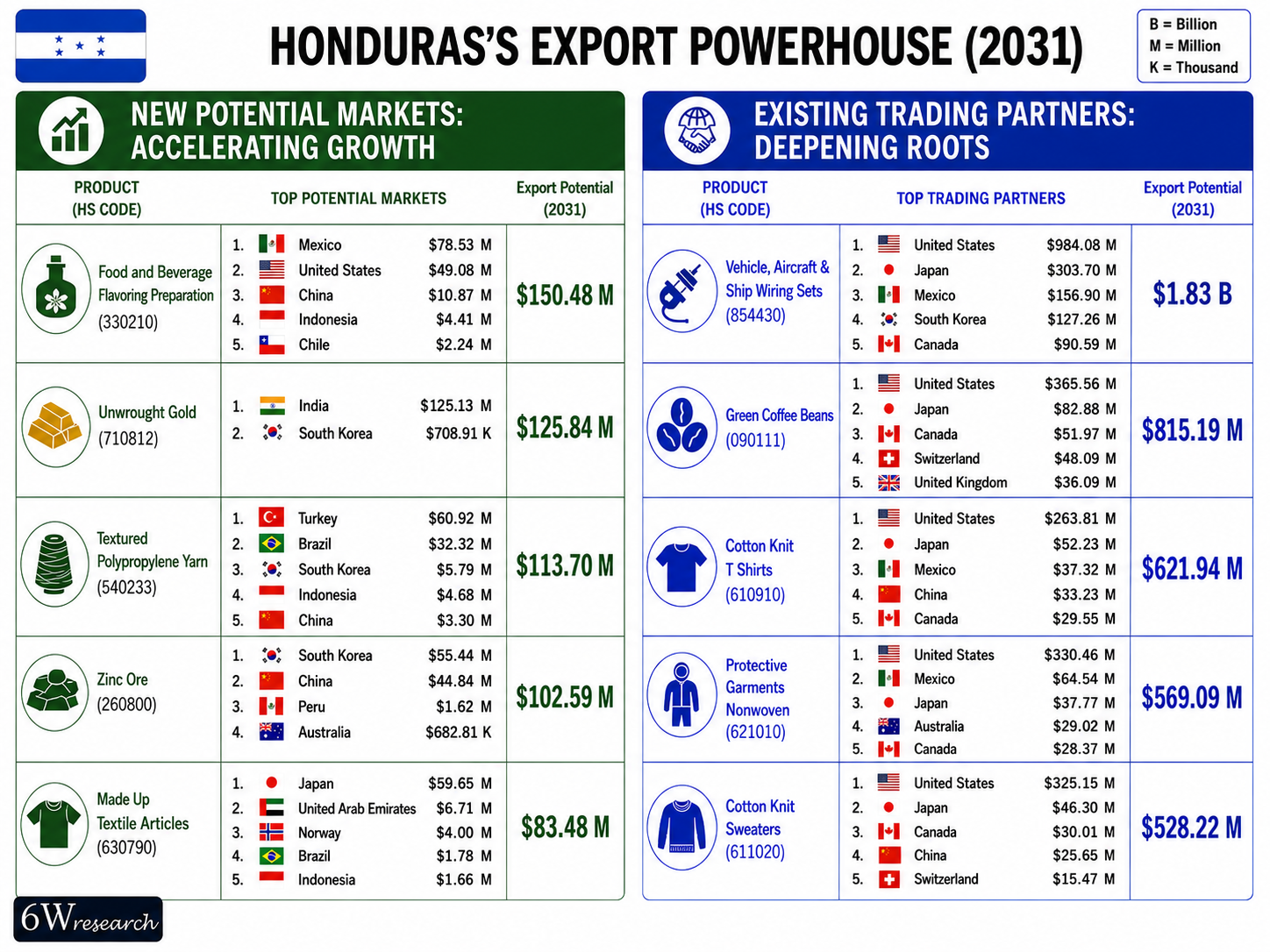 Source: 6WExportGTM
United States Maintains Export Dominance for Honduras, as China Gains Momentum in New Potential Opportunities
Honduras's new export corridors are led by China with USD 298.75 million in potential, followed by India (USD 224.92 million) and the United States (USD 194.96 million). Further opportunities exist in South Korea and Japan at USD 181.85 million and USD 179.26 million respectively, illustrating Honduras’s potential to expand beyond its traditional Central American and North American trade networks. The market mix indicates expanding opportunities for agri-food, mineral, and textile-linked exports, with Asian markets as important destinations for the next phase of Honduras’s export diversification through 2031.
| Top 5 Existing Importers | Export Potential (USD Billion) | Top 5 New Potential Importers | Export Potential (USD Billion) |
| United States | 5.18 | China | 0.30 |
| Japan | 0.78 | India | 0.22 |
| Mexico | 0.74 | United States | 0.20 |
| China | 0.60 | South Korea | 0.18 |
| Canada | 0.56 | Japan | 0.17 |
Source: 6WExportGTM
The United States accounts for USD 5.18 billion of Honduras's established export potential, well ahead of Japan at USD 775.19 million. Mexico ranks third at USD 735.73 million, with China and Canada contributing USD 600.27 million and USD 557.30 million respectively. Honduras’s export profile is well diversified across advanced manufacturing, textiles, agriculture and mineral products. Vehicle wiring systems, apparel, and coffee continue to be strong pillars of the country’s export strength while demand from key markets such as the United States, Mexico, Japan, Canada and China provides a wide international customer base. An existing export flow and opportunity in multiple product categories combine to strengthen Honduras’ potential to expand its global trade footprint through 2031.
Honduras Broadens Its Export Horizon with New Potential Markets and Emerging Product Opportunities
Food & Beverage flavoring preparations represent Honduras's single largest new-corridor opportunity at USD 150.48 million, led by Mexico at USD 78.53 million and the United States at USD 49.08 million, followed by China, Indonesia and Chile. This diversified buyer base reflects Honduras's established food processing and agro-industrial strength, where existing production capacity built to serve regional demand is now positioning the country to reach expanded export opportunities across North American and Asian destinations without requiring significant new production infrastructure.
Unwrought gold and textured polypropylene yarn represent additional high potential export opportunities, contributing USD 125.84 million and USD 113.70 million, respectively. The new market potential for unwrought gold is overwhelmingly driven by India at USD 125.13 million with South Korea accounting for a modest remainder, indicating Honduras’ mining sector strikes a concentrated but substantial new buyer. The other, textured polypropylene yarn, presents a more diversified growth avenue, with Turkey leading at USD 60.92 million, followed by Brazil, South Korea and Indonesia, indicating Honduras’s expanding role in synthetic-textile manufacturing, in addition to its established apparel strengths.
Zinc ore and made-up textile articles round out the new-corridor top five. Zinc ore contributes USD 102.59 million, led by South Korea at USD 55.44 million, followed by China, Peru and Australia — a genuine signal of Honduras's mining base beginning to reach new industrial buyers beyond its traditional partners. Made up textile articles add USD 83.48 million, led by Japan at USD 59.65 million, with the United Arab Emirates, Norway, Brazil and Indonesia providing smaller volumes. Overall, Honduras is positioned to broaden its global export footprint by leveraging its agro-industrial and textile strengths while capturing new growth opportunities across mineral-linked sectors.
Honduras's Established Export Strengths Remain Anchored by Wiring, Coffee and Apparel Manufacturing
Vehicle, aircraft and ship wiring sets represent Honduras's largest established export opportunity at USD 1.83 billion, led by United States at USD 984.08 million and Japan at 303.70 million, followed by Mexico, South Korea and Canada. This genuinely global buyer base reflects Honduras's position as a growing regional hub for automotive and transport wiring-harness manufacturing, anchored by export-oriented assembly plants supplying international vehicle and equipment makers directly.
Green coffee beans and cotton knit T-shirts add a further USD 815.19 million and USD 621.94 million. Green coffee beans are led by the United States at USD 365.56 million and Japan at USD 82.88 million, followed by Canada, Switzerland and the United Kingdom, a buyer base weighted toward North America and Europe, consistent with Honduras's position among the world's leading Arabica coffee origins. Cotton knit T-shirts are led by the United States at USD 263.81 million and Japan at USD 52.23 million, reflecting Honduras's established base of maquila apparel manufacturing reaching customers well beyond its immediate Central American supply chains.
Non-woven protective garments and cotton knit sweaters further strengthen Honduras’s position across international apparel and textile markets. Export opportunity for non-woven protective garments is expected to reach USD 569.09 million by 2031, with the US accounting for USD 330.46 million and significant demand from Mexico, Japan, Australia and Canada. The demand across North America and Asia illustrates the expanding international scope of Honduras’ garment manufacturing base and its ability to address a broader spectrum of medical, industrial and protective-apparel applications. The country’s export portfolio could be worth USD 528.22 million and Cotton knit sweaters are also likely to continue to be part of the country’s export portfolio. The United States leads in this category at USD 325.15 million, followed by Japan at USD 46.30 million, while Canada, China and Switzerland further adding to the market depth. Overall, these 5 categories together demonstrate the breadth of Honduras's developed export platform. The country’s trade strength is increasingly underpinned by a mix of manufacturing ability, textile productions, and agricultural exports, while its growing buyer network across the Americas, Europe and Asia provides a firmer basis for sustained export growth through 2031.
|
Honduras is entering a new phase of export growth, driven by well-known strengths in coffee, textiles and apparel, alongside increasing automotive-wiring production. Evolving opportunities in flavoring preparations, minerals and synthetic textiles are further diversifying its trade base and opening new markets across North America, Europe and Asia, strengthening Honduras’s position within Central America’s export landscape. 6WExportGTM Analysis |
What Honduras Already Sells and Where
Coffee, tea & spices lead Honduras's current exports at USD 1.29 billion, with green coffee beans accounting for 97.76% and coffee products 1.16%. Wiring & cables follow at USD 1.27 billion, dominated by vehicle, aircraft & ship wiring sets at 93.59%. Oilseeds total USD 0.45 billion, led by crude palm oil at 64.38% and palm oil at 23.25%.
| Sector | Exports (USD Billion) | Leading Products / Share |
| Coffee, Tea & Spices | 1.29 | Green Coffee Beans (97.76%), Coffee Products (1.16%) |
| Wiring & Cables | 1.27 | Vehicle, Aircraft & Ship Wiring Sets (93.59%), Electric Cable Assemblies (6.30%) |
| Oilseeds | 0.45 | Crude Palm Oil (64.38%), Palm Oil (23.25%) |
Source: UN Comtrade
The United States is Honduras's largest destination at approximately USD 3.26 billion, led by vehicle, aircraft & ship wiring sets at 33.87% and green coffee beans at 12.24%. El Salvador and Guatemala each account for about USD 0.47 billion, with palm oil (11.07%) and soap (6.45%) leading El Salvador, and food preparations (10.97%) and bakery products (8.89%) leading Guatemala.
| Country | Exports (USD Billion) | Leading Products / Share |
| United States | 3.26 | Vehicle, Aircraft & Ship Wiring Sets (33.87%), Green Coffee Beans (12.24%) |
| El Salvador | 0.47 | Palm Oil (11.07%), Soap (6.45%) |
| Guatemala | 0.47 | Food Preparations (10.97%), Bakery Products (8.89%) |
Source: UN Comtrade
A Textile Investment Wave and a Coffee Production Rebound: Two Developments Shaping Honduras's Export Base
Honduras's export base is being shaped by two notable developments: a major textile manufacturer's new fabric-capacity investment is deepening the country's apparel export cluster, while a forecast rebound in coffee production points toward continued strength in one of Honduras's most established agricultural export categories.
Kattan Group's Fabric-Capacity Investment Points to Honduras's Deepening Apparel Export Base
Honduras's apparel and textile export base includes a long-standing, vertically integrated manufacturing cluster anchored by the Asociación Hondureña de Maquiladores (AHM), whose member companies directly employ approximately 146,000 workers and support roughly 500,000 additional jobs across the wider manufacturing supply chain. Kattan Group, a century-old manufacturer supplying brands such as Calvin Klein and Izod, is investing USD 70 million to expand woven-fabric capacity in the country, alongside a 2026 partnership between AHM and WRAP to strengthen compliance standards for international buyers. Honduras's yarn-forward status under CAFTA-DR, together with sourcing shifts away from Asia amid tariff pressure and an upcoming USMCA review, has added further weight to nearshoring conversations around Central American apparel production. For an established cotton knit T-shirt and sweater export opportunity already reaching the United States, Japan, Mexico, China and Canada at a combined value of over USD 621.94 million, that combination of new fabric-capacity investment and strengthened compliance standards carries implications for Honduras's ability to move further up the apparel value chain rather than compete on labor cost alone.
|
Honduras's export growth will likely remain anchored in apparel and coffee, but new fabric-capacity investment and strengthened compliance standards in the textile sector point toward a credible path for Honduras's manufacturing base to move beyond basic assembly toward higher-value production. Manish Pant, Senior Data Scientist, Data Science & Market Intelligence, 6Wresearch |
A Coffee Production Rebound Reinforces Honduras's Agricultural Export Base
Honduras's coffee sector, the country's second-largest established export category at USD 815.19 million, is entering a period of renewed growth. The USDA Foreign Agricultural Service forecasts national production climbing to 6.03 million 60-kilogram bags in marketing year 2026-27, a 9% increase driven by improved plant nutrition, favorable biennial cycles and the expansion of planted area, including wider adoption of the rust-resistant Parainema variety. Alongside rising output, Honduran co-operatives and exporters have piloted farm-level digital traceability systems using QR-coded identifiers to meet European Union deforestation regulation requirements ahead of a mid-2026 compliance deadline. For an export category already reaching the United States, Japan and Canada, that combination of production growth and traceability infrastructure carries implications for Honduras's ability to sustain and diversify its coffee-buyer base.
|
Honduras’s export growth through 2031 is likely to remain anchored by apparel and coffee, with new textile-sector investment and a projected coffee production rebound highlighting the country’s continuing importance in an increasingly competitive Central American and global agricultural and manufacturing environment. Manisha Gupta, Data Analyst, Data Science & Market Intelligence, 6Wresearch |
The Takeaway
Honduras should focus on extending its existing apparel, coffee and wiring-harness manufacturing capabilities rather than building entirely new export sectors, with textile-sector investment and rising coffee production standing out as near-term catalysts alongside vehicle-wiring's position as the country's largest established export. The country's next phase of expansion will depend on converting these established strengths into higher-value opportunities across processed foods, minerals and expanding Asian demand.
Key strategic priorities for Honduras include:
- Increased capacity in vehicle-wiring and apparel manufacturing capacity to cater to the established demand: With vehicle, aircraft, and ship wiring sets representing USD 1.83 billion in established export potential and cotton apparel exports to the United States, Japan and Canada, Honduras should prioritize capacity expansion and investment in quality-certification to protect its position as a preferred Central American manufacturing base for global buyers.
- Build on Kattan Group's fabric-capacity investment to move apparel exports up the value chain: With Kattan Group committing USD 70 million to new woven-fabric capacity and AHM's 2026 compliance partnership with WRAP, Honduras has an opening to convert cotton knit T-shirt and sweater exports worth over USD 621.94 million into a more vertically integrated, higher-value textile export base.
- Develop the China and India mineral and flavoring-preparation corridors deliberately: China is Honduras's leading new potential market at USD 298.75 million, driven by flavoring preparations, zinc ore and textiles, while India leads new demand for unwrought gold at USD 125.13 million. Honduras should pursue direct trade relationships with these markets to convert early-stage corridors into durable export relationships.
- Protect and deepen the United States relationship while diversifying its supporting cast: The United States accounts for USD 5.18 billion, or 50.2%, of Honduras's established export potential across wiring sets, coffee and apparel. Honduras's priority should be securing this relationship while building out new growth in China, India and South Korea already visible in new-corridor trade, alongside a genuine push to diversify beyond apparel and agriculture.
Overall, Honduras's export growth through 2031 should be driven by upgrading its manufacturing and agricultural-processing ecosystem, moving from cost competitive apparel assembly and raw coffee exports toward higher value wiring-harness production, vertically integrated textiles and a genuinely diversified Asian buyer base while treating its deep United States relationship as the foundation to protect rather than a dependency to diversify away from.

Leadership Perspectives from Industry Events
Search
6Wresearch in the News
 Forbes
Citing 6Wresearch analytics to map global infrastructure and pharmaceutical industry trajectories.
 Bloomberg Law
Direct syndication of 6Wresearch's macro data points, capturing complex supply chain shifts.
 Reuters
Tracking industrial manufacturing adjustments and electronic security ecosystem scaling.
 Mint
Mint
Utilizing deep-tech sector market sizing to analyze global automation and robotics.
 The Economic Times
Anchoring features on industrial IoT growth metrics and connected smart-grid devices.
 Business Standard
Featuring strategic evaluations of Advanced Driver Assistance Systems (ADAS) and AI road safety.
 The Hindu
Spotlighting core commercial metrics ranging from unmanned aerial vehicles (UAVs) to consumer durables.
 Financial Express
Anchoring quarterly reviews on cross-border real estate tech and structural hardware manufacturing.
 Yahoo Finance
Syndicating the tracker's $30.1 billion untapped-market findings, spotlighting Japan, the US and China as India's top new-potential importers.
 India Today
Carrying the release on smartphones leading India's export potential to $94 billion by 2031, per 6WExportGTM data.
 Dailyhunt
Distributing the tracker findings to its regional readership, framing India's export diversification into Japan and Mexico.
 PR Newswire Original release
Publishing the full India Export Attractiveness Tracker 2026, detailing new trade corridors across iron ore, LCVs and pharmaceuticals.
 The Industrial
Highlighting the tracker's read on India's semiconductor ambitions and long-term chip-assembly export potential.
 PTI News
Reporting on the $66.81 billion pharmaceuticals export opportunity flagged in the tracker, amid looming US generic-drug tariffs.
 Tribune India
Covering the tracker's tariff-versus-regulation analysis across India's mature export markets in the US, China and UAE.
 ANI News
Amplifying the report's findings on polished diamonds, refined petroleum and medicines as India's core export engines.
 International Business Magazine
Covering the report's insight into how AEB, blind spot detection, and driver monitoring are reshaping India's ADAS market.
 Focus Gaming News
Highlighting the research forecast for Egypt's gambling market, projecting steady growth through 2032.
Thought Leadership and Analyst Meet





Our Clients








Latest Reports
- Poland Engine Ignition Components Market (2026-2032)
- Peru Engine Ignition Components Market (2026-2032)
- Pakistan Engine Ignition Components Market (2026-2032)
- Oman Engine Ignition Components Market (2026-2032)
- Nigeria Engine Ignition Components Market (2026-2032)
- Nepal Engine Ignition Components Market (2026-2032)
- Myanmar Engine Ignition Components Market (2026-2032)
- Morocco Engine Ignition Components Market (2026-2032)
- Mexico Engine Ignition Components Market (2026-2032)
- Malaysia Engine Ignition Components Market (2026-2032)
Industry Events and Analyst Meet

EV India Expo 2026

HIMTEX 2026

India Refining Summit 2026

India EV Show 2026

EV tech India Expo 2026
Whitepaper
- Middle East & Africa Commercial Security Market Click here to view more.
- Middle East & Africa Fire Safety Systems & Equipment Market Click here to view more.
- GCC Drone Market Click here to view more.
- Middle East Lighting Fixture Market Click here to view more.
- GCC Physical & Perimeter Security Market Click here to view more.


