Angola’s Crude Petroleum Holds USD 26.51 Billion in Existing Export Potential by 2031, with USD 11.70 Billion Emerging Across New Markets
Crude petroleum leads Angola’s export potential across both established and emerging markets, though the destination mix differs sharply. China dominates established trade at 30.87%, followed by India at 25.37% and the United States at 21.61%. In emerging markets, South Korea accounts for 53.85% of potential, ahead of Japan at 25.43%, largely driven by crude oil and LNG, while diamonds continue to anchor Angola’s established export base.
 Source: 6WExportGTM
South Korea's Overwhelming Lead Marks One of the Sharpest New-Corridor Concentrations in This Series
South Korea emerges as Angola’s largest new potential export market, with estimated export potential of USD 11.17 billion, followed by Japan at USD 5.28 billion and China at USD 2.08 billion. These three Asian markets account for the bulk of Angola’s new export opportunity, supported mainly by crude petroleum, LNG and polished diamonds. Australia and Hong Kong provide additional potential of USD 0.41 billion and USD 0.34 billion respectively, further reinforcing Angola’s export diversification across Asia-Pacific markets.
| Top 5 Existing Importers | Export Potential (USD Billion) | Top 5 New Potential Importers | Export Potential (USD Billion) |
| China | 6.46 | South Korea | 11.17 |
| India | 5.31 | Japan | 5.28 |
| United States | 4.53 | China | 2.08 |
| United Arab Emirates | 2.20 | Australia | 0.41 |
| Singapore | 0.60 | Hong Kong | 0.34 |
Source: 6WExportGTM
China accounts for USD 6.46 billion of Angola's established export potential, with India close behind at USD 5.31 billion. The United States ranks third at USD 4.53 billion, followed by the United Arab Emirates at USD 2.20 billion and Singapore at USD 0.60 billion. This spread reflects a mix of long-term crude-oil supply commitments to China, growing Indian demand for both crude and LNG, American purchases of light sweet crude, and the UAE's role as Angola's dominant diamond-trading partner.
South Korea Emerges as a Key Growth Market as Rising LNG Demand Expands Angola’s New Potential Market Opportunity
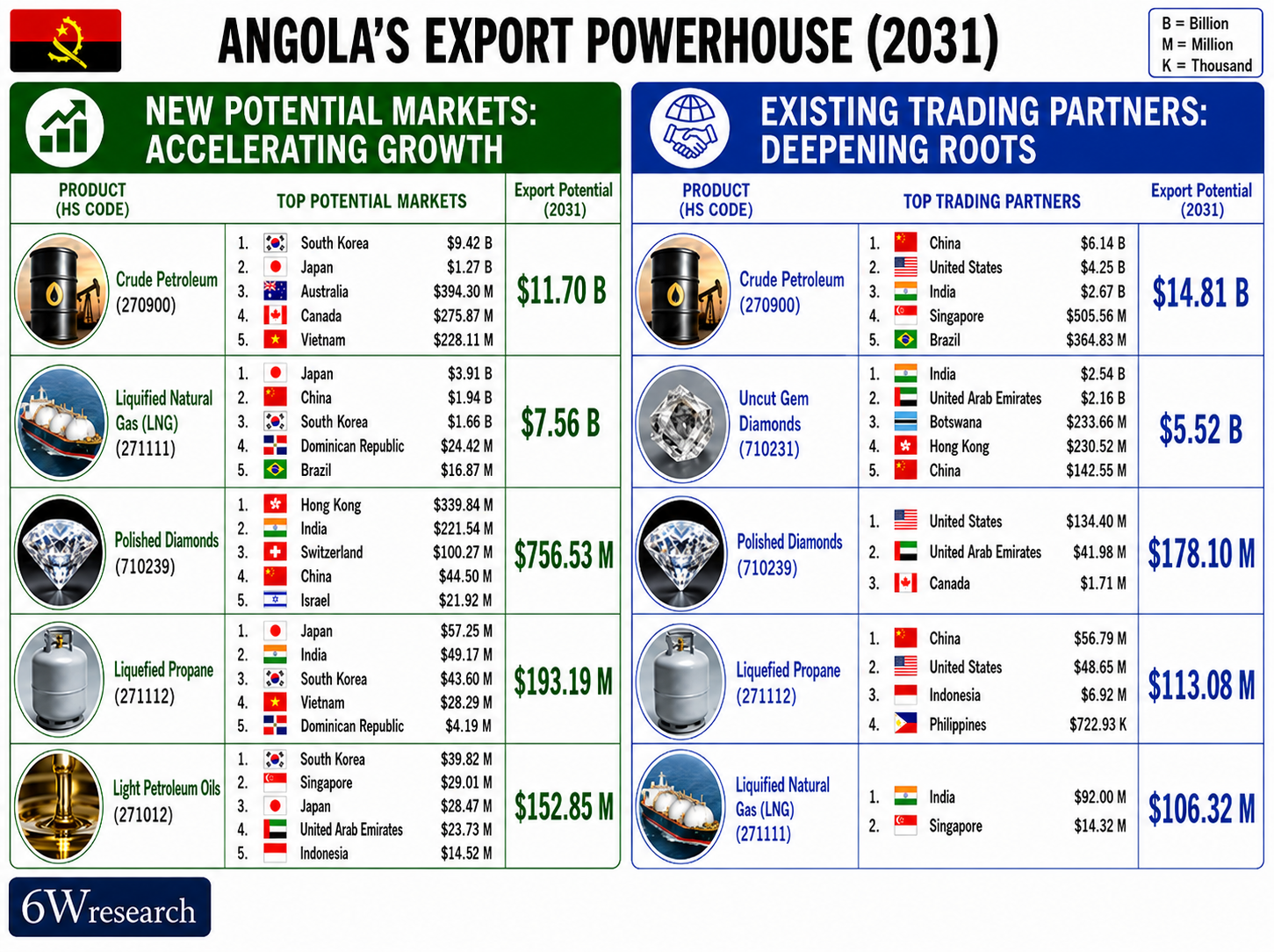
Crude petroleum represents Angola's largest new potential market opportunity at USD 11.70 billion, led overwhelmingly by South Korea at USD 9.42 billion, with Japan, Australia, Canada and Vietnam contributing smaller amounts. Angola has been actively courting South Korean buyers, offering to direct crude sales specifically to Korean refiners as an alternative to Middle Eastern supply, making this the rare new-market figure backed by an active, real-world diplomatic push rather than latent trade potential alone.
Liquefied natural gas represents a further USD 7.56 billion in export potential, with Japan leading at USD 3.91 billion, followed by China at USD 1.94 billion and South Korea at USD 1.66 billion. This buyer base of major Northeast Asian LNG importers builds directly on Angola's existing Soyo LNG facility, suggesting the country's gas-export capacity has room to serve a broader set of Asian buyers than its current established relationships reflect.
Polished diamonds, liquefied propane and light petroleum oils round out the new corridor’s top five, each considerably smaller. Polished diamonds into new markets contribute USD 756.53 million, led by Hong Kong at USD 339.84 million and India at USD 221.54 million, followed by Switzerland, China and Israel a global gem trading buyer base. Liquefied propane and light petroleum oils add USD 193.19 million and USD 152.85 million respectively, both spread across Japan, India, South Korea and Southeast Asian buyers. Overall, Angola's 2031 new market potential is overwhelmingly an energy story, anchored by the rapidly forming South Korea relationship and a broader Asian LNG buyer base.
Angola’s Established Trade Remains Driven by Crude Petroleum and Diamonds
Crude petroleum represents Angola's largest established export opportunity at USD 14.81 billion, led by China at USD 6.14 billion and the United States at USD 4.25 billion, followed by India, Singapore and Brazil. This globally diversified buyer base reflects Angola's status as sub-Saharan Africa's second-largest oil producer, supplying light, sweet, low-sulfur crude that commands a premium among refiners across three continents.
Uncut gem diamonds add a further USD 5.52 billion, led by India at USD 2.54 billion and the United Arab Emirates at USD 2.16 billion, followed by Botswana, Hong Kong and China. This is Angola's second genuine structural pillar, distinct from oil, and reflects the country's emergence as one of the world's fastest-growing diamond producers, anchored by the Catoca and Luele kimberlite mines. Polished diamonds contribute a much smaller USD 178.10 million, led by the United States, reflecting Angola's limited domestic cutting and polishing capacity relative to its rough-diamond output.
Liquefied propane and LNG complete the established top five at a modest USD 113.08 million and USD 106.32 million respectively, both split between India, China, the United States and a handful of Asian buyers. Collectively, these five categories confirm that Angola's established export advantage rests overwhelmingly on two structural pillars crude petroleum and rough diamonds with gas exports still representing a comparatively small share of established trade relative to the much larger opportunity visible in new-corridor markets.
|
6WExportGTM indicates that Angola’s future export strength will continue to be anchored in crude petroleum, LNG and diamonds, as the new market opportunities increasingly broaden across Asia. South Korea and Japan emerge as important new destinations for energy exports, while China, the United States and India remain central to established trade relationships. At the same time, polished diamonds, propane and light petroleum products point to gradual diversification toward higher-value processing and downstream energy exports, reducing reliance on a narrow set of traditional commodity flows. 6WExportGTM Analysis |
Top Global Export Opportunities (2031), By Product
| Product | Export Opportunity (USD Billion) |
| Electronic Integrated Circuits | 685.7 |
| Refined Petroleum Oils | 668.4 |
| Light Petroleum Oils | 588.9 |
| Logic Electronic Integrated Circuits | 507.9 |
| Medicines | 381.2 |
| Gasoline Passenger Cars (1.5–3.0L) | 360.9 |
| Smartphones | 343.6 |
| Electronic Integrated Circuits with Memory | 333.2 |
| Data Transmission Equipment | 216.9 |
| Immunological Products | 209.6 |
Excludes naturally occurring products (e.g., crude oil, raw gold). Source: 6WExportGTM
For Angola, the global opportunity landscape highlights significant scope to move beyond crude-resource exports toward higher-valueprocessed products. Refined petroleum oils and light petroleum oils, with global export opportunities of USD 668.4 billion and USD 588.9 billion, respectively, are particularly relevant given Angola’s expanding refining capacity and established hydrocarbon base. While electronics, medicines and automotive products represent larger diversification opportunities globally, Angola’s most realistic near-term pathway lies in strengthening downstream petroleum processing before progressively developing more sophisticated manufacturing capabilities.
What Angola Already Sells and Where
Oil and gas forms Angola's dominant established trade sector at USD 34.35 billion, led by crude petroleum at 91.51% share, followed by LNG at 6.79% share. Ships and marine equipment rank a distant second at USD 2.71 billion, led by floating platforms at 50.55% share, with cargo vessels and barges adding 23.09% a category tied to Angola's offshore oil-production infrastructure rather than a standalone shipbuilding industry. Precious stones follow at USD 1.53 billion, entirely uncut industrial diamonds, confirming that Angola's second major sector, like its first, rests on genuine extractive capability.
| Sector | Exports (USD Billion) | Leading Products / Share |
| Oil & Gas | 34.35 | Crude Petroleum (91.51%), LNG (6.79%) |
| Ships & Marine Equipment | 2.71 | Floating Platforms (50.55%), Cargo Vessels and Barges (23.09%) |
| Precious Stones | 1.53 | Uncut Industrial Diamonds (100.00%) |
Source: UN Comtrade
China is Angola's largest destination market by a wide margin at USD 16.28 billion, led by crude petroleum at 99.41% of exports to the country a relationship this concentrated reflects both direct commercial demand and long-term supply commitments tied to Chinese development financing. India ranks second at USD 4.23 billion, with crude petroleum contributing 74.07% and LNG 25.82%, a genuinely more diversified energy relationship than China's. Spain follows at USD 2.53 billion, supported by crude petroleum at 78.97% and floating platforms at 7.42% the floating-platforms share likely reflecting offshore oil-infrastructure trade rather than a broader industrial relationship.
| Country | Exports (USD Billion) | Leading Products / Share |
| China | 16.28 | Crude Petroleum (99.41%), Liquefied Propane (0.18%) |
| India | 4.23 | Crude Petroleum (74.07%), LNG (25.82%) |
| Spain | 2.53 | Crude Petroleum (78.97%), Floating Platforms (7.42%) |
Source: UN Comtrade
A Korea Pivot and a Diamond Supply Discipline: Two Developments Shaping Angola's Export Base
Angola’s export trajectory is being influenced by two notable shifts: efforts to strengthen crude-oil trade ties with South Korea are creating additional demand opportunities in Asia, while the state diamond industry is placing greater emphasis on value by reducing the share of lower-value small stones. These developments support Angola’s core strengths in energy and diamonds while encouraging a more value-oriented export strategy.
Angola's Active Push to Redirect Crude Sales Toward South Korea Is Already Underway
Angola’s crude-petroleum export opportunity is increasingly supported by active market diversification efforts rather than relying solely on its traditional buyer base. Angola could consider prioritising crude-oil supplies to South Korea amid rising uncertainty in Middle East supply, Angola's ambassador to Seoul said in May 2026, with discussions already underway between Angolan and South Korean authorities to link Korean refiners directly with Sonangol. Some of Angola’s crude remains committed to existing buyers, chiefly China, but the relationship is expected to initially involve spot-market purchases and could evolve into longer-term supply contracts. This diversification comes as Angola manages a mature production base, with crude output declining from around 1.8 million barrels per day in 2015 to roughly 1.0-1.2 million barrels per day currently, making market optimization increasingly important. Against this backdrop, 6WExportGTM’s (a part of 6Wresearch) estimate of around USD 26 billion combined in established and new potential markets crude petroleum export potential by 2031 remains well supported, as future opportunity is expected to come not only from maintaining production through new upstream projects but also from redirecting available volumes toward high-value buyers such as South Korea while preserving strong existing relationships with China, India and other major importers.
|
Angola’s opportunity with South Korea stands out as more than a modeled trade prospect, with active diplomatic engagement in 2026 already laying the groundwork for deeper economic and trade cooperation. The bigger question is whether Angola's declining production base and its existing commitments to China leave enough uncommitted crude to make the relationship meaningful at scale. Manish Pant, Senior Data Scientist, Data Science & Market Intelligence, 6Wresearch |
Endiama Curbs Small-Diamond Output to Protect Value as Angola's Production Surges
Angola's diamond export position is being reshaped by a deliberate supply discipline move from state miner Endiama. Angola's rough diamond exports surged 70% to 17.7 million carats in 2025, making it the world's fastest growing diamond producer, but average prices fell 29% to just over USD 100 a carat as volume growth outpaced demand, with total 2025 revenue reaching only about USD 1.6 billion despite the sharp rise in output. In response,Endiama announced that it will reduce the volume of small-sized rough diamonds it mines from its flagship Catoca and Luele mines for several months beginning in mid-2026 to avoid flooding an already oversupplied global market, a move that was publicly backed by De Beers chief executive as part of a broader industry shift towards supply discipline. Oman’s sovereign wealth fund acquired a 41% stake in Catoca from Russia’s Alrosa in 2025 under sanctions pressure. Meanwhile Endiama has been weighing a potential bid for a stake in De Beers itself. For an established uncut gem diamond category potential worth USD 5.52 billion, this shift from pure volume growth toward deliberate value management supports the case that Angola's diamond sector is maturing into a more strategically managed industry.
|
Angola’s diamond outlook through 2031 increasingly reflects a shift from volume-led growth toward value management, as Endiama curbs small-diamond supply to support pricing and strengthen revenue realization despite rising carat output. Manisha Gupta, Data Analyst, Data Science & Market Intelligence, 6Wresearch |
The Takeaway
Angola should pursue the South Korean crude relationship deliberately given how much of its production base remains committed elsewhere, while supporting Endiama's shift toward diamond-supply discipline as the right response to a market where volume growth alone is no longer translating into proportional revenue. The path forward depends on converting two genuine, currently forming opportunities a new Asian crude buyer and a more value-focused diamond strategy into durable gains rather than assuming either happens automatically.
Key strategic priorities for Angola include:
- Formalize the South Korea crude relationship while being realistic about available volume: With USD 11.70 billion in new corridor crude potential tied to South Korea and overall production still declining from 2015 levels, Angola should move the relationship from spot-market sales toward longer-term contracts only as quickly as uncommitted crude volume, net of existing Chinese supply obligations, genuinely allows.
- Support Endiama's shift toward diamond-supply discipline rather than chasing volume records: With 2025 carat exports up 70% but revenue growing only 6.7% amid a 29% price decline, Angola's decision to curb small-diamond output from Catoca and Luele is the right response. This discipline should be sustained even if it means reporting lower headline production figures in the near term.
- Build LNG's broader Asian buyer base beyond its current established markets: New-corridor LNG demand from Japan, China and South Korea together totals USD 7.56 billion, considerably larger than Angola's established LNG trade. Angola should pursue longer-term offtake agreements with these buyers to convert Soyo's existing production capacity into more durable export volume.
- Expand diamond cutting and polishing capacity to capture more downstream value: Uncut gem diamonds have USD 5.52 billion of established potential while polished diamonds add only USD 178.10 million. This reflects the still-limited domestic cutting and polishing industry in Angola. Angola should pursue targeted investment in downstream diamond processing to capture more value before stones leave the country.
Overall, Angola's export growth through 2031 will depend on successfully converting two live opportunities an actively forming crude-oil relationship with South Korea and a more disciplined, value-focused approach to diamond production into durable gains, while managing the reality that its underlying oil production base continues to decline.
ISO 9001:2015 CERTIFIED
Quality Management System for market research & advisory services
Cert. No. 3050261008135Q

Leadership Perspectives from Industry Events
Search
6Wresearch in the News
 Forbes
Citing 6Wresearch analytics to map global infrastructure and pharmaceutical industry trajectories.
 Bloomberg Law
Direct syndication of 6Wresearch's macro data points, capturing complex supply chain shifts.
 Reuters
Tracking industrial manufacturing adjustments and electronic security ecosystem scaling.
 Mint
Mint
Utilizing deep-tech sector market sizing to analyze global automation and robotics.
 The Economic Times
Anchoring features on industrial IoT growth metrics and connected smart-grid devices.
 Business Standard
Featuring strategic evaluations of Advanced Driver Assistance Systems (ADAS) and AI road safety.
 The Hindu
Spotlighting core commercial metrics ranging from unmanned aerial vehicles (UAVs) to consumer durables.
 Financial Express
Anchoring quarterly reviews on cross-border real estate tech and structural hardware manufacturing.
 Yahoo Finance
Syndicating the tracker's $30.1 billion untapped-market findings, spotlighting Japan, the US and China as India's top new-potential importers.
 India Today
Carrying the release on smartphones leading India's export potential to $94 billion by 2031, per 6WExportGTM data.
 Dailyhunt
Distributing the tracker findings to its regional readership, framing India's export diversification into Japan and Mexico.
 PR Newswire Original release
Publishing the full India Export Attractiveness Tracker 2026, detailing new trade corridors across iron ore, LCVs and pharmaceuticals.
 The Industrial
Highlighting the tracker's read on India's semiconductor ambitions and long-term chip-assembly export potential.
 PTI News
Reporting on the $66.81 billion pharmaceuticals export opportunity flagged in the tracker, amid looming US generic-drug tariffs.
 Tribune India
Covering the tracker's tariff-versus-regulation analysis across India's mature export markets in the US, China and UAE.
 ANI News
Amplifying the report's findings on polished diamonds, refined petroleum and medicines as India's core export engines.
 International Business Magazine
Covering the report's insight into how AEB, blind spot detection, and driver monitoring are reshaping India's ADAS market.
 Focus Gaming News
Highlighting the research forecast for Egypt's gambling market, projecting steady growth through 2032.
Thought Leadership and Analyst Meet





Our Clients








Latest Reports
- Eritrea Rare Genetic Disorder Market (2026-2032)
- Equatorial Guinea Rare Genetic Disorder Market (2026-2032)
- El Salvador Rare Genetic Disorder Market (2026-2032)
- Ecuador Rare Genetic Disorder Market (2026-2032)
- Dominica Rare Genetic Disorder Market (2026-2032)
- Djibouti Rare Genetic Disorder Market (2026-2032)
- Denmark Rare Genetic Disorder Market (2026-2032)
- Cyprus Rare Genetic Disorder Market (2026-2032)
- Cuba Rare Genetic Disorder Market (2026-2032)
- Croatia Rare Genetic Disorder Market (2026-2032)
Industry Events and Analyst Meet

12th IVASS 2026

EV India Expo 2026

HIMTEX 2026

India Refining Summit 2026

India EV Show 2026
Whitepaper
- Middle East & Africa Commercial Security Market Click here to view more.
- Middle East & Africa Fire Safety Systems & Equipment Market Click here to view more.
- GCC Drone Market Click here to view more.
- Middle East Lighting Fixture Market Click here to view more.
- GCC Physical & Perimeter Security Market Click here to view more.


