Germany's Gasoline Passenger Car Exports to Existing Partners Could Reach USD 78.43 Billion, While Large Aircraft Open USD 1.65 Billion Across New Markets by 2031
The United States leads Germany export potential at 26.15%, ahead of China at 13.58%, while China ranks first across new-market opportunities at 16.01%, more than twice the U.S. share. Germany’s export base remains anchored in passenger vehicles, pharmaceuticals and semiconductors, while future diversification is increasingly linked to aerospace, Southeast Asian demand and China-related raw material opportunities, amid evolving U.S. auto tariffs and EU-China EV trade tensions.
 Source: 6WExportGTM
China Emerges as the Leading Market for Germany’s New Potential Markets, Ahead of the United States
China emerges as Germany’s largest new potential export market, with estimated export potential of USD 6.49 billion, significantly ahead of the United States at USD 2.80 billion. Mexico follows closely with USD 2.39 billion, emphasizing growing opportunities across North America beyond Germany’s traditional U.S. trade relationship. Japan and Vietnam offer additional potential of USD 1.89 billion and USD 1.71 billion, respectively. The strong presence of Asian markets among the top five indicates that Germany’s future export diversification could increasingly be driven by demand from China, Japan and Vietnam, while Mexico provides an important manufacturing linked entry point into the broader North American market.
| Top 5 Existing Importers | Export Potential (USD Billion) | Top 5 New Potential Importers | Export Potential (USD Billion) |
| United States | 429.86 | China | 6.49 |
| China | 223.23 | United States | 2.80 |
| Canada | 84.27 | Mexico | 2.39 |
| Mexico | 74.38 | Japan | 1.89 |
| Japan | 71.86 | Vietnam | 1.71 |
Source: 6WExportGTM
The United States accounts for USD 429.86 billion of Germany's established export potential, nearly double China's USD 223.23 billion in second place. Canada ranks third at USD 84.27 billion, with Mexico and Japan contributing USD 74.38 billion and USD 71.86 billion. This reflects Germany's classic advanced-manufacturing export model, with passenger vehicles, pharmaceuticals and machinery flowing to large, high-income consumer markets across North America and East Asia.
A Raw Materials Corridor to China and an Emerging Aerospace Trade Headline Germany's New Corridor Opportunities
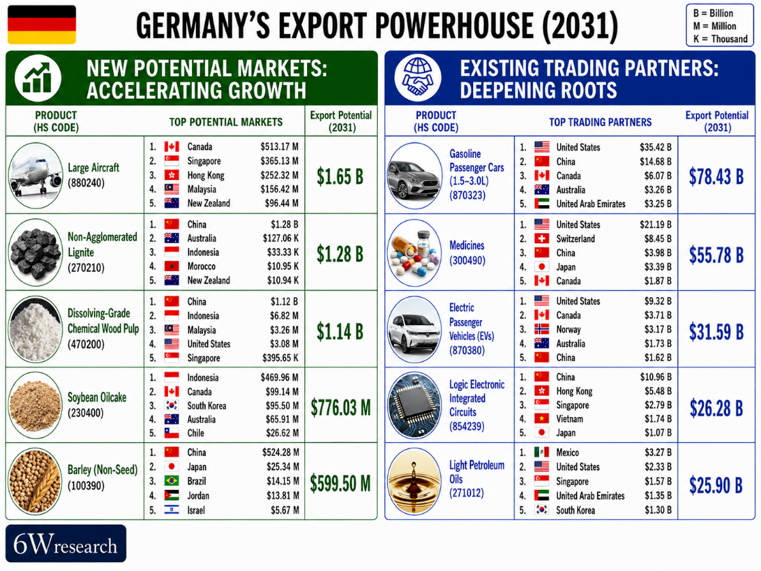
Large aircraft represent Germany's largest new corridor opportunity at USD 1.65 billion, led by Canada at USD 513.17 million and Singapore at USD 365.13 million, with further demand from Hong Kong, Malaysia and New Zealand. The opportunity is spread across five buyers, with no single market accounting for more than one-third of the total, indicating diversified aircraft leasing and delivery opportunities that could extend Germany’s established aerospace production into new export destinations.
Non-agglomerated lignite and dissolving-grade chemical wood pulp add a further USD 1.28 billion and USD 1.14 billion, both sold almost entirely to China at shares above 98%. The near-total concentration in a single buyer for both categories is the notable feature here: lignite is a low-value, bulk energy input and wood pulp a semi-processed industrial material, and China's dominant, price-setting position in both global coal-processing and paper and textile manufacturing makes it the natural, close to exclusive destination for this kind of raw-material export from Germany, with little competing demand from other markets.
Soybean oilcake and barley complete the top five new potential export opportunities, contributing USD 776.03 million and USD 599.50 million, respectively. Soybean oilcake is more diversified, led by Indonesia at USD 469.96 million with smaller volumes to Canada, South Korea, Australia and Chile consistent with its role as livestock feed sold into multiple animal agriculture markets rather than one dominant industrial buyer. Barley, by contrast, mirrors the lignite and pulp pattern, with China absorbing an 87.46% share, as a bulk agricultural commodity used mainly for feed and brewing, its trade flow is again shaped by which single market has the import capacity and demand scale to absorb large, undifferentiated volumes. Across all five categories, Germany's new-corridor opportunity through 2031 looks less like an extension of its advanced-manufacturing export identity and more like a bulk-commodity supply relationship with China, punctuated by one emerging aerospace niche outside it.
Passenger Vehicles and Pharmaceuticals Remain the Foundation of Germany's Established Export Base
Gasoline passenger cars (1.5–3.0L) represent Germany's largest established export opportunity at USD 78.43 billion, led by the United States at USD 35.42 billion (45.16%) and China at USD 14.68 billion (18.72%), followed by Canada, Australia and the UAE. The near-even split between the US and a long tail of secondary markets reflects the category's role as Germany's flagship internal-combustion export, mid-size gasoline vehicles remain the segment where German engineering commands the strongest brand premium, and the US market's scale and preference for larger, higher-margin models make it the natural anchor buyer, with China absorbing a second, smaller tranche driven by its own premium-vehicle demand.
Medicines and electric passenger vehicles add a further USD 55.78 billion and USD 31.59 billion. Medicines are led by the United States at USD 21.19 billion and Switzerland at USD 8.45 billion a pattern consistent with regulated pharmaceutical trade flowing toward large, high-income markets with the reimbursement systems and regulatory recognition to absorb premium-priced German pharmaceutical exports at scale. Electric passenger vehicles are also led by the United States at USD 9.32 billion (29.50%), followed by Canada and Norway, underscoring that Germany's EV export base still leans on the same North American and Nordic markets that have historically led in EV-adoption incentives and charging infrastructure, rather than the Chinese market that increasingly supplies its own EVs domestically.
Logic electronic integrated circuits and light petroleum oils complete the established top five, contributing USD 26.28 billion and USD 25.90 billion. Logic electronic integrated circuits are led by China at USD 10.96 billion (41.72%) and Hong Kong at USD 5.48 billion (20.86%), a pattern that reflects Germany's role supplying specialized components into Asia's concentrated electronics assembly and semiconductor-packaging hubs rather than end-consumer markets. Light petroleum oils are more diversified, spread across Mexico at USD 3.27 billion, United States at USD 2.33 billion with Singapore, UAE and South Korea, consistent with a refined-fuel trade shaped by regional shipping and bunkering demand rather than any single dominant buyer. Together, these five categories confirm that Germany's established export advantage rests on a small set of high-value manufactured goods vehicles, pharmaceuticals and semiconductors sold overwhelmingly into the United States and China, making the trade policies of those two markets the single most consequential variable in the country's near-term export outlook.
|
Germany’s export landscape reflects strong but distinct ties with two major markets, with the United States leading demand for vehicles and pharmaceuticals, while China remains important for semiconductors and is emerging as a key destination for raw-material trade. That dual dependence means Germany's trajectory through 2031 will be shaped as much by Washington's tariff decisions and Beijing's industrial demand as by anything happening on its own factory floors. 6WExportGTM Analysis |
What Germany Already Sells and Where
Passenger Vehicles form Germany's largest established trade sector at USD 170.91 billion, led by gasoline passenger cars at 28.17% share, followed by electric passenger vehicles at 23.25% share. Pharmaceuticals rank second at USD 126.95 billion, led by pharmaceutical preparations at 43.79% share, with immunological products adding 25.97% share. Automotive Parts follow at USD 95.98 billion, led by vehicle gearboxes at 17.14% share, with vehicle safety parts adding 10.06% together confirming that Germany's export base is anchored in a tightly integrated automotive and pharmaceutical manufacturing complex.
| Sector | Exports (USD Billion) | Leading Products / Share |
| Passenger Vehicles | 170.91 | Gasoline Passenger Cars (28.17%), Electric Passenger Vehicles (23.25%) |
| Pharmaceuticals | 126.95 | Pharmaceutical Preparations (43.79%), Immunological Products (25.97%) |
| Automotive Parts | 95.98 | Vehicle Gearboxes (17.14%), Vehicle Safety Parts (10.06%) |
Source: UN Comtrade
The United States is Germany's largest destination market at USD 169.97 billion, led by gasoline passenger cars at an 8.17% share and immunological products at 7.75%. France ranks second at USD 120.51 billion, led by aircraft structural parts at 4.34% and miscellaneous trade goods at 3.71%, while the Netherlands follows at USD 113.84 billion, led by miscellaneous trade goods at 4.54% and pharmaceutical preparations at 4.37% a pattern that shows Germany's current export capacity split between a dominant transatlantic vehicle-and-pharma relationship and deeply integrated intra-European aerospace and logistics trade.
| Country | Exports (USD Billion) | Leading Products / Share |
| United States | 169.97 | Gasoline Passenger Cars (8.17%), Immunological Products (7.75%) |
| France | 120.51 | Aircraft Structural Parts (4.34%), Miscellaneous Trade Goods (3.71%) |
| Netherlands | 113.84 | Miscellaneous Trade Goods (4.54%), Pharmaceutical Preparations (4.37%) |
Source: UN Comtrade
A Tariff Standoff with Washington and an Easing EV Dispute with Beijing: Two Developments Shaping Germany's Export Base
Two developments now underway help explain the pressures and opportunities behind the figures above: renewed uncertainty over US tariffs on German-made cars, which threatens Germany's single largest established export category, and a gradually easing but still unresolved dispute between the EU and China over electric-vehicle tariffs, which sits uneasily alongside Germany's deep manufacturing ties to the Chinese market.
US Auto Tariffs Have Settled at 15%, but Renewed Threats to Raise Them to 25% Keep Germany's Largest Export Category Exposed
Under the EU-US trade framework agreed in mid-2025, the United States set a 15% baseline tariff on European cars from 1 August 2025, down from the 27.5% rate car makers had faced and well below the 25% rate Washington had initially threatened. Even so, German car exports to the United States fell by almost 14% in the first three quarters of 2025, the hardest-hit branch of German industry in the trade dispute, with the Center Automotive Research in Bochum estimating a roughly USD 2.89 billion annual tariff burden on German automakers. In May 2026, President Trump threatened to raise the tariff back toward 25%, citing the EU's compliance with the broader trade deal, a threat industry analysts say would hit Germany hardest given the country's outsized reliance on the US car market. For an established gasoline and electric passenger-vehicle export base worth a combined USD 110.02 billion and led overwhelmingly by the United States, continued tariff volatility remains the single largest risk to Germany's export outlook through 2031.
|
Germany's auto exporters have adjusted to a 15% tariff as the 'new normal,' but the renewed threat of a jump back to 25% shows that this relationship is still being negotiated in real time and with gasoline and electric vehicles together worth around USD 110.02 billion in established export potential, there is very little room for Germany to absorb a swing of that size. Manish Pant, Senior Data Scientist, Data Science & Market Intelligence, 6Wresearch |
The EU-China EV Tariff Dispute Is Reaching a 'Soft Landing,' but Germany's Automakers Remain Caught in the Middle
Since 2024, the EU has applied countervailing tariffs of 7.8% to 35.3% on Chinese-made electric vehicles following an anti-subsidy investigation, a policy German automaker including BMW, Mercedes-Benz and Volkswagen publicly opposed given their extensive manufacturing and joint-venture investments inside China. In January 2026, the EU and China agreed on steps toward resolving the dispute, with Brussels issuing guidance allowing Chinese manufacturers to commit to minimum import prices in place of the tariffs, and China's commerce minister describing a "soft landing" after meeting the head of Germany's VDA automotive association in April 2026. The resolution matters directly for Germany's own trade figures: China is both Germany's second-largest established export market at USD 223.23 billion and its largest new-corridor opportunity at USD 6.49 billion, though that new-corridor figure is currently dominated by raw materials such as lignite, wood pulp and barley rather than the finished vehicles at the center of the tariff dispute underscoring how intertwined, and how asymmetric, the Germany-China trade relationship has become.
|
It is a genuinely unusual position for Germany to be in, its automakers are lobbying against EU tariffs on Chinese EVs to protect their China manufacturing footprint, even as Germany's own new potential market opportunity in China is built almost entirely on raw commodities rather than the advanced manufactured goods the country is known for. Both dynamics will keep shaping the relationship through 2031. Manisha Gupta, Data Analyst, Data Science & Market Intelligence, 6Wresearch |
The Takeaway
Germany should treat its export outlook through 2031 as one of managed exposure rather than diversification away from risk, since its two largest trading relationships the United States and China each carry distinct and unresolved policy uncertainty, and its emerging new-corridor opportunities look structurally different from the advanced-manufacturing exports that built the country's trade surplus. The path forward depends on protecting the automotive-and-pharma trade that anchors current exports while navigating tariff volatility with Washington and a still-evolving trade relationship with Beijing.
Key strategic priorities for Germany include:
- Hedge against renewed US auto tariff volatility: Gasoline and electric passenger vehicles together represent USD 110.02 billion of established export potential, with the United States absorbing 45.16% of gasoline car exports and 29.50% of EV exports. With Washington threatening to raise the 15% tariff back toward 25%, Germany's automakers should accelerate US-based production, as BMW and Mercedes-Benz have already done, to reduce direct exposure to further tariff swings.
- Manage the dual-edged China relationship deliberately: China is simultaneously Germany's second-largest established export market (USD 223.23 billion), its largest new-corridor opportunity (USD 6.49 billion) and the source of EU tariff friction over Chinese EV imports. Germany should pursue the emerging minimum-price framework as a durable resolution rather than a temporary truce, while diversifying new-corridor exports beyond raw commodities like lignite and wood pulp.
- Build out the emerging aerospace corridor beyond Western Europe: Large aircraft are Germany's single largest new potential market opportunity at USD 1.65 billion, led by Canada and Singapore rather than Germany's traditional European aerospace partners. Germany should pursue direct leasing and delivery relationships in these markets to convert early demand into durable trade volume.
- Protect the pharmaceutical export base as a stabilizing counterweight: Pharmaceuticals account for USD 126.95 billion in Germany’s current trade, driven primarily by pharmaceutical preparations and immunological products exported to the United States. With relatively lower tariff exposure among Germany’s leading established sectors, pharmaceuticals provide an important source of export resilience amid greater uncertainty in automotive trade.
Overall, Germany's export growth through 2031 will depend less on discovering entirely new markets and more on how well the country manages tariff risk in its two largest existing relationships a reminder that for an export economy of Germany's scale, trade policy in Washington and Beijing now matters as much as anything happening on its own factory floors.

Leadership Perspectives from Industry Events
Search
6Wresearch in the News
 Forbes
Citing 6Wresearch analytics to map global infrastructure and pharmaceutical industry trajectories.
 Bloomberg Law
Direct syndication of 6Wresearch's macro data points, capturing complex supply chain shifts.
 Reuters
Tracking industrial manufacturing adjustments and electronic security ecosystem scaling.
 Mint
Mint
Utilizing deep-tech sector market sizing to analyze global automation and robotics.
 The Economic Times
Anchoring features on industrial IoT growth metrics and connected smart-grid devices.
 Business Standard
Featuring strategic evaluations of Advanced Driver Assistance Systems (ADAS) and AI road safety.
 The Hindu
Spotlighting core commercial metrics ranging from unmanned aerial vehicles (UAVs) to consumer durables.
 Financial Express
Anchoring quarterly reviews on cross-border real estate tech and structural hardware manufacturing.
 Yahoo Finance
Syndicating the tracker's $30.1 billion untapped-market findings, spotlighting Japan, the US and China as India's top new-potential importers.
 India Today
Carrying the release on smartphones leading India's export potential to $94 billion by 2031, per 6WExportGTM data.
 Dailyhunt
Distributing the tracker findings to its regional readership, framing India's export diversification into Japan and Mexico.
 PR Newswire Original release
Publishing the full India Export Attractiveness Tracker 2026, detailing new trade corridors across iron ore, LCVs and pharmaceuticals.
 The Industrial
Highlighting the tracker's read on India's semiconductor ambitions and long-term chip-assembly export potential.
 PTI News
Reporting on the $66.81 billion pharmaceuticals export opportunity flagged in the tracker, amid looming US generic-drug tariffs.
 Tribune India
Covering the tracker's tariff-versus-regulation analysis across India's mature export markets in the US, China and UAE.
 ANI News
Amplifying the report's findings on polished diamonds, refined petroleum and medicines as India's core export engines.
 International Business Magazine
Covering the report's insight into how AEB, blind spot detection, and driver monitoring are reshaping India's ADAS market.
 Focus Gaming News
Highlighting the research forecast for Egypt's gambling market, projecting steady growth through 2032.
Thought Leadership and Analyst Meet





Our Clients








Latest Reports
- Namibia Financial Asset Management Market (2026-2032)
- Mozambique Financial Asset Management Market (2026-2032)
- Montenegro Financial Asset Management Market (2026-2032)
- Mongolia Financial Asset Management Market (2026-2032)
- Monaco Financial Asset Management Market (2026-2032)
- Micronesia Financial Asset Management Market (2026-2032)
- Mauritius Financial Asset Management Market (2026-2032)
- Mauritania Financial Asset Management Market (2026-2032)
- Marshall Islands Financial Asset Management Market (2026-2032)
- Malta Financial Asset Management Market (2026-2032)
Industry Events and Analyst Meet

EV India Expo 2026

HIMTEX 2026

India Refining Summit 2026

India EV Show 2026

EV tech India Expo 2026
Whitepaper
- Middle East & Africa Commercial Security Market Click here to view more.
- Middle East & Africa Fire Safety Systems & Equipment Market Click here to view more.
- GCC Drone Market Click here to view more.
- Middle East Lighting Fixture Market Click here to view more.
- GCC Physical & Perimeter Security Market Click here to view more.


