Mauritania's Iron Ore Exports to Existing Partners Could Reach USD 2.20 Billion, While the Same Commodity Opens a Further USD 0.34 Billion Across New Markets by 2031
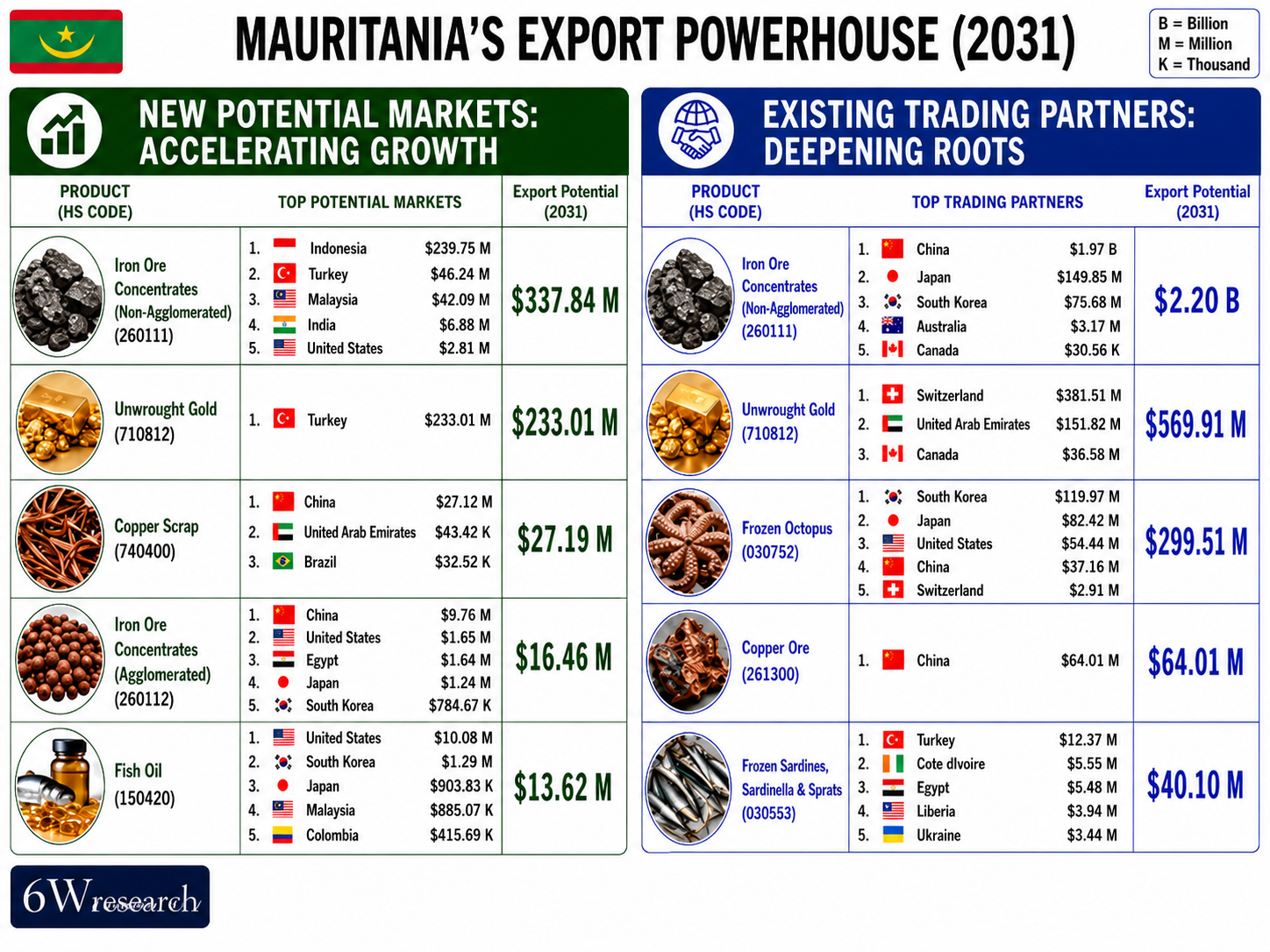
Mauritania export potential highlights a clear shift in market geography between established and new-corridor trade. China leads established export potential with a 65.25% share, followed by Switzerland at 11.32%, while new-corridor opportunities are led by Turkey at 40.83% and Indonesia at 35.01%, with China accounting for 6.99%. Importantly, the new-corridor opportunity remains concentrated in iron ore concentrates and unwrought gold, indicating that Mauritania’s near-term diversification is primarily market-led rather than product-led, as its core mineral exports expand into new buyer markets across the Middle East and Southeast Asia.
 Source: 6WExportGTM
Turkey and Indonesia Replace the China-Led Order to Lead Mauritania's New Potential Markets
Turkey leads Mauritania's new potential importers at USD 0.28 billion, narrowly ahead of Indonesia at USD 0.24 billion. China, Malaysia and the United States round out the top five at USD 0.05 billion, USD 0.04 billion and USD 0.03 billion. The near-tie at the top is the standout feature: unlike established trade, where China holds an overwhelming lead, new-corridor demand is genuinely contested between two buyers, reflecting Turkey's growing role as a gold-trading hub and Indonesia's expanding steel-making capacity. China's established dominance shrinks to a distant third in new-corridor categories, suggesting Mauritania's next wave of growth depends less on deepening its existing relationship with Beijing and more on building out these two emerging corridors.
| Top 5 Existing Importers | Export Potential (USD Billion) | Top 5 New Potential Importers | Export Potential (USD Billion) |
| China | 2.23 | Turkey | 0.28 |
| Switzerland | 0.39 | Indonesia | 0.24 |
| Japan | 0.24 | China | 0.05 |
| South Korea | 0.21 | Malaysia | 0.04 |
| United Arab Emirates | 0.15 | United States | 0.03 |
Source: 6WExportGTM
China accounts for USD 2.23 billion of Mauritania's established export potential, more than five times Switzerland's USD 0.39 billion in second place. Japan and South Korea follow at USD 0.24 billion and USD 0.21 billion, with the UAE rounding out the top five at USD 0.15 billion. This concentration reflects Mauritania's dependence on a single iron-ore-and-gold corridor into China, with Switzerland, Japan, South Korea and the UAE absorbing smaller, more specialized volumes of gold and steel-making inputs.
A Southeast Asian Steel Corridor and a Turkish Gold Relationship Headline Mauritania's New Potential Market Opportunities
Iron ore concentrates (non-agglomerated) represent Mauritania's largest new opportunity at USD 0.34 billion, led by Indonesia at USD 0.24 billion (70.96%), followed by Turkey at USD 0.05 billion (13.69%) and Malaysia at USD 0.04 billion (12.46%). Indonesia's dominant share reflects its rapidly expanding domestic steel and nickel-smelting capacity, which needs imported ore feedstock to keep pace with demand that its own mining sector cannot fully supply, while Turkey and Malaysia's smaller volumes track their own growing construction-driven steel industries a pattern that lines up directly with SNIM's stated strategy of diversifying its buyer base toward the Middle East and Southeast Asia rather than deepening its reliance on China.
Unwrought gold and copper scrap add a further USD 0.23 billion and USD 0.03 billion. Gold is sold entirely to Turkey, whose position as one of the world's largest gold-refining, jewelry-manufacturing and bullion-trading centers makes it a natural market for Mauritanian gold. Copper scrap, by contrast, is sold almost entirely to China (99.72%), consistent with China's outsized global capacity for secondary copper smelting and recycling, which absorbs scrap-metal inputs in addition to the raw copper ore it already buys through established channels.
Iron ore concentrates (agglomerated) and fish oil round out the new corridor’s top five, contributing USD 0.016 billion and USD 0.014 billion. Agglomerated ore is spread more evenly across China, the United States, Egypt, Japan and South Korea, since pelletized, higher-value ore suits a broader range of blast-furnace configurations than the raw non-agglomerated ore that concentrates almost entirely in Indonesia. Fish oil is led by the United States (73.98%), reflecting Western demand for omega-3 nutraceutical and supplement inputs, a genuinely different end-use from the frozen-seafood trade that otherwise defines Mauritania's fisheries exports. Overall, four of Mauritania's five new-corridor categories are simply the country's existing iron-ore-and-gold trade reaching new buyer geographies, with fish oil standing out as the only true new-product opportunity.
Iron Ore and Gold Remain the Foundation of Mauritania's China and Switzerland Anchored Established Trade
Iron ore concentrates (non-agglomerated) represent Mauritania's largest established export opportunity at USD 2.20 billion, led by China at USD 1.97 billion (89.59%), followed by Japan at USD 0.15 billion (6.81%) and South Korea at USD 0.08 billion (3.44%). China's overwhelming share reflects both its position as the world's largest steel producer and the direct rail and port infrastructure SNIM has built from its Zouerate mines to the port of Nouadhibou, engineered for high-volume bulk shipping to Asia, while Japan and South Korea draw smaller, quality-specific volumes for their own steel industries.
Unwrought gold and frozen octopus add a further USD 0.57 billion and USD 0.30 billion. Gold is led by Switzerland (66.94%) and UAE (26.64%), reflecting Switzerland's role as the world's dominant gold-refining hub and Dubai's parallel status as a major bullion trading and jewelry manufacturing center both natural clearinghouses through which African-mined gold re-enters global markets. Frozen octopus is led by South Korea (40.06%), Japan (27.52%) and the United States (18.18%), a pattern that tracks strong East Asian culinary demand for octopus alongside growing US import appetite, positioning Mauritania as a key West African supplier into established seafood-consuming markets.
Copper ore and frozen sardines, sardinella and sprats complete the established top five, contributing USD 0.06 billion and USD 0.04 billion. Copper ore is sold entirely to China, mirroring the iron-ore pattern and reflecting China's dominant global smelting capacity for raw ore inputs. Frozen sardines, by contrast, are spread across Turkey, Cote d'Ivoire, Egypt, Liberia and Ukraine, a far more fragmented buyer base typical of a lower-value, bulk pelagic commodity sold into Mediterranean and West African markets with established canning and direct-consumption demand, rather than into a single dominant industrial buyer. Collectively, these five categories confirm that Mauritania's established export advantage rests on a stark two-commodity, two-buyer structure iron ore to China and gold to Switzerland and UAE with fisheries providing the only meaningful buyer diversity.
|
Mauritania's export base is a story of concentrated dependence on two commodities and two buyer hubs: iron ore into China, and gold into Switzerland and the UAE. What makes Mauritania distinctive is that even its new-corridor opportunity doesn't escape this pattern it's largely the same two commodities finding new buyers in Indonesia and Turkey, rather than genuinely new products entering global trade. 6WExportGTM Analysis |
What Mauritania Already Sells and Where
Precious Metals form Mauritania's largest established trade sector at USD 1.64 billion, led by unwrought gold at 91.08% share, with semi-manufactured gold adding an 8.92% share. Metallic Ores rank second at USD 1.38 billion, led by iron ore concentrates at USD 1.17 billion and an 85.09% share, with copper ore adding USD 0.21 billion and a 14.91% share. Seafood & Fisheries follow at USD 0.97 billion, led by frozen octopus at USD 0.38 billion and a 39.63% share, with frozen whole fish adding USD 0.18 billion and an 18.11% share together confirming that Mauritania's export base is anchored in mining, with fisheries providing a genuine pillar.
| Sector | Exports (USD Billion) | Leading Products / Share |
| Precious Metals | 1.64 | Unwrought Gold (91.08%), Semi Manufactured Gold (8.92%) |
| Metallic Ores | 1.38 | Iron Ore Concentrates, Non-Agg. (85.09%), Copper Ore (14.91%) |
| Seafood & Fisheries | 0.97 | Frozen Octopus (39.63%), Frozen Fish Whole (18.11%) |
Source: UN Comtrade
Canada is Mauritania's largest destination market at USD 1.12 billion, driven almost entirely by unwrought gold at a 99.98% share. China ranks second at USD 1.05 billion, led by iron ore concentrates at a 68.44% share and copper ore at 19.65%, while Switzerland follows at USD 0.37 billion, again driven almost entirely by unwrought gold at a 99.98% share a pattern that shows Mauritania's current export capacity split between gold flowing through North American and Swiss trading channels and iron ore and copper flowing directly to Chinese industrial buyers.
| Country | Exports (USD Billion) | Leading Products / Share |
| Canada | 1.12 | Unwrought Gold (99.98%), Frozen Fish Whole (0.01%) |
| China | 1.05 | Iron Ore Concentrates, Non-Agg. (68.44%), Copper Ore (19.65%) |
| Switzerland | 0.37 | Unwrought Gold (99.98%), Electrical Measuring Devices (0.01%) |
Source: UN Comtrade
A Mining Diversification Push and an EU Fisheries Renewal: Two Developments Shaping Mauritania's Export Base
Two developments now underway help explain the pressures and opportunities behind the figures above: SNIM's deliberate push to diversify its iron-ore buyer base beyond China toward the Middle East and Southeast Asia, which lines up directly with the new-corridor figures above, and the upcoming renewal negotiations for the EU-Mauritania fisheries partnership, the EU's largest such agreement, which will shape the trade environment for Mauritania's third-largest established sector.
SNIM Is Actively Diversifying Iron Ore Exports Beyond China, Targeting the Middle East and Southeast Asia
Mauritania's state mining company SNIM reached record iron ore sales of 14.7 million tons in 2025 and has set a target of 15.5 million tons for 2026, with a long-term goal of 45 million tons of annual capacity by 2031. Alongside this expansion, SNIM has explicitly prioritized diversifying its export markets toward the Middle East while maintaining existing shipments to Europe and China through the port of Nouadhibou, backed by a completed dredging and infrastructure upgrade that lets the port handle vessels of up to 230,000 tons, up from a previous 150,000-ton limit. Mauritania is increasingly broadening its iron ore customer base beyond China, with Indonesia, Turkey and Malaysia emerging as important new markets. This is in line with SNIM’s strategy to diversify the destinations of its exports, to decrease its dependence on a single major buyer and to increase the presence of Mauritania in the Asian and Middle Eastern markets.
|
SNIM’s port and production expansion reflects Mauritania’s broader push to diversify its iron ore customer base while maintaining China as a key market. The growing importance of Indonesia and Turkey highlights the country’s increasing reach into new export destinations and supports a more balanced and resilient trade structure. Manish Pant, Senior Data Scientist, Data Science & Market Intelligence, 6Wresearch |
The EU's Largest Fisheries Agreement Faces Renewal Negotiations Before Its November 2026 Expiry
The EU-Mauritania Sustainable Fisheries Partnership Agreement, the EU's largest such agreement by both financial value and fishing rights, provides for roughly USD 70.39 million in annual EU financial contributions and allows European vessels to fish for shrimp, demersal fish, tuna and small pelagic in Mauritanian waters. The current protocol expires in November 2026, and the European Commission closed a public consultation on renewal in July 2025, with formal negotiations expected to begin in the final quarter of 2025 covering both continuity of access and, per recent EU statements, expanded coverage of tropical tuna. Mauritania’s seafood and fisheries sector remain an important pillar of its export base, supported by products such as frozen octopus and frozen fish. Continued access to European markets, stable fishing quotas and supportive local landing arrangements will be important for sustaining trade flows and strengthening the sector’s long-term export competitiveness.
|
Fisheries will never rival iron ore or gold in headline value, but the EU renewal is the one policy event on the horizon that could meaningfully shift Mauritania's third-largest sector one way or the other and unlike the mining diversification story, this is a negotiation Mauritania does not fully control on its own. Manisha Gupta, Data Analyst, Data Science & Market Intelligence, 6Wresearch |
The Takeaway
Mauritania should treat its export outlook through 2031 as one of buyer diversification rather than product diversification, since both its established and new potential markets trade rest overwhelmingly on the same two commodities iron ore and gold with the primary opportunity lying in finding new buyers for them rather than new things to sell. The path forward depends on executing SNIM's Middle East and Southeast Asia pivot, protecting the fisheries sector through the EU renewal process, and using fish oil and other genuinely new categories to build real product diversity over time.
Key strategic priorities for Mauritania include:
- Press SNIM's iron-ore diversification through to completion: China still absorbs 89.59% of Mauritania's established iron ore exports (USD 2.20 billion), while Indonesia, Turkey and Malaysia together anchor a USD 0.34 billion new corridor opportunity in the same product. Mauritania should treat the port and capacity expansion underway as the foundation for converting these early new-corridor volumes into durable long-term contracts.
- Build a second gold-trading relationship with Turkey without weakening the Swiss channel: Unwrought gold new-corridor potential is currently 100% dependent on Turkey (USD 0.23 billion), a single-buyer concentration echoing Mauritania's Switzerland anchored established gold trade. Mauritania should formalize this relationship through direct trading agreements while continuing to leverage Switzerland's established refining and bullion infrastructure.
- Prepare a strong negotiating position for the EU fisheries renewal: With the current protocol expiring in November 2026 and Seafood & Fisheries representing Mauritania's third-largest sector, Mauritania should use the renewal negotiations to secure improved terms on local landings, processing investment and value capture, building on its existing Fisheries Transparency Initiative commitments.
Overall, Mauritania's export growth through 2031 will depend less on discovering new products to sell and more on how successfully the country spreads its existing iron-ore and gold trade across a wider set of buyers a reminder that for a resource concentrated economy like Mauritania's, geographic diversification is the primary lever available in the near term.

Leadership Perspectives from Industry Events
Search
6Wresearch in the News
 Forbes
Citing 6Wresearch analytics to map global infrastructure and pharmaceutical industry trajectories.
 Bloomberg Law
Direct syndication of 6Wresearch's macro data points, capturing complex supply chain shifts.
 Reuters
Tracking industrial manufacturing adjustments and electronic security ecosystem scaling.
 Mint
Mint
Utilizing deep-tech sector market sizing to analyze global automation and robotics.
 The Economic Times
Anchoring features on industrial IoT growth metrics and connected smart-grid devices.
 Business Standard
Featuring strategic evaluations of Advanced Driver Assistance Systems (ADAS) and AI road safety.
 The Hindu
Spotlighting core commercial metrics ranging from unmanned aerial vehicles (UAVs) to consumer durables.
 Financial Express
Anchoring quarterly reviews on cross-border real estate tech and structural hardware manufacturing.
 Yahoo Finance
Syndicating the tracker's $30.1 billion untapped-market findings, spotlighting Japan, the US and China as India's top new-potential importers.
 India Today
Carrying the release on smartphones leading India's export potential to $94 billion by 2031, per 6WExportGTM data.
 Dailyhunt
Distributing the tracker findings to its regional readership, framing India's export diversification into Japan and Mexico.
 PR Newswire Original release
Publishing the full India Export Attractiveness Tracker 2026, detailing new trade corridors across iron ore, LCVs and pharmaceuticals.
 The Industrial
Highlighting the tracker's read on India's semiconductor ambitions and long-term chip-assembly export potential.
 PTI News
Reporting on the $66.81 billion pharmaceuticals export opportunity flagged in the tracker, amid looming US generic-drug tariffs.
 Tribune India
Covering the tracker's tariff-versus-regulation analysis across India's mature export markets in the US, China and UAE.
 ANI News
Amplifying the report's findings on polished diamonds, refined petroleum and medicines as India's core export engines.
 International Business Magazine
Covering the report's insight into how AEB, blind spot detection, and driver monitoring are reshaping India's ADAS market.
 Focus Gaming News
Highlighting the research forecast for Egypt's gambling market, projecting steady growth through 2032.
Thought Leadership and Analyst Meet





Our Clients








Latest Reports
- Namibia Financial Asset Management Market (2026-2032)
- Mozambique Financial Asset Management Market (2026-2032)
- Montenegro Financial Asset Management Market (2026-2032)
- Mongolia Financial Asset Management Market (2026-2032)
- Monaco Financial Asset Management Market (2026-2032)
- Micronesia Financial Asset Management Market (2026-2032)
- Mauritius Financial Asset Management Market (2026-2032)
- Mauritania Financial Asset Management Market (2026-2032)
- Marshall Islands Financial Asset Management Market (2026-2032)
- Malta Financial Asset Management Market (2026-2032)
Industry Events and Analyst Meet

EV India Expo 2026

HIMTEX 2026

India Refining Summit 2026

India EV Show 2026

EV tech India Expo 2026
Whitepaper
- Middle East & Africa Commercial Security Market Click here to view more.
- Middle East & Africa Fire Safety Systems & Equipment Market Click here to view more.
- GCC Drone Market Click here to view more.
- Middle East Lighting Fixture Market Click here to view more.
- GCC Physical & Perimeter Security Market Click here to view more.


