The United States Leads Both Morocco's USD 37.30 Billion Established Export Base And Its USD 10.17 Billion New-Market Opportunity
The United States accounts for 28.85% of Morocco's export potential in 2031 more than double the share of second-placed China at 11.80% and also leads the new-market opportunity at 26.46%, a rare case where the same country tops both established and entirely new product lines. Medium petrol cars, gasoline passenger cars, lithium-ion batteries, electric vehicles and small petrol cars make up all five of Morocco's leading new-opportunity products.
 Source: 6WExportGTM
United States Retains Its Lead as Mexico Emerges as Morocco’s Key New-Corridor Export Opportunity
Morocco’s export expansion opportunities are concentrated across several major global markets. The United States represents the largest untapped opportunity, with an estimated export potential of USD 2.69 billion, significantly ahead of other markets. Mexico is second with USD 0.80 billion and China has a potential of around USD 0.68 billion. Japan and India further indicate attractive prospective destinations at around USD 0.57 billion each. These markets provide Morocco with the opportunity to diversify its export base and expand its presence in North America and Asia.
| Top 5 Existing Importers | Export Potential (USD Billion) | Top 5 New Potential Importers | Export Potential (USD Billion) |
| United States | 10.76 | United States | 2.69 |
| China | 4.40 | Mexico | 0.80 |
| Japan | 2.44 | China | 0.68 |
| India | 2.41 | Japan | 0.57 |
| Canada | 2.00 | India | 0.57 |
Source: 6WExportGTM
Morocco’s existing partner’s export potential remains strongly concentrated in a few major markets, led by the United States at USD 10.76 billion, well ahead of other destinations. China ranks second with an export potential of USD 4.40 billion, followed by Japan at USD 2.44 billion and India at USD 2.41 billion. Canada, with an estimated potential of USD 2.00 billion, completes the top five. This strong gap between the United States and the rest of the leading importers illustrates the dominant role of the United States in Morocco’s current export opportunity space.
Automotive and Battery Products: High-Potential Opportunities Across New Export Markets
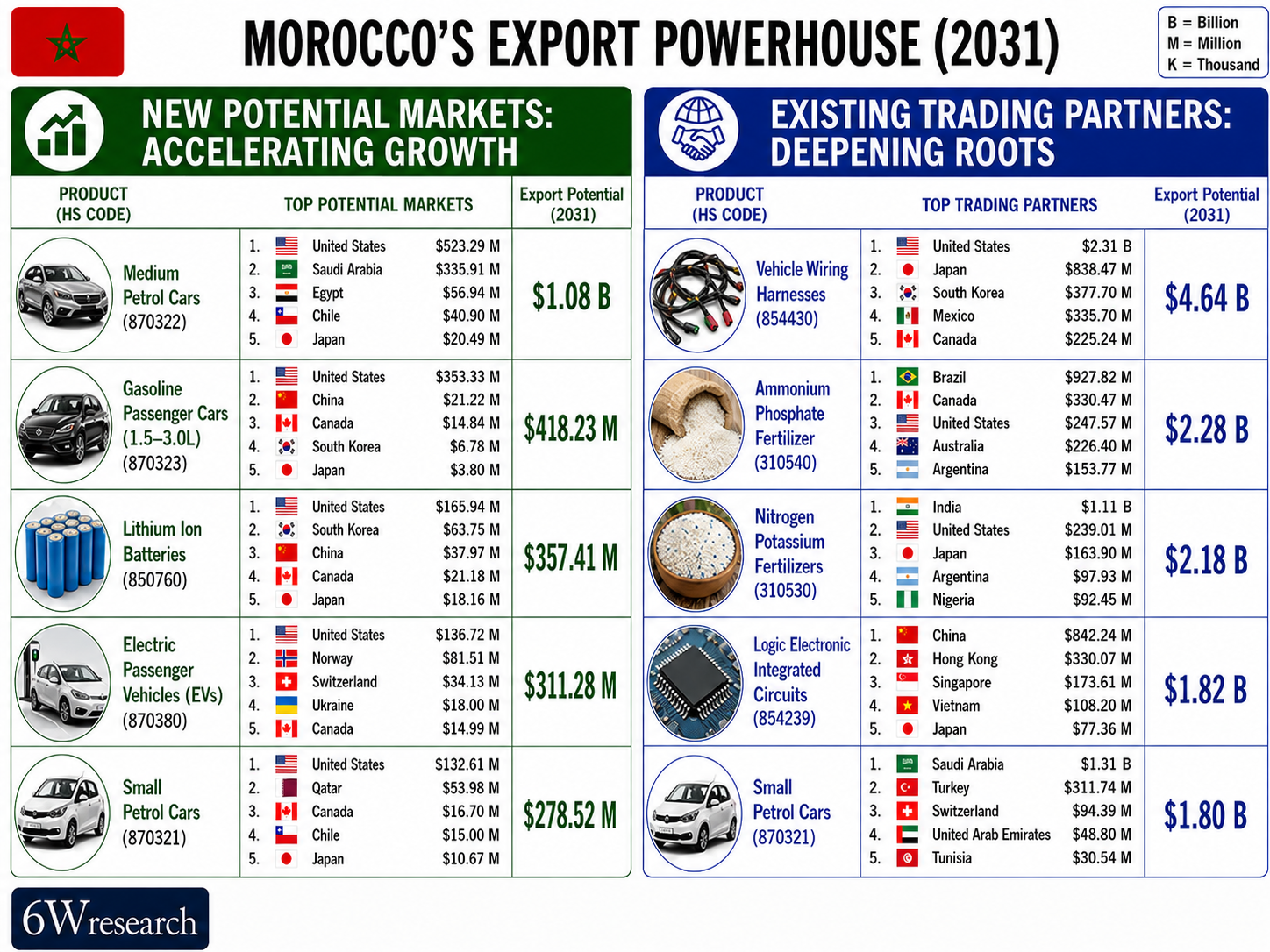
Medium petrol cars represent Morocco’s largest new-corridor opportunity at USD 1.08 billion, led overwhelmingly by the United States at USD 523.29 million and Saudi Arabia at USD 335.91 million, followed by Egypt, Chile and Japan. The scale of this opportunity highlights the automotive sector as the central pillar of Morocco’s prospective export expansion beyond its established trade corridors, with demand distributed across North America, the Middle East, Latin America and Asia.
Gasoline passenger cars (1.5–3.0L) and lithium-ion batteries add a further USD 418.23 million and USD 357.41 million, respectively. Gasoline passenger cars are heavily led by the United States at USD 353.33 million, while China, Canada, South Korea and Japan provide smaller opportunities. Lithium-ion batteries show a comparatively diversified buyer base, with the United States contributing USD 165.94 million, followed by South Korea at USD 63.75 million and China at USD 37.97 million. This combination indicates that Morocco’s potential extends beyond conventional vehicle exports into the increasingly important battery and electrification value chain.
Electric passenger vehicles and small petrol cars round out the top five at USD 311.28 million and USD 278.52 million, respectively. EV potential is led by the United States at USD 136.72 million and Norway at USD 81.51 million, with Switzerland, Ukraine and Canada providing additional opportunities. Small petrol cars are again led by the United States at USD 132.61 million, followed by Qatar, Canada, Chile and Japan. Overall, Morocco’s 2031 new-market potential across these five products totals about USD 2.45 billion and is overwhelmingly automotive-led, with the United States emerging as the most important prospective destination across nearly every major product category.
Morocco's Core Export Engines: Vehicle Wiring, Fertilizers and Electronics
Vehicle wiring harnesses represent Morocco’s largest existing-corridor export opportunity at USD 4.64 billion, led by the United States at USD 2.31 billion and Japan at USD 838.47 million, followed by South Korea, Mexico and Canada. The scale of this opportunity reinforces the importance of Morocco’s automotive-component manufacturing base, with wiring harness exports benefiting from established linkages with major vehicle-production and assembly markets across North America and Asia.
Ammonium phosphate fertilizer and nitrogen potassium fertilizers add a further USD 2.28 billion and USD 2.18 billion, respectively. Ammonium phosphate fertilizer is led by Brazil at USD 927.82 million, followed by Canada, the United States, Australia and Argentina, reflecting Morocco’s strong position in phosphate-based agricultural inputs. Nitrogen potassium fertilizers are led by India at USD 1.11 billion, with additional potential across the United States, Japan, Argentina and Nigeria, giving Morocco a geographically diversified fertilizer export base spanning Asia, the Americas and Africa.
Logic electronic integrated circuits and small petrol cars round out the top five at USD 1.82 billion and USD 1.80 billion respectively. Integrated circuits are led by China at USD 842.24 million, followed by Hong Kong and Singapore, highlighting potential exposure to East Asian electronics supply chains. Small petrol cars are dominated by Saudi Arabia at USD 1.31 billion, with Turkey, Switzerland, the UAE and Tunisia contributing smaller opportunities. Overall, Morocco’s 2031 existing-corridor potential across these five products totals approximately USD 12.71 billion, with automotive components and fertilizers forming the core of the country’s established export opportunity base.
|
Morocco’s export growth is increasingly driven by automotive, fertilizers and emerging EV-related products. The United States stands out across new-market opportunities, while vehicle wiring harnesses remain the strongest established export category. 6Wresearch expects future growth to be supported by EVs, batteries and electronics, alongside Morocco’s established automotive and phosphate industries. 6WExportGTM Analysis |
Top Global Export Opportunities (2031), By Product
| Product | Export Opportunity (USD Billion) |
| Electronic Integrated Circuits | 685.7 |
| Refined Petroleum Oils | 668.4 |
| Light Petroleum Oils | 588.9 |
| Logic Electronic Integrated Circuits | 507.9 |
| Medicines | 381.2 |
| Gasoline Passenger Cars (1.5–3.0L) | 360.9 |
| Smartphones | 343.6 |
| Electronic Integrated Circuits with Memory | 333.2 |
| Data Transmission Equipment | 216.9 |
| Immunological Products | 209.6 |
Excludes naturally occurring products (e.g., crude oil, raw gold). Source: 6WExportGTM
Morocco’s export opportunity profile is increasingly aligned with several of the world’s fastest-growing traded product categories. Globally, electronic integrated circuits lead with USD 685.7 billion in export opportunity by 2031, while logic integrated circuits add another USD 507.9 billion. Morocco is already developing exposure to this segment, with 6WExportGTM identifying around USD 1.82 billion in 2031 potential for logic electronic integrated circuits, led by China and other Asian markets. The global opportunity in gasoline passenger cars (1.5–3.0L) reaches USD 360.9 billion, which also aligns closely with Morocco’s expanding automotive manufacturing base and estimated USD 418.23 million in new-corridor potential for this product. While petroleum products, medicines and smartphones dominate other parts of the global opportunity landscape, Morocco’s strongest positioning remains concentrated in automotive, electronics, batteries and fertilizers, where existing industrial capacity and ongoing investment provide a clearer pathway to capturing future export growth.
Morocco's Current Export Base: Sectors and Countries
Morocco’s leading current export sectors are fertilizers, passenger vehicles, and wiring & cables. This reflects country’s strong export position in phosphate-based products, automotive manufacturing, and electrical components. fertilizers Passenger vehicles & wiring & cables. Fertilizers lead at USD 13.60 billion, driven by diammonium phosphate accounted for 30.32% and monoammonium phosphate for 28.96%. Medium petrol cars accounted for dominant share (83.29%) of the passenger vehicle exports, which accounted for USD 12.79 billion. In addition, wiring & cables contribute USD 10.61 billion, led by vehicle, aircraft & ship wiring sets (42.40%) and insulated electric cables (21.96%). Together, these sectors highlight Morocco’s strong current export base across phosphate-based products, automotive manufacturing, and electrical components.
| Sector | Exports (USD Billion) | Leading Products / Share |
| Fertilizers | USD 13.60B | Diammonium Phosphate (30.32%), Monoammonium Phosphate (28.96%) |
| Passenger Vehicles | USD 12.79B | Medium Petrol Cars (83.29%), Gasoline Passenger Cars 1.5–3.0L (6.88%) |
| Wiring & Cables | USD 10.61B | Vehicle, Aircraft & Ship Wiring Sets (42.40%), Insulated Electric Cables (21.96%) |
Source: UN Comtrade
By trading value, three markets stand out. Spain leads at USD 18.21 billion, led by vehicle, aircraft and ship wiring sets (9.26%) and women's woven suits (5.68%). France follows at USD 15.84 billion, led by medium petrol cars (19.00%) and aircraft structural parts (16.83%). Germany ranks third at USD 4.40 billion, led by medium petrol cars (26.44%) and vehicle, aircraft and ship wiring sets (10.48%) confirming that Morocco's three largest trading relationships all sit with Western European automotive and aerospace manufacturers.
| Country | Exports | Leading Products / Share |
| Spain | USD 18.21B | Vehicle, Aircraft & Ship Wiring Sets (9.26%), Women's Woven Suits (5.68%) |
| France | USD 15.84B | Medium Petrol Cars (19.00%), Aircraft Structural Parts (16.83%) |
| Germany | USD 4.40B | Medium Petrol Cars (26.44%), Vehicle, Aircraft & Ship Wiring Sets (10.48%) |
Source: UN Comtrade
Two Developments Supporting Morocco's Export Growth
Two current developments help explain Morocco’s potential: a fast-scaling electric-vehicle battery manufacturing buildout centered on Kenitra, and a multi-billion-dollar expansion of Morocco's phosphate fertilizer production.
Morocco's Electric-Vehicle Battery Manufacturing Buildout
Morocco’s automotive export outlook is being strengthened by a rapidly expanding EV and battery manufacturing ecosystem. Major investments, including Gotion High-Tech’s planned battery gigafactory in Kenitra and projects by BTR New Material Group, CNGR–Al Mada, Hailiang and Shinzoom, are helping establish a more integrated domestic battery supply chain. This expansion is well aligned with the emerging export opportunities with Morocco. 6WExportGTM identified USD 357.41 million of lithium-ion battery export potential and USD 311.28 million of electric passenger vehicle potential by 2031. The opportunities are on top of the already strong automotive manufacturing base in the country, with potential for vehicle wiring harnesses and passenger cars. To realize this potential, timely commissioning of new capacity, continued integration with the global automotive supply chains, stronger OEM linkages and access to key overseas markets will be necessary. Overall, the ongoing investment wave could help Morocco move further into higher-value EV, battery and automotive-component exports.
|
Morocco is evolving from a low-cost manufacturing hub into a strategic export platform, with its automotive base increasingly extending into EVs, batteries and electronics—products that can deepen its role in global supply chains. Manish Pant, Senior Data Scientist, Data Science & Market Intelligence, 6Wresearch |
OCP Group's Phosphate Fertilizer Expansion
Morocco’s fertilizer export outlook is being reinforced by OCP Group’s large-scale capacity expansion and deeper integration with overseas customers. OCP’s investment programme aims to raise fertilizer production from around 12 million tonnes to 20 million tonnes annually by the end of 2027, supported by substantial capital spending and new financing. This expansion is well in line with the present export potential of Morocco, with 6WExportGTM estimating approximately USD 2.28 billion for ammonium phosphate fertilizers and USD 2.18 billion for nitrogen potassium fertilizers by 2031, together worth around USD 4.46 billion. Demand prospects are also being strengthened by OCP Nutricrops’ joint venture with Koch Ag & Energy Solutions, which increases their combined phosphate fertilizer capacity to roughly 2.5 million tonnes annually and strengthens access to North American customers. Overall, higher production capacity, stronger international partnerships and Morocco’s large phosphate resource base provide a solid foundation for further expansion of fertilizer exports across major agricultural markets.
|
The biggest upside lies in combining old and new strengths: Morocco can leverage its established wiring-harness and fertilizer relationships to open doors for newer products, allowing export diversification to come from both sector expansion and cross-selling into existing trade networks. Manisha Gupta, Data Analyst, Data Science & Market Intelligence, 6Wresearch |
The Takeaway
Morocco should focus on converting its established strengths in automotive components and fertilizers into higher-value growth while accelerating the emerging EV, battery and electronics opportunity. The country already has USD 37.30 billion in established export potential and USD 10.17 billion in new-market opportunity, with the United States leading both categories. The path forward depends on translating major industrial investments into export-ready capacity, deepening access to the United States and Asian markets, and simultaneously preserving Morocco’s strong manufacturing relationships with Europe.
- Convert the EV and battery investment pipeline into commercial exports: Lithium-ion batteries and electric passenger vehicles represent around USD 357.41 million and USD 311.28 million in potential, respectively. With Gotion High-Tech, BTR, CNGR–Al Mada, Hailiang and Shinzoom building an increasingly integrated battery ecosystem, Morocco should prioritize timely commissioning, stronger OEM linkages and integration of locally produced battery materials into vehicle manufacturing.
- Scale fertilizer exports alongside OCP’s productionexpansion: Ammonium phosphate and nitrogen potassium fertilizers together represent approximately USD 4.46 billion in established export potential, with Brazil and India among the largest opportunities. OCP’s plan to increase fertilizer production from around 12 million tonnes to 20 million tonnes annually by end-2027 should be matched by deeper market penetration across the Americas, Asia and Africa.
- Use automotive manufacturing strength to capture new markets beyond Europe: Vehicle wiring harnesses alone provide approximately USD 4.64 billion in established-corridor potential, while Morocco’s five largest new-corridor products are all automotive or battery related. The United States ranks first across all five, making it the clearest destination for incremental automotive growth while Saudi Arabia, Norway, Canada and Asian markets provide additional diversification opportunities.
- Move further into higher-value electronics while protecting established European relationships: Logic electronic integrated circuits offer around USD 1.82 billion in potential, led by China, Hong Kong and Singapore, giving Morocco an avenue into Asian electronics supply chains. At the same time, Spain, France and Germany remain Morocco’s largest current trading relationships, anchored heavily in automotive and aerospace manufacturing, making continued European integration critical even as new markets are developed.
Overall, Morocco’s export growth through 2031 will depend on using its established automotive and phosphate industries as the foundation for a broader move into EVs, batteries and electronics. The strongest opportunity lies not in replacing its European export base, but in combining those existing industrial relationships with new demand from the United States, Asia, the Gulf and other emerging markets to create a more diversified and higher-value export portfolio.

Leadership Perspectives from Industry Events
Search
6Wresearch in the News
 Forbes
Citing 6Wresearch analytics to map global infrastructure and pharmaceutical industry trajectories.
 Bloomberg Law
Direct syndication of 6Wresearch's macro data points, capturing complex supply chain shifts.
 Reuters
Tracking industrial manufacturing adjustments and electronic security ecosystem scaling.
 Mint
Mint
Utilizing deep-tech sector market sizing to analyze global automation and robotics.
 The Economic Times
Anchoring features on industrial IoT growth metrics and connected smart-grid devices.
 Business Standard
Featuring strategic evaluations of Advanced Driver Assistance Systems (ADAS) and AI road safety.
 The Hindu
Spotlighting core commercial metrics ranging from unmanned aerial vehicles (UAVs) to consumer durables.
 Financial Express
Anchoring quarterly reviews on cross-border real estate tech and structural hardware manufacturing.
 Yahoo Finance
Syndicating the tracker's $30.1 billion untapped-market findings, spotlighting Japan, the US and China as India's top new-potential importers.
 India Today
Carrying the release on smartphones leading India's export potential to $94 billion by 2031, per 6WExportGTM data.
 Dailyhunt
Distributing the tracker findings to its regional readership, framing India's export diversification into Japan and Mexico.
 PR Newswire Original release
Publishing the full India Export Attractiveness Tracker 2026, detailing new trade corridors across iron ore, LCVs and pharmaceuticals.
 The Industrial
Highlighting the tracker's read on India's semiconductor ambitions and long-term chip-assembly export potential.
 PTI News
Reporting on the $66.81 billion pharmaceuticals export opportunity flagged in the tracker, amid looming US generic-drug tariffs.
 Tribune India
Covering the tracker's tariff-versus-regulation analysis across India's mature export markets in the US, China and UAE.
 ANI News
Amplifying the report's findings on polished diamonds, refined petroleum and medicines as India's core export engines.
 International Business Magazine
Covering the report's insight into how AEB, blind spot detection, and driver monitoring are reshaping India's ADAS market.
 Focus Gaming News
Highlighting the research forecast for Egypt's gambling market, projecting steady growth through 2032.
Thought Leadership and Analyst Meet





Our Clients








Latest Reports
- Namibia Financial Asset Management Market (2026-2032)
- Mozambique Financial Asset Management Market (2026-2032)
- Montenegro Financial Asset Management Market (2026-2032)
- Mongolia Financial Asset Management Market (2026-2032)
- Monaco Financial Asset Management Market (2026-2032)
- Micronesia Financial Asset Management Market (2026-2032)
- Mauritius Financial Asset Management Market (2026-2032)
- Mauritania Financial Asset Management Market (2026-2032)
- Marshall Islands Financial Asset Management Market (2026-2032)
- Malta Financial Asset Management Market (2026-2032)
Industry Events and Analyst Meet

EV India Expo 2026

HIMTEX 2026

India Refining Summit 2026

India EV Show 2026

EV tech India Expo 2026
Whitepaper
- Middle East & Africa Commercial Security Market Click here to view more.
- Middle East & Africa Fire Safety Systems & Equipment Market Click here to view more.
- GCC Drone Market Click here to view more.
- Middle East Lighting Fixture Market Click here to view more.
- GCC Physical & Perimeter Security Market Click here to view more.


