Costa Rica's Electronic Integrated Circuit Exports to Existing Partners Could Reach USD 14.25 Billion, While Other Food Preparations Open around USD 51 Million Across New Markets by 2031
Costa Rica’s export potential profile is anchored by a strong USD 22.17 billion established base, led by semiconductors and a diversified medical-device industry. China accounts for the largest share of established trade, followed by the United States. In contrast, the USD 1.02 billion new potential market opportunity is more fragmented, with emerging potential concentrated in electronics components and food preparations, reflecting scope for selective diversification beyond Costa Rica’s established high-value manufacturing strengths.
 Source: 6WExportGTM
Hong Kong Edges Ahead in a New-Corridor Category Far Smaller and More Fragmented Than Established Trade
Costa Rica’s new-market export potential is led by Hong Kong at USD 109.41 million, followed by the United States at USD 89.20 million and China at USD 78.42 million. India and South Korea also emerge as notable prospective destinations, with potential of USD 70.80 million and USD 58.80 million, respectively. Overall, the opportunity is geographically diversified across key Asian and North American markets, which helps with a broader market expansion beyond Costa Rica’s current trade relationships.
| Top 5 Importers | Export Potential (USD Billion) | Top 5 New Potential Importers | Export Potential (USD Million) |
| China | 8.18 | Hong Kong | 109.41 |
| United States | 4.96 | United States | 89.20 |
| Hong Kong | 1.87 | China | 78.42 |
| South Korea | 1.14 | India | 70.80 |
| Singapore | 0.98 | South Korea | 58.80 |
Source: 6WExportGTM
China accounts for USD 8.18 billion of Costa Rica's established export potential, well ahead of the United States at USD 4.96 billion. Hong Kong ranks third at USD 1.87 billion, with South Korea and Singapore rounding out the top five at USD 1.14 billion and USD 0.98 billion. This concentration is driven almost entirely by semiconductor supply chains: Costa Rica's chip exports flow disproportionately toward Asian electronics-manufacturing hubs rather than directly to the United States, despite Intel's American ownership, reflecting how deeply Costa Rica's assembly and test operations are embedded in global, not just American, supply chains.
Food Preparations and Electronics Components Emerge as Key Opportunities Across New Potential Markets
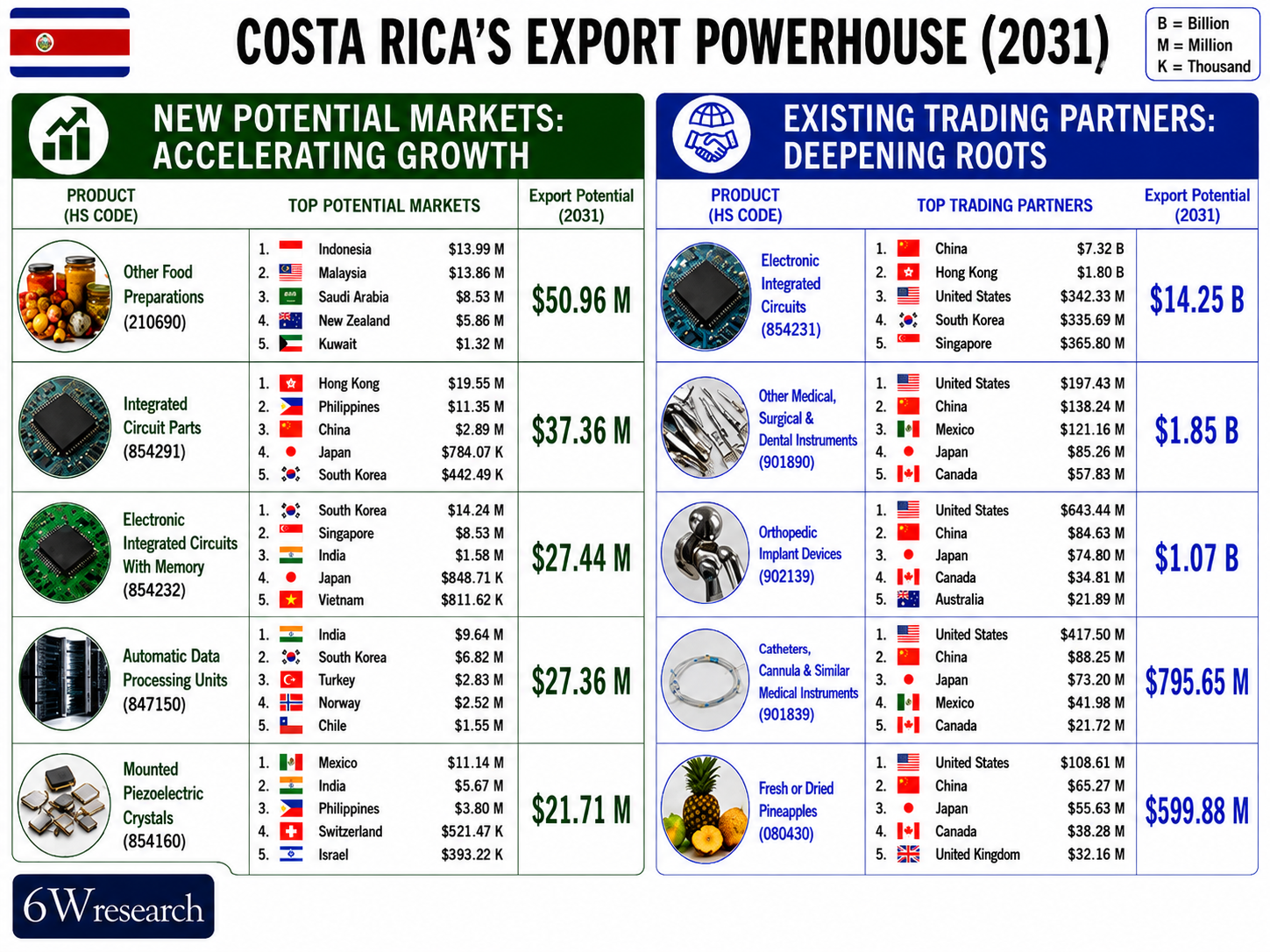
Other food preparations represent Costa Rica's largest new corridor category at USD 50.96 million, led by Indonesia at USD 13.99 million and Malaysia at USD 13.86 million, followed by Saudi Arabia, New Zealand and Kuwait. This is a genuinely different buyer geography from Costa Rica's established food-export markets, pointing to real, if still small-scale, demand for Costa Rican processed foods across Southeast Asia and the Gulf.
Integrated circuit parts and electronic integrated circuits with memory add a further USD 37.36 million and USD 27.44 million. Integrated circuit parts are led by Hong Kong at USD 19.55 million and the Philippines at USD 13.25 million, followed by China, Japan and South Korea. Memory-enabled integrated circuits are led by South Korea at USD 14.21 million and Singapore at USD 9.51 million, followed by India, Japan and Vietnam both categories extending Costa Rica's semiconductor supply chain into smaller component-level trade beyond the finished chips that dominate established markets.
Automatic data processing units and mounted piezoelectric crystals round out the new-corridor’s top five. Automatic data processing units contribute USD 27.36 million, led by India at USD 9.64 million and South Korea at USD 6.82 million, followed by Turkey, Norway and Chile. Mounted piezoelectric crystals add USD 21.71 million, led by Mexico at USD 11.14 million and India at USD 5.67 million, followed by the Philippines, Switzerland and Israel. Overall, Costa Rica's new-corridor potential through 2031 is a modest, genuinely diverse set of smaller electronics and food categories, dwarfed in scale by the established semiconductor and medical-device base.
Semiconductors and Medical Devices Overwhelmingly Define Costa Rica's Established Export Base
Electronic integrated circuits represent Costa Rica's largest established export opportunity by an extraordinary margin at USD 14.25 billion nearly two-thirds of the entire established total led by China at USD 7.32 billion and Hong Kong at USD 1.80 billion, followed by the United States, South Korea and Singapore. This concentration reflects Costa Rica's transformation, anchored by Intel's decades-long presence, into one of the world's most important semiconductor assembly and test hubs, with a substantial share of global server chips passing through Costa Rican facilities before reaching Asian and American electronics manufacturers.
Other medical, surgical and dental instruments and orthopedic implant devices add a further USD 1.85 billion and USD 1.07 billion. Other medical, surgical and dental instruments are led by the United States at USD 997.43 million, followed by China, Mexico, Japan and Canada. Orthopedic implants are led even more heavily by the United States at USD 643.44 million, followed by China, Japan, Canada and Australia both categories reflecting Costa Rica's parallel emergence as a major medical device manufacturing hub, distinct from and considerably more US-oriented than its semiconductor trade.
Catheters and similar medical instruments and fresh or dried pineapples complete the established top five. Catheters contribute USD 795.65 million, led by the United States at USD 417.50 million, followed by China, Japan, Mexico and Canada. Fresh or dried pineapples add USD 599.88 million, led by the United States at USD 308.61 million, followed by China, Japan, Canada and the United Kingdom the one category among Costa Rica's top five that reflects the country's traditional agricultural export base rather than its more recent high-tech manufacturing transformation. Collectively, these five categories confirm that Costa Rica's established export advantage rests on two structural pillars semiconductor assembly and medical-device manufacturing with agriculture providing a smaller, more traditional third layer.
|
Costa Rica has undergone a remarkable industrial transformation, evolving from an economy centered on coffee and bananas into a globally integrated exporter of semiconductors and medical devices, supported by decades of free-trade-zone policies and sustained foreign investment. That transformation leaves comparatively little obvious new-corridor headroom, but it also means Costa Rica's near-term trajectory depends on defending and deepening two genuinely world-class industrial clusters rather than searching for new ones. 6WExportGTM Analysis |
Top Global Export Opportunities (2031), By Product
| Product | Export Opportunity (USD Billion) |
| Electronic Integrated Circuits | 685.7 |
| Refined Petroleum Oils | 668.4 |
| Light Petroleum Oils | 588.9 |
| Logic Electronic Integrated Circuits | 507.9 |
| Medicines | 381.2 |
| Gasoline Passenger Cars (1.5–3.0L) | 360.9 |
| Smartphones | 343.6 |
| Electronic Integrated Circuits with Memory | 333.2 |
| Data Transmission Equipment | 216.9 |
| Immunological Products | 209.6 |
Excludes naturally occurring products (e.g., crude oil, raw gold). Source: 6WExportGTM
The global export opportunity landscape is concentrated in semiconductors, refined energy products, pharmaceuticals, automotive products, smartphones, and data-transmission equipment. For Costa Rica, the strongest alignment is with electronic integrated circuits, memory chips and data-transmission equipment, reflecting the country’s established strengths in semiconductors, life sciences, and advanced manufacturing. These categories provide a strong base for Costa Rica to scale exports and deepen participation in high-value global supply chains.
What Costa Rica Already Sells and Where
Medical devices form Costa Rica's largest established trade sector at USD 6.92 billion, led by catheters, cannulae and similar medical instruments at 46.81% share, followed by other medical, surgical and dental instruments at 41.72% share. Fruits rank second at USD 2.78 billion, with fresh or dried pineapples contributing 49.03% share, while banana products add 43.24%. Orthopedic devices follow at USD 1.66 billion, led by orthopedic implant devices at an 87.53% share, with orthopedic fracture appliances adding 10.65% together confirming that Costa Rica's manufacturing base spans a genuinely diversified medical-device cluster alongside its traditional tropical-fruit export industry.
| Sector | Exports (USD Billion) | Leading Products / Share |
| Medical Devices | 6.92 | Catheters, Cannulae & Similar Instruments (46.81%), Other Medical/Surgical/Dental Instruments (41.72%) |
| Fruits | 2.78 | Fresh or Dried Pineapples (49.03%), Banana Products (43.24%) |
| Orthopedic Devices | 1.66 | Orthopedic Implant Devices (87.53%), Orthopedic Fracture Appliances (10.65%) |
Source: 6WExportGTM
The United States is Costa Rica's largest destination market by a wide margin at USD 9.53 billion, led by other medical, surgical and dental instruments at 22.28% of exports to the country and catheters at 21.59% confirming the US as the dominant buyer for Costa Rica's medical-device cluster specifically, distinct from the more Asian-oriented semiconductor trade. The Netherlands ranks second at USD 1.71 billion, with catheters contributing 32.75% and other medical instruments 18.60%, reflecting Rotterdam's role as a European medical device distribution gateway. Guatemala follows at USD 1.03 billion, supported by other food preparations at 20.69% and sauces and seasonings at 4.99% a genuinely regional, food-focused trade relationship distinct from Costa Rica's global high-tech exports.
| Country | Exports (USD Billion) | Leading Products / Share |
| United States | 9.53 | Other Medical, Surgical & Dental Instruments (22.28%), Catheters & Cannulae (21.59%) |
| Netherlands | 1.71 | Catheters & Cannulae (32.75%), Other Medical, Surgical & Dental Instruments (18.60%) |
| Guatemala | 1.03 | Other Food Preparations (20.69%), Sauces and Seasonings (4.99%) |
Source: 6WExportGTM
A Semiconductor Legacy and a Medical-Device Building Boom: Two Developments Shaping Costa Rica's Export Base
Costa Rica is well positioned to capture emerging global export opportunities in semiconductors, medical devices, and advanced electronics. Products such as integrated circuits, memory chips, orthopedic implant devices, medicines, and data-transmission equipment closely align with the country’s existing high-value manufacturing capabilities, supporting further export expansion and deeper integration into global technology and healthcare supply chains.
Intel's Costa Rica Operations Remain the Foundation of the Country's Semiconductor Export Base
Costa Rica's semiconductor export position rests on more than two decades of sustained Intel investment. Following a 2022 commitment of roughly USD 1.2 billion tied in part to US CHIPS and Science Act support for allied semiconductor hubs, Intel's assembly and test operations in San Antonio de Belén have grown into one of the company's most important global sites, with roughly 80% of the world's server semiconductors reported to pass through Costa Rican facilities as of 2023. The relationship has not been without volatility Costa Rica's government has historically observed how sensitive Intel's local employment and output are to global semiconductor cycles, which was part of the original motivation for cultivating the medical-device cluster as a diversification hedge. For an established electronic integrated circuits category export potential worth USD 14.25 billion, nearly two-thirds of Costa Rica's entire established export base, this single-company concentration remains the most consequential structural feature of the country's export profile.
|
Costa Rica's semiconductor dominance is a genuine industrial achievement built over two decades with Intel, but the same concentration that makes the category so large also makes it Costa Rica's single biggest point of export-revenue exposure to one company's global investment decisions. Manish Pant, Senior Data Scientist, Data Science & Market Intelligence, 6Wresearch |
A Wave of 2026 Medical-Device Expansions Reinforces Costa Rica's Diversification Strategy
Costa Rica's medical-device export position is being reinforced by a concentrated wave of expansion activity at the Coyol Free Trade Zone in 2026. Resonetics began construction on its third Coyol manufacturing plant in February 2026, a roughly USD 15 million investment expected to create 300 jobs; Switchback Medical signed a lease for an 18,000-square-foot facility, including a dedicated cleanroom, in April 2026, with a second, larger site planned for 2027; and Cirtec Medical added more than 50,000 square feet to its Coyol operations that same month to expand manufacturing for neuromodulation, electrophysiology and structural-heart device markets. Coyol Free Zone alone now accounts for 54.9% of Costa Rica's total medical-device exports, hosting 34 companies across medical devices, semiconductors and smart manufacturing. For a medical-devices sector worth USD 6.92 billion current export and export potential of orthopedic-devices category worth a further USD 1.85 billion, this sustained wave of 2026 capacity additions supports the case that Costa Rica's diversification strategy away from single-sector dependency on semiconductors is working as intended.
|
Costa Rica's medical-device sector is doing exactly what it was built to do Resonetics, Switchback and Cirtec all expanding at Coyol within the same few months of 2026 shows this cluster has become a genuine second growth engine, not just a diversification talking point. Manisha Gupta, Data Analyst, Data Science & Market Intelligence, 6Wresearch |
The Takeaway
Costa Rica should continue defending its two world-class established clusters semiconductor assembly and medical-device manufacturing while recognizing that its new-corridor opportunities, though genuine, will remain a minor complement given how much of the country's obvious export potential has already been captured by these mature industries. The path forward depends on managing concentration risk within the semiconductor category while sustaining the medical-device investment momentum already visible in 2026.
Key strategicpriorities for Costa Rica include:
- Manage single-company concentration risk within the semiconductor cluster: With electronic integrated circuits worth USD 14.25 billion, nearly two-thirds of Costa Rica's entire established export base and heavily tied to Intel's global investment decisions, Costa Rica should continue courting additional semiconductor and electronics investors to reduce reliance on any single company's cycle.
- Sustain the medical-device investment pipeline building on 2026's momentum: The expansion of Resonetics, Switchback Medical and Cirtec Medical at the Coyol Free Zone within months in 2026, combined with Coyol now accounting for 54.9% of the country's exports of medical devices, indicates Costa Rica should continue to invest in specialized workforce training and regulatory infrastructure to sustain this engine of growth.
- Build out the Hong Kong and broader Asian electronics-component corridor deliberately: New-corridor integrated circuit parts and memory-enabled chips together total more than USD 64 million, led by Hong Kong, the Philippines and South Korea. Costa Rica should pursue direct relationships with these component-level buyers to extend its semiconductor ecosystem beyond finished-chip exports.
- Treat traditional agriculture as a stable, if slower-growing, fourth pillar: Fresh or dried pineapples and banana products can together generate high revenues in established and new markets exports. Costa Rica should continue supporting this traditional export base even as semiconductor and medical-device manufacturing dominate the country's growth narrative.
Overall, Costa Rica's export growth through 2031 will depend on defending two mature, world-class industrial clusters semiconductors and medical devices against their respective risks of single-company concentration and competitive pressure, while treating the country's comparatively modest new-corridor opportunities as a genuine but secondary complement to an already highly developed export base.

Leadership Perspectives from Industry Events
Search
6Wresearch in the News
 Forbes
Citing 6Wresearch analytics to map global infrastructure and pharmaceutical industry trajectories.
 Bloomberg Law
Direct syndication of 6Wresearch's macro data points, capturing complex supply chain shifts.
 Reuters
Tracking industrial manufacturing adjustments and electronic security ecosystem scaling.
 Mint
Mint
Utilizing deep-tech sector market sizing to analyze global automation and robotics.
 The Economic Times
Anchoring features on industrial IoT growth metrics and connected smart-grid devices.
 Business Standard
Featuring strategic evaluations of Advanced Driver Assistance Systems (ADAS) and AI road safety.
 The Hindu
Spotlighting core commercial metrics ranging from unmanned aerial vehicles (UAVs) to consumer durables.
 Financial Express
Anchoring quarterly reviews on cross-border real estate tech and structural hardware manufacturing.
 Yahoo Finance
Syndicating the tracker's $30.1 billion untapped-market findings, spotlighting Japan, the US and China as India's top new-potential importers.
 India Today
Carrying the release on smartphones leading India's export potential to $94 billion by 2031, per 6WExportGTM data.
 Dailyhunt
Distributing the tracker findings to its regional readership, framing India's export diversification into Japan and Mexico.
 PR Newswire Original release
Publishing the full India Export Attractiveness Tracker 2026, detailing new trade corridors across iron ore, LCVs and pharmaceuticals.
 The Industrial
Highlighting the tracker's read on India's semiconductor ambitions and long-term chip-assembly export potential.
 PTI News
Reporting on the $66.81 billion pharmaceuticals export opportunity flagged in the tracker, amid looming US generic-drug tariffs.
 Tribune India
Covering the tracker's tariff-versus-regulation analysis across India's mature export markets in the US, China and UAE.
 ANI News
Amplifying the report's findings on polished diamonds, refined petroleum and medicines as India's core export engines.
 International Business Magazine
Covering the report's insight into how AEB, blind spot detection, and driver monitoring are reshaping India's ADAS market.
 Focus Gaming News
Highlighting the research forecast for Egypt's gambling market, projecting steady growth through 2032.
Thought Leadership and Analyst Meet





Our Clients








Latest Reports
- Namibia Financial Asset Management Market (2026-2032)
- Mozambique Financial Asset Management Market (2026-2032)
- Montenegro Financial Asset Management Market (2026-2032)
- Mongolia Financial Asset Management Market (2026-2032)
- Monaco Financial Asset Management Market (2026-2032)
- Micronesia Financial Asset Management Market (2026-2032)
- Mauritius Financial Asset Management Market (2026-2032)
- Mauritania Financial Asset Management Market (2026-2032)
- Marshall Islands Financial Asset Management Market (2026-2032)
- Malta Financial Asset Management Market (2026-2032)
Industry Events and Analyst Meet

EV India Expo 2026

HIMTEX 2026

India Refining Summit 2026

India EV Show 2026

EV tech India Expo 2026
Whitepaper
- Middle East & Africa Commercial Security Market Click here to view more.
- Middle East & Africa Fire Safety Systems & Equipment Market Click here to view more.
- GCC Drone Market Click here to view more.
- Middle East Lighting Fixture Market Click here to view more.
- GCC Physical & Perimeter Security Market Click here to view more.


