Colombia’s Bituminous Coal Exports to Existing Partners Could Reach USD 8.6 Billion, While Crude Petroleum Opens USD 1.07 Billion Across New Markets by 2031.
In the future, the Colombia’s export potential is expected to remain anchored by major global markets, with the United States representing the largest share of established market opportunities at 26.15%, followed by China at 18.49%, Japan at 8.93%, India at 8.70%, and South Korea at 5.52%. Emerging corridors further highlight the diversification potential with China and Japan representing 12.98% and 12.77% of additional opportunities along with Malaysia, Indonesia and Australia.
 Source: 6WExportGTM
United States Leads Established Demand as Crude Petroleum Buyers Anchor Colombia’s New Potential Markets
China and Japan led the Colombia’s new potential export opportunities, representing USD 1.30 billion and USD 1.28 billion, respectively, highlighting strong potential to expand into major Asian markets. Malaysia and Indonesia provide additional opportunities of USD 0.96 billion and USD 0.81 billion, reflecting growing demand across Southeast Asia, while Australia contributes USD 0.53 billion in potential. Together, these markets indicate opportunities for Colombia to diversify its export destinations beyond traditional partners and strengthen its presence across Asia-Pacific markets through energy, mining, agricultural, and value-added exports.
| Top 5 Existing Importers | Export Potential (USD Billion) | Top 5 New Potential Importers | Export Potential (USD Billion) |
| United States | 12.49 | China | 1.30 |
| China | 8.83 | Japan | 1.28 |
| Japan | 4.27 | Malaysia | 0.96 |
| India | 4.16 | Indonesia | 0.81 |
| South Korea | 2.64 | Australia | 0.53 |
Source: 6WExportGTM
Colombia's established export opportunities remain closely tied to major global markets, with the United States sitting well ahead of everyone else at USD 12.49 billion — a clear reflection of just how central it is to Colombian exports. China comes in second at USD 8.83 billion, followed by Japan (USD 4.27 billion) and India (USD 4.16 billion), both pointing to real demand growth across major Asian economies. South Korea adds another USD 2.64 billion, further reinforcing Colombia's foothold in East Asia. Between these markets, Colombia has genuine room to deepen existing relationships and grow exports across energy, mining, agriculture and value-added products.
Colombia’s New Export Corridors Expand Beyond Traditional Markets, Led by Energy and Industrial Commodities
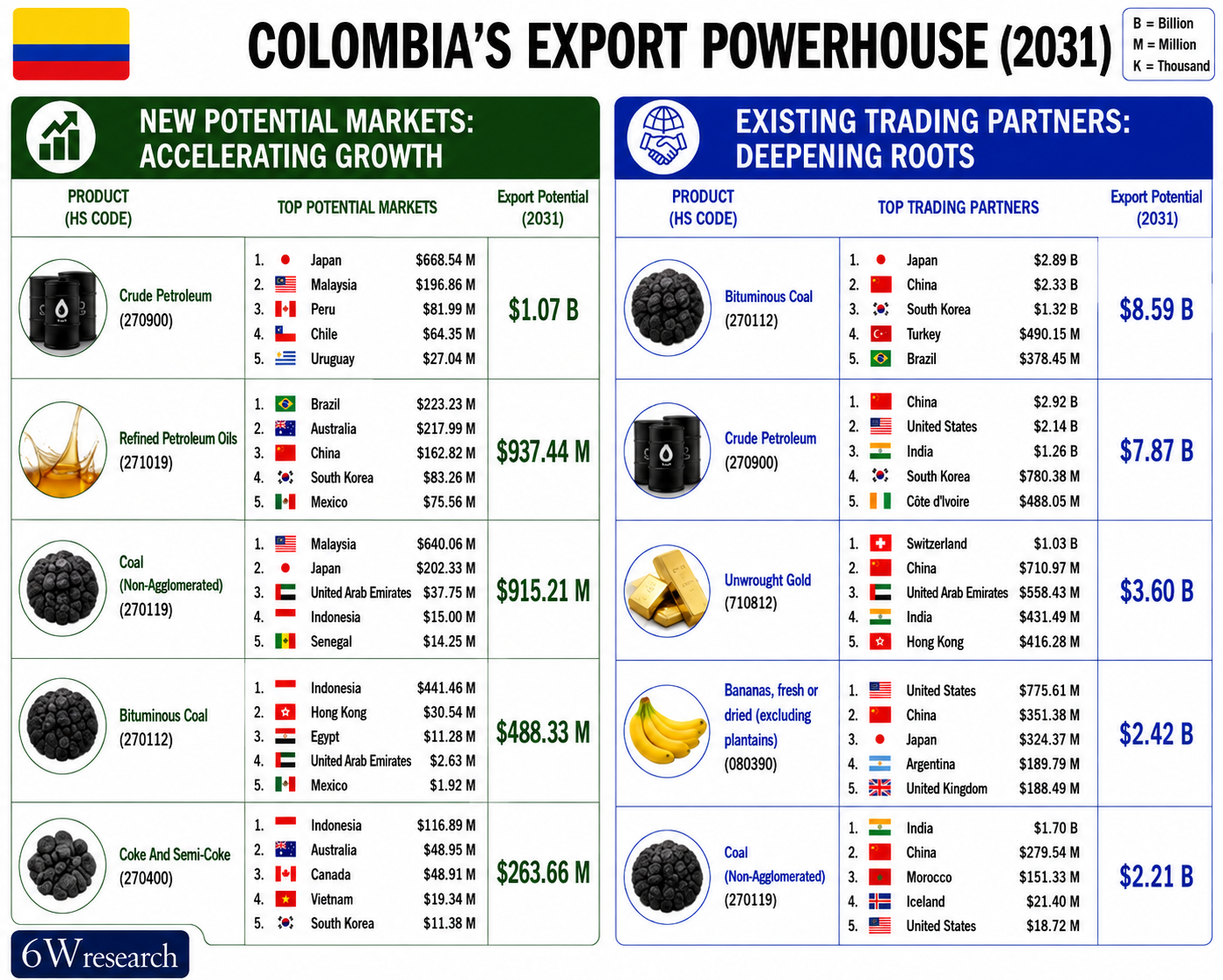
Crude petroleum stands out as Colombia's biggest new-corridor opportunity at USD 1.07 billion, led by Japan at USD 669 million, with Malaysia (USD 197 million), Peru (USD 82 million), Chile (USD 64 million) and Uruguay (USD 27 million) rounding things out. Japan's position here isn't surprising — it still depends heavily on imported crude given its limited domestic production, and it's actively working to diversify away from traditional suppliers. Malaysia's opportunity ties back to its role as a regional refining hub that needs imported crude grades, while the neighboring Latin American markets give Colombia extra room to grow regional energy trade beyond its usual buyers.
Refined petroleum oils add another USD 937 million, and non-agglomerated coal contributes USD 915 million. On refined petroleum, Brazil leads at USD 223 million, followed by Australia (USD 218 million) and China (USD 163 million) — driven by regional fuel demand, industrial users and refining needs. Non-agglomerated coal is mostly a Malaysia story at USD 640.06 million, with Japan adding USD 202.33 million, both reflecting how much Southeast and East Asian markets still lean on coal for power and industry. These corridors let Colombia build on what it already does well in energy exports while pushing into new destinations.
Bituminous coal and coke & semi-coke bring in USD 488 million and USD 264 million respectively as new-corridor opportunities. Indonesia dominates the bituminous coal opportunity at USD 441 million — most of it, really — thanks to the country's heavy energy and industrial demand, where Colombian coal offers a real diversification and quality edge. Coke and semi-coke opportunities are spread more evenly, with Indonesia at USD 116.89 million, Australia at USD 48.95 million and Canada at USD 48.91 million, mostly tied to steel production and metallurgical use. Taken together, these open up real potential for Colombia across global energy and industrial supply chains, especially in Asia-Pacific.
Colombia’s Established Export Base Is Anchored by Energy and Mineral Commodities, with Key Markets Driving Coal, Petroleum, Gold, and Agricultural Trade
Bituminous coal is Colombia's single largest established export opportunity at USD 8.59 billion, led by Japan (USD 2.89 billion), China (USD 2.33 billion) and South Korea (USD 1.32 billion) — these three alone accounts for a big chunk of Colombia's coal export base, driven by steady demand from power generation and industry. Turkey and Brazil add further established opportunity, showing Colombia can serve a genuinely diverse set of energy and industrial markets.
Crude petroleum and unwrought gold round out the established export strengths. Crude petroleum comes in at USD 7.87 billion, led by China (USD 2.92 billion), the United States (USD 2.14 billion) and India (USD 1.26 billion) — a good spread across major refining hubs and energy-hungry economies. Unwrought gold contributes USD 3.60 billion, led by Switzerland (USD 1.03 billion), followed by China (USD 711 million), the UAE (USD 558 million), India (USD 431 million) and Hong Kong (USD 416 million) — all pointing to Colombia's role feeding into global refining, bullion trading and precious-metal markets.
Non-agglomerated coal and bananas add USD 2.21 billion and USD 2.42 billion respectively. India is the largest non-agglomerated coal opportunity at USD 1.70 billion, driven by thermal power and industrial use, with demand from China, Morocco and Iceland. On bananas, the US leads at USD 776 million, followed by China (USD 351 million) and Japan (USD 324 million) — reflecting steady consumer demand and Colombia's well-established fresh-produce supply chains. Altogether, these sectors show just how much Colombia's export base still leans on energy, mining and agriculture, even as it holds strong global market connections across all three.
|
Colombia’s export opportunity is a story of market expansion, not product reinvention. 6WExportGTM data highlights that the country’s USD 10.03 billion new-corridor opportunity is concentrated in the same commodity strengths that already define its export base, particularly crude petroleum and coal. The strategic opportunity lies in identifying underpenetrated buyers across Asia-Pacific and emerging markets while reducing dependence on a limited number of established destinations. 6WExportGTM Analysis |
Top Global Export Opportunities (2031), By Product
| Product | Export Opportunity (USD Billion) |
| Electronic Integrated Circuits | 685.7 |
| Refined Petroleum Oils | 668.4 |
| Light Petroleum Oils | 588.9 |
| Logic Electronic Integrated Circuits | 507.9 |
| Medicines | 381.2 |
| Gasoline Passenger Cars (1.5–3.0L) | 360.9 |
| Smartphones | 343.6 |
| Electronic Integrated Circuits with Memory | 333.2 |
| Data Transmission Equipment | 216.9 |
| Immunological Products | 209.6 |
Excludes naturally occurring products (e.g., crude oil, raw gold). Source: 6WExportGTM
Global trade patterns through 2031 point to a growing shift toward technology-heavy, energy-related, healthcare and advanced manufacturing products — and that opens up a real diversification path for Colombia beyond its traditional commodity base. Right now, Colombia's exports still lean heavily on crude petroleum, coal, gold and agricultural products, but pushing into value-added segments like refined energy products, electronics supply chains, pharmaceuticals and data-driven tech could meaningfully strengthen its position in global trade. Given its natural resource base, strategic location, industrial capabilities and access to major markets, Colombia is well positioned to build out downstream processing and get more actively involved in emerging global value chains — reducing reliance on raw commodities while capturing more of the higher-value opportunity.
Two Developments Shaping Colombia’s Export Base: A Coal Policy Reversal and a New US Tariff Threat
Two developments are shaping Colombia's export outlook right now. On the domestic side, policy changes under the new administration look set to reshape the direction of the mining and fossil fuel sectors. On the external side, shifting trade measures in major markets could affect how easily Colombia can reach some of its key buyers. Together, these capture both the opportunity and the risk sitting in front of Colombia's export growth.
A New Pro-Mining Government Reverses Course on Colombia’s USD 12.21 Billion Coal Base
Colombia’s energy policy direction shifted in 2026 as the new administration moved toward a more supportive framework for fossil fuel industries, emphasizing energy security, investment stability, and regulatory predictability. The policy transition is particularly relevant for the coal sector, which represents USD 9.08 billion in bituminous coal export potential and USD 3.13 billion in non-agglomerated coal export potential. The government’s focus on strengthening Ecopetrol and restoring investor confidence is expected to improve certainty for producers and global buyers. The reopening of thermal coal trade relationships, including exports to Israel, further reflects renewed support for the sector, which generated approximately USD 1.09 billion in royalties in 2025, accounting for nearly 80% of mining royalties. For key markets such as Japan and South Korea, which together represent potential of around USD 4.2 billion in established coal demand, the policy shift could enhance Colombia’s competitiveness against major suppliers including Australia and Indonesia.
|
Colombia's coal sector is a good example of how policy stability can affect export competitiveness. With USD 12.21 billion in combined bituminous and non-agglomerated coal potential on the table, keeping mining regulations predictable and strengthening long-term buyer relationships will matter a lot going forward. This more supportive policy environment — and the reopening of coal trade channels that's come with it — gives Colombia a real opportunity to shore up its position against competing suppliers in the global energy market. Manish Pant, Senior Data Scientist, Data Science & Market Intelligence, 6Wresearch |
A Proposed US Forced-Labor Tariff Threatens Colombia’s Top Trading Relationship
Colombia's trade relationship with the US faces potential pressure, with a proposed tariff tied to forced-labor supply-chain concerns. In June 2026, the US Trade Representative rolled out a two-tier tariff proposal that could push Colombia into a higher-risk category — potentially stacking a 12.5% duty on top of the existing 10% reciprocal tariff that's been in place since April 2025. That's a real concern given the US represents USD 12.49 billion, or 26.15%, of Colombia's established export potential, including USD 2.14 billion just in crude petroleum. This isn't coming out of nowhere either — it follows the 2025 dispute over deportation flights — though it's worth noting that total US-Colombia goods trade still hit roughly USD 37.2 billion in 2025. If this extra tariff burden goes through, it could hurt the competitiveness of Colombian crude oil, gold and agricultural exports, and likely push exporters to speed up their pivot toward Asia and other emerging markets. On the flip side, higher import costs could also nudge US buyers and refiners to rethink where they're sourcing Colombian commodities from.
|
The United States remains Colombia’s most important established market, accounting for USD 12.49 billion of export potential, but proposed tariff measures highlight the risks of buyer concentration. Colombia’s exporters must accelerate diversification toward markets such as Japan, China, Malaysia, and Indonesia, where emerging opportunities can provide greater resilience while maintaining strong existing trade relationships. Manisha Gupta, Data Analyst, Data Science & Market Intelligence, 6Wresearch |
The Takeaway
Colombia's export base is deep, but it's also concentrated — extractive commodities make up the bulk of its established export potential, and the new-corridor opportunities aren't all that different, still anchored mostly in coal and crude-related categories. So, the real strategic priority for Colombia isn't finding brand-new export categories — it's strengthening market access, growing the buyer network, and building resilience across the pillars it already has, especially as a more pro-mining domestic stance and ongoing US tariff uncertainty start reshaping the trade landscape.
Key strategic priorities for Colombia include:
- Colombia's export strength is still concentrated in established sectors — coal, crude petroleum, gold and agricultural products remain the backbone of its global trade position. The real task here isn't discovering new categories, it's getting more competitive within the ones that already work.
- New-corridor opportunities are mostly an extension of Colombia's existing commodity strengths into new markets, particularly across Asia-Pacific, where energy and industrial demand can help diversify the buyer base beyond a small group of established partners.
- Policy shifts and external trade risk will both shape where Colombia's exports go from here — a friendlier mining environment opens doors for coal and energy, while tariff risk in key markets makes the case for diversifying buyers even stronger.
- Long-term resilience really comes down to balancing resource exports with real value addition — downstream processing, stronger buyer relationships, and a bigger foothold in higher-value segments to build a genuinely more diversified export base.
Ultimately, Colombia’s 2031 export outlook will be decided less by new markets than by how well the country defends the concentrated buyer relationships in coal, crude and gold that already generate the bulk of its export value.

Leadership Perspectives from Industry Events
Search
6Wresearch in the News
 Forbes
Citing 6Wresearch analytics to map global infrastructure and pharmaceutical industry trajectories.
 Bloomberg Law
Direct syndication of 6Wresearch's macro data points, capturing complex supply chain shifts.
 Reuters
Tracking industrial manufacturing adjustments and electronic security ecosystem scaling.
 Mint
Mint
Utilizing deep-tech sector market sizing to analyze global automation and robotics.
 The Economic Times
Anchoring features on industrial IoT growth metrics and connected smart-grid devices.
 Business Standard
Featuring strategic evaluations of Advanced Driver Assistance Systems (ADAS) and AI road safety.
 The Hindu
Spotlighting core commercial metrics ranging from unmanned aerial vehicles (UAVs) to consumer durables.
 Financial Express
Anchoring quarterly reviews on cross-border real estate tech and structural hardware manufacturing.
 Yahoo Finance
Syndicating the tracker's $30.1 billion untapped-market findings, spotlighting Japan, the US and China as India's top new-potential importers.
 India Today
Carrying the release on smartphones leading India's export potential to $94 billion by 2031, per 6WExportGTM data.
 Dailyhunt
Distributing the tracker findings to its regional readership, framing India's export diversification into Japan and Mexico.
 PR Newswire Original release
Publishing the full India Export Attractiveness Tracker 2026, detailing new trade corridors across iron ore, LCVs and pharmaceuticals.
 The Industrial
Highlighting the tracker's read on India's semiconductor ambitions and long-term chip-assembly export potential.
 PTI News
Reporting on the $66.81 billion pharmaceuticals export opportunity flagged in the tracker, amid looming US generic-drug tariffs.
 Tribune India
Covering the tracker's tariff-versus-regulation analysis across India's mature export markets in the US, China and UAE.
 ANI News
Amplifying the report's findings on polished diamonds, refined petroleum and medicines as India's core export engines.
 International Business Magazine
Covering the report's insight into how AEB, blind spot detection, and driver monitoring are reshaping India's ADAS market.
 Focus Gaming News
Highlighting the research forecast for Egypt's gambling market, projecting steady growth through 2032.
Thought Leadership and Analyst Meet





Our Clients








Latest Reports
- Namibia Financial Asset Management Market (2026-2032)
- Mozambique Financial Asset Management Market (2026-2032)
- Montenegro Financial Asset Management Market (2026-2032)
- Mongolia Financial Asset Management Market (2026-2032)
- Monaco Financial Asset Management Market (2026-2032)
- Micronesia Financial Asset Management Market (2026-2032)
- Mauritius Financial Asset Management Market (2026-2032)
- Mauritania Financial Asset Management Market (2026-2032)
- Marshall Islands Financial Asset Management Market (2026-2032)
- Malta Financial Asset Management Market (2026-2032)
Industry Events and Analyst Meet

EV India Expo 2026

HIMTEX 2026

India Refining Summit 2026

India EV Show 2026

EV tech India Expo 2026
Whitepaper
- Middle East & Africa Commercial Security Market Click here to view more.
- Middle East & Africa Fire Safety Systems & Equipment Market Click here to view more.
- GCC Drone Market Click here to view more.
- Middle East Lighting Fixture Market Click here to view more.
- GCC Physical & Perimeter Security Market Click here to view more.


