Kazakhstan's Crude Petroleum Exports to Existing Partners Could Reach USD 51.84 Billion, While Refined Petroleum Oils Open USD 0.82 Billion Across New Markets by 2031
Kazakhstan’s future export potential is expected to remain concentrated among major global markets, with China accounting for 37.21% of the main category opportunity, followed by the United States at 15.97%, India at 10.98%, Japan at 10.89%, and South Korea at 7.20%. In emerging corridors, China and the US together represent nearly 39% of additional opportunities, highlighting strong diversification potential.
 Source: 6WExportGTM
China Leads Kazakhstan's Established Base by a Wide Margin, With a Closer Race for New Potential Markets
Kazakhstan's emerging export opportunities are concentrated across Asia and a few key global markets, with China coming out on top —valued at USD 1.45 billion. The United States trails closely at USD 1.26 billion, pointing to solid potential for Kazakhstan to grow beyond its traditional regional trade routes. Kazakhstan export opportunities also extend to Hong Kong which adds another USD 0.62 billion, largely due to its standing as a global trading and financial hub, while Malaysia and India bring in USD 0.56 billion and USD 0.42 billion respectively — both reflecting real momentum across Southeast and South Asia. Put together, these markets offer Kazakhstan's exporters a genuine diversification path, one that could reduce dependence on existing partners and open up access to higher-value international corridors.
| Top 5 Existing Importers | Export Potential (USD Billion) | Top 5 New Potential Importers | Export Potential (USD Billion) |
| China | 30.52 | China | 1.45 |
| United States | 13.10 | United States | 1.26 |
| India | 9.00 | Hong Kong | 0.62 |
| Japan | 8.93 | Malaysia | 0.56 |
| South Korea | 5.90 | India | 0.42 |
Source: 6WExportGTM
Chromium, Gold and Copper Add Depth to Kazakhstan's Crude Oil Anchored Established Trade
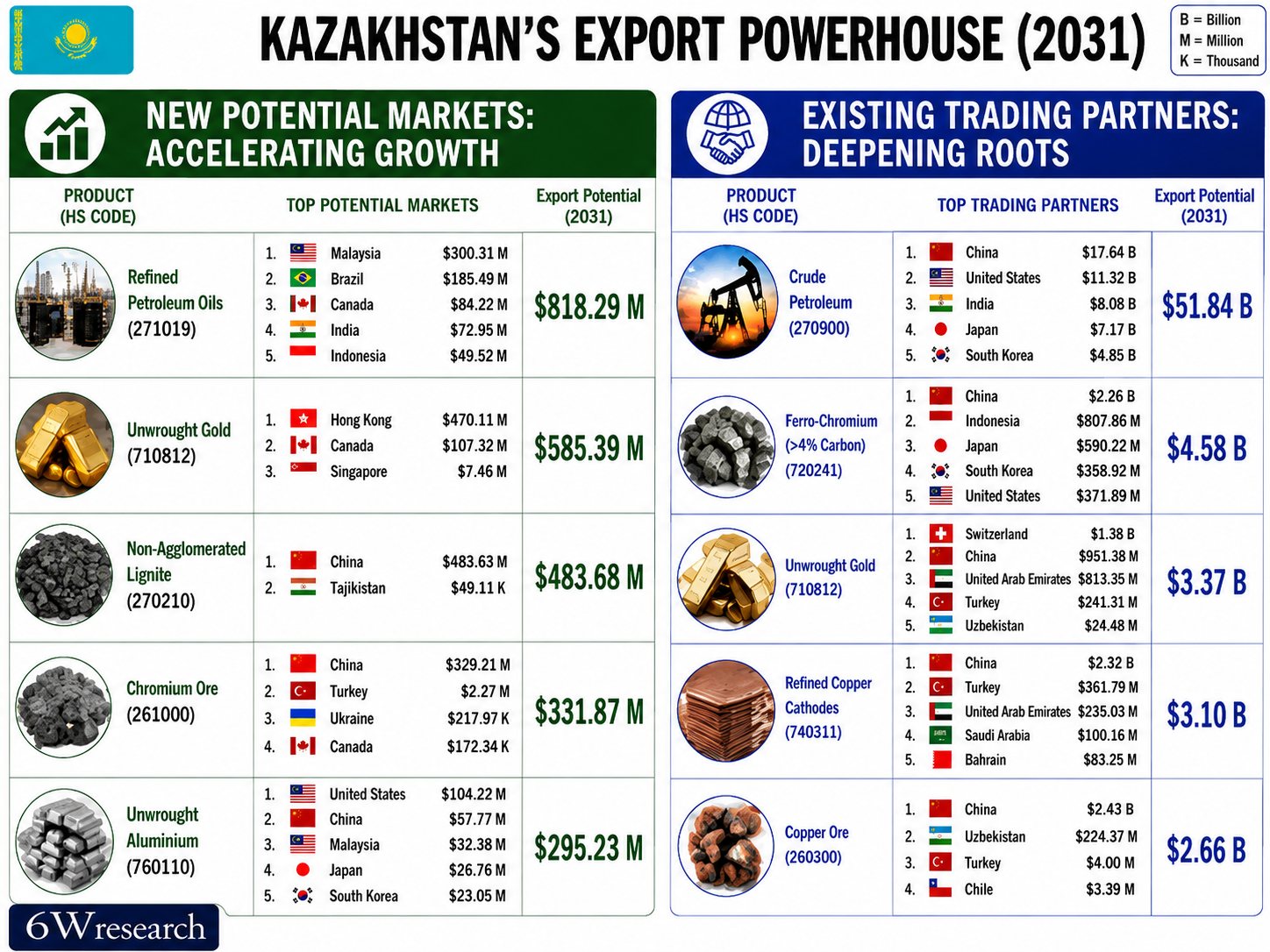
Crude petroleum represents Kazakhstan's largest established export opportunity at USD 51.84 billion, led by China at USD 17.64 billion, the United States at USD 11.32 billion and India at USD 8.08 billion. China's leading position reflects its status as the world's largest crude importer and refiner, while the United States and India's substantial volumes reflect the global reach of Kazakhstan's Caspian Pipeline Consortium exports, which move crude from the Tengiz and Kashagan fields to the Black Sea for onward shipment worldwide, with Japan (USD 7.17 billion) and South Korea (USD 4.85 billion) absorbing further volumes for their own refining industries.
Ferrochromium and unwrought gold add a further USD 4.58 billion and USD 3.37 billion. Ferrochromium is led by China at USD 2.26 billion, Indonesia at USD 0.81 billion and Japan at USD 0.59 billion, reflecting China's enormous stainless-steel production capacity alongside Indonesia's fast-growing nickel and stainless-steel industry emerging as a genuine second buyer. Unwrought gold is led by Switzerland at USD 1.33 billion, China at USD 0.95 billion and the UAE at USD 0.81 billion, reflecting Switzerland's role as the world's dominant gold-refining hub alongside China and the UAE's positions as major consumer and bullion-trading markets respectively.
Refined copper cathodes and copper ore round out the established top five, contributing USD 3.10 billion and USD 2.66 billion. Refined copper cathodes are led by China at USD 2.32 billion, Turkey at USD 0.36 billion and the UAE at USD 0.24 billion, reflecting China's enormous refined-copper demand for electronics and construction. Copper ore is led even more heavily by China at USD 2.43 billion, with Uzbekistan a distant second at USD 0.22 billion, mirroring the refined-copper pattern with China's smelting capacity absorbing the large majority of raw ore. Collectively, these five categories confirm that Kazakhstan's established export advantage rests overwhelmingly on China as the anchor buyer across oil, metals and minerals alike, with crude petroleum standing out as the one category with genuine diversification beyond China through the United States, India, Japan and South Korea.
A More Geographically Varied Set of Buyers Emerges Across Kazakhstan's New Potential Markets
Refined petroleum oils represent Kazakhstan's largest new-corridor opportunity at USD 0.82 billion, led by Malaysia at USD 0.30 billion, Brazil at USD 0.19 billion and Canada at USD 0.08 billion. This spread of buyers reflects genuinely new refined-fuel trading relationships in Southeast Asia and Latin America, regions with limited historical exposure to Kazakh petroleum products, more consistent with fuel-trading and re-export dynamics than long-term supply contracts.
Unwrought gold and non-agglomerated lignite add a further USD 0.59 billion and USD 0.48 billion. Gold is led by Hong Kong at USD 0.47 billion and Canada at USD 0.11 billion, giving Kazakhstan a second gold-trading channel through Hong Kong's bullion-trading infrastructure alongside its established Switzerland relationship. Lignite (non-agglomerated) is sold almost entirely to China at USD 0.48 billion, reflecting China's vast coal-fired power and industrial-heating demand absorbing lower-grade coal that established Western markets have limited appetite for.
Chromium ore and unwrought aluminum round out the new-corridor’s top five, contributing USD 0.33 billion and USD 0.30 billion. Chromium ore is sold almost entirely to China at USD 0.33 billion, mirroring the established ferrochromium pattern, with China's stainless-steel industry seeking raw ore directly as an alternative feedstock to processed ferrochromium. Unwrought aluminum is led by the United States at USD 0.10 billion, China at USD 0.06 billion and Malaysia at USD 0.03 billion, a genuinely new and more geographically diverse set of buyers than Kazakhstan's traditional regional aluminum trade. Across all five categories, Kazakhstan's new-corridor opportunity looks like a mix of genuinely new buyer relationships Malaysia, Brazil, Canada, Hong Kong and the United States layered onto largely the same resource base of petroleum, gold, chromium and aluminum that defines established trade, with China remaining a recurring, if not always dominant, presence across both.
|
Kazakhstan's export base is a story of concentrated dependence on China across nearly every major category oil, ferrochromium, gold and copper alike. What's notable about the new-corridor opportunity is how much more geographically varied it looks: Malaysia, Brazil, Hong Kong and the United States all appear as genuinely new buyers, even as China still shows up in several categories. 6WExportGTM Analysis |
Top Global Export Opportunities (2031), By Product
| Product | Export Opportunity (USD Billion) |
| Electronic Integrated Circuits | 685.7 |
| Refined Petroleum Oils | 668.4 |
| Light Petroleum Oils | 588.9 |
| Logic Electronic Integrated Circuits | 507.9 |
| Medicines | 381.2 |
| Gasoline Passenger Cars (1.5–3.0L) | 360.9 |
| Smartphones | 343.6 |
| Electronic Integrated Circuits with Memory | 333.2 |
| Data Transmission Equipment | 216.9 |
| Immunological Products | 209.6 |
Excludes naturally occurring products (e.g., crude oil, raw gold). Source: 6WExportGTM
The global export landscape through 2031 is expected to be driven by high-value technology, energy, healthcare, and mobility products, creating potential diversification avenues for Kazakhstan beyond its traditional commodity exports. While Kazakhstan’s current strengths remain concentrated in crude petroleum, uranium, and metals, rising global demand for electronic components, refined energy products, advanced medicines, automotive products, and data transmission equipment highlights opportunities to move toward higher-value export segments. Leveraging its abundant energy resources, mineral reserves, and strategic location between major markets, Kazakhstan can strengthen participation in global supply chains by developing downstream processing capabilities, particularly in refined metals, energy-related products, and technology-enabled industries. This transition could help Kazakhstan capture emerging opportunities while reducing dependence on raw commodity exports.
What Kazakhstan Already Sells and Where
Oil & Gas is the dominant sector in Kazakhstan’s current exports, valued at USD 45.56 billion. Crude petroleum makes up 94.12% of that and liquefied petroleum gas contributes another 3.12% – a clear reflection of the country’s status as a major global energy supplier. Metallic ores contributed USD 4.91 billion, of which the bulk was contributed by copper ore (64.34%) and agglomerated iron ore concentrates (8.78%), indicating the substantial size of Kazakhstan's mineral base. The Nuclear Equipment sector also contributes USD 4.91 billion, largely on the back of natural uranium and uranium compounds (92.49%) plus nuclear reactor components (7.24%). Together, these three sectors form the real backbone of Kazakhstan's export portfolio, underlining just how central energy, mining and nuclear resources are to its trade position globally.
| Sector | Exports (USD Billion) | Leading Products / Share |
| Oil & Gas | 45.56 | Crude Petroleum (94.12%), Liquefied Petroleum Gas (3.12%) |
| Metallic Ores | 4.91 | Copper Ore (64.34%), Iron Ore Concentrates, Agglomerated (8.78%) |
| Nuclear Equipment | 4.91 | Natural Uranium & Uranium Compounds (92.49%), Nuclear Reactor Components (7.24%) |
Source: UN Comtrade
Kazakhstan’s current export portfolio is anchored by strong energy and mineral trade relationships, with Italy emerging as the largest export destination with USD 18.66 billion, primarily driven by crude petroleum, which accounts for 98.32% of exports to the market, along with a smaller contribution from unwrought aluminum. The second largest destination is China, with USD 14.90 billion, driven by large exports of copper ore (19.31%) and refined copper cathodes (16.67%), highlighting Kazakhstan’s role in global mineral supply chains. Russia accounts for USD 9.55 billion in exports, led by natural uranium and uranium compounds (18.99%) and aluminum oxide, calcined (3.83%). These markets demonstrate Kazakhstan’s established position as a major supplier of energy, metals, and mineral resources globally.
| Country | Exports (USD Billion) | Leading Products / Share |
| Italy | 18.66 | Crude Petroleum (98.32%), Unwrought Aluminum (0.37%) |
| China | 14.90 | Copper Ore (19.31%), Refined Copper Cathodes (16.67%) |
| Russia | 9.55 | Natural Uranium & Uranium Compounds (18.99%), Aluminum Oxide, Calcined (3.83%) |
Source: UN Comtrade
A Pipeline Under Attack and a Uranium Sector in the Middle: Two Developments Shaping Kazakhstan's Export Base
Two developments are really shaping Kazakhstan's export outlook right now. First, repeated drone attacks on the Caspian Pipeline Consortium (CPC) infrastructure through 2025 and 2026 have raised serious concerns about the security of a route that handles most of Kazakhstan's crude oil shipments. Second, Kazakhstan's uranium sector is navigating a tricky geopolitical balancing act — juggling strong demand from Russia, China and Western markets while still holding its position as a key global supplier of nuclear fuel. Together, these two threads capture both the real vulnerabilities and the strategic opportunities sitting within Kazakhstan's energy and mineral export landscape.
Repeated Drone Strikes on the Caspian Pipeline Consortium Have Disrupted Kazakhstan's Main Oil Export Route Throughout 2025-2026
The Caspian Pipeline Consortium carries more than 80% of Kazakhstan's oil exports — moving crude from the Tengiz and Kashagan fields to the Black Sea port of Novorossiysk — and it's faced repeated drone strikes ever since Ukraine's first attack on the pipeline's Kropotkinskaya pumping station back in February 2025. Things escalated through late 2025 and into 2026: a November 2025 strike knocked out two of the pipeline's three offshore loading berths, and a fresh wave of tanker attacks in July and August 2026 repeatedly halted Black Sea loadings altogether, cutting monthly export volumes by as much as 20 to 40% during the worst stretches of disruption. Analysts have estimated potential financial damage of at least USD 1.5 billion from a single month of reduced exports, and Kazakhstan has responded by rerouting limited volumes through the Baku-Tbilisi-Ceyhan pipeline, the Atasu-Alashankou pipeline to China and the Atyrau-Samara pipeline to Russia, though none can match CPC's scale. For an established crude petroleum export opportunity worth USD 51.84 billion, and an Italy relationship worth USD 18.66 billion built almost entirely on crude moving through this exact route, continued disruption to the CPC represents the single largest risk to Kazakhstan's export outlook through 2031.
|
The CPC attacks show just how concentrated Kazakhstan's oil-export infrastructure really is: more than eighty percent of the country's crude moves through one pipeline system, and repeated strikes on it in 2025 and 2026 have already cost Kazakhstan billions in lost revenue. Diversification routes exist on paper, but none come close to matching CPC's capacity, which is exactly why this remains the central risk to watch through 2031. Manish Pant, Senior Data Scientist, Data Science & Market Intelligence, 6Wresearch |
Kazakhstan's Uranium Sector Is Increasingly Caught Between Russian, Chinese and Western Demand
Kazakhstan, which produces roughly 38 to 40% of the world's mined uranium, occupies an increasingly delicate position between three major buyers. Russia's Rosatom continues to hold joint-venture stakes in several Kazakh uranium deposits and has historically handled much of the enrichment and conversion of Kazakh uranium, even as Rosatom has sold some stakes to Chinese state-owned firms since 2024 to reduce its exposure to Western sanctions. At the same time, Kazatomprom has been actively courting Western utilities, signing new supply agreements with Switzerland's Axpo, the Czech Republic's CEZ Group and Japan's Kansai Electric Power in 2025 and working to finalize a long-term supply deal with India, as Western buyers seek alternatives following a US ban on Russian uranium imports. Kazatomprom's decision to cut 2026 production by roughly 10%, partly due to a persistent sulfuric acid shortage, has tightened global supply further and pushed long-term contract prices to a fourteen-year high of USD 90 per pound. For current export of natural uranium and uranium compounds trade worth USD 4.54 billion, with Russia alone absorbing USD 1.81 billion of Kazakhstan's current uranium and related nuclear exports, how this three-way balance between Russia, China and Western buyers evolves will shape one of Kazakhstan's most strategically significant export categories through 2031.
|
Kazakhstan's uranium sector is a genuine geopolitical balancing act: Russia still holds processing and joint-venture ties, China has been buying up stakes divested for sanctions reasons, and Western utilities are signing new long-term contracts to reduce their own reliance on Russian material. Kazakhstan doesn't have to choose a side, which is precisely what makes it such a valuable supplier to all three. Manisha Gupta, Data Analyst, Data Science & Market Intelligence, 6Wresearch |
The Takeaway
Kazakhstan should treat its export outlook through 2031 as one of protecting concentrated infrastructure and managing strategic positioning rather than straightforward volume growth, since its two most consequential export categories crude oil and uranium each face a different kind of external pressure: physical disruption to pipeline infrastructure in one case, and a genuine multi-power balancing act in the other. The path forward depends on accelerating oil-export route diversification while carefully managing uranium supply commitments across Russian, Chinese and Western buyers.
Key strategic priorities for Kazakhstan include:
- Accelerate oil-export route diversification beyond the CPC: With more than 80% of Kazakhstan's USD 51.84 billion crude petroleum export potential dependent on a single pipeline system that has faced repeated attacks throughout 2025 and 2026, Kazakhstan should continue investing in the Trans-Caspian route, the Baku-Tbilisi-Ceyhan pipeline and Aktau port capacity, even though none can fully replace CPC's scale in the near term.
- Manage uranium supply commitments across all three major buyer blocs deliberately: With Russia absorbing USD 1.81 billion of current uranium exports even as Western utilities sign new long-term contracts and China acquires divested Russian stakes, Kazakhstan should continue building out its own conversion and enrichment capacity to reduce dependence on any single processing partner.
- Build on the ferrochromium and copper relationship with China while diversifying downstream buyers: China absorbs the large majority of Kazakhstan's established ferrochromium (USD 2.26 billion), refined copper cathode (USD 2.32 billion) and copper ore (USD 2.43 billion) exports. Kazakhstan should use its new-corridor chromium ore relationship with China alongside emerging Indonesian ferrochromium demand to avoid overreliance on a single buyer for its non-oil metals trade.
- Convert new-corridor gold and refined-fuel relationships into durable trade: Hong Kong's emerging USD 0.47 billion gold-trading relationship and Malaysia's USD 0.30 billion refined-petroleum-oils relationship represent genuinely new buyer relationships. Kazakhstan should formalize these through direct trading agreements to convert early volumes into durable long-term contracts.
Overall, Kazakhstan's export growth through 2031 will depend less on discovering new products to sell and more on how well the country protects its existing oil-export infrastructure and navigates a genuinely complex, three-way uranium relationship a reminder that for a resource-concentrated economy positioned between Russia, China and the West, geopolitics now shapes the export outlook as much as global commodity demand.

Leadership Perspectives from Industry Events
Search
6Wresearch in the News
 Forbes
Citing 6Wresearch analytics to map global infrastructure and pharmaceutical industry trajectories.
 Bloomberg Law
Direct syndication of 6Wresearch's macro data points, capturing complex supply chain shifts.
 Reuters
Tracking industrial manufacturing adjustments and electronic security ecosystem scaling.
 Mint
Mint
Utilizing deep-tech sector market sizing to analyze global automation and robotics.
 The Economic Times
Anchoring features on industrial IoT growth metrics and connected smart-grid devices.
 Business Standard
Featuring strategic evaluations of Advanced Driver Assistance Systems (ADAS) and AI road safety.
 The Hindu
Spotlighting core commercial metrics ranging from unmanned aerial vehicles (UAVs) to consumer durables.
 Financial Express
Anchoring quarterly reviews on cross-border real estate tech and structural hardware manufacturing.
 Yahoo Finance
Syndicating the tracker's $30.1 billion untapped-market findings, spotlighting Japan, the US and China as India's top new-potential importers.
 India Today
Carrying the release on smartphones leading India's export potential to $94 billion by 2031, per 6WExportGTM data.
 Dailyhunt
Distributing the tracker findings to its regional readership, framing India's export diversification into Japan and Mexico.
 PR Newswire Original release
Publishing the full India Export Attractiveness Tracker 2026, detailing new trade corridors across iron ore, LCVs and pharmaceuticals.
 The Industrial
Highlighting the tracker's read on India's semiconductor ambitions and long-term chip-assembly export potential.
 PTI News
Reporting on the $66.81 billion pharmaceuticals export opportunity flagged in the tracker, amid looming US generic-drug tariffs.
 Tribune India
Covering the tracker's tariff-versus-regulation analysis across India's mature export markets in the US, China and UAE.
 ANI News
Amplifying the report's findings on polished diamonds, refined petroleum and medicines as India's core export engines.
 International Business Magazine
Covering the report's insight into how AEB, blind spot detection, and driver monitoring are reshaping India's ADAS market.
 Focus Gaming News
Highlighting the research forecast for Egypt's gambling market, projecting steady growth through 2032.
Thought Leadership and Analyst Meet





Our Clients








Latest Reports
- Namibia Financial Asset Management Market (2026-2032)
- Mozambique Financial Asset Management Market (2026-2032)
- Montenegro Financial Asset Management Market (2026-2032)
- Mongolia Financial Asset Management Market (2026-2032)
- Monaco Financial Asset Management Market (2026-2032)
- Micronesia Financial Asset Management Market (2026-2032)
- Mauritius Financial Asset Management Market (2026-2032)
- Mauritania Financial Asset Management Market (2026-2032)
- Marshall Islands Financial Asset Management Market (2026-2032)
- Malta Financial Asset Management Market (2026-2032)
Industry Events and Analyst Meet

EV India Expo 2026

HIMTEX 2026

India Refining Summit 2026

India EV Show 2026

EV tech India Expo 2026
Whitepaper
- Middle East & Africa Commercial Security Market Click here to view more.
- Middle East & Africa Fire Safety Systems & Equipment Market Click here to view more.
- GCC Drone Market Click here to view more.
- Middle East Lighting Fixture Market Click here to view more.
- GCC Physical & Perimeter Security Market Click here to view more.


