Bhutan’s Dolomite Exports to Existing Partners Could Reach USD 168.41 Million, While Ferro Silicon Opens USD 278.82 Million Across New Markets by 2031.
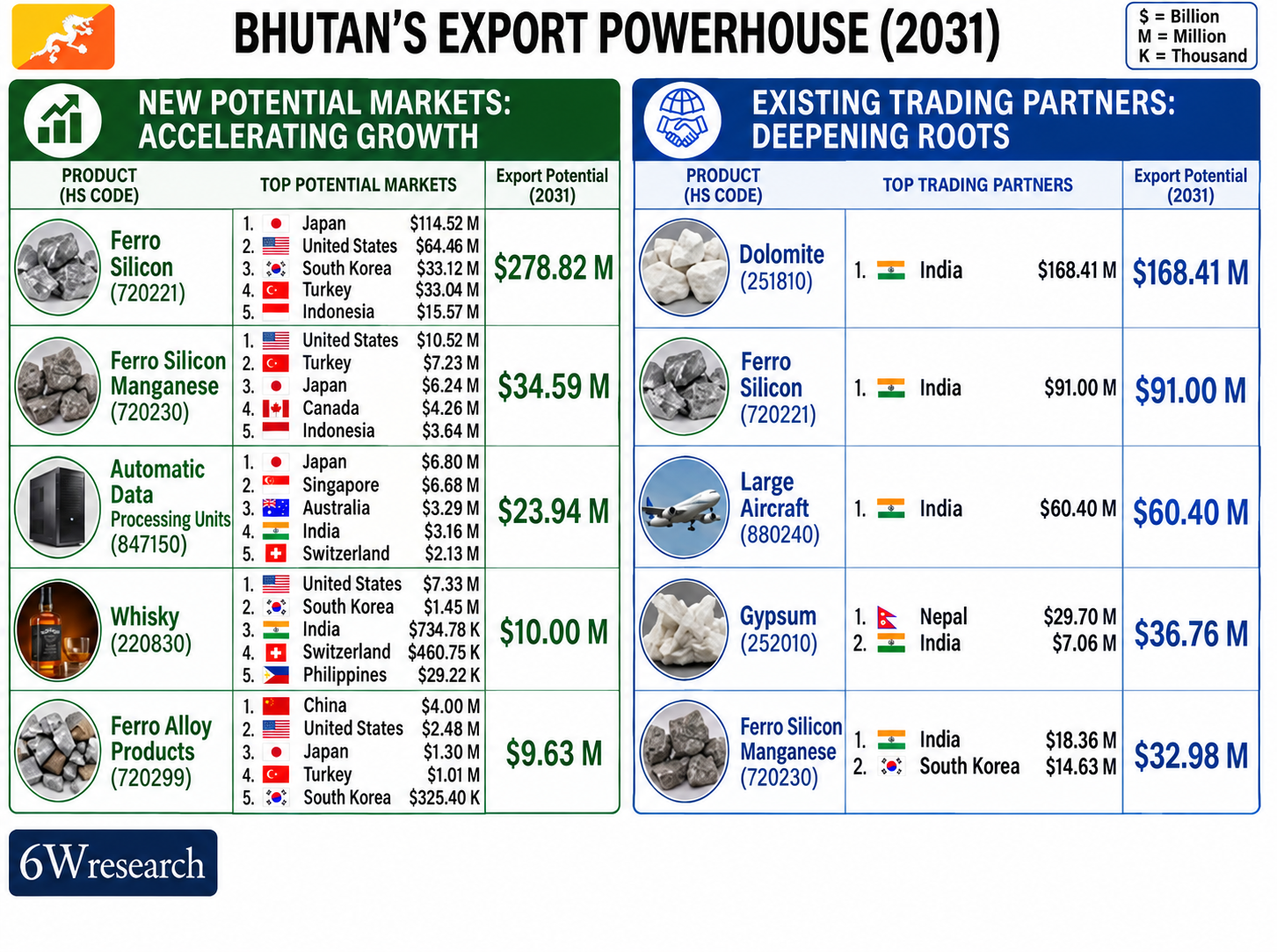
Dolomite leads Bhutan’s established export base, though India alone accounts for over 85% of all established demand and takes 100% of the country’s top three products outright. While new market opportunity looks very different: ferro silicon alone represents over two-thirds of new-corridor value, led by Japan at just over 32%, with the United States, South Korea and Turkey each capturing meaningful double-digit shares a far more distributed buyer base than Bhutan’s established trade.
 Source: 6WExportGTM
Japan Leads Bhutan’s New-Corridor Demand While India Commands the Established Base
Bhutan’s export opportunities show strong potential across a diversified set of global markets, led by Japan with an export opportunity of USD 0.13 billion, followed by the United States at USD 0.10 billion. South Korea and Turkey represent additional growth markets with USD 0.04 billion each, supported by demand for ferroalloy inputs from major steel-producing economies, while Indonesia offers a smaller but emerging opportunity at USD 0.02 billion. These markets highlight Bhutan’s potential to expand beyond traditional regional trade through hydropower-based ferroalloy exports and other value- added products.
| Top 5 Existing Importers | Export Potential (USD Billion) | Top 5 New Potential Importers | Export Potential (USD Billion) |
| India | 0.39 | Japan | 0.13 |
| Nepal | 0.03 | United States | 0.10 |
| Japan | 0.01 | South Korea | 0.04 |
| South Korea | 0.01 | Turkey | 0.04 |
| United States | 0.01 | Indonesia | 0.02 |
Source: 6WExportGTM
Bhutan’s export base is strongly rooted in regional markets, with India accounting for the largest share of export potential at USD 0.39 billion, indicating strong trade ties and geographic proximity. Next is Nepal with USD 0.03 billion due to demand for mineral based products including gypsum and other products. Established Asian markets including Japan and South Korea, along with the United States, represent smaller but strategic opportunities, highlighting potential for Bhutan to strengthen existing relationships while gradually diversifying its export destinations.
Ferro Silicon and Ferroalloys Anchor Bhutan’s Emerging Export Opportunities Across Global Industrial Markets
Ferro silicon is leading the new market opportunities at USD 278.82 million, led by Japan (USD 114.52 million), the United States (USD 64.46 million) and South Korea (USD 39.12 million). Japan and South Korea are both major steelmaking economies that use ferrosilicon as a deoxidizing and alloying agent, and both appear to be diversifying supply beyond traditional producers as global ferroalloy capacity tightens; the United States shows a similar pattern, having pursued trade-remedy actions against several established Asian and European ferroalloy exporters, which opens room for Bhutan’s hydropower-smelted, comparatively low-carbon ferrosilicon to compete on emissions grounds as well as price.
Ferro silicon manganese and automatic data processing units together account for another USD 58.53 million of new-corridor potential. Ferro silicon manganese’s USD 34.59 million is led by the United States (USD 10.52 million), Turkey (USD 7.23 million) and Japan (USD 6.24 million), reflecting the same steelmaking-input logic Turkey in particular is one of the world’s largest steel producers and a natural buyer of ferroalloy inputs it does not fully produce domestically. Automatic data processing units’ USD 23.94 million is more evenly split between Japan (USD 6.80 million) and Singapore (USD 6.68 million), both established regional electronics-trading hubs, a smaller and less obviously extractive line that likely reflects re-export or assembly-linked trade rather than domestic manufacturing at scale.
Whisky and ferro alloy products close out the new-corridor top five opportunity. Whisky’s USD 10.00 million is dominated by the United States (USD 7.33 million), suggesting Bhutan’s small craft-distilling sector is finding a foothold in the world’s largest premium spirits market. Ferro alloy products’ USD 9.63 million is led by China (USD 4.00 million) and the United States (USD 2.48 million), a marginal line reflecting miscellaneous alloy demand from the world’s largest steel industry. Taken together, the five products confirm that Bhutan’s new-corridor opportunity is built almost entirely on hydropower-enabled ferroalloy manufacturing reaching global steelmaking economies directly, with small emerging lines in electronics and spirits layered on top.
India and Nepal Anchor Bhutan’s Established Export Potential Across Dolomite, Ferro Silicon, Gypsum, and Ferroalloys
Dolomite exports are currently dependent entirely on India because of the product’s heavy weight and relatively low value, making transportation costs a key factor. Indian cement and steel plants, especially in nearby states such as West Bengal and Assam, are the most practical markets due to their geographic proximity. Expanding to distant markets remains difficult as higher shipping costs reduce competitiveness.
Ferro silicon (USD 91.00 million) and large aircraft (USD 60.40 million) are likewise sold entirely to India today. Ferro silicon’s India-only established profile reflects proximity and Bhutan’s free-trade arrangement with its neighbor. Bhutan’s abundant hydropower resources supporting cost-competitive and lower-carbon ferroalloy production, and India’s large steel industry providing sustained demand for ferro silicon as a deoxidizing and alloying material. The large aircraft opportunity is likely to be driven by the needs of the aviation sector in Bhutan, and India is a natural partner given its proximity, existing connectivity and regional aviation linkages. While the aircraft opportunity may represent a one-time transaction rather than a repeatable export stream, ferro silicon provides a more scalable pathway for Bhutan to deepen its existing trade relationship with India.
Gypsum (USD 36.76 million) and ferro silicon manganese (USD 32.98 million) close out the top five opportunities. Gypsum is led by Nepal (USD 29.70 million), reflecting Nepal’s own rapidly expanding cement industry sourcing from geographically proximate Bhutanese deposits under similar cross-border trucking economics to the dolomite-India relationship, with India taking a smaller USD 7.06 million share. Ferro silicon manganese splits between India (USD 18.36 million) and South Korea (USD 14.63 million). Read together, the established base is fundamentally a story of geographic and logistical necessity: three of five products have literally no buyer besides India, underscoring how much of Bhutan’s near-term diversification depends on the same low-carbon ferroalloys finding new buyers as transport and trade-facilitation barriers ease.
|
Bhutan’s established trade is really a story about geography and a free-trade agreement, not about product diversity three of its top five products are sold to India and nowhere else. The new-corridor data is where the real story is: the same hydropower-smelted ferroalloys already finding genuine, diversified buyers among the world’s major steelmaking economies. The opportunity for Bhutan is not finding new products it is getting the ferroalloys it already makes to the buyers who are already showing up in the new-corridor numbers. 6WExportGTM Analysis |
Top Global Export Opportunities (2031), By Product
| Product | Export Opportunity (USD Billion) |
| Electronic Integrated Circuits | 685.7 |
| Refined Petroleum Oils | 668.4 |
| Light Petroleum Oils | 588.9 |
| Logic Electronic Integrated Circuits | 507.9 |
| Medicines | 381.2 |
| Gasoline Passenger Cars (1.5–3.0L) | 360.9 |
| Smartphones | 343.6 |
| Electronic Integrated Circuits with Memory | 333.2 |
| Data Transmission Equipment | 216.9 |
| Immunological Products | 209.6 |
Excludes naturally occurring products (e.g., crude oil, raw gold). Source: 6WExportGTM
Global export opportunities through 2031 are expected to be concentrated in technology-intensive and high-value manufactured products, with electronic integrated circuits, petroleum products, pharmaceuticals, and advanced electronics representing the largest growth segments. Compared with these global trends, Bhutan’s export opportunities are concentrated in products where it has natural and structural advantages, particularly hydropower-based ferro silicon, ferro silicon manganese, minerals, and niche products such as whisky. While Bhutan is unlikely to participate in large-scale technology or energy commodity exports, its low-carbon ferroalloy production, improved connectivity, and access to diversified markets such as Japan, the United States, South Korea, and Turkey provide opportunities to strengthen its position in specialized global supply chains.
Two Developments Shaping Bhutan’s Export Base: A Hydropower Squeeze and a New Trade Corridor
Two factors are at play in shaping Bhutan’s future export outlook. Firstly, the growing domestic demand for power is cutting the availability of surplus hydropower for energy intensive industries such as ferroalloy production, which could constrain industrial growth and power exports. Secondly, the development of a Japan-supported transport corridor is expected to improve Bhutan’s connectivity beyond traditional trade routes with India, enabling greater market diversification and strengthening access to emerging international buyers.
A Hydropower Squeeze Threatens the Energy Base Behind Bhutan’s Ferroalloy Exports
Bhutan’s ferrosilicon and ferro silicon manganese industries together worth USD 123.98 million in established and USD 313.41 million in new-corridor 2031 potential depend entirely on cheap, abundant hydropower to run their energy-intensive smelting furnaces, and that surplus has been under increasing pressure. Hydropower exports, historically as much as 40–50% of total exports and 25–40% of government revenue, have declined since 2020 as rising domestic electricity demand absorbs more of the generation that would otherwise be exported or fed into industrial use. India and Bhutan have responded with new trading mechanisms rather than new capacity alone: a new modality for exporting electricity through Indian Power Exchanges began in September 2023, and for the 2025 lean season India approved Bhutan’s request to import 1,250 megawatts of power to cover its own winter shortfall a reversal that would have been unthinkable when Bhutan was purely a net exporter. With ferro silicon already Bhutan’s single largest industrial export line by combined value, any further tightening of the domestic power balance would directly constrain the sector’s capacity to serve the diversified new-corridor buyers like Japan, the United States, South Korea and Turkey.
|
While Bhutan is not positioned to compete in the world’s largest technology export categories, its hydropower-based ferroalloy exports align with growing global demand for lower-carbon industrial inputs. Expanding value addition and strengthening trade connectivity can help Bhutan capture opportunities in specialized global markets while diversifying beyond traditional regional trade. Manish Pant, Senior Data Scientist, Data Science & Market Intelligence, 6Wresearch |
A Japan-Backed Rail Corridor Aims to Diversify Bhutan’s Trade Routes
In March 2026, India’s prime minister virtually inaugurated the Gelephu–Dalu corridor, a cross-border rail and road initiative centered on the planned Gelephu Mindfulness City in southern Bhutan that is designed explicitly to connect Bhutan and Northeast India onward to Bangladesh and the Bay of Bengal. The centerpiece 69-kilometer railway linking Assam to Gelephu is fully financed by the Government of India and is scheduled to begin construction in 2027, but the wider corridor covering regional roadways and cross-border bridges is substantially funded through Japanese official development assistance, the same country that already leads Bhutan’s new-corridor demand at 32.24% of the category. Indian officials have framed the project as a way to boost exports of hydropower-based industrial products and support the industrial diversification Bhutan has pursued since its 2023 graduation from Least Developed Country status. For a country where three established products currently reach no market beyond India at all, a corridor explicitly built to open new trade routes backed by Bhutan’s largest new-corridor buyer is a rare structural opportunity to convert an existing trading relationship into deeper physical connectivity.
|
Global export opportunities through 2031 are expected to be dominated by technology-driven and high-value manufactured products, particularly semiconductors, pharmaceuticals, and advanced electronics. In contrast, Bhutan’s export potential is concentrated in resource-based and niche segments such as ferro silicon, ferro silicon manganese, minerals, and premium products, reflecting its competitive advantages in hydropower and natural resources. Manisha Gupta, Data Analyst, Data Science & Market Intelligence, 6Wresearch |
The Takeaway
Bhutan’s export base is defined by an unusually stark contrast: an established trade dominated almost entirely by India, which alone takes 85.16% of established value and is the sole buyer for three of five top products, against a new-corridor opportunity that is already genuinely diversified across Japan, the United States, South Korea and Turkey. The strategic task for Bhutan is to protect the hydropower base that makes its ferroalloy exports possible while using new infrastructure and existing relationships to convert new-corridor demand into a durable, less India-dependent trading position.
Key strategic priorities for Bhutan include:
- Diversify deliberately away from near-total India dependence, since India represents 85.16% of established demand and is the sole buyer for dolomite, ferro silicon and large aircraft, while Japan, the United States, South Korea and Turkey already show a genuinely diversified new-corridor base worth USD 403.27 million that Bhutan can build on directly.
- Protect the hydropower base behind ferroalloy exports, given ferro silicon and ferro silicon manganese together represent USD 123.98 million in established and USD 313.41 million in new-corridor 2031 potential, all dependent on the same surplus electricity that Bhutan has, for the first time, had to import during recent lean seasons.
- Convert the Gelephu-Dalu corridor into a deeper Japan relationship, since Japan already leads new-corridor demand at 32.24% of the category and is simultaneously financing infrastructure explicitly designed to diversify Bhutan’s trade routes beyond India.
- Treat the large aircraft line as a one-off, not a foundation, since Bhutan’s USD 60.40 million in established large-aircraft trade almost certainly reflects a single capital-goods transaction rather than a repeatable export line, making the scalable ferroalloy and mineral lines the more reliable basis for planning.
Ultimately, Bhutan’s 2031 export outlook depends on whether a small, hydropower-dependent economy can turn an already-diversified new-corridor buyer base into durable trade relationships before rising domestic electricity demand or continued overwhelming reliance on a single neighbor limit how much of that opportunity it can actually capture.

Leadership Perspectives from Industry Events
Search
6Wresearch in the News
 Forbes
Citing 6Wresearch analytics to map global infrastructure and pharmaceutical industry trajectories.
 Bloomberg Law
Direct syndication of 6Wresearch's macro data points, capturing complex supply chain shifts.
 Reuters
Tracking industrial manufacturing adjustments and electronic security ecosystem scaling.
 Mint
Mint
Utilizing deep-tech sector market sizing to analyze global automation and robotics.
 The Economic Times
Anchoring features on industrial IoT growth metrics and connected smart-grid devices.
 Business Standard
Featuring strategic evaluations of Advanced Driver Assistance Systems (ADAS) and AI road safety.
 The Hindu
Spotlighting core commercial metrics ranging from unmanned aerial vehicles (UAVs) to consumer durables.
 Financial Express
Anchoring quarterly reviews on cross-border real estate tech and structural hardware manufacturing.
 Yahoo Finance
Syndicating the tracker's $30.1 billion untapped-market findings, spotlighting Japan, the US and China as India's top new-potential importers.
 India Today
Carrying the release on smartphones leading India's export potential to $94 billion by 2031, per 6WExportGTM data.
 Dailyhunt
Distributing the tracker findings to its regional readership, framing India's export diversification into Japan and Mexico.
 PR Newswire Original release
Publishing the full India Export Attractiveness Tracker 2026, detailing new trade corridors across iron ore, LCVs and pharmaceuticals.
 The Industrial
Highlighting the tracker's read on India's semiconductor ambitions and long-term chip-assembly export potential.
 PTI News
Reporting on the $66.81 billion pharmaceuticals export opportunity flagged in the tracker, amid looming US generic-drug tariffs.
 Tribune India
Covering the tracker's tariff-versus-regulation analysis across India's mature export markets in the US, China and UAE.
 ANI News
Amplifying the report's findings on polished diamonds, refined petroleum and medicines as India's core export engines.
 International Business Magazine
Covering the report's insight into how AEB, blind spot detection, and driver monitoring are reshaping India's ADAS market.
 Focus Gaming News
Highlighting the research forecast for Egypt's gambling market, projecting steady growth through 2032.
Thought Leadership and Analyst Meet





Our Clients








Latest Reports
- Austria X-ray Imaging Devices Market (2026-2032)
- Armenia X-ray Imaging Devices Market (2026-2032)
- Antigua and Barbuda X-ray Imaging Devices Market (2026-2032)
- Angola X-ray Imaging Devices Market (2026-2032)
- Andorra X-ray Imaging Devices Market (2026-2032)
- Albania X-ray Imaging Devices Market (2026-2032)
- Afghanistan X-ray Imaging Devices Market (2026-2032)
- United States (US) X-ray Imaging Devices Market (2026-2032)
- United Kingdom (UK) X-ray Imaging Devices Market (2026-2032)
- United Arab Emirates (UAE) X-ray Imaging Devices Market (2026-2032)
Industry Events and Analyst Meet

EV India Expo 2026

HIMTEX 2026

India Refining Summit 2026

India EV Show 2026

EV tech India Expo 2026
Whitepaper
- Middle East & Africa Commercial Security Market Click here to view more.
- Middle East & Africa Fire Safety Systems & Equipment Market Click here to view more.
- GCC Drone Market Click here to view more.
- Middle East Lighting Fixture Market Click here to view more.
- GCC Physical & Perimeter Security Market Click here to view more.


