Cambodia's Plastic Handbag Exports to Existing Partners Could Reach USD 1.55 Billion, While Iron Ore Concentrates Open USD 1.23 Billion Across New Markets by 2031
The United States dominates Cambodia’s established export base with 43.97% of total potential, nearly triple China’s 14.26% share. New potential markets tell a different story, with China leading at 24.16% and Switzerland at 17.34%. Handbags, solar panels and knitwear anchor established exports, while iron ore, electronics, rice and solar products are emerging as the next diversification opportunities through 2031, increasingly shaping the Cambodia export potential amid evolving U.S. tariff policy.
 Source: 6WExportGTM
China and Switzerland Emerge as Leading Destinations for Cambodia’s New Potential Markets
Cambodia’s new export opportunities through 2031 are led by China, with USD 1.35 billion in potential, followed by Switzerland at USD 0.97 billion. Mexico and India each represent USD 0.38 billion, while Hong Kong add another USD 0.27 billion. This mix shows a wider geographical diversification of Cambodia’s trade, with opportunities across Asia, Europe and North America. China has the greatest potential for exports of resources, agricultural products and manufactured exports, while Switzerland could support higher-value commodities and specialty trade. Mexico, India and Hong Kong further expand Cambodia’s reach into fast-growing consumer and industrial markets, reducing dependence on a narrow set of traditional buyers.
| Top 5 Existing Leading Importers | Export Potential (USD Billion) | Top 5 New Potential Importers | Export Potential (USD Billion) |
| United States | 11.64 | China | 1.35 |
| China | 3.77 | Switzerland | 0.97 |
| Japan | 2.21 | Mexico | 0.38 |
| South Korea | 1.14 | India | 0.38 |
| Canada | 1.11 | Hong Kong | 0.27 |
Source: 6WExportGTM
The United States accounts for USD 11.64 billion of Cambodia's established export potential, more than triple China's USD 3.77 billion in second place. Japan ranks third at USD 2.21 billion, with South Korea and Canada contributing USD 1.14 billion and USD 1.11 billion. This concentration reflects Cambodia's deep integration into US-bound garment, footwear and travel-goods supply chains, with China, Japan, South Korea and Canada absorbing smaller volumes across a mix of the same apparel categories plus solar equipment.
China Emerges as the Centerpiece of Cambodia’s New Iron-Ore Export Opportunity, Supported by a Broader Set of Emerging Trade Corridors
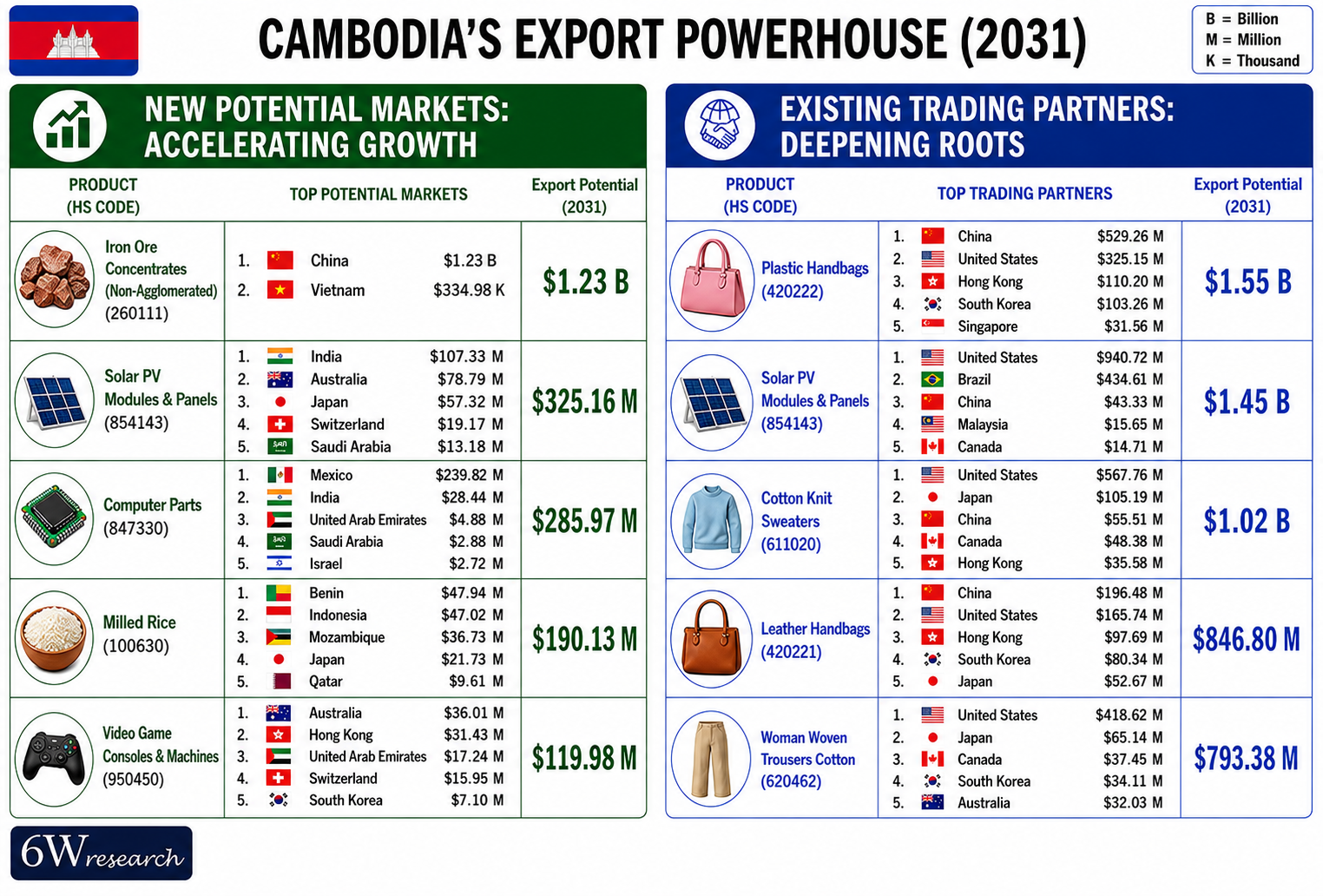
Iron ore concentrates represent Cambodia's largest new-corridor opportunity at USD 1.23 billion, sold almost entirely to China. Cambodia is not traditionally associated with large-scale iron mining, so this concentrated flow most likely reflects a specific, relatively recent mining project rather than a broad domestic ore-extraction industry worth monitoring for confirmation of sustained output rather than treating as an established capability.
Solar PV modules and computer parts add a further USD 0.33 billion and USD 0.29 billion. New-corridor solar panels are led by India at USD 0.11 billion and Australia at USD 0.08 billion, a genuinely different buyer base from the American demand that dominates Cambodia's established solar trade. Computer parts are led by Mexico at USD 0.24 billion, with India, the UAE, Saudi Arabia and Israel providing smaller volumes, a pattern more consistent with electronics-assembly and re-export trade than large-scale domestic component manufacturing.
Milled rice and video game consoles round out the new potential markets’ top five, both modest in scale. Milled rice contributes USD 0.19 billion, led by Benin and Indonesia, extending Cambodia's traditional rice-export base into new African and Southeast Asian buyers. Video game consoles and machines add USD 0.12 billion, led by Australia and Hong Kong, likely reflecting electronics re-export activity. Overall, Cambodia's 2031 new-corridor potential looks considerably more fragmented and exploratory than its established base, anchored mainly by one large, still unproven iron-ore relationship.
Handbags, Solar Panels and Knitwear Remain the Foundation of Cambodia's US-Anchored Established Trade
Plastic handbags represent Cambodia's largest established export opportunity at USD 1.55 billion, led by China at USD 0.53 billion and the United States at USD 0.33 billion, followed by Hong Kong, South Korea and Singapore. This blend of Chinese and American demand reflects Cambodia's role within Chinese-owned manufacturing operations that assemble bags domestically before shipping both to the Chinese parent groups' distribution networks and directly to American retailers.
Solar PV modules and panels add a further USD 1.45 billion, led overwhelmingly by the United States at USD 0.94 billion and Brazil at USD 0.43 billion, followed by China, Malaysia and Canada. Cotton knit sweaters contribute USD 1.02 billion, led by the United States at USD 0.57 billion and Japan at USD 0.11 billion, followed by China, Canada and Hong Kong both categories underscoring how central American demand is to Cambodia's manufacturing base, and how exposed that base is to shifts in US trade policy.
Leather handbags and women's cotton woven trousers complete the established top five. Leather handbags contribute USD 0.85 billion, led by China at USD 0.20 billion and the United States at USD 0.17 billion, followed by Hong Kong, South Korea and Japan. Women's cotton woven trousers add USD 0.79 billion, led by the United States at USD 0.42 billion and Japan at USD 0.07 billion, followed by Canada, South Korea and Australia. Collectively, these five categories confirm that Cambodia's established export advantage rests overwhelmingly on US-facing garment, travel-goods and solar-equipment manufacturing, making American trade policy the single most consequential variable in the country's near-term export outlook.
|
Cambodia's export base is a story of concentrated success built almost entirely around serving the American market, whether through garments, travel goods or solar equipment. That concentration has powered rapid export growth, but it also means Cambodia's trajectory through 2031 will be shaped as much by Washington's tariff decisions as by anything happening inside the country's own factories. 6WExportGTM Analysis |
Top Global Export Opportunities (2031), By Product
| Product | Export Opportunity (USD Billion) |
| Electronic Integrated Circuits | 685.7 |
| Refined Petroleum Oils | 668.4 |
| Light Petroleum Oils | 588.9 |
| Logic Electronic Integrated Circuits | 507.9 |
| Medicines | 381.2 |
| Gasoline Passenger Cars (1.5–3.0L) | 360.9 |
| Smartphones | 343.6 |
| Electronic Integrated Circuits with Memory | 333.2 |
| Data Transmission Equipment | 216.9 |
| Immunological Products | 209.6 |
Excludes naturally occurring products (e.g., crude oil, raw gold). Source: 6WExportGTM
Globally, the largest export opportunities through 2031 are concentrated in electronics, refined energy products, pharmaceuticals and automotive products. For Cambodia, the strongest opportunity lies in leveraging its established strengths in garments, handbags, solar modules, rice and selected electronics assembly, rather than competing directly in capital-intensive semiconductor or automotive manufacturing. According to 6WExportGTM, a part of 6Wresearch, Cambodia should focus on moving further up the value chain in light manufacturing and electronics, while expanding market diversification and strengthening domestic production capabilities to capture a larger share of future global demand.
What Cambodia Already Sells and Where
Apparel forms Cambodia's largest established trade sector at USD 9.67 billion, led by cotton knit sweaters at USD 0.97 billion and a 10.04% share, followed by synthetic knit sweaters at USD 0.71 billion and a 7.35% share. Travel goods rank second at USD 1.99 billion, with plastic handbags contributing USD 0.66 billion and a 33.48% share, while textile travel bags add USD 0.59 billion and 29.82%. Cereals and grains follow at USD 1.95 billion, led by paddy rice at USD 1.40 billion and a 71.88% share, with milled rice adding USD 0.48 billion and 24.79% together confirming Cambodia's manufacturing base spans garment and travel-goods assembly alongside a genuine agricultural rice-export industry.
| Sector | Exports (USD Billion) | Leading Products / Share |
| Apparel | 9.67 | Cotton Knit Sweaters (10.04%), Synthetic Knit Sweaters (7.35%) |
| Travel Goods | 1.99 | Plastic Handbags (33.48%), Textile Travel Bags (29.82%) |
| Cereals & Grains | 1.95 | Paddy Rice (71.88%), Milled Rice (24.79%) |
Source: 6WExportGTM
The United States is Cambodia's largest destination market at USD 9.93 billion, led by solar PV modules and panels at 6.85% of exports to the country and passenger car tyres at 5.45%. Vietnam ranks second at USD 3.62 billion, with paddy rice contributing 38.60% and cashew nuts in shell 13.74% a distinctly agricultural, regional trade relationship. China follows at USD 1.75 billion, supported by tanned mink fur at 22.64% and preserved fruit at 8.39%, an unusually specific pairing that likely reflects niche manufacturing and processing activity rather than broad-based trade. This partner mix shows Cambodia's exports split between American-bound manufactured goods, Vietnam-bound raw agricultural commodities, and a narrower, more specialized set of Chinese-bound products.
| Country | Exports (USD Billion) | Leading Products / Share |
| United States | 9.93 | Solar PV Modules & Panels (6.85%), Passenger Car Tyres (5.45%) |
| Vietnam | 3.62 | Paddy Rice (38.60%), Cashew Nuts In Shell (13.74%) |
| China | 1.75 | Tanned Mink Fur (22.64%), Preserved Fruit (8.39%) |
Source: 6WExportGTM
A Tariff De-Escalation and a Lingering Solar Dispute: Two Developments Shaping Cambodia's Export Base
Two developments now underway help explain the pressures and opportunities for Cambodia: a sharp reduction in the general US tariff rate applied to Cambodian goods, which eases pressure on the country's dominant garment and travel-goods categories, and a set of extraordinarily high anti-dumping and countervailing duties on Cambodian solar equipment that remains firmly in place.
US Tariffs on Cambodian Goods Have Fallen Sharply, Easing Pressure on Its Largest Export Categories
Cambodia's garment- and travel-goods-heavy established export base has been reinforced by a significant de-escalation in US tariff policy through 2026. The reciprocal tariff rate applied to Cambodian goods fell from 49% during the 2025 IEEPA period to 19% under an October 2025 bilateral agreement, and effectively to a flat 10% Section 122 rate after the US Supreme Court struck down the broader IEEPA reciprocal-tariff regime in February 2026, in exchange for Cambodia eliminating tariffs on all US-origin products. Cambodia was also selected as one of only four countries, alongside Bangladesh, Indonesia and Malaysia, eligible for a new three-year duty-free Tariff Rate Quota on textile and apparel exports that use US-sourced cotton and yarn. Strong bilateral trade momentum has further reinforced the United States’ position as Cambodia’s second-largest trading partner. For an established base export opportunity handbags, sweaters and trousers alone, this de-escalation removes what had briefly been an existential-level tariff threat.
|
Cambodia's garment and travel-goods exports looked genuinely threatened during the 49% IEEPA tariff period in 2025, and the drop to a 10% flat rate plus a new duty-free textile quota materially improves the outlook for the country's largest established export categories through 2031. Manish Pant, Senior Data Scientist, Data Science & Market Intelligence, 6Wresearch |
Extraordinarily High Solar Duties Remain a Persistent Risk to Cambodia's Second-Largest Established Category
Unlike the broader tariff de-escalation benefiting garments, Cambodia's solar-panel export position continues to face severe, category-specific trade barriers. In 2025, the United States finalized steep antidumping and countervailing duties on Cambodian solar cells and modules, with combined rates reaching approximately 3,521% for certain producers, significantly constraining Cambodia’s access to its previously important U.S. solar market, after Cambodian producers did not participate in the underlying investigation, leaving officials to set rates based on adverse inferences. These duties stack on top of Section 301 tariffs on Chinese-origin solar inputs and apply independently of the general reciprocal-tariff rate that has since fallen to 10%, meaning the relief benefiting Cambodia's garment sector does not extend to solar equipment. For an established solar PV modules and panels category opportunities worth USD 1.45 billion and led overwhelmingly by the United States at USD 940.72 million, this unresolved dispute represents the clearest single-category risk in Cambodia's entire established export base.
|
Cambodia's solar-panel exports illustrate that not every US trade dispute affecting the country has resolved in its favor duties exceeding 3,500% remain firmly in place, and that category's outlook through 2031 depends on a separate, unresolved trade case rather than the broader tariff relief Cambodia has secured elsewhere. Manisha Gupta, Data Analyst, Data Science & Market Intelligence, 6Wresearch |
The Takeaway
Cambodia should treat 2026 as a year of genuinely mixed trade-policy outcomes rather than assume its US relationship is uniformly improving, since the country's largest established category has benefited from sharp tariff relief while its second-largest still faces punitive, unresolved duties. The path forward depends on capitalizing fully on the garment-sector de-escalation while working through diplomatic and legal channels to address the solar dispute, all while building out the more diversified but still-nascent new-corridor opportunities in iron ore, electronics and agriculture.
Key strategic priorities for Cambodia include:
- Capitalize fully on the garment-sector tariff de-escalation: With the reciprocal tariff rate falling from 49% to an effective 10% and a new duty-free Tariff Rate Quota now available for US-cotton-sourced textiles, Cambodia should move quickly to help garment manufacturers meet the TRQ's sourcing requirements and capture the full benefit for its more than USD 4.2 billion in established handbag, sweater and trouser exports.
- Pursue a resolution to the solar anti-dumping and countervailing duty case: Combined duties of up to 3,521% put the entire USD 1.45 billion solar PV modules and panels category at serious risk, separate from the broader tariff relief benefiting garments. Cambodia should pursue participation in any renewed investigation process or diplomatic channel that could bring these extraordinary rates down.
- Verify and formalize the iron-ore relationship with China before treating it as durable: Iron ore concentrates represent Cambodia's largest new potential market opportunity at USD 1.23 billion, almost entirely with China, but the country has no established track record as a significant iron exporter. Cambodia should confirm this reflects sustained production capacity rather than a one-off shipment before building strategy around it.
- Continue diversifying beyond the US-anchored garment and solar base: New-corridor computer parts, milled rice and video game consoles together add a modest but genuine USD 0.60 billion in potential across Mexico, India, Benin, Indonesia and Australia. Cambodia should keep nurturing these smaller categories as a hedge against continued concentration risk in its two largest, US-facing export categories.
Overall, Cambodia's export growth through 2031 will depend on how well it capitalizes on genuinely improved garment-tariff terms while resolving the solar dispute that continues to threaten its second-largest established category a reminder that even within a single trading relationship, outcomes can diverge sharply by product.

Leadership Perspectives from Industry Events
Search
6Wresearch in the News
 Forbes
Citing 6Wresearch analytics to map global infrastructure and pharmaceutical industry trajectories.
 Bloomberg Law
Direct syndication of 6Wresearch's macro data points, capturing complex supply chain shifts.
 Reuters
Tracking industrial manufacturing adjustments and electronic security ecosystem scaling.
 Mint
Mint
Utilizing deep-tech sector market sizing to analyze global automation and robotics.
 The Economic Times
Anchoring features on industrial IoT growth metrics and connected smart-grid devices.
 Business Standard
Featuring strategic evaluations of Advanced Driver Assistance Systems (ADAS) and AI road safety.
 The Hindu
Spotlighting core commercial metrics ranging from unmanned aerial vehicles (UAVs) to consumer durables.
 Financial Express
Anchoring quarterly reviews on cross-border real estate tech and structural hardware manufacturing.
 Yahoo Finance
Syndicating the tracker's $30.1 billion untapped-market findings, spotlighting Japan, the US and China as India's top new-potential importers.
 India Today
Carrying the release on smartphones leading India's export potential to $94 billion by 2031, per 6WExportGTM data.
 Dailyhunt
Distributing the tracker findings to its regional readership, framing India's export diversification into Japan and Mexico.
 PR Newswire Original release
Publishing the full India Export Attractiveness Tracker 2026, detailing new trade corridors across iron ore, LCVs and pharmaceuticals.
 The Industrial
Highlighting the tracker's read on India's semiconductor ambitions and long-term chip-assembly export potential.
 PTI News
Reporting on the $66.81 billion pharmaceuticals export opportunity flagged in the tracker, amid looming US generic-drug tariffs.
 Tribune India
Covering the tracker's tariff-versus-regulation analysis across India's mature export markets in the US, China and UAE.
 ANI News
Amplifying the report's findings on polished diamonds, refined petroleum and medicines as India's core export engines.
 International Business Magazine
Covering the report's insight into how AEB, blind spot detection, and driver monitoring are reshaping India's ADAS market.
 Focus Gaming News
Highlighting the research forecast for Egypt's gambling market, projecting steady growth through 2032.
Thought Leadership and Analyst Meet





Our Clients








Latest Reports
- Poland Engine Ignition Components Market (2026-2032)
- Peru Engine Ignition Components Market (2026-2032)
- Pakistan Engine Ignition Components Market (2026-2032)
- Oman Engine Ignition Components Market (2026-2032)
- Nigeria Engine Ignition Components Market (2026-2032)
- Nepal Engine Ignition Components Market (2026-2032)
- Myanmar Engine Ignition Components Market (2026-2032)
- Morocco Engine Ignition Components Market (2026-2032)
- Mexico Engine Ignition Components Market (2026-2032)
- Malaysia Engine Ignition Components Market (2026-2032)
Industry Events and Analyst Meet

EV India Expo 2026

HIMTEX 2026

India Refining Summit 2026

India EV Show 2026

EV tech India Expo 2026
Whitepaper
- Middle East & Africa Commercial Security Market Click here to view more.
- Middle East & Africa Fire Safety Systems & Equipment Market Click here to view more.
- GCC Drone Market Click here to view more.
- Middle East Lighting Fixture Market Click here to view more.
- GCC Physical & Perimeter Security Market Click here to view more.


