Canada’s Export Potential Is Set for Strong Growth by 2031, with USD 42.65 Billion Emerging from New Product Lines Across Established Trade Corridors
Canada’s export potential in 2031 remains heavily concentrated in the United States, which accounts for 34.52% of existing opportunities more than double China’s 20.02% share. However, among entirely new product lines, Japan emerges as the leading market with a 15.66% share, more than twice that of the next-largest destination. With crude petroleum and unwrought gold contributing the largest values, Canada’s export outlook remains fundamentally driven by energy and commodities, while weakening trade ties with the United States are accelerating its strategic shift toward Asian markets.
Source: 6WExportGTM
The China Dominates Existing Export Potential, While Japan and Singapore Lead Growth in New Export Corridors
Japan leads entirely new product-line opportunities for Canada with USD 6.68 billion in export potential, more than double second-placed Singapore at USD 4.05 billion. India, China and Mexico round out the top five, each contributing between USD 2.76 billion and USD 2.84 billion, highlighting that Canada's next wave of export growth is concentrated in Asian energy-importing economies rather than spread evenly across a broad field of new buyers. The mix suggests new opportunities will be driven primarily by crude oil, refined fuels and LPG diversification away from Canada's traditional single-buyer dependence on the United States.
| Top 5 Current Leading Importers | Export Potential (USD Billion) | Top 5 New Potential Importers for New Product Lines | Export Potential (USD Billion) |
| United States | 196.78 | Japan | 6.68 |
| China | 114.13 | Singapore | 4.05 |
| India | 34.95 | India | 2.84 |
| Switzerland | 28.06 | China | 2.77 |
| United Arab Emirates | 23.02 | Mexico | 2.76 |
Source: 6WExportGTM
Canada's export strategy for 2031 remains heavily anchored in established trade. In established trade relationships, export potential reaches USD 570.12 billion, led by the United States at 34.52% well over double the share of second-placed China at 20.02%. India, Switzerland and the UAE round out the top five, with Switzerland and the UAE's presence driven almost entirely by Canada's gold trade rather than the energy exports that dominate the US and Chinese relationships.
Crude Petroleum Leads Canada's New Export-Corridor Potential, with LPG, Aircraft and Aluminum Broadening Opportunities by 2031
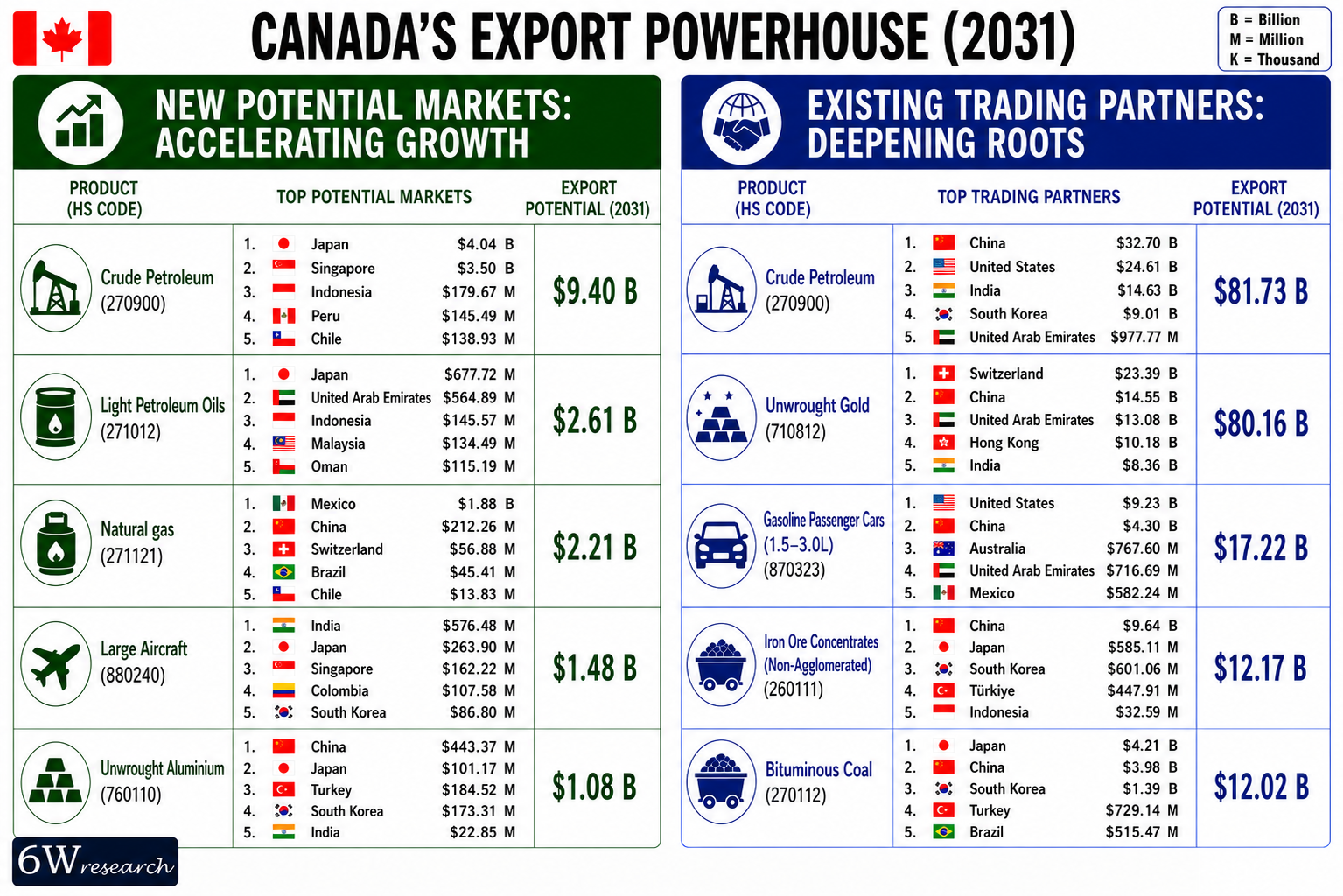
Crude petroleum, light petroleum oils, natural gas, large aircraft and unwrought aluminum define Canada's highest-value new export opportunities by 2031, reflecting both the country's resource advantages and evolving global trade patterns. Japan and Singapore emerge as the largest opportunities for crude petroleum and refined fuels as both economies rely heavily on imported energy and continue to diversify supply sources to strengthen energy security. Mexico dominates new natural gas demand as expanding industrial activity, electricity generation and manufacturing nearshoring increase gas consumption, while Canada is well positioned to serve this demand through growing LNG export capacity. Meanwhile, India's rapidly expanding aviation market creates strong demand for large aircraft, whereas China's extensive manufacturing base and energy-transition industries sustain high demand for unwrought aluminum.
Crude petroleum represents Canada's largest new-market export opportunity at USD 9.40 billion, led by Japan (USD 4.04 billion) and Singapore (USD 3.50 billion), together accounting for more than four-fifths of the total opportunity. Japan continues to diversify crude imports following shifts in global energy markets, while Singapore's position as Asia's largest refining and petroleum trading hub supports substantial import demand. Light petroleum oils contribute another USD 2.61 billion, with Japan again leading, followed by the UAE, Indonesia, Malaysia and Oman—markets where refining, aviation and marine bunker fuel demand continue to underpin imports and diversify Canada's customer base beyond North America.
Natural gas adds USD 2.21 billion in export potential, with Mexico (USD 1.88 billion) accounting for more than 85% of the opportunity as industrial expansion, power generation and cross-border energy integration continue to increase gas demand. Large aircraft provide a further USD 1.48 billion, led by India (USD 0.58 billion), where rapidly rising passenger traffic, airline fleet expansion and airport infrastructure development are driving one of the world's largest aircraft procurement cycles. Unwrought aluminum contributes USD 1.08 billion, led by China (USD 0.43 billion) and Japan (USD 0.20 billion), reflecting sustained demand from automotive, aerospace, construction and renewable-energy manufacturing, where lightweight metals remain a critical input. Together, these opportunities indicate that while Canada's future export growth remains firmly anchored in energy, aerospace and advanced materials provide meaningful avenues for export diversification.
Established Export Strength: Crude Oil, Gold and Passenger Vehicles
Crude petroleum, unwrought gold, gasoline passenger cars, iron ore concentrates and bituminous coal define Canada’s largest established export opportunities through 2031, reflecting a trade structure still anchored in energy and minerals, with automotive manufacturing providing a smaller but important industrial component. China and the United States recur across the leading categories because of their scale, industrial demand and established trade links with Canada. Switzerland and the UAE feature prominently in gold owing to their roles as global refining, trading and re-export hubs, while Japan remains a major destination for Canadian coal because of its dependence on imported fuel for steelmaking and power generation.
Crude petroleum remains Canada’s largest established opportunity at USD 81.73 billion, led by China (USD 32.70 billion) and the United States (USD 24.61 billion). U.S. demand is supported by deeply integrated pipelines, refineries and long-standing cross-border energy infrastructure, while China’s position reflects its large crude-import requirement and efforts to diversify supply away from concentrated sources. Unwrought gold follows at USD 80.16 billion, with Switzerland (USD 23.29 billion) leading because of its globally important refining and bullion-trading ecosystem. China, the UAE, Hong Kong and India also rank highly due to strong jewellery consumption, investment demand and their roles in regional precious-metals trading.
Gasoline passenger cars in the 1.5–3.0 litre range contribute USD 17.22 billion, led by the United States (USD 9.23 billion) because Canada’s automotive industry is tightly integrated into North American production and distribution networks. Iron ore concentrates add USD 12.17 billion, with China (USD 9.94 billion) accounting for more than four-fifths of the opportunity as its steel industry remains the world’s largest consumer of imported iron ore. Bituminous coal contributes a further USD 12.02 billion, led by Japan (USD 4.21 billion) and China, where demand is tied primarily to steelmaking and energy security. Together, these product lines confirm that Canada’s established export base remains dominated by hydrocarbons, precious metals and bulk commodities, despite the continued relevance of automotive manufacturing.
|
Canada's strongest export priorities remain crude oil and gold into China, the United States and Switzerland, but the reordering of crude petroleum's top buyer from the US to China signals a structural shift in Canada's energy trade that this report's other product lines have not yet caught up to. 6WExportGTM Analysis |
Tariffs, Pipelines and USMCA: Current Developments Supporting and Threatening Canada's Export Growth
Three current developments help explain, and in one case directly threaten, the figures above: a new US tariff action targeting Canadian autos and agricultural goods, the collapse of USMCA's scheduled 16-year renewal into an annual review process, and a Trans Mountain pipeline expansion that has already made China Canada's top crude oil buyer.
A New 50% US Tariff on Canadian Autos, Alcohol and Dairy
Canada's third-largest established export product, gasoline passenger cars at USD 17.22 billion in potential over half of it bound for the United States now faces a direct and serious threat. On July 20, 2026, President Trump invoked Section 338 of the Tariff Act of 1930 to impose a new 50% duty on alcoholic beverages, dairy and motor vehicles imported from Canada, effective August 19, 2026, following a 30-day negotiation window. Critically, these Section 338 tariffs apply even to many products that would otherwise qualify for duty-free treatment under USMCA, meaning the automotive trade this report's USD 9.23 billion US-bound gasoline passenger car figure depends on which could face a materially different tariff environment within weeks of this report's publication.
|
A 50% tariff invoked specifically to override USMCA's duty-free treatment is a different order of threat than the tariff-and-truce cycles seen elsewhere in this report series this isn't a negotiating tactic layered on top of a stable agreement; it's a direct challenge to the agreement itself. Manish Pant, Senior Data Scientist, Data Science & Market Intelligence, 6Wresearch |
China Overtakes the US as Canada's Top Crude Oil Buyer via Trans Mountain
China has already overtaken the United States as the top buyer of Canadian crude moving through the Trans Mountain pipeline, completed in May 2024, which tripled capacity to 890,000 barrels a day and gave landlocked Alberta crude its first major access to Pacific tanker routes: China's average daily offtake from the pipeline rose from roughly 7,000 barrels a day in the decade to 2023 to about 207,000 barrels a day since the expansion, ahead of the roughly 173,000 barrels a day the United States has taken from the same pipeline over that period, driven by Chinese refiners' desire to diversify away from sanctioned Russian and Venezuelan supply and by Canadian producers securing better netbacks than selling exclusively into the US Midwest. This shift is specific to the Trans Mountain corridor for now the United States still receives the large majority of Canada's total crude exports, roughly 4 million barrels a day, through the older north-south pipeline network but it is the first time China has led any major Canadian export corridor. 6Wresearch's 2031 outlook projects this reordering extending to Canada's crude petroleum trade as a whole: China (USD 32.70 billion) is forecast to overtake the United States (USD 24.61 billion) as Canada's largest crude buyer by value, a shift reinforced by Prime Minister Mark Carney's July 2026 mandate to the government-owned Trans Mountain Corporation to build a further 1 million-barrel-a-day pipeline and deepwater port near Vancouver, explicitly targeting Asian demand from Japan, South Korea, China and India.
|
Producers still selling the bulk of their crude into the US Midwest should study the netback gains Trans Mountain shippers have already captured in the Pacific market, and use them as a benchmark when deciding how much new capacity to commit to Asia-bound contracts versus traditional US buyers. Manisha Gupta, Data Analyst, Data Science & Market Intelligence, 6Wresearch |
Top Global Export Opportunities (2031), By Product
| Product | Export Opportunity (USD Billion) |
| Electronic Integrated Circuits | 685.7 |
| Refined Petroleum Oils | 668.4 |
| Light Petroleum Oils | 588.9 |
| Logic Electronic Integrated Circuits | 507.9 |
| Medicines | 381.2 |
| Gasoline Passenger Cars (1.5–3.0L) | 360.9 |
| Smartphones | 343.6 |
| Electronic Integrated Circuits with Memory | 333.2 |
| Data Transmission Equipment | 216.9 |
| Immunological Products | 209.6 |
Excludes naturally occurring products (e.g., crude oil, raw gold). Source: 6WExportGTM
Globally, the largest export opportunities beyond naturally occurring products are concentrated in electronics, refined energy products and pharmaceuticals, reflecting the growing importance of advanced manufacturing and high-value technology in international trade. Canada already participates in several of these sectors, but its priority through 2031 should be to strengthen value-added processing of energy and critical minerals, support the automotive industry’s transition toward electric and hybrid vehicles, expand aerospace and technology manufacturing, and diversify export markets beyond the United States to reduce trade concentration risk.
What Canada Already Sells, and to Whom
Oil & gas dominates Canada’s established export base as the largest sector at USD 131.32 billion, led by crude petroleum with a 79.11% share and refined petroleum oils with 7.67%. Passenger vehicles rank second at USD 30.76 billion, driven by gasoline passenger cars in the 1.5–3.0L range (45.92% share) and hybrid petrol cars (18.92% share). Precious metals follow closely at USD 29.84 billion, overwhelmingly led by unwrought gold with a 92.09% share, while unwrought silver contributes 3.43%.
| Sector | Export (USD Billion) | Leading Products / Share |
| Oil & Gas | 131.32 | Crude Petroleum (79.11%), Refined Petroleum Oils (7.67%) |
| Passenger Vehicles | 30.76 | Gasoline Passenger Cars, 1.5–3.0L (45.92%), Hybrid Petrol Cars (18.92%) |
| Precious Metals | 29.84 | Unwrought Gold (92.09%), Unwrought Silver (3.43%) |
Source: UN Comtrade
By trading value,Canada’s export potential remains heavily concentrated in the United States, which represents the largest destination at USD 419.61 billion, led by crude petroleum (23.66%) and gasoline passenger cars in the 1.5–3.0L range (3.11%). China ranks second at USD 21.15 billion, with rapeseed accounting for 13.45% and bituminous coal contributing 9.13%. The United Kingdom follows closely at USD 20.28 billion, overwhelmingly driven by unwrought gold (78.98%), while crude petroleum accounts for 2.54%.
| Country | Export (USD Billion) | Leading Products / Share |
| United States | 419.61 | Crude Petroleum (23.66%), Gasoline Passenger Cars, 1.5–3.0L (3.11%) |
| China | 21.15 | Rapeseed (13.45%), Bituminous Coal (9.13%) |
| United Kingdom | 20.28 | Unwrought Gold (78.98%), Crude Petroleum (2.54%) |
Source: UN Comtrade
The Takeaway
Canada’s next phase of export growth will unfold amid mounting pressure on its long-standing trade relationship with the United States. The strategic priority is threefold: treat the new 50% Section 338 tariff on autos, alcohol and dairy as a material threat to the USD 9.23 billion US-bound share of gasoline passenger car exports; strengthen the competitiveness and geographic reach of automotive, energy and value-added manufacturing exports to reduce exposure to policy shifts in a single market; and build on the diversification already achieved in crude oil, where China’s emergence as Canada’s leading buyer through the Trans Mountain pipeline demonstrates that expanding access to alternative markets is commercially achievable. These priorities—not simply the identification of new trade corridors—will determine whether Canada can unlock USD 42.65 billion in untapped potential or not.

Leadership Perspectives from Industry Events
Search
6Wresearch in the News
 Forbes
Citing 6Wresearch analytics to map global infrastructure and pharmaceutical industry trajectories.
 Bloomberg Law
Direct syndication of 6Wresearch's macro data points, capturing complex supply chain shifts.
 Reuters
Tracking industrial manufacturing adjustments and electronic security ecosystem scaling.
 Mint
Mint
Utilizing deep-tech sector market sizing to analyze global automation and robotics.
 The Economic Times
Anchoring features on industrial IoT growth metrics and connected smart-grid devices.
 Business Standard
Featuring strategic evaluations of Advanced Driver Assistance Systems (ADAS) and AI road safety.
 The Hindu
Spotlighting core commercial metrics ranging from unmanned aerial vehicles (UAVs) to consumer durables.
 Financial Express
Anchoring quarterly reviews on cross-border real estate tech and structural hardware manufacturing.
 Yahoo Finance
Syndicating the tracker's $30.1 billion untapped-market findings, spotlighting Japan, the US and China as India's top new-potential importers.
 India Today
Carrying the release on smartphones leading India's export potential to $94 billion by 2031, per 6WExportGTM data.
 Dailyhunt
Distributing the tracker findings to its regional readership, framing India's export diversification into Japan and Mexico.
 PR Newswire Original release
Publishing the full India Export Attractiveness Tracker 2026, detailing new trade corridors across iron ore, LCVs and pharmaceuticals.
 The Industrial
Highlighting the tracker's read on India's semiconductor ambitions and long-term chip-assembly export potential.
 PTI News
Reporting on the $66.81 billion pharmaceuticals export opportunity flagged in the tracker, amid looming US generic-drug tariffs.
 Tribune India
Covering the tracker's tariff-versus-regulation analysis across India's mature export markets in the US, China and UAE.
 ANI News
Amplifying the report's findings on polished diamonds, refined petroleum and medicines as India's core export engines.
 International Business Magazine
Covering the report's insight into how AEB, blind spot detection, and driver monitoring are reshaping India's ADAS market.
 Focus Gaming News
Highlighting the research forecast for Egypt's gambling market, projecting steady growth through 2032.
Thought Leadership and Analyst Meet





Our Clients








Latest Reports
- Austria X-ray Imaging Devices Market (2026-2032)
- Armenia X-ray Imaging Devices Market (2026-2032)
- Antigua and Barbuda X-ray Imaging Devices Market (2026-2032)
- Angola X-ray Imaging Devices Market (2026-2032)
- Andorra X-ray Imaging Devices Market (2026-2032)
- Albania X-ray Imaging Devices Market (2026-2032)
- Afghanistan X-ray Imaging Devices Market (2026-2032)
- United States (US) X-ray Imaging Devices Market (2026-2032)
- United Kingdom (UK) X-ray Imaging Devices Market (2026-2032)
- United Arab Emirates (UAE) X-ray Imaging Devices Market (2026-2032)
Industry Events and Analyst Meet

EV India Expo 2026

HIMTEX 2026

India Refining Summit 2026

India EV Show 2026

EV tech India Expo 2026
Whitepaper
- Middle East & Africa Commercial Security Market Click here to view more.
- Middle East & Africa Fire Safety Systems & Equipment Market Click here to view more.
- GCC Drone Market Click here to view more.
- Middle East Lighting Fixture Market Click here to view more.
- GCC Physical & Perimeter Security Market Click here to view more.


