Electronic Integrated Circuits and Smartphones to Lead China's Export Potential to Existing Trading Partners, Reaching USD 165.48 Billion and USD 158.04 Billion by 2031
In 2031, the United States constitutes 27.00% (largest) of China's existing export potential, more than three times the share of second-placed Hong Kong at 8.01% but in the smaller set of entirely new product lines, India leads at 20.96%, ahead of the United States itself at 12.50%. Smartphones, semiconductors and computing hardware dominate the numbers so thoroughly that China's export potential is, above all, an electronics story, with the same handful of Asian and Western buyers appearing again and again across nearly every major product line.
Source: 6WExportGTM
The United States Dominates Existing Export Potential at While India and Mexico Drive Growth in New Export Corridors
India leads entirely new product-line opportunities for China with USD 5.28 billion in export potential, followed by the United States at USD 3.15 billion even within "untapped markets" bracket. Mexico, Kazakhstan and Turkey complete the top five, highlighting that China's next wave of export growth is expected to reach beyond its traditional East Asian and North American buyer base into South Asian, Central Asian and Middle Eastern corridors. The mix of destinations suggests new opportunities will be driven by aviation, nuclear fuel, agriculture and heavy transport equipment rather than the electronics categories that dominate China's established trade.
| Importers | Export Potential (USD Billion) | Top 5 New Potential Importers for New Product Lines | Export Potential (USD Billion) |
| United States | 1192.93 | India | 5.28 |
| Hong Kong | 353.71 | United States | 3.15 |
| Japan | 261.25 | Mexico | 2.24 |
| South Korea | 236.51 | Kazakhstan | 1.74 |
| Mexico | 199.18 | Turkey | 1.13 |
Source: 6WExportGTM
China's export strategy for 2031 rests overwhelmingly on established trade. In established trade relationships will be led by the United States at 27.00% (USD 1,192.93 billion) more than three times the share of second-placed Hong Kong at 8.01% (USD 353.71 billion). Japan, South Korea and Mexico round out the top five, confirming that China's biggest future export relationships remain concentrated in a small number of very large, electronics-hungry economies rather than spread across a wide field of buyers.
Large Aircraft Lead China's New Export-Corridor Potential, with Uranium, Rice and Heavy Trucks Broadening Opportunities by 2031
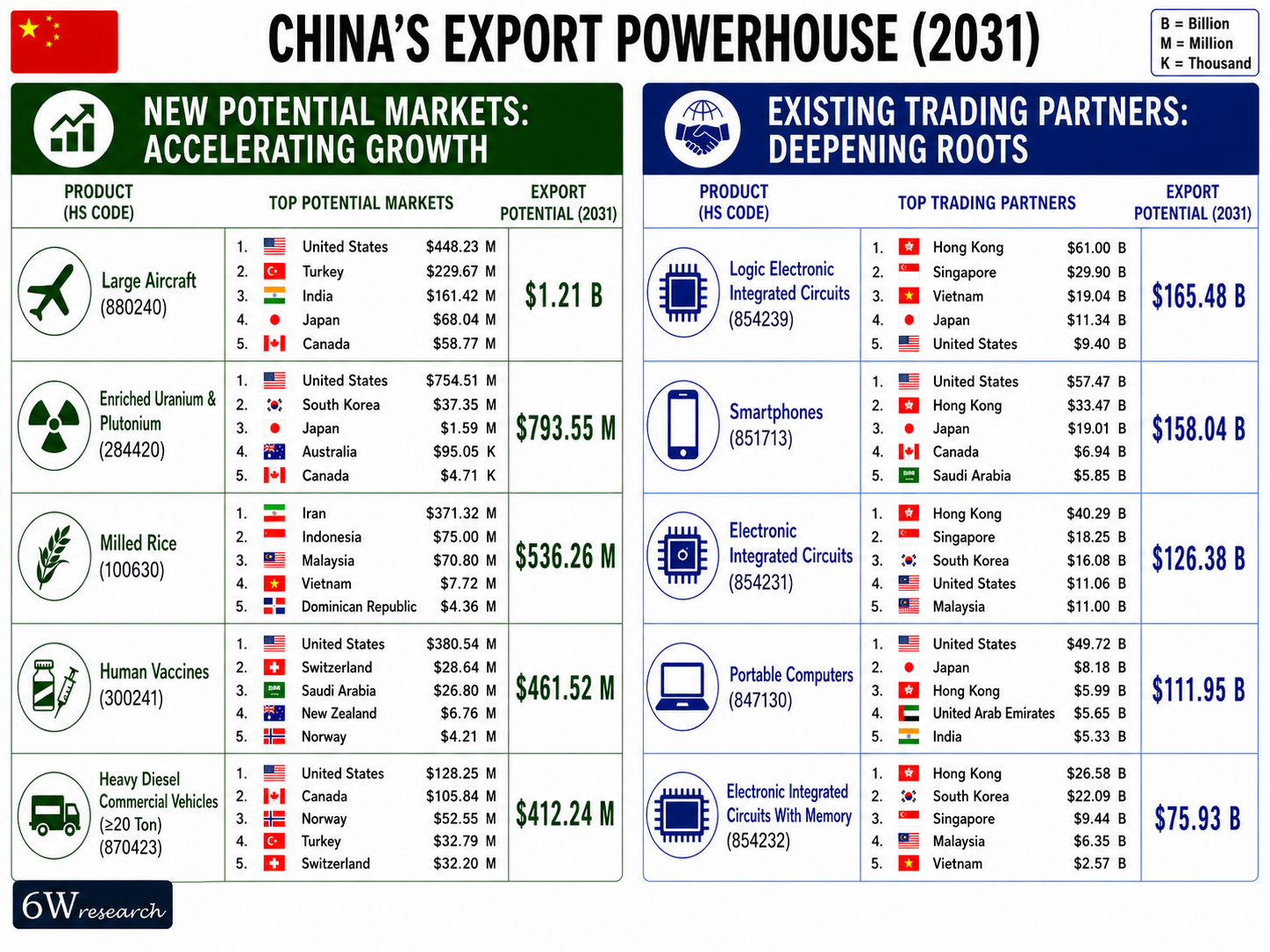
Large aircraft, enriched uranium and plutonium, milled rice, human vaccine products and Heavy diesel commercial vehicles (≥20 Ton) define China's highest-value new export opportunities by 2031, creating a genuinely varied mix across aerospace, energy, agriculture and industrial equipment. The United States leads demand for large aircraft, enriched uranium and plutonium and human vaccine products, Iran dominates the milled rice opportunity, and Canada and Norway feature prominently in heavy diesel commercial vehicles (≥20 Ton), defining China's established exports.
Large aircraft represent China's largest new-corridor export opportunity at USD 1.21 billion, led by the United States (USD 448.23 million), Turkey (USD 229.67 million) and India (USD 161.42 million), with Japan and Canada rounding out the top five. This buyer mix reflects the growing international ambitions of China's own aircraft manufacturing programme reaching beyond its home region. Enriched uranium and plutonium rank second at USD 793.55 million, led overwhelmingly by the United States (USD 754.51 million) accounting for over 95% of the category's total potential followed by South Korea and Japan at a fraction of that scale.
Milled rice contributes USD 536.26 million in new export potential, with Iran (USD 371.32 million) representing over two-thirds of the opportunity, followed by Indonesia, Malaysia, Vietnam and the Dominican Republic. Human vaccine products add a further USD 461.52 million, led again by the United States (USD 380.54 million), with Switzerland, Saudi Arabia, New Zealand and Norway completing the list. Heavy diesel commercial vehicles (≥20 Ton) round out the top five at USD 412.24 million, led by the United States (USD 128.25 million) and Canada (USD 105.84 million), with Norway, Turkey and Switzerland also featuring together these five categories show China's new-market growth prospects span aerospace, energy, agriculture and heavy industry, well outside the electronics base that defines its existing trade.
Established Export Strength: Semiconductors, Smartphones and Computing Hardware
Logic electronic integrated circuits, smartphones, electronic integrated circuits, portable computers and electronic integrated circuits with memory form the backbone of China's established export potential by 2031, reflecting the country's position at the centre of global electronics assembly and semiconductor packaging. Hong Kong appears repeatedly across the leading product lines as a re-export gateway, while the United States, Singapore, South Korea and Japan also play major roles in sustaining China's existing trade base.
Logic electronic integrated circuits lead China's established export potential at USD 165.48 billion, underlining the country's position in mid-tier chip assembly and packaging. Hong Kong is the largest destination at USD 61.00 billion, followed by Singapore (USD 29.90 billion) and Vietnam (USD 19.04 billion), with Japan and the United States also contributing meaningful demand. Smartphones follow closely at USD 158.04 billion, led by the United States (USD 57.47 billion) and Hong Kong (USD 33.47 billion), while Japan, Canada and Saudi Arabia broaden the buyer base a spread that reflects both direct consumer demand and re-export activity through regional trading hubs.
Electronic integrated circuits contribute a further USD 126.38 billion, led by Hong Kong (USD 40.29 billion) and Singapore (USD 18.25 billion), with South Korea, the United States and Malaysia completing the leading destinations. Portable computers add USD 111.95 billion, driven primarily by the United States (USD 49.72 billion) nearly half the category on its own followed by Japan, Hong Kong, the UAE and India. Electronic integrated circuits with memory round out the top five at USD 75.93 billion, led by Hong Kong (USD 26.58 billion) and South Korea (USD 22.09 billion), with Singapore, Malaysia and Vietnam also featuring prominently. Together, these product lines confirm the central role of semiconductors, smartphones and computing hardware in China's established export base.
|
China's strongest export priorities remain semiconductors, smartphones and computing hardware into the United States and regional re-export hubs like Hong Kong and Singapore, while its emerging new-corridor opportunities in aerospace, uranium and agriculture point toward a genuinely different set of buyers. 6WExportGTM Analysis |
Supply Chains, Minerals and Tariffs: Current Developments Supporting China's Export Growth
Three current developments help explain and complicate the figures above: a fast-moving shift of smartphone assembly toward India and Vietnam, a one-year suspension of China's own rare earth and battery export controls, and a fragile but functioning tariff truce with the United States.
Smartphone Manufacturing Shifts Toward India and Vietnam
Smartphones are China's second-largest established export product at USD 158.04 billion in potential, and the United States alone accounts for USD 57.47 billion of it but the underlying manufacturing footprint behind that trade is shifting fast. Canalys data shows the share of US-bound smartphones assembled in China falling from 61% to 25% in a single year, as Apple's "China Plus One" strategy pushed India's share of US-bound shipments from 13% to 44% and Vietnam's from 24% to 30% over the same period. Apple is reportedly aiming to shift the majority of iPhones sold in the US to Indian production lines by the end of 2026, with India projected to manufacture 20-25% of all iPhones globally by 2026-27, even as roughly 80% of iPhones were still made in China as of 2025.
|
The gap between China's USD 158 billion smartphone export potential and its rapidly eroding share of actual US-bound assembly is the clearest tension in this entire report the dollar figure reflects today's trade base, but the manufacturing footprint behind it is already moving elsewhere. Manish Pant, Senior Data Scientist, Data Science & Market Intelligence, 6Wresearch |
Rare Earths and Batteries: China's One-Year Export Control Pause
China's own rare earth and lithium-battery export controls are directly relevant to product lines like lithium-ion batteries a top-ten US import line from China worth roughly USD 15.34 billion and to semiconductor and electric-vehicle supply chains more broadly. Beijing announced sweeping new controls on rare earths, battery materials and superhard materials on October 9, 2025, but suspended their implementation on November 7, 2025, for one full year through November 10, 2026, following the Trump-Xi meeting and as part of a broader trade détente that also included renewed US soybean purchases. China still controls roughly 91% of global rare earth refining capacity and 80% or more of key battery midstream and downstream production, meaning the suspension is a tactical pause rather than a structural change official have explicitly framed it as under review for late 2026, with re-tightening a real possibility if bilateral relations deteriorate.
|
China holding, rather than dismantling, its rare earth and battery export-control architecture means this report's electronics and battery export figures carry a policy contingency that few other product categories in this series do the underlying leverage hasn't gone away, it's just been set aside for a year. Manisha Gupta, Data Analyst, Data Science & Market Intelligence, 6Wresearch |
A Fragile Truce: The US-China Tariff Relationship Through November 2026
China's single largest export relationship, worth USD 1,192.93 billion in established potential, sits on top of a tariff truce rather than a settled agreement. Following the 2025 escalation that saw US tariffs on Chinese goods reach 145% and Chinese retaliatory tariffs reach 125%, both sides agreed to a one-year truce running through November 2026, cutting rates to more manageable levels and pairing China's rare-earth suspension with renewed agricultural purchases and reduced fentanyl-related tariffs from Washington. The arrangement covers the electronics, smartphone and computing categories that dominate this report's largest numbers, but both governments have described it as conditional, leaving open the possibility of renewed escalation if either side is seen to fall short of its commitments before the truce's scheduled review.
Top Global Export Opportunities (2031), By Product
| Product | Export Opportunity (USD Billion) |
| Electronic Integrated Circuits | 685.7 |
| Refined Petroleum Oils | 668.4 |
| Light Petroleum Oils | 588.9 |
| Logic Electronic Integrated Circuits | 507.9 |
| Medicines | 381.2 |
| Gasoline Passenger Cars (1.5–3.0L) | 360.9 |
| Smartphones | 343.6 |
| Electronic Integrated Circuits with Memory | 333.2 |
| Data Transmission Equipment | 216.9 |
| Immunological Products | 209.6 |
Excludes naturally occurring products (e.g., crude oil, raw gold). Source: 6WExportGTM
Globally, the largest export opportunities beyond naturally occurring products are concentrated in electronics, energy and pharmaceuticals highlighting the growing dominance of semiconductors, advanced manufacturing and high-value technology products in global trade. Japan already sits inside several of these categories, but its real priority through 2031 is defending semiconductor-equipment leadership, stabilizing its auto industry through a difficult transition, and using energy and metals diversification to reduce the geopolitical exposure that comes with a resource-poor, trade-dependent economy.
What China Already Sells, and to Whom
Semiconductors form the largest of China’s top export sectors at USD 225.66 billion, led by electronic integrated circuits with memory (30.45% share) and electronic integrated circuits (25.25% share), highlighting the scale of China’s semiconductor manufacturing, assembly and packaging ecosystem. Telecommunications equipment ranks second at USD 214.77 billion, overwhelmingly driven by smartphones (61.72% share), with data transmission equipment contributing a further 18.35%. Computers & IT hardware round out the top three at USD 212.52 billion, led by portable computers (48.08% share) and computer parts (15.54% share), underscoring China’s continued strength across global electronics and computing supply chains.
| Sector | Export (USD Billion) | Leading Products / Share |
| Semiconductors | 225.66 | Electronic ICs With Memory (30.45%), Electronic Integrated Circuits (25.25%) |
| Telecommunications Equipment | 214.77 | Smartphones (61.72%), Data Transmission Equipment (18.35%) |
| Computers & IT Hardware | 212.52 | Portable Computers (48.08%), Computer Parts (15.54%) |
Source: UN Comtrade
The United States is China’s largest export destination at USD 525.64 billion, led by smartphones (6.69% share) and portable computers (6.17% share), reflecting strong demand for Chinese consumer electronics and computing hardware. Hong Kong ranks second at USD 290.87 billion, with smartphones (10.15% share) and electronic integrated circuits (9.56% share) forming the leading product categories, consistent with its role as major electronics trading and re-export hub. Vietnam follows at USD 161.85 billion, led by electronic integrated circuits (4.82% share) and electronic integrated circuits with memory (4.59% share), highlighting the growing integration of China and Vietnam within regional semiconductor and electronics supply chains.
| Country | Export (USD Billion) | Leading Products / Share |
| United States | 525.64 | Smartphones (6.69%), Portable Computers (6.17%) |
| Hong Kong | 290.87 | Smartphones (10.15%), Electronic Integrated Circuits (9.56%) |
| Vietnam | 161.85 | Electronic Integrated Circuits (4.82%), Electronic Integrated Circuits with Memory (4.59%) |
Source: UN Comtrade
The Takeaway
China's next chapter of export growth will be written against a backdrop of real structural tension, not smooth continuation. The playbook is threefold: defend smartphone and electronics assembly share as Apple and its peers accelerate a genuine "China Plus One" shift toward India and Vietnam, rather than assuming the USD 158 billion smartphone figure in this report is immune to that migration; treat the one-year suspension of rare earth and battery export controls as a temporary window rather than a settled policy, using it to build durable downstream export value in batteries and advanced materials before the review deadline in late 2026; and manage a US tariff truce that, despite cutting rates from their 2025 peaks, remains conditional and could re-escalate before its scheduled review. Together, these three fronts not the discovery of new corridors are where the next USD 25.19 billion in untapped potential, and the far larger question of whether China holds onto its USD 4.42 trillion established base, will actually be decided.

Leadership Perspectives from Industry Events
Search
6Wresearch in the News
 Forbes
Citing 6Wresearch analytics to map global infrastructure and pharmaceutical industry trajectories.
 Bloomberg Law
Direct syndication of 6Wresearch's macro data points, capturing complex supply chain shifts.
 Reuters
Tracking industrial manufacturing adjustments and electronic security ecosystem scaling.
 Mint
Mint
Utilizing deep-tech sector market sizing to analyze global automation and robotics.
 The Economic Times
Anchoring features on industrial IoT growth metrics and connected smart-grid devices.
 Business Standard
Featuring strategic evaluations of Advanced Driver Assistance Systems (ADAS) and AI road safety.
 The Hindu
Spotlighting core commercial metrics ranging from unmanned aerial vehicles (UAVs) to consumer durables.
 Financial Express
Anchoring quarterly reviews on cross-border real estate tech and structural hardware manufacturing.
 Yahoo Finance
Syndicating the tracker's $30.1 billion untapped-market findings, spotlighting Japan, the US and China as India's top new-potential importers.
 India Today
Carrying the release on smartphones leading India's export potential to $94 billion by 2031, per 6WExportGTM data.
 Dailyhunt
Distributing the tracker findings to its regional readership, framing India's export diversification into Japan and Mexico.
 PR Newswire Original release
Publishing the full India Export Attractiveness Tracker 2026, detailing new trade corridors across iron ore, LCVs and pharmaceuticals.
 The Industrial
Highlighting the tracker's read on India's semiconductor ambitions and long-term chip-assembly export potential.
 PTI News
Reporting on the $66.81 billion pharmaceuticals export opportunity flagged in the tracker, amid looming US generic-drug tariffs.
 Tribune India
Covering the tracker's tariff-versus-regulation analysis across India's mature export markets in the US, China and UAE.
 ANI News
Amplifying the report's findings on polished diamonds, refined petroleum and medicines as India's core export engines.
 International Business Magazine
Covering the report's insight into how AEB, blind spot detection, and driver monitoring are reshaping India's ADAS market.
 Focus Gaming News
Highlighting the research forecast for Egypt's gambling market, projecting steady growth through 2032.
Thought Leadership and Analyst Meet





Our Clients








Latest Reports
- Peru Holistic Health Market (2026-2032)
- Pakistan Holistic Health Market (2026-2032)
- Oman Holistic Health Market (2026-2032)
- Nigeria Holistic Health Market (2026-2032)
- Nepal Holistic Health Market (2026-2032)
- Myanmar Holistic Health Market (2026-2032)
- Morocco Holistic Health Market (2026-2032)
- Mexico Holistic Health Market (2026-2032)
- Malaysia Holistic Health Market (2026-2032)
- Lebanon Holistic Health Market (2026-2032)
Industry Events and Analyst Meet

EV India Expo 2026

HIMTEX 2026

India Refining Summit 2026

India EV Show 2026

EV tech India Expo 2026
Whitepaper
- Middle East & Africa Commercial Security Market Click here to view more.
- Middle East & Africa Fire Safety Systems & Equipment Market Click here to view more.
- GCC Drone Market Click here to view more.
- Middle East Lighting Fixture Market Click here to view more.
- GCC Physical & Perimeter Security Market Click here to view more.


